
What Does the Handoff from AI SDR to Human Account Executive Look Like?
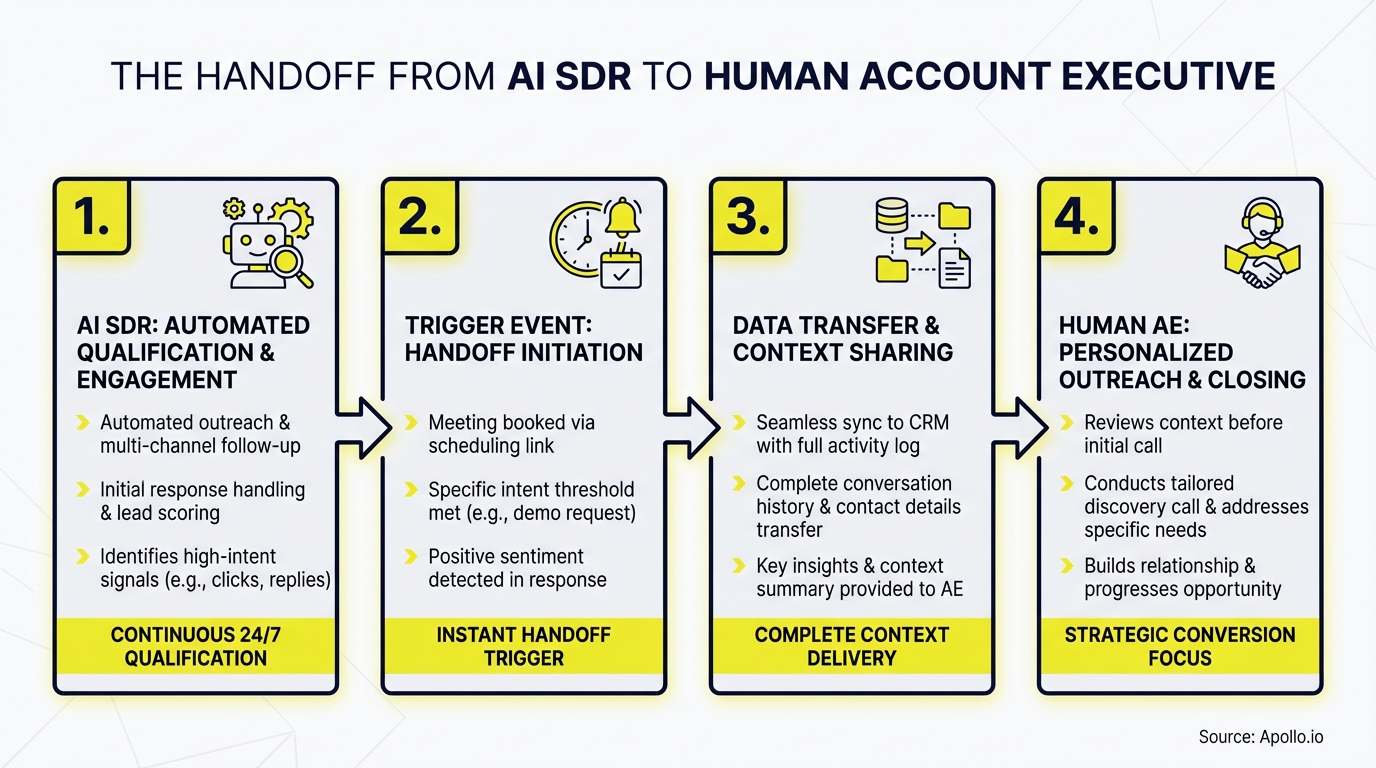
The handoff from an AI SDR to a human Account Executive is a structured escalation event, not just a meeting booking. The AI handles prospecting, qualification, and outreach, then transfers a documented opportunity packet to the AE at a defined trigger point. Understanding this process matters because the B2B buyer journey has changed dramatically, and buyers now arrive at their first vendor conversation far more informed, and often more decided, than before.
Tools like Apollo's AI Sales Assistant help bridge this gap by handling the full pre-handoff motion: researching accounts, building qualified lists, generating personalized sequences, and surfacing context so AEs can walk into discovery ready to close, not catch up. According to Autobound.ai, by the end of 2026, AI SDRs are projected to handle over 30% of initial outreach, with human reps intervening after a positive response.

Research Less, Pipeline More With Apollo
Tired of burning hours hunting down contact info that's already outdated? Apollo delivers verified emails and business numbers so your reps spend time selling, not searching. Join 600K+ companies building pipeline faster.
Start Free with Apollo →Key Takeaways
- The AI SDR's job ends at a qualified signal, not just a booked meeting. The handoff is an escalation with full context attached.
- AEs now inherit prospects who have often pre-ranked their vendor shortlist, making the first conversation disproportionately important.
- High-performing handoffs use structured CRM artifacts (qualification data, intent signals, objections, recommended talk-track), not Slack messages or raw transcripts.
- Guardrails matter: irrelevant AI outreach actively damages pipeline. Relevance scoring and suppression rules protect both the buyer relationship and the AE's conversion rate.
- Platforms that unify AI outreach, enrichment, and deal tracking in one workspace reduce the context loss that kills handoff quality.
What Triggers the AI SDR to AE Handoff?
The handoff triggers when a prospect crosses a qualification threshold that the AI cannot resolve alone. Common escalation signals include: a positive reply to outreach, a meeting request, a pricing or security question, a multi-stakeholder mention, or an intent spike flagged by the platform.
These are not arbitrary — they mark the point where human judgment, relationship depth, and negotiation skill outperform automation.
Think of it as the AI running the workflow until a "human-required" condition fires. At that point, the agent creates an opportunity record, attaches context, assigns the AE, and triggers a task sequence, all without manual intervention.
This escalation-by-design model is increasingly standard across modern revenue stacks.
What Does a Good AI SDR Handoff Packet Contain?
A complete handoff packet is what separates pipeline that converts from pipeline that stalls. The AE should never have to ask "What did we send them?" or "Why did they respond?"
| Handoff Artifact | What It Includes | Where It Lives |
|---|---|---|
| Qualification Summary | MEDDICC fields, ICP fit score, firmographics | CRM opportunity record |
| Engagement History | Emails sent, replies, calls, opens, clicks | Sales engagement platform |
| Intent Signals | Pages visited, content downloaded, timing | CRM + enrichment data |
| Objections Logged | Concerns raised in replies or calls | CRM notes / conversation intelligence |
| Recommended Talk-Track | AI-generated first-meeting agenda | AE notification / CRM task |
| Stakeholder Map | Contacts engaged, titles, roles in deal | CRM account record |
Apollo's pre-meeting insights and conversation intelligence features surface exactly this kind of context automatically, so AEs arrive at discovery calls informed rather than starting from zero.
How Do AEs Prepare for the First Meeting After Handoff?
Account Executives should treat the first post-handoff meeting as the highest-leverage moment in the deal. Research from the 6sense 2025 Buyer Experience Report found that buyers' first vendor conversation is frequently with the eventual deal winner, making preparation non-negotiable.
An AE's pre-meeting checklist should include:
- Review the AI-generated handoff summary and qualification fields in CRM
- Read all prior outreach and the exact reply that triggered escalation
- Check intent signals and pages the prospect visited
- Prepare a hypothesis about the buyer's top problem (not a generic pitch)
- Identify which stakeholders are attending and their likely priorities
- Use Apollo's AI Assistant to surface any recent news, funding, or hiring signals about the account
Struggling to keep AEs focused on selling instead of research? Apollo's meeting intelligence tools auto-generate pre-meeting briefings so AEs spend time closing, not catching up.

What Guardrails Prevent AI SDR Handoffs from Burning Buyers?
Guardrails are the rules that stop the AI SDR from damaging relationships before the AE even enters the picture. Irrelevant, high-volume outreach is the fastest way to get blacklisted — and it directly harms the AE's pipeline quality. According to SalesMotion.io, as of 2025, 22% of sales teams have fully replaced human SDRs with AI and another 45% are operating hybrid models, meaning guardrail design is now a core RevOps responsibility.
Key guardrails every team should configure:
- Relevance scoring: Only contact prospects above a minimum ICP fit threshold (Apollo's Scores handle this automatically)
- Suppression rules: Exclude existing customers, recent churned accounts, and opted-out contacts
- Outreach caps: Set maximum touches per prospect per sequence
- Escalation thresholds: Define exactly which signals route to human (positive reply, pricing question, legal mention)
- Approval gates: Require human review before adding high-value accounts to automated sequences
Understanding what your ICP truly looks like is foundational to setting these guardrails correctly. Without a precise ICP definition, relevance scoring has nothing to calibrate against.
How Should SDRs and AEs Collaborate Around the Handoff?
SDRs, even in AI-augmented teams, remain responsible for handoff quality. Their role shifts from high-volume outreach execution to qualifying signals, reviewing AI-drafted messages before they send, and ensuring the handoff packet is complete before the AE inherits the opportunity. As Lead-Spot's 2025 demand generation benchmark notes, the SDR role is shifting from repetitive tasks to that of a strategic, tech-enabled communicator.
For Account Executives, the collaboration expectation runs the other direction: feed signal back into the AI. If a discovery call reveals that a particular pain point resonates, that insight should update the AI Content Center so future sequences reflect it.
This feedback loop is what separates teams that improve over time from those that plateau.
"With thousands of accounts in our CRM, building fair, high-quality territories used to be a guessing game. Apollo's AI Assistant helped me instantly qualify or disqualify accounts using the right signals." — Harry Gable-Newkirk, Enterprise Sales Development Manager, YipitData
Spending too much time on manual outreach prep? Apollo's AI sales automation handles prospecting, sequencing, and qualification so your team focuses on conversations that close.
Turn Funnel Guesswork Into Pipeline Clarity
Quota stress keeping you up at night? Apollo surfaces in-market buyers the moment they're ready, so your forecast reflects reality — not hope. Join 600K+ companies turning qualified leads into closed revenue.
Start Free with Apollo →What Metrics Prove a Handoff Process Is Working?
Measuring handoff effectiveness requires looking beyond meeting volume. A booked meeting is not a successful handoff — a qualified opportunity with complete context that converts to pipeline is. The sales acceleration formula depends on each stage converting at a predictable rate, and the handoff stage is where most teams leak the most.
| KPI | What It Measures | Healthy Signal |
|---|---|---|
| Handoff Completeness Rate | % of opps with full packet (MEDDICC filled, intent logged) | Rising over time |
| Meeting-to-Opportunity Rate | % of first AE meetings that create a formal opportunity | Improving with better qualification |
| Opportunity-to-Close Rate | Win rate on AI SDR-sourced pipeline | Comparable to or above manually-sourced |
| Time-to-First-AE-Touch | Lag between qualification event and AE action | Under 2 hours (ideally automated) |
| AE Acceptance Rate | % of handoffs AEs actually work (vs. deprioritize) | High = trust in handoff quality |
These metrics also feed directly into B2B sales funnel analysis, helping RevOps identify exactly where AI-sourced pipeline diverges from manually-sourced deals.

How Do You Build This Handoff Process in 2026?
The AI SDR to AE handoff is now a workflow primitive, not a people process. The winning teams in 2026 define it with the same rigor they apply to any other revenue operation: clear triggers, standardized artifacts, defined SLAs, and a measurement cadence.
Platforms that unify prospecting, enrichment, sequencing, meeting intelligence, and deal tracking in one workspace make this dramatically easier to execute without stitching together multiple tools.
Apollo consolidates the full handoff motion: AI-driven prospecting and qualification, automated sequences with signal-based personalization, pre-meeting briefings, conversation intelligence, and post-meeting follow-up, all in one platform. As Tory Kindlick, Head of Revenue Ops at RapidSOS, put it: "Work that would've taken me hours was done before I even got off the train."
If your team is ready to build a handoff process that actually converts, start a free trial of Apollo and see how the full GTM motion runs from a single workspace.
Apollo Turns Pipeline Into Proof
ROI pressure killing your next budget approval? Apollo delivers measurable pipeline impact your leadership can't argue with. Join 600K+ companies turning sales activity into revenue your CFO will actually sign off on.
Start Free with Apollo →Don't miss these
Sales
Inbound vs Outbound Marketing: Which Strategy Wins?
Sales
What Is a Sales Funnel? The Non-Linear Revenue Framework for 2026
Sales
What Is a Go-to-Market Strategy? The 2026 GTM Playbook
See Apollo in action
We'd love to show how Apollo can help you sell better.
By submitting this form, you will receive information, tips, and promotions from Apollo. To learn more, see our Privacy Statement.
4.7/5 based on 9,690 reviews
