
What Does SDR Stand For in Sales?
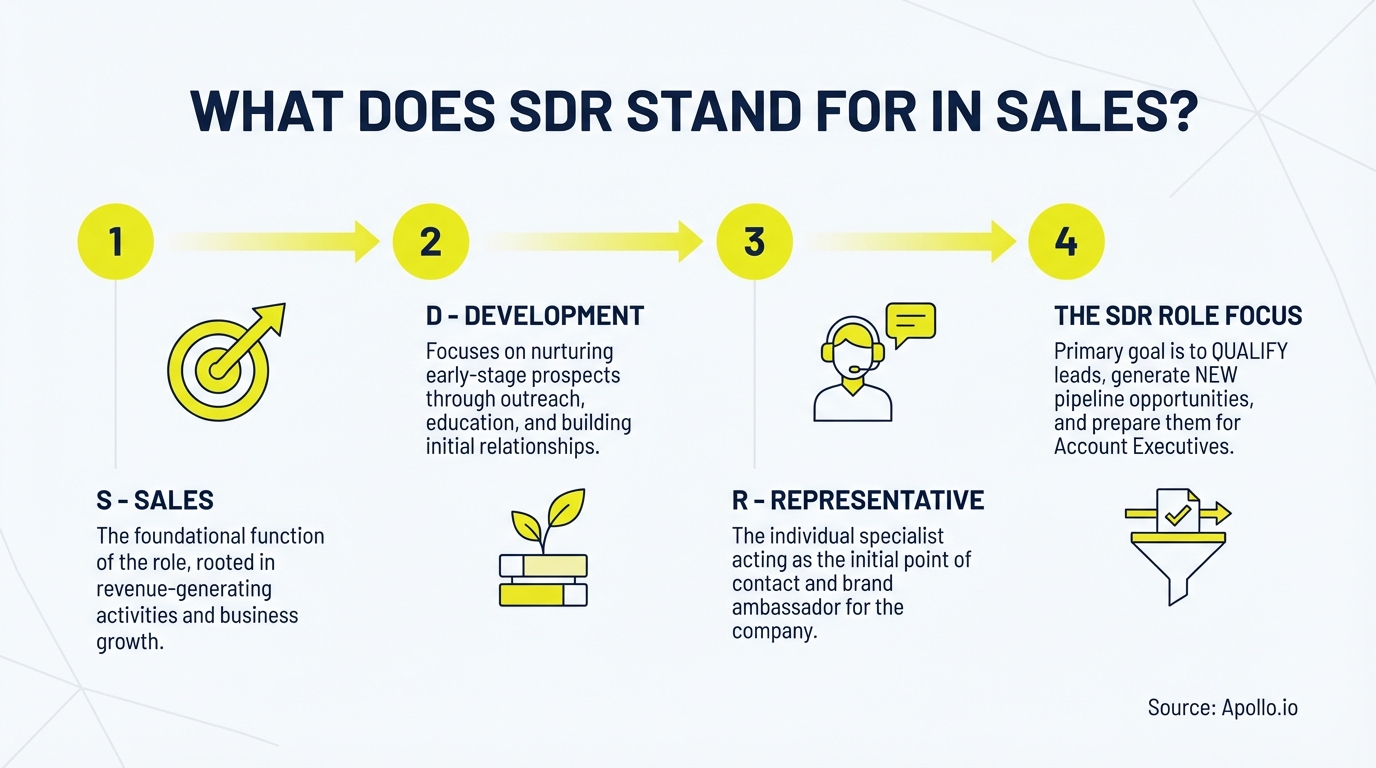
In 2026, SDR stands for Sales Development Representative, but the role has evolved far beyond cold calling and email blasts. Modern SDRs operate at the intersection of data intelligence, AI-powered workflows, and buying-group engagement.
With buyers preferring self-service journeys and avoiding irrelevant outreach, today's SDRs must earn conversations through context and relevance, not volume. This guide explores what SDRs do now, how the role is changing, and the systems that separate high-performing teams from those struggling to hit quota.

Build Pipeline on Verified Data
Tired of hours lost to manual research and bounced emails? Apollo surfaces verified contacts instantly so your reps spend time selling, not searching. Join 550K+ companies building predictable pipeline.
Start Free with Apollo →Key Takeaways
- SDRs identify prospects, qualify leads, and book meetings for Account Executives rather than closing deals themselves
- Modern SDR teams focus on buying-group engagement and multi-threading across personas, not single-contact outreach
- AI-powered workflows and signal-based selling are replacing manual prospecting and static sequences
- SDR success now depends on infrastructure (data quality, workflow automation, intent signals) more than individual hustle
- Organizations are shifting SDR reporting from Marketing to Sales leadership to tighten alignment with revenue outcomes
What Does SDR Stand for in Sales?
SDR stands for Sales Development Representative. According to Monday.com, SDRs are responsible for identifying potential customers, initiating contact, qualifying leads, and setting up meetings or opportunities for Account Executives, rather than closing deals themselves. The role sits at the top of the sales funnel, converting prospects into qualified opportunities that AEs can close.
Unlike Account Executives who manage full sales cycles and close revenue, SDRs specialize in early-stage qualification. They research prospects, execute outreach campaigns across email and phone, assess fit and timing, and hand off qualified opportunities. This specialization allows AEs to focus on high-value conversations while SDRs generate pipeline at scale. The average SDR-to-AE ratio is 2.6 AEs for every 1 SDR, according to Gradient Works.
For Sales Leaders managing growth targets, understanding sales performance management strategies helps optimize SDR team structure and compensation models that drive consistent pipeline generation.
What Is the Difference Between SDRs and BDRs?
SDRs and BDRs (Business Development Representatives) perform similar functions but traditionally focus on different lead sources. Research from T2D3 shows that SDRs typically specialize in qualifying inbound leads (prospects who submitted forms, downloaded content, or engaged with marketing), whereas BDRs focus on outbound prospecting (cold outreach to target accounts), though these distinctions can vary by organization.
In practice, many companies use the terms interchangeably or organize teams by market segment rather than lead source. Some orgs assign SDRs to inbound + mid-market while BDRs handle outbound + enterprise.
Others use a unified SDR title with specialization by vertical or account tier. What matters more than the title is the reporting structure and KPIs.
Teams reporting to Sales leadership now represent 80% of BDR/SDR orgs in 2025, up from 60% in 2022, signaling tighter integration with revenue operations and pipeline forecasting.
Understanding ideal customer profile (ICP) targeting helps both SDRs and BDRs focus outreach on accounts most likely to convert, improving qualification rates and reducing wasted effort on poor-fit prospects.
How Do SDRs Generate Qualified Pipeline in 2026?
Modern SDRs generate pipeline through signal-based selling and buying-group engagement, not spray-and-pray sequences. They monitor intent signals (content downloads, site visits, funding announcements, hiring activity, tech-stack changes) to time outreach when prospects show readiness.
When a lead enters the system, SDRs multi-thread across personas within the buying group rather than chase a single contact.
According to 6sense, 79% of BDR teams either maintained or increased in size from 2024 to 2025, with 58% reporting growth. This growth comes despite headcount pressure in other sales roles because high-performing SDR teams demonstrate measurable pipeline influence through better targeting and workflow automation.
Struggling to find qualified leads at scale? Search Apollo's 224M+ contacts with 65+ filters to build targeted prospect lists based on job title, company size, tech stack, and intent signals.
What Are the Core SDR Responsibilities?
- Prospect Research: Identify target accounts and contacts using sales intelligence platforms and intent data
- Outreach Execution: Run multi-channel sequences (email, phone, social) with personalized messaging
- Lead Qualification: Assess fit (budget, authority, need, timeline) through discovery conversations
- Meeting Coordination: Schedule qualified opportunities and provide context for AE handoff
- Pipeline Hygiene: Maintain CRM data accuracy and document all prospect interactions
- Buying-Group Mapping: Identify and engage multiple stakeholders within target accounts
SDRs using sales productivity frameworks report measurable improvements in meetings booked per rep by focusing on high-signal activities and eliminating low-value administrative work.
Turn Funnel Guesswork Into Real Pipeline
Forecasts feel like fiction when quality leads dry up mid-funnel. Apollo surfaces in-market buyers and tracks deal signals in real time. Top revenue teams use Apollo to build pipeline they can actually predict.
Schedule a Demo →Why Are SDR Teams Shifting to Sales Leadership?
Organizations are moving SDR reporting lines from Marketing to Sales to tighten alignment with revenue outcomes. When SDRs report to Marketing, they optimize for lead volume and MQL handoffs.
When they report to Sales, they optimize for qualified pipeline and meeting-to-opportunity conversion. This structural change reflects the evolution from activity-based to outcome-based SDR performance measurement.
Sales-led SDR teams show different motion patterns. When BDRs report to Sales, 88% are primarily outbound-focused.
When they report to Marketing, 73% are primarily outbound-focused. The reporting structure directly influences playbook design, compensation models, and handoff SLAs between SDRs and AEs.
For organizations navigating this transition, revenue operations frameworks provide governance templates for SDR-AE handoffs, shared KPIs, and cross-functional accountability that prevent pipeline leakage at the qualification stage.
What Metrics Matter Most for SDR Performance?
| Metric Category | Key Indicators | Why It Matters |
|---|---|---|
| Activity Volume | Calls made, emails sent, accounts touched | Baseline effort indicators (but insufficient alone) |
| Conversion Efficiency | Connect rate, reply rate, meeting-held rate | Measures outreach quality and message relevance |
| Pipeline Influence | Meetings-to-opps, pipeline created, sourced revenue | Direct connection to revenue outcomes |
| Speed Metrics | Lead response time, time-to-first-touch, speed-to-meeting | Captures urgency and follow-up discipline |
| Account Coverage | Buying-group penetration, personas engaged per account | Reflects multi-threading effectiveness |
Modern dashboards emphasize conversion and pipeline metrics over raw activity counts because AI tools make it easier to inflate activity volume without improving outcomes. Leaders now track meeting-to-opportunity conversion and incremental pipeline contribution to assess true SDR effectiveness.

How Are AI and Automation Changing SDR Workflows?
AI is taking over repetitive SDR tasks (list building, data enrichment, first-draft messaging, routing, prioritization) while humans focus on live conversations, qualification, and stakeholder coordination. This shift means the SDR role is evolving from "entry-level dialer" to "AI-orchestrated conversation specialist" who manages technology workflows and handles high-value human interactions.
AI SDR agents now handle end-to-end outbound workflows: research target accounts, enrich contact data, generate personalized messaging, execute sequences, and surface high-intent prospects for human follow-up. This automation addresses a critical constraint where sales reps spend only 29% of their workweek selling and 71% on non-selling administrative work.
Spending hours on manual prospecting and data entry? Automate your SDR workflows with Apollo's AI-powered GTM system that consolidates prospecting, engagement, and intelligence in one workspace.
What Should SDRs Automate vs. Keep Human?
Automate These Tasks:
- Prospect list building and contact discovery
- Data enrichment (job titles, company info, contact details)
- Email sequence execution and follow-up cadences
- Lead scoring and prioritization based on intent signals
- CRM data entry and activity logging
- Meeting scheduling and calendar coordination
Keep These Tasks Human:
- Live phone conversations and discovery calls
- Complex qualification and objection handling
- Buying-group mapping and stakeholder navigation
- Custom research for strategic accounts
- AE handoffs with nuanced context and next steps
Organizations implementing AI writing tools for sales report that automation handles 60-70% of prospecting grunt work, freeing SDRs to focus on qualification conversations that require human judgment and relationship-building skills.
What Are the Biggest Challenges Facing SDRs in 2026?
SDRs face three converging pressures: buyer preference for rep-free experiences, declining response rates to generic outreach, and organizational scrutiny on SDR ROI. These challenges are forcing teams to rethink playbooks, metrics, and tooling investments.
Buyers actively avoid irrelevant outreach. Generic prospecting sequences that worked in 2020 now generate single-digit reply rates because prospects expect personalization and context.
SDRs must demonstrate research depth and relevance in every touchpoint, which requires better data infrastructure and intent signal integration.
The "Great SDR Downsizing" saw 36% of venture-backed B2B software companies decrease SDR headcount in 2025, according to SaaStr. But this isn't the death of SDRs; it's the elimination of low-signal outbound teams that couldn't prove pipeline influence. High-performing SDR orgs that operationalize AI, data quality, and signal-based selling continue to grow and expand headcount.
How Can SDR Teams Overcome These Challenges?
- Signal-Based Selling: Replace static cadences with triggered outreach based on intent signals, hiring activity, and account engagement
- Buying-Group Plays: Build account-level playbooks that map personas, sequence multiple stakeholders, and coordinate touchpoints
- Data Infrastructure: Invest in verified contact data, enrichment workflows, and deliverability tools that improve connect rates
- Outcome Metrics: Shift dashboards from activity volume to conversion efficiency, pipeline influence, and revenue attribution
- AI Integration: Deploy automation for repetitive tasks while training SDRs on conversation skills and qualification frameworks
For Sales Leaders building scalable SDR operations, Apollo provides unified sales intelligence and engagement tools that consolidate prospecting, outreach, and analytics in one platform, eliminating the need for 3-5 separate point solutions.
What Tools Do High-Performing SDR Teams Use?
Modern SDR tech stacks integrate six core capabilities: contact data and enrichment, sales engagement and sequencing, conversation intelligence, intent signals, deliverability monitoring, and CRM connectivity. High-performing teams consolidate these functions to reduce tool sprawl and improve workflow efficiency.
| Capability | Function | Impact on SDR Productivity |
|---|---|---|
| Contact Intelligence | Verified B2B contacts, job changes, company data | Reduces manual research time by 60-70% |
| Sales Engagement | Multi-channel sequences, A/B testing, cadence management | Automates follow-up execution and improves consistency |
| Conversation Intel | Call recording, transcription, coaching insights | Accelerates rep ramp time and improves qualification quality |
| Intent Signals | Website visits, content downloads, tech-stack changes | Improves outreach timing and message relevance |
| Deliverability Tools | Email verification, domain health, bounce monitoring | Protects sender reputation and inbox placement rates |
Teams that consolidate their tech stack report measurable cost savings and productivity gains. As one RevOps leader shared: "We reduced the complexity of three tools into one" (Predictable Revenue).
Another reported: "We cut our costs in half" (Census). Tool consolidation eliminates integration headaches, reduces training overhead, and provides unified analytics across the SDR workflow.
Building a modern SDR stack? Read our complete guide to building a sales tech stack that scales revenue with frameworks for evaluating tools, integration architecture, and vendor selection criteria.
Start Building Your High-Performance SDR Team
The SDR role in 2026 demands more than cold calling and email volume. Successful teams combine verified contact data, AI-powered workflows, signal-based selling, and buying-group engagement to generate qualified pipeline at scale.
Organizations that invest in SDR infrastructure (data quality, automation, intent signals, conversation intelligence) will outperform competitors still running manual, low-signal outbound motions.
Whether you're a Sales Leader building an SDR function from scratch, a RevOps professional optimizing existing workflows, or an SDR looking to level up your skills, the path forward is clear: consolidate your tools, automate repetitive work, and focus human effort on high-value qualification conversations that move deals forward.
Ready to transform your SDR operations? Start a trial with Apollo's all-in-one sales intelligence and engagement platform. Join 2M+ users who consolidated their sales tech stack into one workspace for prospecting, outreach, and pipeline management.
Prove Pipeline ROI From Day One
Budget approval stuck on unclear metrics? Apollo delivers measurable pipeline impact fast — so you walk into every budget review with real numbers. Leadium 3x'd their revenue. Your turn.
Start Free with Apollo →Don't miss these
Sales
Inbound vs Outbound Marketing: Which Strategy Wins?
Sales
What Is a Sales Funnel? The Non-Linear Revenue Framework for 2026
Sales
What Is a Go-to-Market Strategy? The 2026 GTM Playbook
See Apollo in action
We'd love to show how Apollo can help you sell better.
By submitting this form, you will receive information, tips, and promotions from Apollo. To learn more, see our Privacy Statement.
4.7/5 based on 9,690 reviews
