
How Much Does It Cost to Build an Agentic GTM Stack From Scratch
Building an agentic GTM stack from scratch costs anywhere from $15,000 for a basic single-agent deployment to well over $300,000 for a full multi-agent system. But the headline number is rarely the real bill. In 2026, agentic costs split across three distinct meters: platform seats, usage credits or API calls, and the often-overlooked integration and governance layer. Before you scope a budget, you need to understand all three. Start by clarifying your ideal customer profile and your core GTM motion, because those decisions shape which agents you actually need.

Research Less, Close More With Apollo
Tired of burning hours verifying contact info instead of selling? Apollo delivers accurate, ready-to-work leads so your team spends time closing, not digging. Join 600K+ companies building pipeline faster.
Start Free with Apollo →Key Takeaways
- Agentic GTM stack costs span three tiers: Starter ($15K–$80K), Growth ($80K–$300K+), and Enterprise (custom), with governance and integration often exceeding model costs.
- The global agentic AI market is growing at a 43.84% CAGR, meaning vendor pricing is still volatile and early buyers face both opportunity and cost risk.
- 62% of organizations expect an ROI exceeding 100% from agentic AI, but only if utilization rates stay high. Low adoption is the silent TCO killer.
- Modern agentic pricing is hybrid: seats plus credits or messages, not a single per-seat SKU. Budget for variable consumption, not just licenses.
- Consolidating your GTM stack into a unified platform dramatically reduces integration overhead, the category where most agentic budgets overrun.
What Does It Actually Cost to Build an Agentic GTM Stack from Scratch?
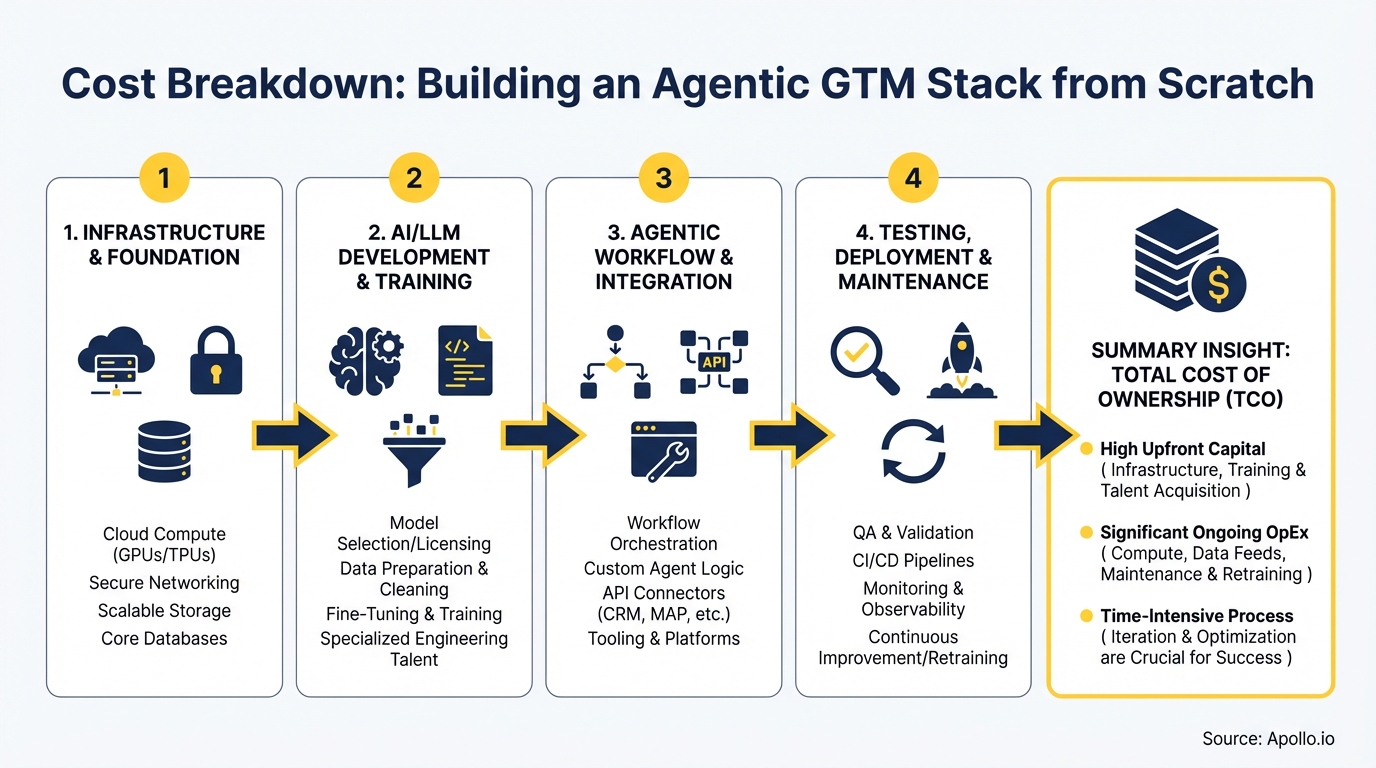
The cost to build an agentic GTM stack from scratch ranges from roughly $15,000 to over $1.5 million depending on complexity, build approach, and governance requirements. According to Acceldata, a basic single-agent deployment starts between $15,000 and $40,000, while Groovyweb notes a full multi-agent system replacing a team of five to ten people can cost upwards of $300,000. Custom enterprise builds go higher still.
| Tier | Typical Cost Range | Scope | Best For |
|---|---|---|---|
| Starter | $15,000 – $80,000 | 1–2 agents, single workflow (e.g., prospecting or follow-up) | Early-stage teams, pilots |
| Growth | $80,000 – $300,000 | Multi-agent, CRM-integrated, basic governance | Mid-market GTM teams scaling outbound |
| Enterprise | $300,000+ | Full orchestration, domain-specific models, security controls | Companies with complex compliance needs |
These ranges cover development and licensing. They do not include ongoing API consumption, data prep, or the human QA layer that most production deployments require.
What Are the Hidden Cost Drivers in an Agentic GTM Stack?
The hidden costs in an agentic GTM stack are integration overhead, data preparation, and consumption-based billing that compounds as workflows deepen. Platform vendors have moved away from flat per-seat pricing.
Salesforce Agentforce, for example, introduced hybrid packaging with a per-conversation option alongside per-user licensing. HubSpot's Breeze agents now use a seat-plus-credits model.
Microsoft Copilot Studio prices by "messages" consumed. This means two teams using identical base models can see radically different monthly bills depending on workflow complexity and guardrails.
The hidden line items most budgets miss:
- Data preparation:Softermii reports AI implementation costs related to data work increased by 89% between 2023 and 2025.
- CRM connectors and permissions: Each integration requires build time, testing, and ongoing maintenance.
- Retrieval and tool-call billing: OpenAI began billing File Search tool calls separately from tokens in late 2025. These accumulate fast in multi-step agent loops.
- Monitoring and FinOps tooling: Rate limits, caching, and spend dashboards are no longer optional.
- Human QA loops: Production agentic workflows require human review checkpoints, especially for outbound messaging.
Struggling to keep your pipeline data clean enough for agents to act on? Start with Apollo's verified contact database to reduce data-prep costs from day one.
Turn Funnel Guesswork Into Pipeline Clarity
Pipeline forecasting a guessing game because leads stall before they ever become opportunities? Apollo surfaces high-intent prospects and moves them forward — fast. Nearly 100K paying customers stopped guessing and started closing.
Start Free with Apollo →How Should RevOps Leaders Budget for an Agentic GTM Stack?
RevOps leaders should budget for an agentic GTM stack using a three-bucket model: platform and licenses, consumption and API overhead, and governance plus enablement. The nominal license cost is often the smallest of the three. Research from USM Systems shows 62% of organizations expect an ROI exceeding 100% from agentic AI, but that ROI depends entirely on utilization rates staying high.
A practical budget allocation framework:
- Platform licenses (seats): 30–40% of total stack budget
- API consumption and tool calls: 20–30% (model this against projected workflow volume before committing)
- Integration and CRM connectors: 15–20%
- Governance, security, and monitoring: 10–15%
- Enablement and change management: 10–15%
For context on what an optimized sales tech stack looks like before layering in agents, map your current tool spend first. Many teams discover they are paying for redundant capabilities that agents would consolidate anyway.

What Governance and Security Costs Should You Plan For?
Governance and security add a meaningful but unavoidable cost layer to any agentic GTM build. According to MediaPost, security and privacy concerns are a primary barrier for 54% of B2B companies adopting agentic AI. Gartner projects 40% of enterprise applications will include task-specific agents by end of 2026, accelerating both adoption and the risk of ungoverned "agent sprawl."
Governance checklist for any agentic GTM deployment:
- Data access controls: Define which agents can read, write, or trigger actions in your CRM
- Prompt and output logging: Maintain audit trails for all agent-generated outbound content
- Spend caps and rate limits: Set hard limits per workflow before launch, not after an overrun
- Human-in-the-loop checkpoints: Require approval gates for high-stakes actions (sending sequences, updating deal stages)
- Kill criteria: Define in advance the utilization or cost thresholds that trigger a workflow pause or shutdown
For teams standardizing on revenue operations principles, governance is not a separate workstream. It is built into how you design agent permissions and CRM sync rules from the start.
How Can SDRs and GTM Teams Reduce Agentic Stack Build Costs?
SDRs and GTM teams reduce agentic stack build costs by consolidating tools rather than stacking new agent layers on top of fragmented infrastructure. Every disconnected tool adds an integration cost multiplier.
The teams that build agentic GTM stacks most efficiently start with a unified platform and add agent capabilities within it, rather than orchestrating five separate vendors.
Consolidation is the clearest path to a defensible TCO. As Predictable Revenue found after consolidating their GTM stack: "We reduced the complexity of three tools into one." Census reported a similar result: "We cut our costs in half." The pattern holds because integration maintenance, duplicate data, and context-switching are silent budget drains that compound over time. See the full Predictable Revenue cost reduction story for specifics.
Spending hours stitching together manual outreach workflows that agents should be handling? Explore Apollo's AI-powered sales automation to consolidate your GTM stack and reduce build complexity.
What Is the ROI Timeline for an Agentic GTM Stack?
The ROI timeline for an agentic GTM stack typically ranges from six to eighteen months, depending on adoption rates and how tightly the agents map to active workflows. The market opportunity is real: Landbase reports the global agentic AI market is projected to grow from $5.25 billion in 2024 to $199.05 billion by 2034, a CAGR of 43.84%. And according to SuperAGI, Gartner predicts companies adopting agentic AI are likely to see a 30% reduction in sales costs.
But utilization is the variable that determines whether those projections materialize. A stack with strong ROI potential but low adoption delivers neither. Build your demand generation agent workflows around the highest-frequency, highest-volume tasks first: ICP prospecting, sequence personalization, and meeting follow-up. Those use cases have the shortest path to measurable output and the clearest kill criteria if adoption stalls.

How Do You Start Building an Agentic GTM Stack Without Overspending?
Start building an agentic GTM stack without overspending by piloting a single high-frequency workflow before committing to a full multi-agent architecture. A focused pilot surfaces real consumption costs, integration friction, and adoption gaps before you've locked in a large contract.
From there, layer additional agents only when the prior workflow has hit a defined utilization threshold.
The teams that scale most efficiently treat their GTM strategy as the design document for their agentic architecture. Agents built around a clearly defined motion and a verified go-to-market plan outperform agents built speculatively. Apollo gives B2B GTM teams a unified platform covering prospecting, engagement, enrichment, and pipeline management, so you add AI capability within one workspace rather than across five vendors. As Cyera's team put it: "Having everything in one system was a game changer."
The agentic GTM stack that wins in 2026 is not the most complex one. It is the one with the highest utilization, the lowest integration surface, and governance baked in from day one. Start your free Apollo trial and see how far a consolidated GTM platform takes you before adding custom agent infrastructure.
Prove Pipeline ROI With Apollo
ROI pressure killing your tool budget before it even gets approved? Apollo delivers measurable pipeline impact from day one — faster meetings, higher win rates, real numbers. Leadium 3x'd annual revenue. Your board wants proof. Apollo gives it to you.
Start Free with Apollo →Don't miss these
Sales
Inbound vs Outbound Marketing: Which Strategy Wins?
Sales
What Is a Sales Funnel? The Non-Linear Revenue Framework for 2026
Sales
What Is a Go-to-Market Strategy? The 2026 GTM Playbook
See Apollo in action
We'd love to show how Apollo can help you sell better.
By submitting this form, you will receive information, tips, and promotions from Apollo. To learn more, see our Privacy Statement.
4.7/5 based on 9,690 reviews
