
GTM Engineering at Scale: How Fast-Growing Companies Build It
Most fast-growing companies hit a wall somewhere between $5M and $50M ARR. The GTM motion that got them here stops working.
Reps are rebuilding lists every quarter, leadership's strategy gets lost in translation by the time it reaches execution, and nobody can answer basic questions like "what percentage of our market have we actually contacted?" That's not a headcount problem. That's a systems problem.
GTM Engineering at scale is the discipline of solving that systems problem before it becomes a ceiling. It means building a unified, repeatable, self-optimizing revenue engine, not managing a Frankenstack of 14 tools duct-taped together at 2am. This article breaks down what that actually looks like inside a fast-growing company.

Scale Smarter With Apollo's GTM Engine
Tired of slow lead gen and inconsistent processes holding your team back? Apollo standardizes your outreach, automates research, and scales pipeline across every rep. Join 600K+ companies growing faster.
Start Free with Apollo →Key Takeaways
- GTM Engineering at scale is a revenue strategy discipline, not a tool-integration job. The best GTM Engineers are system designers, not tool sommeliers.
- Fragmented tech stacks create a compounding "scale tax." Research from G2 found 84% of buyers prefer a single solution over multiple tools, yet most teams keep adding vendors instead of consolidating.
- A unified TAM list, signal-based scoring, and human-in-the-loop review are the three structural pillars that separate scalable GTM from perpetual rebuilding.
- AI governance, not just AI adoption, is the differentiator. Fully autonomous outreach creates brand risk; the winning model separates AI research and drafting from human judgment on conversations.
- RevOps leaders who consolidate their stack report faster pivots, better attribution, and significantly less busywork across SDR and AE teams.
What Does GTM Engineering Look Like at Scale in a Fast-Growing Company?
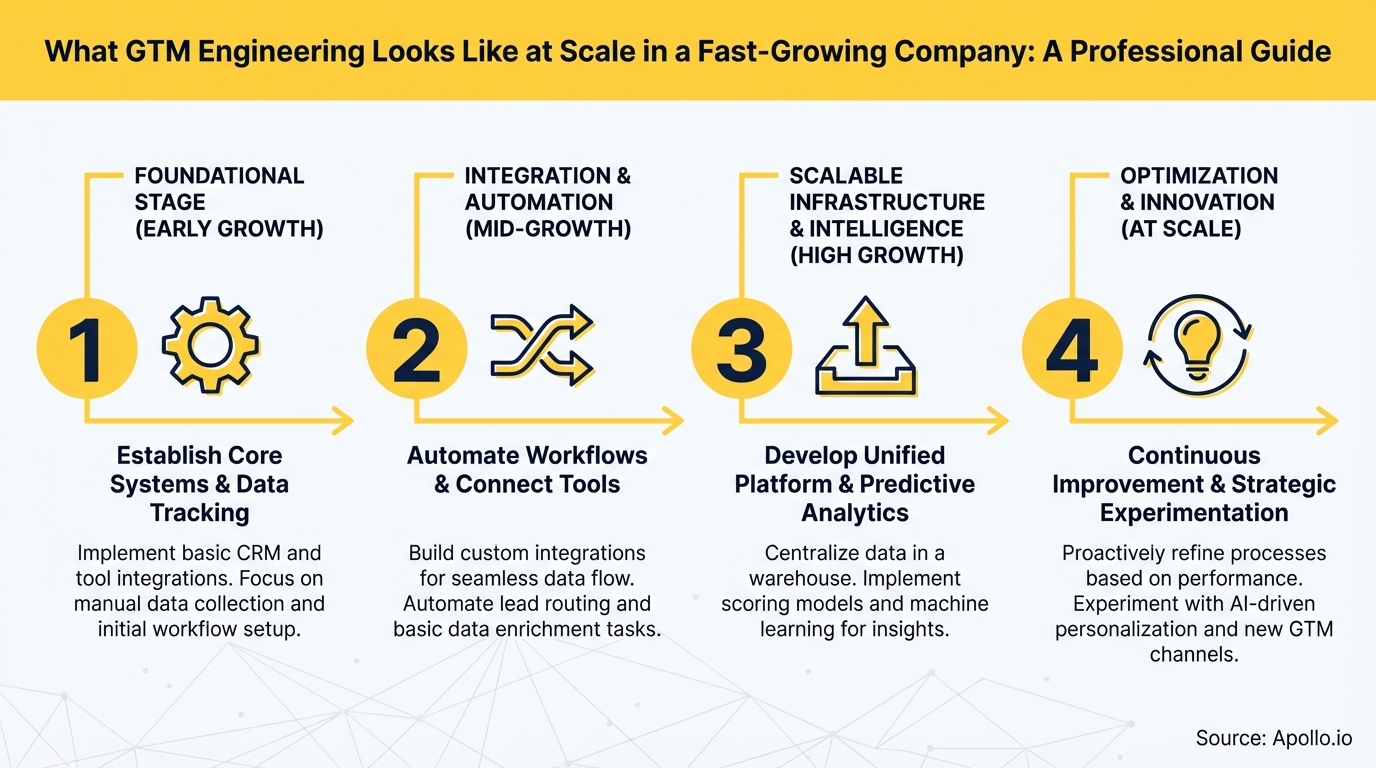
GTM Engineering at scale looks like a single, connected system where targeting, scoring, messaging, and reporting all feed each other continuously, rather than a series of disconnected campaigns rebuilt every quarter. The GTM strategy that leadership sets shows up in what reps actually do, without interpretation or dilution. Data from all sources flows into one place. Accounts are ranked automatically. Outreach goes to the right people at the right time. The system learns from every outcome.
Data from drli.blog shows GTM Engineering roles have seen 217% year-over-year growth, reflecting how urgently fast-growing companies need this capability. The demand is real, but the execution gap is wider. Many organizations confuse hiring a GTM Engineer with building a GTM system. The role is only as valuable as the architecture underneath it.
Why Does GTM Engineering Break Down as Companies Grow?
GTM operations break down at scale because complexity compounds faster than headcount can absorb it. Each new rep, new segment, and new campaign adds surface area without adding coherence.
The result is a stack that grows but doesn't scale.
According to Fast Company, only 47% of companies are satisfied with their current RevOps stack, and 75% cite data inconsistency as their top frustration. That stat describes what a scaling GTM failure feels like from the inside: every team has its own version of the truth, and nobody trusts the data enough to act on it. The RevOps function exists to solve this, but without a proper GTM system underneath it, RevOps ends up firefighting instead of building.
The Frankenstack problem makes this worse. Research from GTM Monday found the average enterprise runs 23 vendors in its core GTM tech stack. Twenty-three. Each one requires maintenance, each API is a potential point of failure, and every handoff between tools is a place where data gets lost or delayed. Wearing that as a badge of honor is the wrong instinct.

What Are the Core Components of a Scalable GTM System?
A scalable GTM system has seven structural components, each feeding the next. The GTME methodology defines these as pillars that work together as one connected foundation.
| Pillar | What It Does | Owner |
|---|---|---|
| Build TAM List | Centralize your entire addressable market in one qualified list | Sales Lead |
| Deliverability & Burn Rate | Size infrastructure to market; no guessing on mailbox count or send capacity | RevOps |
| Scoring & Prioritization | Translate business priorities into a numeric score for every account | Management |
| Messaging Intelligence | Generate persona-specific, signal-informed messaging at scale | Management |
| Data Orchestration Workflows | Connect 1st, 2nd, and 3rd party data into one always-on processing layer | RevOps |
| Human in the Loop (HITL) | Route top-scored accounts to human review before outreach fires | Leadership |
| Reporting & Optimization | Track which signals predict wins; adjust weights based on real outcomes | Sales Mgmt |
The critical insight is that scoring and messaging use the same data. An account flagged for recent funding or a website visit gets both prioritized in the queue and a message that references that signal specifically.
This is what separates research-based personalization at scale from generic templates.
Struggling to build qualified pipeline while your SDRs spend hours on manual research? Search Apollo's 230M+ contacts with 65+ filters and let the system surface who to contact next.
Turn Funnel Gaps Into Closed Deals
Pipeline forecasting a guessing game? Apollo surfaces high-intent prospects and moves them from lead to opportunity faster. Nearly 100K paying customers use Apollo to build pipeline they can actually count on.
Schedule a Demo →How Do RevOps Leaders Govern GTM Engineering at Scale?
RevOps leaders govern GTM Engineering through signal-weight ownership, cadence discipline, and a clear RACI that separates who builds the system from who maintains it. Without this, scoring models drift, campaigns revert to manual, and the system stops compounding.
The governance model has three cadences:
- Daily: SDRs review AI-surfaced accounts, approve or refine outreach, flag anomalies
- Monthly: RevOps tunes scoring weights based on reply and meeting data; management reviews signal correlation
- Quarterly: TAM list refresh, signal pruning, strategic alignment with leadership priorities
The key metric is not reply rate. It's which signals correlate with pipeline. A signal with an r-value above 0.7 gets more weight. Below 0.5, it gets reduced or removed. This turns reporting into a self-optimizing loop, not a retrospective exercise. For a deeper look at building this function, the GTME Program details walk through the full week-by-week build including how governance is handed off to the internal team.
This also resolves the alignment problem that plagues scaling orgs. When leadership shifts focus to a new segment, the system re-ranks the entire market overnight by adjusting a scoring weight. No campaign rebuild. No retraining the team. The demand generation motion stays continuous instead of resetting every quarter.
How Do SDRs and AEs Operate Inside a Scaled GTM System?
SDRs inside a scaled GTM system shift from list-builders to conversation-starters. Instead of pulling exports and writing cold emails from scratch, they start the day with a prioritized queue: AI has already researched each account, assigned a score, and drafted a message tied to the signals that triggered the outreach.
SDRs review the top accounts flagged for human judgment, refine where needed, approve the rest.
For Account Executives, the system provides pre-meeting intelligence automatically. Inbound signals like pricing page visits or content downloads feed into scoring and surface in the AE's workflow before the call. The sales funnel stops being a passive tracker and becomes an active prioritization engine.
Research from SignalFire found that in 2024, 93% of GTM leaders reported using AI in some capacity, with 78% planning to increase their AI investments. The adoption is there. The governance mostly isn't. The teams winning in 2026 are the ones who have figured out where AI operates autonomously and where human judgment is non-negotiable.

What Is the Right AI Governance Model for GTM at Scale?
The right AI governance model for GTM at scale separates automation of research and drafting from human judgment on conversations. Fully autonomous AI outreach creates brand risk and mishandles nuanced replies.
The scalable model uses AI to handle account research, signal aggregation, scoring, and first-draft messaging, then routes high-priority accounts to a human review queue before anything goes out.
This Human-in-the-Loop (HITL) design is not a limitation. It's a feature.
SDRs reviewing AI-drafted messages catch hallucinations before they reach prospects. Their edits and overrides feed back into the system, improving prompt quality over time.
The automation rate for research and drafting reaches 90-95%, while the conversations that actually move deals forward remain human-driven.
Spending hours on manual outreach while high-priority accounts go untouched? Automate your sequences with Apollo's AI-powered outreach and keep your team focused on conversations that close.
How Do You Build This System Without Disrupting Current Operations?
The system gets built in parallel with current operations. Reps keep selling. The GTM system is constructed alongside, not on top of, the existing motion. The GTM Engineering (GTME) Program structures this as a 12-week build: foundation and TAM unification in weeks 1-3, scoring and messaging in weeks 4-6, data orchestration in weeks 7-9, human-layer training and launch in weeks 10-12.
The time commitment from internal stakeholders is 15-20 hours total across the build, not 20 hours per week. Weekly sessions run 45-60 minutes.
The goal is a system the internal team can maintain with 2-4 hours per month after launch, not a consulting dependency.
Stack consolidation is a direct output of this process. Cyera summarized it well: "Having everything in one system was a game changer." Census found they could cut costs significantly by consolidating. Predictable Revenue reduced the complexity of three separate tools into one. The CRM integration strategy shifts from "how do we connect all these tools" to "how do we reduce the number of tools that need connecting."
Conclusion: GTM Engineering at Scale Is a Strategic Bet, Not a Tooling Problem
The question fast-growing companies need to answer is not "which tools should we add" but "what system do we need to build." A GTM Engineer who defines their value by how many integrations they've stitched together is optimizing for the wrong thing. The one who wins is the revenue strategist who deploys an elegant, compounding system at high velocity.
The trajectory is clear: agentic GTM, where targeting, scoring, messaging, and optimization run continuously without manual intervention, is the endgame. The companies investing in that architecture now will have a compounding advantage over those still rebuilding campaigns every quarter. For teams ready to move from the Frankenstack to a unified GTM engine, starting with a clearly defined ICP and a single source of truth for your market is the first step.
Start Free with Apollo and build the GTM system your growth stage actually demands.
Prove Pipeline ROI With Apollo
ROI pressure killing your next budget approval? Apollo delivers measurable pipeline impact your leadership can't ignore. Leadium 3x'd their annual revenue — see what Apollo can justify for your team.
Schedule a Demo →Don't miss these
Sales
Inbound vs Outbound Marketing: Which Strategy Wins?
Sales
What Is a Sales Funnel? The Non-Linear Revenue Framework for 2026
Sales
What Is a Go-to-Market Strategy? The 2026 GTM Playbook
See Apollo in action
We'd love to show how Apollo can help you sell better.
By submitting this form, you will receive information, tips, and promotions from Apollo. To learn more, see our Privacy Statement.
4.7/5 based on 9,690 reviews
