
What Does an AI-Augmented SDR Team Look Like at a 50-100 Person B2B Company in 2026?
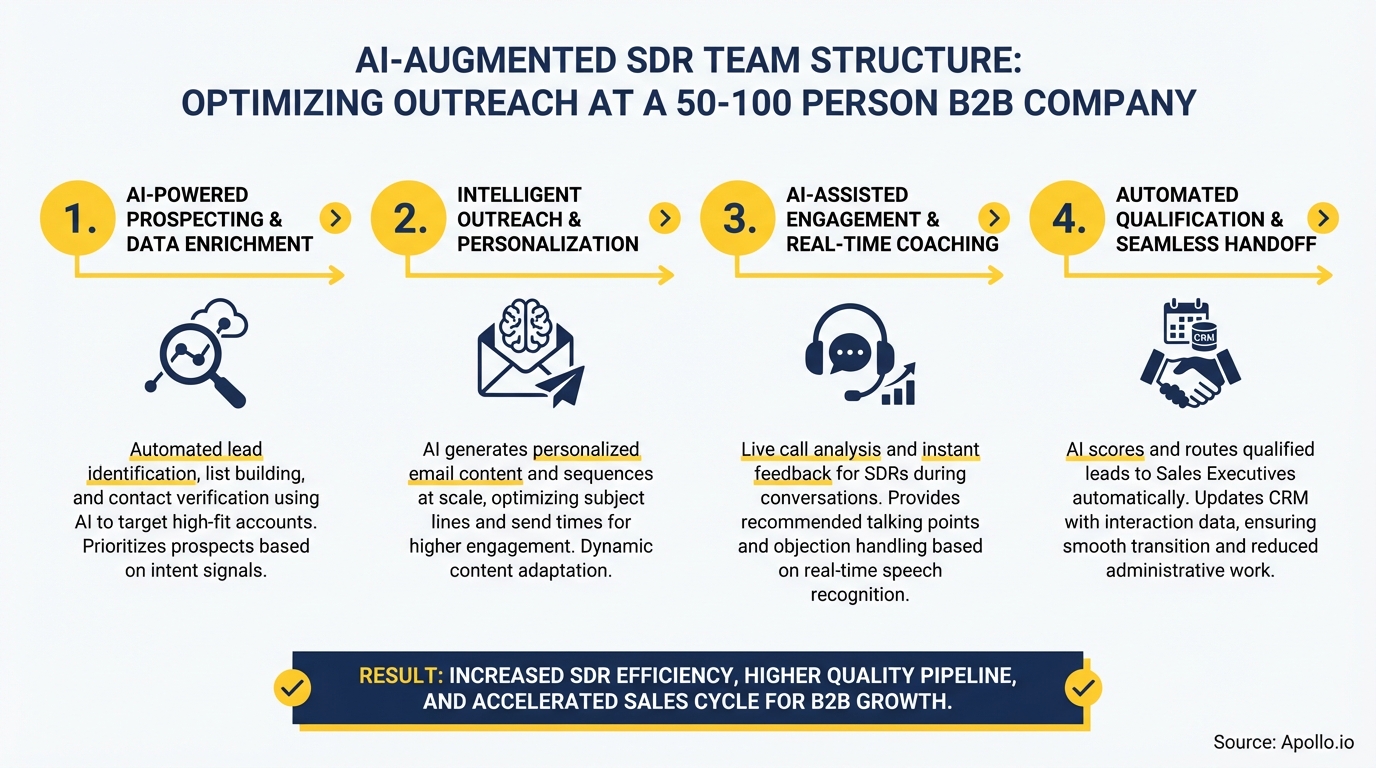
At a 50-100 person B2B company, an AI-augmented SDR team typically runs leaner than you'd expect: fewer reps doing higher-quality work, with AI handling the research, list-building, sequencing, and CRM hygiene that used to consume most of the day. The shift is less about headcount and more about workflow architecture. SDRs become player-coaches who manage AI throughput and quality rather than grinding through manual tasks. Tools like Apollo's AI Sales Assistant make this practical by running end-to-end GTM workflows from a single natural-language prompt, no engineering required.
The opportunity is real, but adoption is still uneven. According to Cirrus Insight, AI adoption among sales reps nearly doubled from 24% in 2023 to 43% in 2024. Mid-market teams that move now build a compounding advantage over competitors still running fully manual SDR operations.

Research Less, Close More With Apollo
Tired of burning hours verifying contacts instead of selling? Apollo delivers 230M+ accurate business contacts so your team spends time closing, not chasing. Join 600K+ companies building pipeline faster.
Start Free with Apollo →Key Takeaways
- A well-structured AI-augmented SDR team at a 50-100 person company typically runs 2-4 SDRs managing AI-assisted workflows rather than a large manual activity-only team.
- AI delivers the most immediate ROI on research, list-building, and sequence creation — tasks that previously consumed the majority of an SDR's day.
- Signal-based personalization (hiring events, funding, intent data) outperforms generic AI mail-merge in deliverability and reply rates.
- RevOps alignment and clean CRM data are prerequisites — AI amplifies bad data as readily as good data.
- Teams that partner with AI tools report meaningfully higher quota attainment than those relying on manual-only workflows.
What Roles Make Up an AI-Augmented SDR Team?
An AI-augmented SDR team at this company size usually consists of three functional roles, not necessarily three separate people.
| Role | Primary Responsibility | AI Handles |
|---|---|---|
| SDR / BDR (player-coach) | Live conversations, qualification, handoffs | Research, list-building, sequence drafts, CRM updates |
| RevOps / AI Operator | Workflow governance, data hygiene, ICP guardrails | Trigger logic, enrichment automation, QA rubrics |
| Sales / Revenue Leader | Coaching, pipeline review, messaging strategy | Performance analytics, conversation summaries, rep scoring |
RevOps leaders find this structure dramatically reduces tool sprawl. As Cyera put it: "Having everything in one system was a game changer." For B2B sales organizations at this size, keeping the stack unified is critical to maintaining data integrity and SDR focus.
How Do SDRs Actually Spend Their Day With AI?
An AI-augmented SDR's daily workflow shifts from manual research to managing AI outputs and focusing on live engagement. Here's what the operating model looks like in practice:
- Morning (30 min): Review AI-generated prospect lists and approve or refine before sequences launch. Apollo's Outbound Copilot automates ICP-matched list building and sequence enrollment on a daily or weekly cadence.
- Mid-morning (60 min): Live calls and follow-up on replies. Pre-meeting AI research preps reps with account priorities, key contacts, and objection history before each call.
- Afternoon (45 min): Review conversation AI summaries, update pipeline, send AI-drafted follow-ups. No manual note-taking or CRM data entry.
- End of day (15 min): Check sequence performance analytics and flag any messaging that needs refinement.
Research from MarketsandMarkets indicates AI tools save sales representatives an average of 11 to 12 hours per week by automating repetitive tasks. That recovered time goes directly into prospect conversations and pipeline-building activities.
Struggling to build qualified prospect lists fast enough? Search Apollo's 230M+ contacts with 65+ filters and let AI do the heavy lifting.
What Does Signal-Based Personalization Look Like for SDRs?
Signal-based personalization means triggering outreach based on real buying evidence rather than static firmographic data. This is the primary differentiator between AI teams that get replies and those that get spam-filtered.
Effective signals to build sequences around:
- Job changes: A new VP of Sales at a target account is a high-priority trigger.
- Funding announcements: Series A/B companies often expand headcount and tooling within 90 days.
- Intent signals: Prospects researching your category actively are warmer than cold lists. See how intent data powers smarter B2B outreach.
- Product launches or hiring surges: Indicate growth initiatives that your solution may support.
Apollo's AI Research pulls these signals automatically and uses them as dynamic variables in email personalization, so each message references real prospect context rather than generic tokens. Erik Fernando Nieto, BDR at JumpCloud, notes: "Apollo's AI Assistant filters and cleans prospect data for me, so I can find the right people faster and run better searches. It saves me about an hour per prospecting session."
Turn Funnel Guesswork Into Real Pipeline
Tired of watching marketing leads stall before they ever reach your pipeline? Apollo surfaces in-market buyers with precision so your team acts on real signals, not stale lists. 600K+ companies stopped guessing and started closing.
Start Free with Apollo →What ICP and Data Readiness Do You Need Before Deploying AI?
AI amplifies your existing data quality — for better or worse. Before deploying AI workflows, mid-market RevOps teams need to establish three foundations.
- Defined ICP with firmographic guardrails: Industry, headcount range, tech stack, geography, and revenue band. Without these, AI generates volume without precision. Review what ICP means in sales to build a tight targeting framework.
- Clean CRM data: Deduplicated contacts, accurate job titles, and mapped account hierarchies. AI enrichment tools can close gaps, but messy CRM data creates compounding errors in automated sequences.
- Configured AI Content Center: Apollo's AI Content Center grounds all messaging in your value proposition, pain points, and differentiators. This step alone significantly improves output quality across every AI-generated email, call script, and follow-up.
According to Salesforce, 91% of SMBs using AI reported revenue increases. The qualifier is that the AI is working from accurate, well-structured data.

How Do Revenue Leaders Measure AI SDR Performance?
Revenue leaders managing AI-augmented teams track a different set of metrics than traditional activity-based SDR management. Volume metrics matter less; quality and conversion metrics matter more.
| Metric | What It Measures | AI Impact |
|---|---|---|
| Reply rate by signal type | Which triggers drive engagement | Identifies highest-ROI personalization angles |
| Meeting-to-opportunity conversion | Qualification quality | AI pre-meeting research improves fit before the call |
| Sequence completion rate | Deliverability and list hygiene | Flags domain reputation issues early |
| CRM data completeness | Pipeline visibility for AEs | Conversation AI auto-populates fields post-call |
For sales leaders reviewing the evolving B2B buyer journey, these metrics reflect a buyer population that increasingly self-educates before engaging with a rep. SDR touchpoints need to add information value, not just generate activity volume.
Spending too much time managing disconnected tools? Run your entire outbound motion from one platform with Apollo.
What Are the Most Common Failure Modes for AI SDR Teams?
Most AI SDR deployments underperform for predictable reasons, not technical ones.
- Generic outputs from unconfigured AI: AI that isn't grounded in your ICP, value prop, and buyer pain points produces generic messaging that prospects ignore.
- Volume-first thinking: Increasing send volume without improving relevance accelerates domain reputation damage. Gmail and Yahoo bulk-sender enforcement makes this a critical risk for smaller teams with limited sending domains.
- No human review gate: Fully automated sequences without an approval step allow unqualified prospects or poorly timed messages to ship at scale.
- Skipping RevOps alignment: Without a dedicated operator managing ICP guardrails, trigger logic, and enrichment rules, AI workflows drift from strategy over time.
- Treating AI as a one-time setup: Signal libraries, messaging, and ICP definitions need regular review as markets and buyer behaviors shift.
Predictable Revenue found that consolidating their outbound stack resolved many of these issues: "We reduced the complexity of three tools into one." A unified platform with built-in governance controls is more reliable than stitching together multiple point solutions.
How Should a 50-100 Person B2B Company Start Building an AI SDR Team?
Start with a focused pilot rather than a full deployment. Most teams see the fastest ROI by automating one workflow end-to-end before expanding.
30-day pilot plan:
- Define one ICP segment with clear firmographic and technographic criteria.
- Configure the AI Content Center with your value proposition and top three buyer pain points.
- Build one signal-triggered sequence (e.g., recent funding + ICP match) using Apollo's Outbound Copilot.
- Set a manual approval gate: every SDR reviews AI-generated contacts before enrollment.
- Track reply rate, meeting rate, and sequence completion rate weekly. Adjust messaging based on results.
Use Apollo's AI Assistant to Sell Smarter guide to structure your prompts and workflows from day one. Teams that start with a defined pilot and expand from proven results outperform those that deploy broadly without a baseline.

Build Your AI SDR Team on a Unified GTM Platform
An AI-augmented SDR team at a 50-100 person B2B company is defined by workflow discipline, not headcount. The teams generating the most pipeline in 2026 are those where SDRs focus on qualified conversations and AI handles everything upstream: research, list-building, sequencing, and post-call follow-up.
The key ingredients are a tight ICP, clean data, configured AI messaging, and a RevOps operator managing quality. Start with one workflow, prove the model, then scale.
Apollo consolidates all of these capabilities into a single platform, so your team isn't stitching together five tools to run one outbound motion.
Get Leads Now and see how Apollo's AI SDR tools can transform your outbound motion.
Prove Pipeline ROI With Apollo
Budget approval stuck on unclear metrics? Apollo delivers measurable pipeline impact from day one — so you justify the investment fast. Join 600K+ companies turning sales activity into undeniable ROI.
Start Free with Apollo →Don't miss these
Sales
Inbound vs Outbound Marketing: Which Strategy Wins?
Sales
What Is a Sales Funnel? The Non-Linear Revenue Framework for 2026
Sales
What Is a Go-to-Market Strategy? The 2026 GTM Playbook
See Apollo in action
We'd love to show how Apollo can help you sell better.
By submitting this form, you will receive information, tips, and promotions from Apollo. To learn more, see our Privacy Statement.
4.7/5 based on 9,690 reviews
