
What Does a Well-Structured Outbound Pipeline Review Look Like for a VP of Sales?
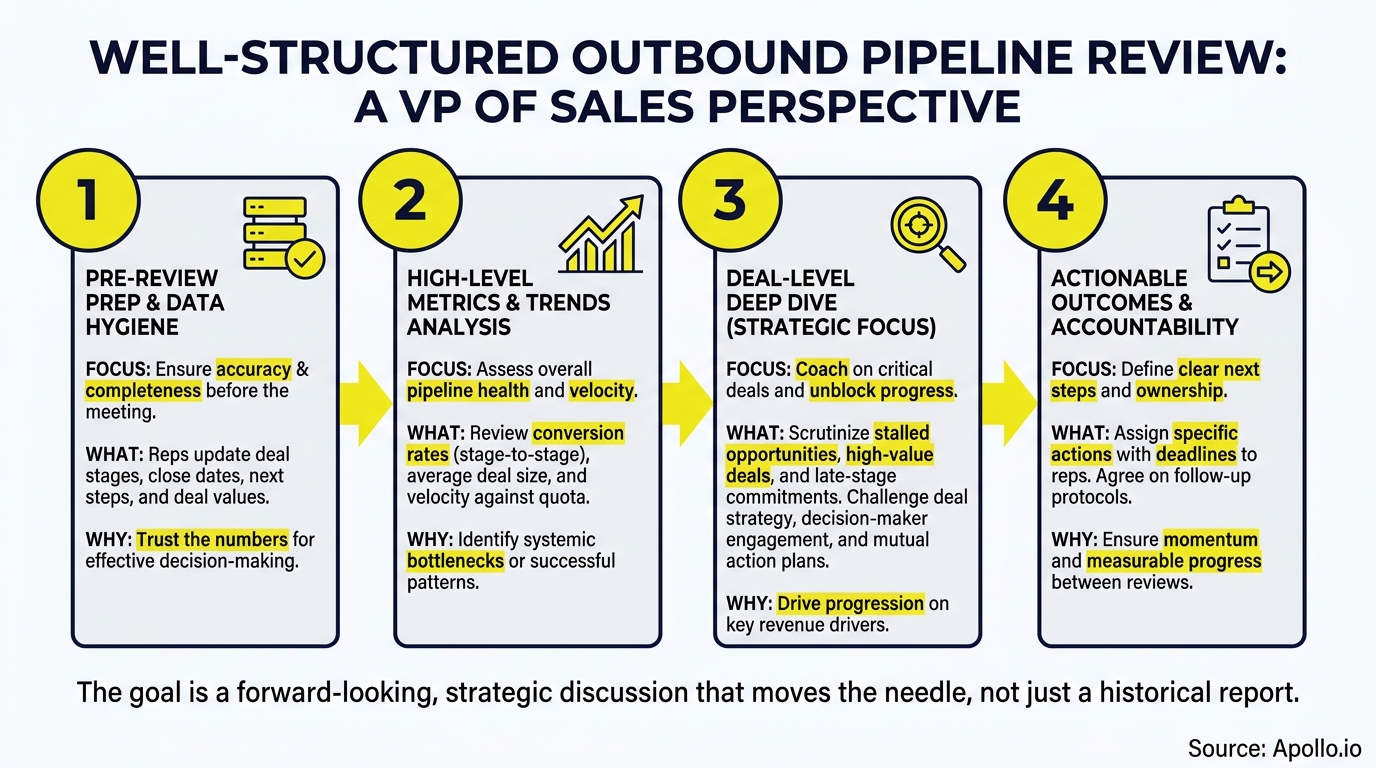
Most pipeline reviews are just forecast calls in disguise. Reps recite deal stages, managers nod, and the quarter still misses. A well-structured outbound pipeline review for a VP of Sales is a disciplined operating ritual that combines data integrity checks, capacity math, buyer consensus scoring, and evidence-based forecasting into one repeatable cadence. Getting this right is foundational to sales performance management and separates teams that predict revenue from those that react to it.
According to SalesGrowth.com, structured pipeline reviews help sales leaders spot risk early and prevent inaccurate forecasting. The stakes are high: data from Landbase shows only around 24% of salespeople exceed their yearly quota. A better review process is one of the highest-leverage interventions a VP can make.

Research Less, Close More With Apollo
Tired of burning hours verifying contact info instead of selling? Apollo surfaces accurate leads instantly so your team spends time closing, not chasing. Join 600K+ companies building pipeline faster.
Start Free with Apollo →Key Takeaways
- A VP-of-Sales pipeline review has five distinct layers: data readiness, capacity planning, channel performance, buyer consensus, and forecast governance.
- CRM data quality must be validated before any deal is counted in a forecast — dirty data produces unreliable commits.
- Pipeline coverage targets vary by win rate, but healthy teams generally maintain a 3:1 to 4:1 ratio to confidently hit quota.
- Buyer consensus health — how many stakeholders are engaged and aligned — is a stronger leading indicator than deal stage alone.
- Weekly cadence with defined exit criteria and action-item accountability converts pipeline reviews from status updates into revenue-moving operating rituals.
What Is the Data Readiness Gate and Why Does It Come First?
The data readiness gate is a mandatory CRM quality check that must pass before any deal enters a forecast cycle. Validity's 2024 study of 631 CRM admins found nearly 25% reported less than half of their CRM data is accurate and complete.
Forecasting on top of dirty data creates false confidence and missed commits.
Before your review begins, enforce these required fields for every open opportunity:
- Stage definition compliance: Does the deal meet the exit criteria for its current stage?
- Next step with a date: No stage without a scheduled, buyer-confirmed next action.
- Close date logic: Is the close date realistic given average cycle length?
- Duplicate and stale deal audit: Flag deals with no activity in 14+ days for review or removal.
- ICP fit score: Does the account match your defined ideal customer profile?
Deals that fail the data readiness gate are quarantined from the forecast until fields are updated. This single policy eliminates the most common source of forecast pollution.
How Do VPs of Sales Build Capacity Planning Into Pipeline Reviews?
Capacity planning in a pipeline review links rep selling-time availability directly to pipeline creation targets. Research cited in 2024 coverage indicates reps spend roughly 29% of their time on actual selling, with the remainder consumed by admin work.
A VP who ignores this bottleneck sets activity targets that are structurally impossible to hit.
Use this capacity math model in every weekly review:
| Input | Example Benchmark | Review Action |
|---|---|---|
| Selling time per rep per week | ~29% of 40 hrs = ~12 hrs | Identify admin tasks to automate |
| Outbound touches per hour | Varies by channel mix | Compare by rep; coach outliers |
| Meetings booked per week | Target per quota segment | Flag reps below threshold |
| Pipeline generated per rep | 3-4x quota coverage target | Reallocate territory if under |
Struggling to see which reps are actually generating pipeline? Track outbound pipeline creation by rep with Apollo's pipeline tools and connect activity to revenue in one view.
According to Rachel Akrug, a common rule of thumb in B2B sales is to maintain a 3:1 pipeline coverage ratio, though a 15% win rate might require a 6x multiplier while a 40% win rate might need only 2.5x. Build this ratio into your capacity model so reps know exactly how much pipeline they need to create each week to stay on track.
Turn Funnel Gaps Into Pipeline With Apollo
Pipeline forecasting a guessing game? Apollo surfaces high-intent prospects and fills your funnel with leads that actually convert. Top revenue teams rely on Apollo to move from guesswork to predictable growth.
Schedule a Demo →How Should VPs Evaluate Channel Mix and Outbound Reach?
Channel performance analysis determines which outbound touchpoints are actually generating qualified conversations — not just logged activities. Buyers now use an average of 10 interaction modes across their journey (McKinsey B2B Pulse, 2024), which means a rep's activity volume tells you almost nothing if you don't know which channels are converting.
Review these channel metrics weekly:
- Email reply rate by sequence: Benchmark against the platform-wide average of 3.43% (top campaigns exceed 10%), per Fundraise Insider's 2026 Cold Email Benchmark data.
- Phone connect rate by segment: Track connects, not just dials. Low connect rates signal list quality issues.
- Social touch response rate: Monitor engagement across professional network outreach separate from email.
- SDR-to-AE handoff conversion: What percentage of SDR-sourced meetings result in qualified opportunities for Account Executives?
Signal-based inspection is replacing pure activity volume as the primary outbound lens. The review question is shifting from "how many touches?" to "which accounts are showing buying signals, and did reps act in time?" This is where sales analytics infrastructure becomes critical for a VP of Sales.
How Do VPs Inspect Buyer Consensus and Stakeholder Coverage?
Buyer consensus health measures whether enough of the buying committee is engaged and aligned to move a deal forward. According to Gartner research (Aug-Sep 2024, n=632 B2B buyers), 74% of B2B buyer teams demonstrate unhealthy conflict during decisions, and buying groups that reach consensus are 2.5x more likely to report the deal as high-quality.
Data from Trykondo shows the average B2B tech sales cycle has expanded to 6.5 months, with buying committees averaging 25 stakeholders. Multi-threading is no longer optional — it is the primary risk mitigation strategy for late-stage deals.
Score every deal in your review against this stakeholder coverage checklist:
- Economic buyer identified and contacted: Yes/No
- Champion with internal influence confirmed: Yes/No
- Technical evaluator engaged: Yes/No
- Procurement/legal loop opened (if enterprise): Yes/No
- Mutual action plan shared with buyer: Yes/No
Any deal missing two or more of these checkpoints is a single-threaded risk. Flag it for immediate escalation or re-qualification before it enters a commit forecast.
For Account Executives managing complex deals, this scorecard becomes their pre-call preparation checklist, not just a review artifact.

What Does Anti-Surprise Forecast Governance Look Like?
Anti-surprise forecast governance is a set of structured rules that prevent late-quarter deal slippage from blindsiding leadership. Gong research found more than 80% of companies missed their sales forecast in at least one quarter over the prior two years — evidence that most teams rely on rep sentiment rather than exit-criteria evidence.
A VP of Sales needs three governance mechanisms in every pipeline review:
- Evidence-based commit criteria: A deal can only be committed if it has a signed mutual action plan, confirmed budget, and a buyer-confirmed close date within the quarter.
- Slip-trigger rules: Any deal that misses two consecutive scheduled next steps moves automatically from Commit to Pipeline. No exceptions without VP override.
- Action-item accountability log: Every review ends with a documented list of owner, action, and due date. The next review opens by checking completion rates — not pipeline totals.
Research from Forecastio shows organizations with a well-defined sales pipeline management process report 28% higher revenue growth. Governance rituals are what separate a defined process from an ad hoc one.
Need cleaner deal data to enforce these rules? Apollo's deal management tools give VPs full pipeline visibility with stage tracking, activity history, and rep-level performance — all in one workspace.
What Is the Recommended Weekly Cadence for Outbound Pipeline Reviews?
The recommended cadence is a 45-60 minute weekly review with a fixed agenda, not a free-form status call. Teams running weekly pipeline reviews reported 12-18% win rate lifts by prioritizing mid-stage deals, according to Elefante RevOps. Consistency is the mechanism — not the meeting length.
Recommended weekly agenda structure:
| Segment | Duration | Focus |
|---|---|---|
| Data readiness gate | 5 min | Flag incomplete deals; quarantine from forecast |
| Capacity and activity review | 10 min | Selling time, channel mix, meetings booked |
| Mid-stage deal inspection | 20 min | Stakeholder coverage, next steps, slip risk |
| Commit and forecast call | 15 min | Evidence-based commit vs. pipeline vs. upside |
| Action-item accountability close | 5 min | Document owners, actions, deadlines |
RevOps leaders find that locking this agenda and making it non-negotiable is what drives behavioral change. The meeting format signals to the team what actually matters. For organizations investing in revenue operations, this cadence becomes the operating heartbeat that keeps sales productivity metrics visible and actionable week over week.

How Can VPs Build a Better Outbound Pipeline Review Starting Today?
A well-structured outbound pipeline review is a five-layer system: data readiness, capacity planning, channel performance, buyer consensus, and forecast governance. Each layer feeds the next.
Skipping any one of them produces the same outcome — a forecast call that feels productive but misses the quarter.
Start with the data readiness gate this week. It costs nothing to implement and immediately raises the quality of every conversation that follows.
Then add capacity math, then stakeholder scoring. Build the cadence before you optimize the tools.
For VPs ready to operationalize this across their entire GTM team, Apollo consolidates prospecting, engagement, deal tracking, and pipeline analytics into one platform. As Cyera's team put it, "Having everything in one system was a game changer." Explore how Apollo helps sales leaders hit quotas and boost team performance — or start prospecting free today.
Prove Pipeline ROI With Apollo
ROI pressure killing your next budget approval? Apollo delivers measurable pipeline impact from day one — so you walk into every review with numbers, not gut feelings. Leadium 3x'd revenue. You're next.
Start Free with Apollo →Don't miss these
Sales
Inbound vs Outbound Marketing: Which Strategy Wins?
Sales
What Is a Sales Funnel? The Non-Linear Revenue Framework for 2026
Sales
What Is a Go-to-Market Strategy? The 2026 GTM Playbook
See Apollo in action
We'd love to show how Apollo can help you sell better.
By submitting this form, you will receive information, tips, and promotions from Apollo. To learn more, see our Privacy Statement.
4.7/5 based on 9,690 reviews
