
How a RevOps-Led Agentic GTM Workflow Works in Practice
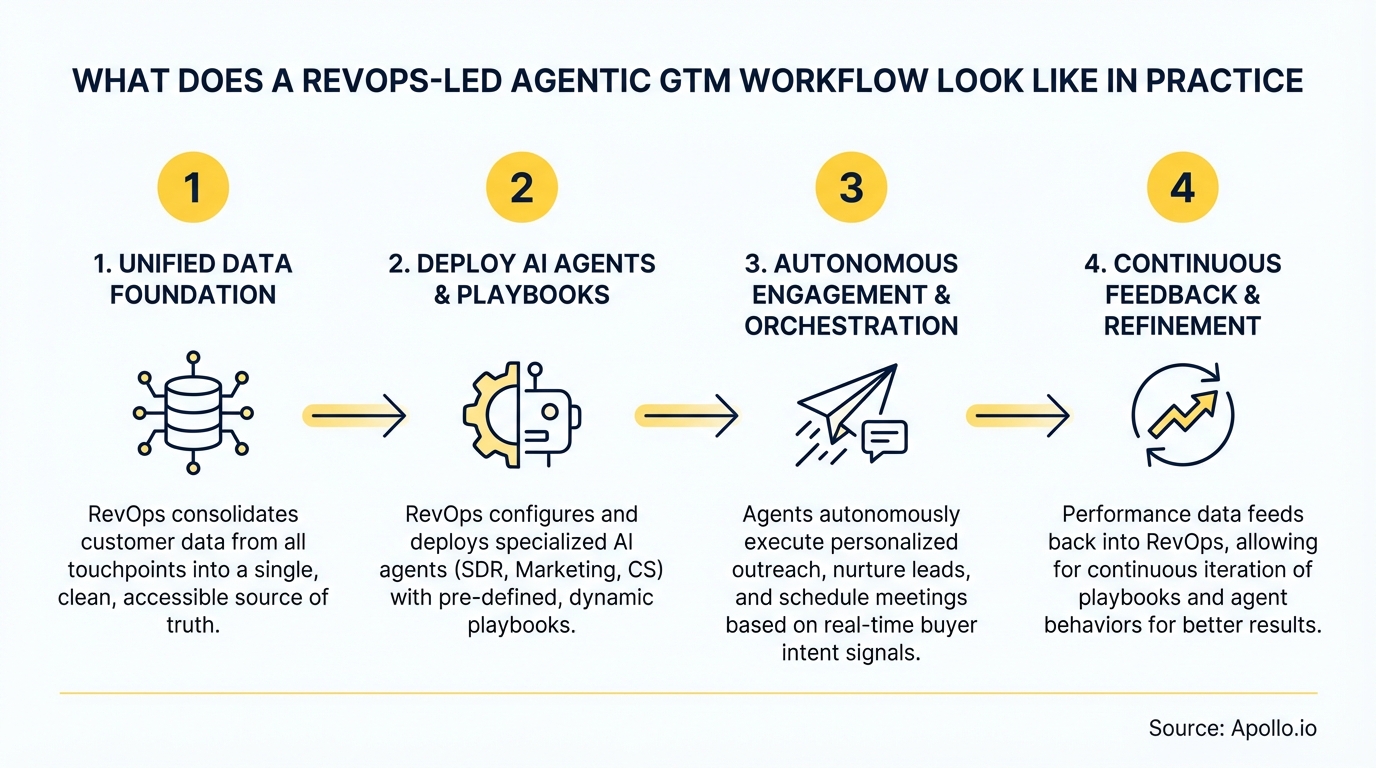
Most GTM teams run on disconnected workflows: marketing generates leads, sales works them manually, and RevOps patches the gaps with reports after the fact. A RevOps-led agentic GTM workflow changes that model entirely. It positions RevOps as the operating system, with AI agents executing across the funnel in real time, governed by rules RevOps defines. Understanding what revenue operations actually drives is the foundation before layering in agentic automation.
According to Forrester's State of Customer Obsession Survey, 2025, 88% of B2B organizations are adopting or planning to adopt AI agents. The question is no longer whether to build this, but how to build it correctly.

Apollo Turns Research Hours Into Pipeline
Tired of your reps burning the day on manual research instead of selling? Apollo delivers verified contacts instantly so your team spends time closing, not digging. Nearly 100K paying customers scaled pipeline without adding headcount.
Start Free with Apollo →Key Takeaways
- A RevOps-led agentic GTM workflow connects data, AI agents, and activation in one governed loop, not a sequence of handoffs.
- RevOps owns the rules: which agents act, what triggers them, when humans must approve, and how outcomes are logged.
- Maturity builds in three phases: Pilot (assistive AI), Scale (multi-agent orchestration), and Governed Agentic (closed-loop automation with audit trails).
- Clean ICP data is the non-negotiable foundation; agents built on dirty data produce compounding errors.
- ROI is measurable at each phase, making it easier to build a business case before committing to full deployment.
What Is a RevOps-Led Agentic GTM Workflow?
A RevOps-led agentic GTM workflow is an operating model where AI agents handle defined GTM tasks autonomously, with RevOps setting the policies, permissions, and quality gates that govern every action. It is not a chatbot layer or a single automation sequence.
Agents read and write across your CRM, enrichment tools, and engagement platforms, operating within boundaries RevOps configures.
This is the shift from systems of record to systems of action. Major platforms are already embedding this framing: agents that can update records, trigger sequences, and escalate to humans when confidence thresholds aren't met. RevOps becomes less of a reporting function and more of an "agent ops" owner. A well-designed GTM strategy defines the logic before any agent is deployed.
What Does the Reference Architecture Look Like?
The end-to-end architecture flows across five layers, each owned or governed by RevOps.
| Layer | What Happens | RevOps Role |
|---|---|---|
| Data | ICP signals, intent data, firmographics, enrichment | Define clean data standards and enrichment rules |
| Orchestration | Workflow engine triggers agents based on signals | Set trigger logic, confidence thresholds, escalation paths |
| AI Agents | Research, personalization, routing, scheduling | Approve agent permissions, define scope of action |
| Activation | Multi-channel outreach, meeting booking, deal updates | Govern messaging templates and compliance guardrails |
| Measurement | Attribution, pipeline influence, audit logs | Own closed-loop reporting and ROI gates |
As noted by IntentAmplify, RevOps professionals are increasingly leveraging data and AI for forecasting, lead scoring, and pipeline analysis, but effectiveness relies on clean data and well-defined processes. That prerequisite belongs in the Data layer before any agent is activated.
Struggling to keep your pipeline data clean and current? Start free with Apollo's 230M+ verified business contacts and build your agentic workflow on a foundation that holds.
Turn Funnel Guesswork Into Qualified Pipeline
Pipeline forecasting a guessing game because marketing leads never convert? Apollo surfaces high-intent prospects that actually close, giving your team a real-time edge. 600K+ companies stopped guessing and started growing.
Start Free with Apollo →How Do RevOps Leaders Build a Phased Maturity Model?
RevOps leaders build toward governed agentic automation in three phases, each with clear entry criteria and measurable KPIs before advancing.
- Phase 1: Pilot (Assistive AI). Agents assist reps with research and draft personalization. Humans approve all outbound. KPI: rep time saved on pre-call research; output quality score.
- Phase 2: Scale (Multi-Agent Orchestration). Agents handle ICP scoring, enrichment, routing, and sequence enrollment autonomously. RevOps reviews exception queues. KPI: pipeline sourced per agent action; sequence reply rate.
- Phase 3: Governed Agentic. Closed-loop automation with full audit trails, confidence-score gates, and human-in-the-loop escalations for high-value decisions. KPI: attributed revenue per workflow; audit pass rate.
Research from Default's AI 2025 Report shows nearly 45% of RevOps teams plan to expand AI usage across GTM workflows in the coming year. Most are still in Phase 1. The gap between piloting and governed agentic automation is where competitive advantage is built in 2026.
How Do SDRs and AEs Operate Inside an Agentic GTM Workflow?
SDRs and AEs shift from manual research and data entry to reviewing agent-prepared context and approving high-value actions. Their workflows become faster, not automated away.
For SDRs, the agentic workflow looks like this:
- An intent signal fires, triggering an agent to enrich the account against the ICP definition.
- The agent drafts a personalized first-touch sequence and routes the record to the correct SDR queue.
- The SDR reviews, approves, and launches. No manual research. No copy-pasting between tools.
For Account Executives, agents surface deal risk signals, update CRM fields after calls via the AI call assistant, and prepare pre-meeting briefs automatically. AEs spend their time on judgment calls and relationship work, not administrative tasks. This aligns with how the sales acceleration formula treats rep time as the scarce resource to protect.
Data from Pavilion's research shows AI-native companies allocate 9% of GTM headcount to RevOps, compared to just 6% in non-AI companies. The difference is RevOps roles now include AI engineers and GTM technologists who instrument the workflows SDRs and AEs operate inside.

What Governance Framework Does RevOps Need?
RevOps governs the agentic GTM workflow through four controls: permissions, confidence thresholds, audit trails, and escalation paths.
- Permissions: Define exactly what each agent can read, write, and trigger. No agent should have broader access than its task requires.
- Confidence thresholds: Set minimum confidence scores before an agent acts autonomously. Below the threshold, the action routes to a human queue.
- Audit trails: Every agent action logs who triggered it, what data was used, what was sent, and the outcome. This is non-negotiable for compliance and optimization.
- Escalation paths: High-value accounts, contract changes, or anomalous signals always route to a human. Agents flag; humans decide.
Gartner warns that a meaningful share of agentic projects will be canceled if value isn't proven early. RevOps governance is what keeps projects alive by producing audit-ready evidence of pipeline impact at every phase gate. Pair governance with Apollo's workflow automation to build observable, auditable sequences that RevOps can inspect and iterate without engineering support.
How Does a RevOps-Led Agentic GTM Workflow Drive Measurable ROI?
ROI from a RevOps-led agentic GTM workflow comes from three measurable sources: rep capacity recovered, pipeline velocity improved, and tool consolidation achieved.
| ROI Source | Baseline Metric | Agent-Driven Improvement |
|---|---|---|
| Rep research time | Hours per week on manual account prep | Agents handle enrichment and brief generation |
| Pipeline velocity | Days from signal to first touch | Agents trigger outreach within minutes of intent signal |
| Tech stack cost | Number of point tools and total spend | Unified platform replaces fragmented tools |
Tool consolidation is a documented driver. As Cyera put it: "Having everything in one system was a game changer." Census reported: "We cut our costs in half." Both outcomes trace back to RevOps making a deliberate architectural choice to unify data, engagement, and automation rather than adding another point tool. Explore how demand generation ROI compounds when the workflow is governed end-to-end rather than managed in silos.

How Do You Start Building This Workflow in 2026?
Start with the pilot phase: one workflow, one ICP segment, one measurable outcome. Build the governance layer before scaling agents, not after.
Quick-start checklist for RevOps leaders:
- Define your ICP with firmographic and behavioral criteria (see ICP framework).
- Audit your current data quality before connecting any agent to live records.
- Map one trigger-to-action workflow: intent signal fires, agent enriches, SDR queue updates.
- Set confidence thresholds and log every agent action from day one.
- Review outcomes weekly and promote to Phase 2 only when Phase 1 KPIs are met.
- Consolidate your tech stack to reduce the integration surface area agents must navigate.
Apollo's unified GTM platform gives RevOps a single workspace for data, enrichment, workflow automation, and multi-channel engagement, cutting the number of systems agents need to touch. "We reduced the complexity of three tools into one," noted Predictable Revenue. That simplicity is what makes governed agentic workflows actually governable.
Ready to build your RevOps-led agentic GTM workflow on verified data and unified automation? Try Apollo Free and give your team the platform to move from pilot to governed agentic, without the fragmented stack that slows everything down.
Prove Pipeline ROI With Apollo
ROI pressure killing your next budget approval? Apollo delivers measurable pipeline impact from day one — no guesswork, no waiting. Leadium 3x'd annual revenue. You're next.
Start Free with Apollo →Don't miss these
Sales
Inbound vs Outbound Marketing: Which Strategy Wins?
Sales
What Is a Sales Funnel? The Non-Linear Revenue Framework for 2026
Sales
What Is a Go-to-Market Strategy? The 2026 GTM Playbook
See Apollo in action
We'd love to show how Apollo can help you sell better.
By submitting this form, you will receive information, tips, and promotions from Apollo. To learn more, see our Privacy Statement.
4.7/5 based on 9,690 reviews
