
What Does a GTM Engineer's Day-to-Day Workflow Look Like at a Scaling B2B Company?
A GTM Engineer's day-to-day workflow at a scaling B2B company centers on one thing: turning revenue strategy into a running system. Not attending standups. Not babysitting API connections. Building, measuring, and compounding a GTM engine that produces pipeline without constant human intervention. Understanding this role clearly matters — especially now that GTM Engineer has become one of the fastest-growing functions in B2B sales.
According to Rio Grande Guardian, GTM Engineering jobs grew 205% in 2025 compared to 2024, with over 3,000 open postings in January 2026 alone. That hiring spike signals something important: companies are no longer treating GTM workflow as an ad-hoc side project. It is becoming a core operational capability — and the role is standardizing around it.

Let Apollo Find Your Next Deal
Tired of burning hours on manual research just to get a bounced email? Apollo surfaces verified contacts instantly so your reps spend time selling, not searching. Join 600K+ companies building pipeline on autopilot.
Start Free with Apollo →Key Takeaways
- A GTM Engineer is a revenue strategist, not a systems integrator — the job is designing execution velocity, not collecting tools.
- The daily workflow follows a repeatable loop: TAM maintenance, scoring review, enrichment QA, sequence performance, and signal tuning.
- Cross-functional alignment is a core output — GTM Engineers connect sales, marketing, and customer success around shared data and KPIs.
- AI adoption in GTM workflows is concentrating first in reporting and measurement, making data governance a daily priority.
- The trajectory is toward agentic GTM — where the system runs autonomously and the engineer's job shifts to strategy and optimization.
What Does a GTM Engineer Actually Do Day to Day?
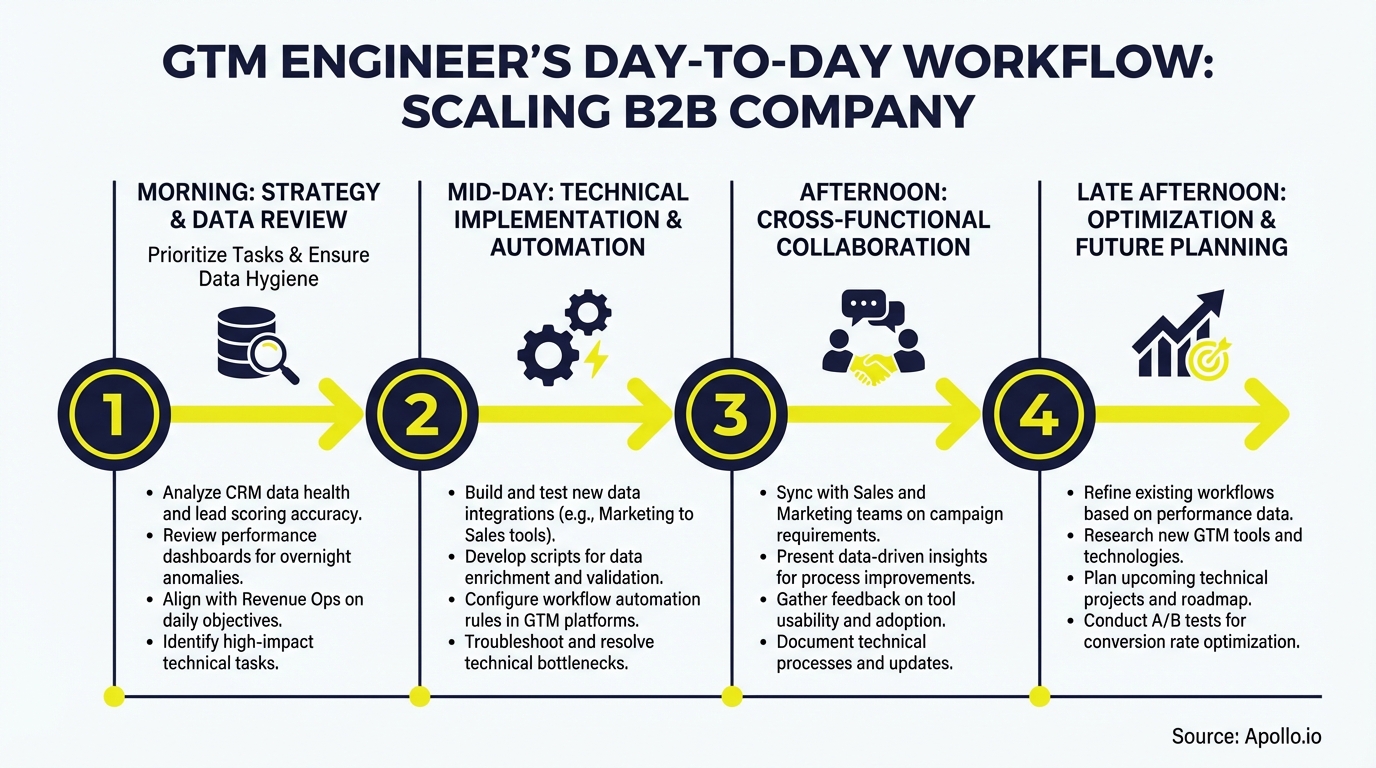
A GTM Engineer builds and operates the systems that connect go-to-market strategy to daily execution across sales, marketing, and revenue operations. The daily workflow is not random. It follows a structured loop: intake new requests, build or tune workflow components, validate data quality, and measure signal-to-outcome correlations.
The biggest misconception is that this role exists to stitch tools together. Many GTM Engineers wear a badge of honor around how many disparate systems they have connected — and call it a "seamless workflow." Seamless and a 14-tool Frankenstack are an oxymoron.
The best GTM Engineers are revenue strategists who design elegant execution systems, not tool sommeliers who collect integrations.
| Workflow Area | Daily Activity | Owner |
|---|---|---|
| TAM & Data | Enrichment QA, field governance, deduplication | GTM Engineer / RevOps |
| Scoring | Review signal weights, flag scoring outliers | GTM Engineer |
| Sequences | Monitor reply rates, approve AI-drafted messages | GTM Engineer / SDRs |
| Routing | Test lead routing rules, resolve assignment errors | GTM Engineer / RevOps |
| Reporting | Update dashboards, run correlation analysis | GTM Engineer |
How Does the GTM Engineer's Weekly Cadence Work?
The GTM Engineer's week runs like a sprint board, not an ops queue. Each week has defined rituals across intake, build, QA, and measurement — ensuring that work compounds rather than resets every quarter.
- Monday: Review intake queue (new automation requests, data quality flags, workflow change requests). Prioritize by revenue impact.
- Tuesday–Wednesday: Build sprint — workflow configuration, enrichment automation, scoring model updates, sequence assembly.
- Thursday: QA pass — test routing logic, validate enrichment fallbacks, audit deliverability metrics (bounce rates, domain health).
- Friday: Measurement review — pull signal-to-outcome data, adjust scoring weights, prepare weekly performance summary for leadership.
The monthly cadence adds a scoring model tuning session and messaging architecture review. Quarterly, the GTM Engineer refreshes the TAM list, prunes underperforming signals, and realigns priorities with leadership strategy. As ATAK Interactive notes, GTM Engineers bridge the gap between sales, marketing, and customer success — ensuring these teams operate with shared data and aligned KPIs, not competing spreadsheets.
Turn Funnel Guesswork Into Pipeline Wins
Tired of watching quality leads stall before they ever reach your pipeline? Apollo surfaces verified, in-market buyers so your team stops chasing cold contacts and starts closing. Nearly 100K paying customers already know what their next deal looks like.
Start Free with Apollo →What Do RevOps Leaders and SDRs Each Need from a GTM Engineer?
RevOps leaders need the GTM Engineer to own system reliability — scoring model accuracy, data hygiene, routing logic, and attribution governance. SDRs need the GTM Engineer to surface high-priority accounts with pre-researched context, so their day starts with judgment calls instead of list-building.
The handoff between the GTM Engineer and SDRs is where most scaling teams break down. The GTM Engineer builds the human-in-the-loop (HITL) workflow: AI researches and drafts, SDRs review top-scored accounts, approve or refine messages, and route approved touches into sequences.
SDRs stop spending hours on research and data entry. They spend their time on relationships and conversations that close deals.
Struggling to give your SDRs pre-qualified accounts with verified contacts? Search Apollo's 230M+ contacts with 65+ filters to build your TAM and surface the right accounts automatically.

How Does Data Governance Fit Into the Daily Workflow?
Data governance is not a quarterly project — it is a daily GTM engineering responsibility. Field definitions, enrichment fallbacks, deduplication logic, and CRM sync hygiene all require ongoing attention.
A broken enrichment workflow silently corrupts scoring. A misconfigured routing rule sends high-value accounts to the wrong rep.
Research from Bloomberry's analysis of 1,000 GTM Engineering job postings confirms the role's rapid growth, underscoring that data orchestration and enrichment are now core competencies — not supporting tasks. The goal is seamless data flow across the entire tech stack, eliminating manual work that slows execution. For GTM Engineers building these pipelines, Apollo's data enrichment provides verified contact and company data that flows directly into scoring and sequencing workflows — without manual exports.
Understanding intent data is increasingly central to this work. GTM Engineers now govern how intent signals enter the scoring model, validate AI-generated summaries before they trigger plays, and measure downstream lift from intent-based routing decisions.
How Does AI Change the GTM Engineer's Daily Responsibilities?
AI is entering the GTM workflow unevenly — concentrating first in reporting and evaluation, then expanding into outreach and research. The GTM Engineer's job is not to generate AI content.
It is to govern AI outputs, harden the data pipelines that feed them, and measure whether AI-assisted touches actually convert.
The practical day-to-day shift looks like this: instead of pulling intent reports manually, the GTM Engineer validates AI-generated intent summaries, routes triggered plays to the right reps, and tracks downstream pipeline lift. Instead of writing sequences, the GTM Engineer configures prompt architecture that generates persona-specific messaging from scoring signals — and monitors whether those messages produce replies.
The trajectory is clear: agentic GTM, where the system runs the find-enrich-score-sequence-measure loop autonomously. The GTM Engineer who wins long-term is not the one who builds the most elaborate workflow. It is the one who deploys the most elegant strategy at the highest velocity. Apollo's GTM Engineering (GTME) Program is built around this principle — collapsing the fragmented stack into one end-to-end workflow across TAM, scoring, messaging, and reporting. For teams ready to operationalize this approach, the GTME methodology provides the seven-pillar framework that makes it systematic.
The B2B marketing metrics that matter most to revenue leaders — pipeline contribution by segment, time-to-meeting by account score, reply rate by signal tier — are exactly what a well-instrumented GTM engineering workflow should surface automatically.

What Does an Effective GTM Engineer's Workflow Produce?
An effective GTM engineering workflow produces four measurable outcomes: complete TAM visibility, evergreen account prioritization, AI-assisted outreach with human review, and self-optimizing scoring based on real conversion data.
Organizations that establish this kind of structured RevOps and GTM function see measurable revenue impact. According to Partner2B's analysis of Deloitte research, organizations with a firmly established RevOps model are 1.4 times more likely to exceed revenue targets by 10% or more. The GTM Engineer is the architect of that model at the execution layer.
For teams building or scaling this function, understanding the full B2B sales funnel and where GTM engineering interventions produce the highest leverage is the starting point — not the tooling decision.
How Should Your Team Start Building This Workflow?
A scaling B2B company should operationalize the GTM Engineer workflow in phases: start with TAM unification and scoring model design, then layer in enrichment automation and sequence infrastructure, then add HITL review workflows and measurement dashboards. Each phase compounds on the last.
The anti-pattern is starting with tool selection. The right starting point is strategy: who is your total addressable market, what signals predict a win, and what does your messaging need to communicate to each persona.
Tools serve that strategy. Apollo's platform consolidates the core workflow — data, scoring, sequencing, and reporting — into one system, so GTM Engineers spend their time on strategy and optimization rather than API maintenance.
As Cyera's team put it: "Having everything in one system was a game changer."
Ready to build a GTM engine that runs without constant manual intervention? Schedule a Demo and see how Apollo's platform supports the full GTM Engineering workflow — from TAM to pipeline.
Apollo Turns ROI Doubt Into Revenue Proof
ROI pressure killing your tool budget before it even starts? Apollo delivers measurable pipeline impact fast — Leadium 3x'd annual revenue, Built-In added 10% win rate. Start free today.
Start Free with Apollo →Don't miss these
Sales
Inbound vs Outbound Marketing: Which Strategy Wins?
Sales
What Is a Sales Funnel? The Non-Linear Revenue Framework for 2026
Sales
What Is a Go-to-Market Strategy? The 2026 GTM Playbook
See Apollo in action
We'd love to show how Apollo can help you sell better.
By submitting this form, you will receive information, tips, and promotions from Apollo. To learn more, see our Privacy Statement.
4.7/5 based on 9,690 reviews
