
What a Fully Autonomous AI-Driven GTM Motion Looks Like in Practice
A fully autonomous AI-driven GTM motion is not a single tool or workflow. It is a coordinated system where AI agents handle prospecting, outreach, qualification, content delivery, and pipeline management with minimal human intervention, while humans own strategy, governance, and relationship decisions. Understanding what a go-to-market strategy requires is the foundation before any autonomy layer is added.
According to GM Insights, the global autonomous AI and autonomous agents market was valued at $6.8 billion in 2024 and is projected to reach $93.7 billion by 2034. The revenue opportunity is real, but so is the execution risk. A Gartner prediction from June 2025 warns that over 40% of agentic AI projects could be canceled by end of 2027 due to cost and value challenges.

Let Apollo Do the Digging For You
Tired of reps burning half their day on manual research instead of selling? Apollo surfaces verified contacts instantly, so your team spends time closing — not copy-pasting. Join 600K+ companies building pipeline faster.
Start Free with Apollo →Key Takeaways
- A fully autonomous GTM motion combines AI agents for prospecting, outreach, and pipeline tasks, with humans focusing on strategy and governance.
- Autonomy must be phased: assistive first, then semi-autonomous, then supervised autonomy, with governance gates at every stage.
- Data quality is the bottleneck, not model quality. Bad enrichment data amplifies errors at scale.
- Buyer-group orchestration matters more than single-lead targeting. Most B2B purchases involve multiple decision-makers simultaneously.
- ROI measurement and closed-loop telemetry separate successful agentic GTM programs from canceled ones.
What Does a Fully Autonomous AI-Driven GTM Motion Look Like in Practice?
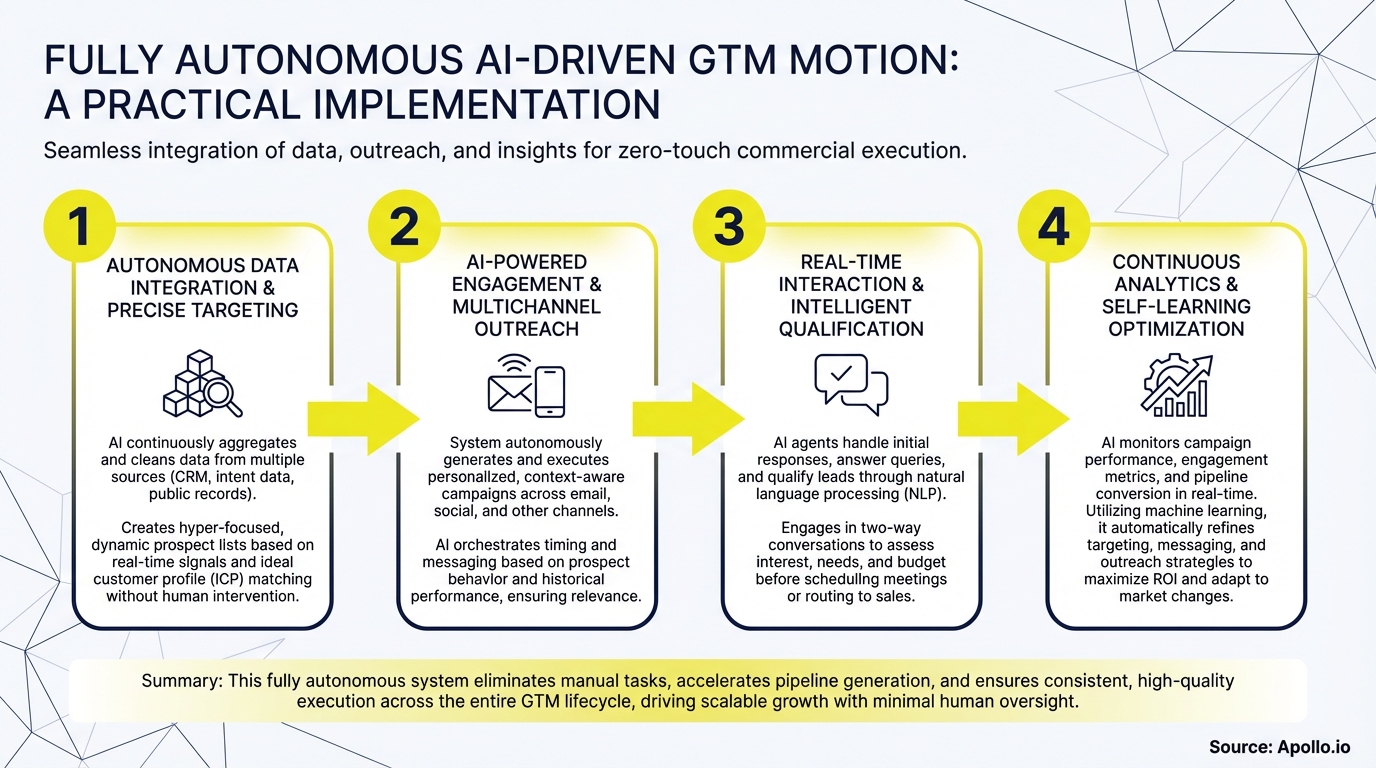
A fully autonomous AI-driven GTM motion in practice means AI agents execute the entire top-of-funnel workflow: identifying accounts that match your ideal customer profile, enriching contact data, launching personalized multi-channel sequences, qualifying responses, booking meetings, and logging everything to CRM, without a rep touching each step manually.
This is distinct from AI-assisted GTM, where humans use AI tools to speed up individual tasks. In an autonomous motion, agents operate workflows end-to-end.
Humans set parameters, review exceptions, and own the relationships once a prospect engages.
| Maturity Stage | What AI Does | Human Role |
|---|---|---|
| Assistive | Drafts emails, suggests contacts | Approves every action |
| Semi-Autonomous | Runs sequences, logs CRM updates | Reviews exceptions and escalations |
| Supervised Autonomy | Prospects, qualifies, books meetings | Sets rules, audits outputs weekly |
| Constrained Autonomy | Orchestrates full funnel within guardrails | Strategic decisions and governance |
How Does the End-to-End Operating Model Work by Funnel Stage?
The autonomous GTM operating model assigns specific AI agent functions to each funnel stage, mapped to the buyer group, not just a single lead. Research shows that most B2B purchases involve groups of multiple decision-makers, which means autonomous orchestration must target multiple personas simultaneously with coordinated messaging rather than a single contact sequence.
- Awareness: Intent signal detection triggers account-level targeting. Agents launch persona-specific content to all identified stakeholders at the account.
- Consideration: AI personalizes outreach based on role, seniority, and prior engagement. Demand generation sequences run across email, phone, and social channels automatically.
- Qualification: Agents score responses, update lead status, and route high-intent signals to AEs for human follow-up.
- Conversion: Meeting scheduling, pre-call research, and CRM opportunity creation happen without rep involvement.
Spending hours on manual prospecting across multiple personas? Automate your multi-channel sequences with Apollo's sales engagement platform and let AI handle the orchestration.
What Governance and QA Gates Are Required for Autonomous GTM?
Governance is what separates a successful autonomous GTM program from a canceled one. Without write-permission controls, approval workflows, and audit trails, AI agents can amplify bad data, damage brand reputation, or trigger compliance incidents at scale.
Essential governance components include:
- Data access controls: Agents can only act on verified, enriched records. Stale or unverified contacts are quarantined before agents touch them.
- Brand and messaging QA gates: All outbound copy passes tone, compliance, and personalization checks before sending. RevOps leaders typically own these thresholds.
- Stage-exit criteria: Each autonomy level requires documented performance benchmarks before the team advances. No skipping stages based on enthusiasm alone.
- Escalation and rollback rules: Agents flag anomalies (bounce spikes, negative sentiment, opt-outs) and pause sequences pending human review.
- Account-level suppression lists: Named accounts, existing customers, and sensitive verticals are excluded from autonomous outreach automatically.
Fill Your Funnel With Buyers Who Convert
Running out of qualified leads before the quarter ends? Apollo surfaces in-market prospects aligned to your ICP, so your pipeline stays full — not just busy. Nearly 100K paying customers use Apollo to turn outreach into revenue.
Start Free with Apollo →How Do SDRs and RevOps Teams Fit Into an Autonomous GTM Motion?
SDRs shift from manual prospecting and sequence management to exception handling, relationship escalation, and account strategy when an autonomous GTM motion is fully operational. This is not a headcount reduction story.
It is a leverage story: SDRs handle more accounts at higher quality because agents handle the volume tasks.
For RevOps leaders, the autonomous GTM motion creates a new operational responsibility: data pipeline health. Revenue operations teams own the enrichment SLAs, intent signal freshness, and CRM hygiene that agents depend on. Bad data is amplified by autonomous systems, so RevOps becomes the quality control layer.
According to Cirrus Insight, citing Bain and Company research from 2025, early AI deployments have boosted win rates by over 30%. That lift requires both the autonomous execution layer and the governance layer working together.
Struggling to keep your pipeline data clean enough for agents to act on? Enrich and verify your contacts with Apollo's 230M+ person database before your agents touch a single record.

How Do You Measure ROI and Optimize a Fully Autonomous GTM Motion?
Closed-loop telemetry is what keeps an autonomous GTM program from getting canceled. Every agent action must be tied to a measurable outcome so teams can attribute pipeline impact, run controlled experiments, and justify continued investment.
Core metrics to instrument from day one:
- Meeting-to-opportunity conversion rate: Baseline before agents launch, compare after.
- Sales cycle length:GetMichaelAI reports that companies fully integrating AI into their sales process see a 22% shorter sales cycle on average.
- Pipeline coverage ratio: Track total pipeline generated per rep equivalent to understand leverage.
- Sequence performance by persona: Which buyer roles respond? Which stages drop off? Agents use this data to adjust targeting.
- CAC and ACV trends: Monitor ACV and customer acquisition cost over time to validate that automation is improving unit economics, not just volume.
Run holdout groups (accounts receiving human-only outreach vs. agent-driven outreach) to isolate the true lift from autonomous execution. This is the evidence base that protects the program budget when leadership asks for proof.
What Does a Practical Implementation Roadmap Look Like in 2026?
A practical autonomous GTM implementation roadmap in 2026 follows a phased sequence tied to governance readiness, not tool availability. Most teams that fail skip the assistive stage and deploy agents before their data and process foundations are solid.
| Phase | Timeline | Key Deliverable | Exit Criteria |
|---|---|---|---|
| 1. Foundation | Weeks 1-4 | ICP definition, data enrichment, CRM hygiene | 90%+ contact coverage on target accounts |
| 2. Assistive Pilot | Weeks 5-8 | AI-drafted sequences, human approval on every send | Positive reply rate benchmark established |
| 3. Semi-Autonomous | Weeks 9-16 | Agents run sequences within approved templates | Conversion parity with human baseline |
| 4. Supervised Autonomy | Month 5+ | Full funnel orchestration with exception escalation | Measurable pipeline lift, CAC improvement |
The GTM strategy layer must be locked before the automation layer is deployed. Agents execute strategy. They do not create it. Teams that deploy agents before defining their ideal customer profile, messaging hierarchy, and buyer-group structure will automate the wrong motion at scale.
Data from Insight Mark Research shows that by the end of 2025, 95% of B2B organizations are either using or planning to use some form of AI tool, confirming that the competitive baseline is shifting rapidly. Teams still operating manual-only GTM motions will face compounding disadvantages as autonomous competitors outpace them on volume and personalization simultaneously.

How Do You Build a Fully Autonomous AI-Driven GTM Motion With Apollo?
Apollo provides the unified platform that makes autonomous GTM practical without stitching together five separate tools. As Predictable Revenue noted, "We reduced the complexity of three tools into one." Apollo combines verified contact data (230M+ people, 30M+ companies), AI-powered sequencing, workflow automation, meeting scheduling, and deal management in one workspace, giving agents a single system of record to operate from.
For teams building toward autonomous GTM, the consolidation benefit is operational, not just financial. Fewer integrations means fewer data sync failures, fewer permission conflicts, and fewer surfaces where agent actions can break. "Having everything in one system was a game changer," noted Cyera in their Apollo case study.
Apollo's workflow automation engine and AI sales automation let teams progress through each maturity stage, from assistive to supervised autonomy, without changing platforms mid-journey. Apollo also supports enterprise GTM teams with advanced routing, governance controls, and admin permissions that scale with the program.
Ready to build your autonomous GTM motion on a unified platform? Schedule a Demo and see how Apollo's AI-driven platform supports every stage from ICP definition to closed-loop pipeline optimization.
Prove Pipeline ROI Before Next Budget Review
ROI pressure killing your tool adoption? Apollo delivers measurable pipeline outcomes your exec team can actually see — not vanity metrics. Leadium 3x'd their revenue. Start yours free.
Start Free with Apollo →Don't miss these
Sales
Inbound vs Outbound Marketing: Which Strategy Wins?
Sales
What Is a Sales Funnel? The Non-Linear Revenue Framework for 2026
Sales
What Is a Go-to-Market Strategy? The 2026 GTM Playbook
See Apollo in action
We'd love to show how Apollo can help you sell better.
By submitting this form, you will receive information, tips, and promotions from Apollo. To learn more, see our Privacy Statement.
4.7/5 based on 9,690 reviews
