
How to Run a 90-Day AI SDR Pilot and Measure Success
A 90-day AI SDR pilot is a time-boxed experiment that validates whether AI-assisted outbound can improve SDR productivity, pipeline quality, and cost-per-outcome before committing to full-scale deployment. Done right, it produces a clear go/no-go signal backed by data, not anecdotes. Tools like Apollo's AI Sales Assistant make this easier by consolidating prospecting, research, sequencing, and scoring into one workflow-native platform, so SDRs spend less time switching tools and more time selling.
The most common pilot mistake is measuring only volume (emails sent, meetings booked) while ignoring quality (show rate, meeting-to-opportunity conversion, pipeline created). This article gives you a measurement-first, governance-forward blueprint for all 90 days.

Research Less, Pipeline More With Apollo
Tired of burning hours verifying contact info instead of selling? Apollo delivers 230M+ accurate business contacts so your team spends time closing, not digging. Start building real pipeline today.
Start Free with Apollo →Key Takeaways
- Start with a narrow scope: one ICP segment, one workflow, and two or three measurable KPIs tied to pipeline outcomes.
- Separate efficiency metrics (speed, volume) from effectiveness metrics (reply rate, SQL rate, pipeline created) and track both from day one.
- Build a holdout group so you can prove incrementality, not just activity lift.
- Success metrics are shifting from raw meetings booked to meeting quality and downstream conversion, because volume is easy to inflate with automation.
- Governance guardrails (audit logs, CRM logging integrity, sender reputation controls) are core pilot workstreams, not afterthoughts.
What Should a 90-Day AI SDR Pilot Include at the Start?
A well-scoped pilot begins in days 1-7 with clear objective setting focused on a single pain point or a few key metrics such as increasing lead volume, reducing costs, or improving efficiency, as outlined in the Think Technologies Group AI Pilot Playbook. Resist the urge to boil the ocean.
Define these elements before anything else:
- ICP segment: One vertical or persona (e.g., VP Sales at 50-500 person SaaS companies)
- Pilot cohort: 2-4 SDRs on AI-assisted workflows vs. a holdout group running standard process
- Tooling: Lock in your stack. Consolidating into a unified platform avoids integration noise that obscures results.
- Baseline metrics: Pull 30-60 days of pre-pilot data on touches per rep, reply rate, meetings booked, and SQL rate
- MQL/SQL definitions: Document these before launch. Changing definitions mid-pilot invalidates comparisons.
Struggling to build clean prospect lists for your pilot cohort? Search Apollo's 230M+ contacts with 65+ filters to find exactly the right ICP match from day one.
What Is the Week-by-Week 90-Day Rollout Plan?
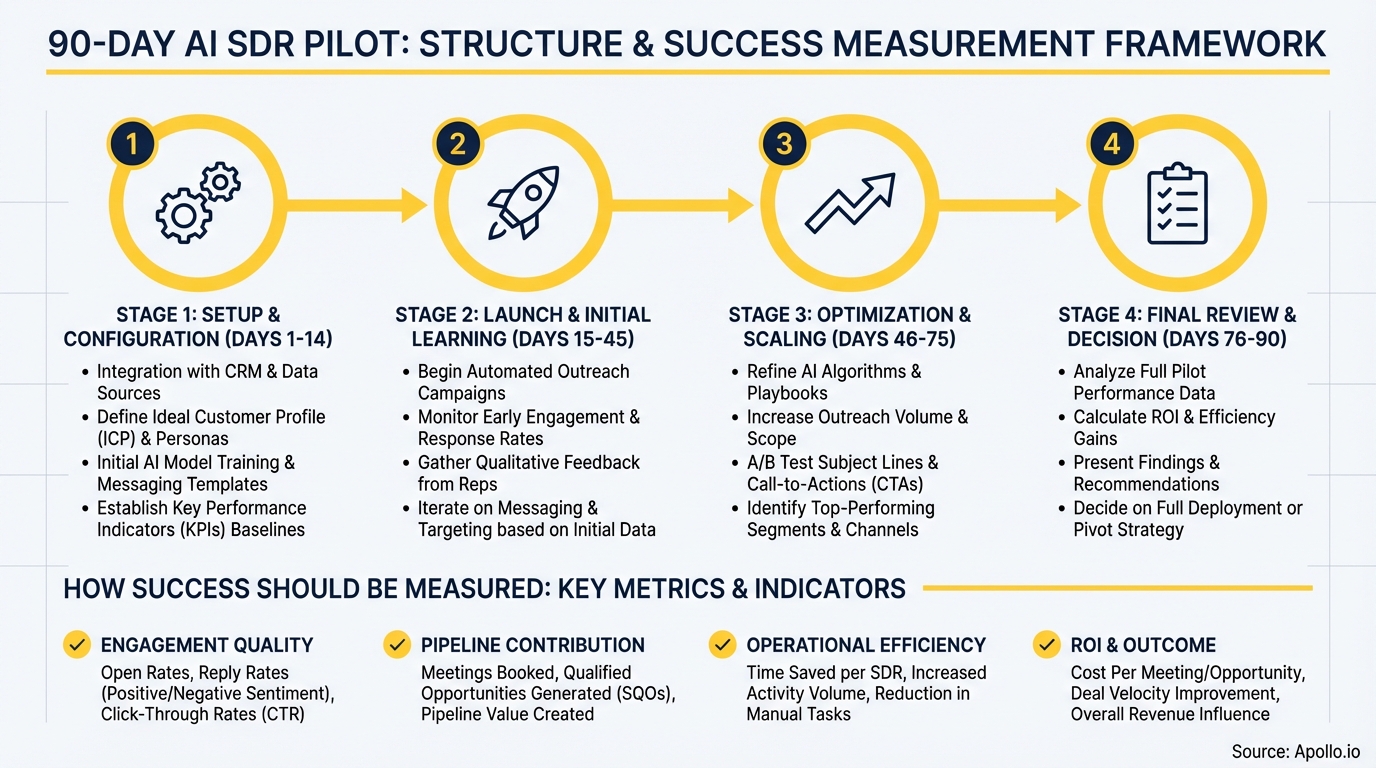
A 90-day AI SDR pilot runs best in three 30-day phases, each with a distinct focus and exit criteria.
| Phase | Days | Focus | Key Milestones |
|---|---|---|---|
| Foundation | 1-30 | Setup, baseline, first campaign | ICP defined, AI Content Center configured, first sequence live, domain warming initiated |
| Optimization | 31-60 | Iterate on messaging, score and prioritize | A/B test results reviewed, scoring model calibrated, first qualified meetings logged |
| Evaluation | 61-90 | Measure outcomes, build go/no-go case | SQL rate and pipeline value vs. holdout confirmed, unit economics calculated, scale recommendation documented |
Domain warming and inbox placement monitoring belong in Phase 1, not Phase 3. Deliverability is a gating factor for any outbound pilot, and sender reputation problems discovered late can invalidate 60 days of data.
Turn Funnel Guesswork Into Real Pipeline
Tired of watching marketing leads stall before they ever reach your pipeline? Apollo surfaces high-intent prospects and keeps your funnel moving with 230M+ verified contacts. Top sales teams close with confidence, not guesswork.
Start Free with Apollo →How Should SDRs and RevOps Measure AI SDR Pilot Success?
Pilot success requires two distinct metric layers: efficiency (are reps doing more?) and effectiveness (is more of it converting?). Tracking only one layer gives a misleading picture.
According to MarketBetter.ai's 2026 B2B Sales Meta-Analysis, AI SDRs convert meetings to opportunities at 15% compared to human SDRs at 25% in certain scenarios, a gap that highlights why quality metrics matter alongside volume metrics.
| Metric Type | Metric | Why It Matters |
|---|---|---|
| Efficiency | Touches per rep per week | Baseline productivity lift |
| Efficiency | Time-to-first-touch | Speed of ICP engagement |
| Effectiveness | Reply rate | Message relevance signal |
| Effectiveness | Meeting show rate | Quality of booked meetings |
| Effectiveness | Meeting-to-SQL rate | Downstream funnel conversion |
| Unit Economics | Cost per qualified meeting | ROI and scale decision input |
| Unit Economics | Pipeline created ($) | Business impact of the pilot |
For RevOps leaders, revenue operations owns the measurement architecture here. Define your holdout group before the pilot starts, track the same metrics for both cohorts, and compare at day 90. Without a holdout, you cannot prove incrementality.
Data from Optif.ai indicates that improved personalization through AI can increase email reply rates by 3.2x, making reply rate one of the most sensitive early signals to monitor in Phase 1.
What Governance and Risk Controls Does an AI SDR Pilot Need?
Governance is not optional in a 90-day pilot. According to Everworker.ai, prioritizing tools with audit logs, SOC2 coverage, and seat-level controls is crucial for data security when deploying AI SDR tooling at scale.
Build these controls before day one:
- CRM logging integrity: Every AI-generated touch must log to CRM automatically. Manual logging introduces gaps that corrupt attribution data.
- Brand safety review: Approve all AI-generated message templates before sequences go live. Spot-check personalization outputs weekly.
- Sender reputation monitoring: Track bounce rate, spam complaint rate, and inbox placement from week one. Treat these as pilot health metrics.
- Credit and usage governance: Set per-seat credit limits and review weekly. GenAI spend is growing fast and pilots can overshoot budgets without guardrails.
- Routing SLAs: Define how quickly AEs must accept or reject AI-sourced SQLs. Acceptance rate is a quality signal for the pilot.
For teams using sales automation platforms, built-in audit logs and SOC2 coverage (as Apollo provides) reduce the governance overhead significantly.

How Do SDRs Run AI-Assisted Outbound That Actually Converts?
SDRs get the most from an AI SDR pilot when the AI is embedded in their existing workflow, not bolted on as a separate tool. Apollo's Outbound Copilot automates ICP list building, adds matched prospects to sequences automatically, and generates multi-channel sequences (email, call, and social) from a single prompt, so SDRs focus on conversations rather than copy-pasting between tools.
Effective AI-assisted outbound in a pilot follows this pattern:
- Configure the AI Content Center with your value prop, ICP pain points, and differentiators. This grounds every AI-generated message in real business context rather than generic copy.
- Use AI Research to surface account-level signals (funding, headcount changes, tech stack) before a rep touches a prospect.
- Score and tier accounts using Apollo's Scores before adding them to sequences. SDRs should work Excellent and Good-scored accounts first.
- Run A/B tests on subject lines and openers in Phase 2. Small copy changes often produce the largest reply rate swings.
As Erik Fernando Nieto, BDR at JumpCloud, put it: "Apollo's AI Assistant filters and cleans prospect data for me, so I can find the right people faster and run better searches. It saves me about an hour per prospecting session."
Spending too much time building sequences manually? Automate your multichannel sequences with Apollo's AI-powered sales engagement platform and let your SDRs focus on conversations.
As noted in the sales acceleration formula, the biggest lever is not sending more emails but improving the quality of each interaction. AI research and personalization are the primary mechanisms for that quality lift in a pilot context.

What Does Day 90 Look Like and How Do You Decide to Scale?
Day 90 is a structured go/no-go decision, not a retrospective. Bring these outputs to the evaluation meeting:
- Efficiency delta: pilot cohort vs. holdout group (touches, time-to-first-touch)
- Effectiveness delta: reply rate, show rate, SQL rate, pipeline created
- Unit economics: cost per qualified meeting for AI-assisted vs. standard workflow
- Governance scorecard: CRM logging accuracy, brand safety incidents, sender reputation health
- AE acceptance rate: what percentage of AI-sourced SQLs did AEs accept and advance?
As Qualified.com notes, continuous iteration throughout the 90 days through regular review of metrics and continuous adjustment of strategies is essential for optimizing outcomes. The teams that reach day 90 with clean data are those that reviewed metrics bi-weekly and adjusted, not those that set the pilot and waited.
Scale if: AI cohort shows a statistically meaningful lift on at least two effectiveness metrics AND cost per qualified meeting is equal to or better than the baseline. Pause if: reply rate or show rate is lower than baseline, or CRM logging integrity is below an acceptable threshold.
Connecting your pilot results to broader sales transformation goals makes the go/no-go case easier to present to leadership with clear ROI framing.
Ready to Run Your 90-Day AI SDR Pilot?
A 90-day AI SDR pilot succeeds when it is scoped tightly, measured rigorously, and governed proactively. The goal is not to prove AI works in theory but to prove it works in your workflow, with your ICP, at a cost-per-outcome that justifies scale.
Apollo consolidates prospecting, AI research, sequencing, scoring, and conversation intelligence into one platform, so your pilot data reflects actual workflow impact, not integration overhead. Teams like Cyera have found that "having everything in one system was a game changer" for measuring and scaling outbound performance.
Learn more about running end-to-end AI-assisted outbound in the AI Assistant to Sell Smarter guide, or explore how Apollo's full AI feature set maps to each phase of your pilot.
Start a Trial and launch your 90-day AI SDR pilot with a platform built for measurable, scalable outbound from day one.
Prove Pipeline ROI With Apollo
Budget approval stuck on unclear metrics? Apollo delivers measurable pipeline impact from day one — so you walk into every renewal conversation with hard numbers. Leadium 3x'd their annual revenue. You're next.
Start Free with Apollo →Don't miss these
Sales
Inbound vs Outbound Marketing: Which Strategy Wins?
Sales
What Is a Sales Funnel? The Non-Linear Revenue Framework for 2026
Sales
What Is a Go-to-Market Strategy? The 2026 GTM Playbook
See Apollo in action
We'd love to show how Apollo can help you sell better.
By submitting this form, you will receive information, tips, and promotions from Apollo. To learn more, see our Privacy Statement.
4.7/5 based on 9,690 reviews
