
What Criteria Should You Use to Find High-Value B2B Leads in 2026?
Most B2B pipeline problems aren't volume problems. They're quality problems. According to Leads at Scale, poor lead qualification is responsible for 67% of lost sales in B2B, and 79% of marketing-generated leads never convert into sales. Chasing the wrong leads wastes your team's most limited resource: time.
The fix isn't more leads. It's smarter criteria. This guide gives you a practical, research-backed framework for identifying high-value B2B leads, including a weighted scorecard, intent hygiene principles, and buying-group signals that SDRs, AEs, and RevOps teams can implement immediately. You can also find B2B leads by title, industry, or company to start applying these filters right away.

Build Pipeline From Verified Data
Tired of burning hours on research that leads nowhere? Apollo surfaces accurate contacts so your team spends time selling, not searching. Nearly 100K paying customers trust Apollo to turn slow lead gen into scalable pipeline.
Start Free with Apollo →Key Takeaways
- High-value leads require a weighted score combining firmographic fit, behavioral signals, intent data, and buying-group coverage, not just job title and company size.
- Intent data is only reliable when validated against ICP fit, recency, and multi-source confirmation. Single-signal intent creates false positives.
- Tightening qualification criteria typically reduces MQL volume but significantly improves MQL-to-opportunity conversion rates.
- Buying-group mapping is essential: engaging only one stakeholder at a target account substantially reduces win probability.
- Your ICP should be derived from closed-won data, not assumptions. Teams that audit real deals routinely discover their theoretical ICP was inaccurate.
What Makes a B2B Lead "High-Value"?
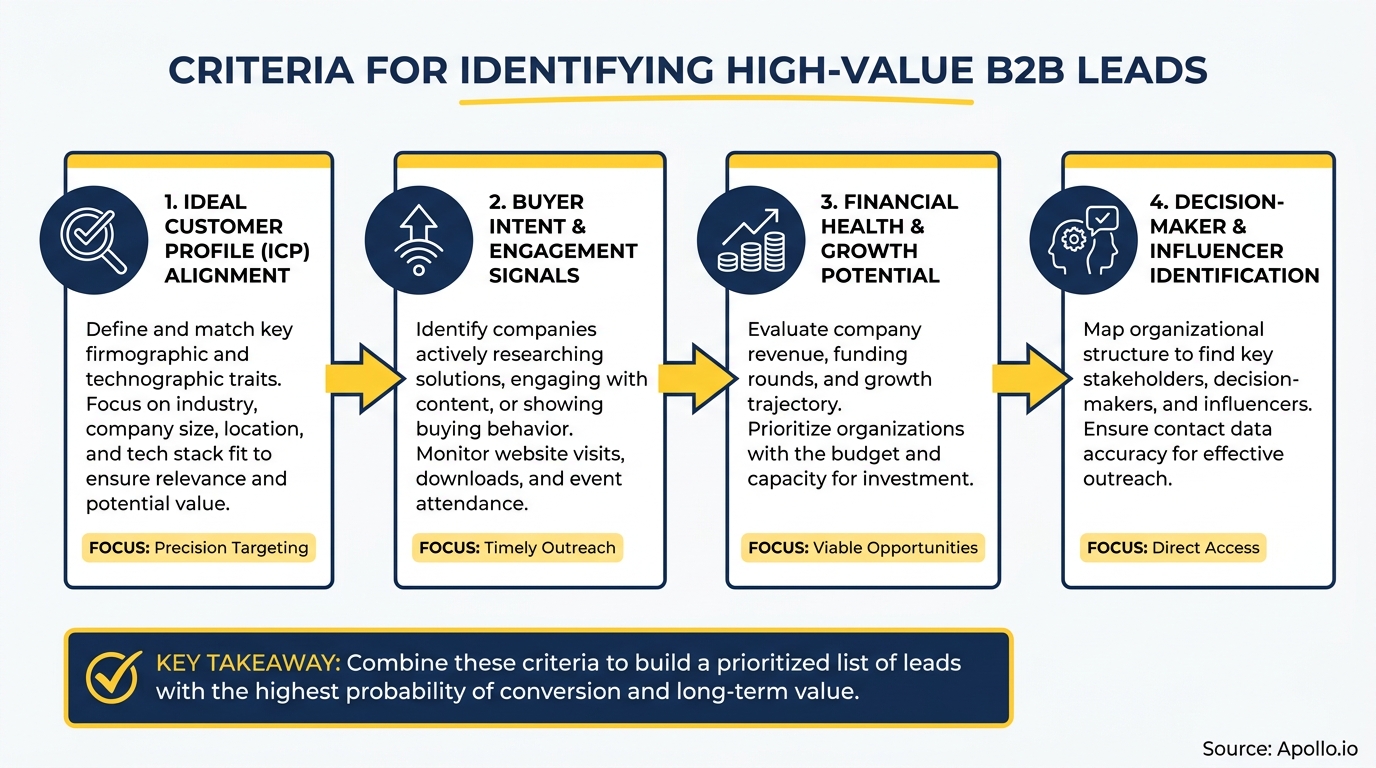
A high-value B2B lead is one that matches your Ideal Customer Profile, shows active buying signals, and includes stakeholders with budget authority and a genuine need your solution addresses. Firmographic fit alone is not enough.
According to Cirrus Insight, lead generation is the top priority for 91% of B2B marketers. Yet most teams still rely on surface-level criteria like industry and company size, ignoring the behavioral and intent signals that separate active buyers from passive contacts.
High-value leads share four common characteristics:
- ICP firmographic fit: Industry, company size, revenue range, geography, and tech stack alignment
- Active buying signals: Pricing page visits, competitor comparisons, ROI content consumption
- Intent confirmation: Third-party topic surge validated across multiple sources
- Buying-group coverage: At least two stakeholders engaged, including a budget holder
What Is the High-Value Lead Scorecard?
The high-value lead scorecard is a weighted point system that combines firmographic, behavioral, and intent signals into a single score, letting your team prioritize outreach based on conversion likelihood rather than gut feel.
As noted by Intent Amplify, firmographic data is now enriched by AI and merged with intent, technographics, and behavioral signals for further precision.
Use this framework as your starting template:
| Criterion | Signal Type | Suggested Weight | Example Signals |
|---|---|---|---|
| ICP Firmographic Fit | Static | 25% | Industry, headcount, revenue, tech stack |
| Behavioral Engagement | Dynamic | 30% | Pricing page, demo request, case study views |
| Validated Intent Data | Dynamic | 25% | Multi-source topic surge, recency within 30 days |
| Buying-Group Coverage | Relational | 20% | 2+ stakeholders engaged, budget holder identified |
Map this score directly in your CRM. Leads scoring above 70% should trigger immediate SDR follow-up. Leads between 40–69% enter a nurture sequence. Below 40% get disqualified early. Landbase reports that organizations implementing early disqualification protocols can save 32% of sales time by identifying poor-fit prospects.
Struggling to find qualified leads at scale? Search Apollo's 230M+ contacts with 65+ filters to build lists that already pass your firmographic criteria before a single outreach is sent.

How Should SDRs and RevOps Validate Intent Data?
SDRs and RevOps teams should validate intent signals by confirming three conditions: the signal comes from a reliable source, it was generated within the last 30 days, and it is corroborated by at least one additional source or behavioral action.
Research from TechInformed shows that 65% of marketers say intent signals have improved their pipeline forecasting accuracy. However, intent without ICP fit or behavioral confirmation produces false positives that burn SDR capacity.
Apply this three-gate validation before escalating an intent signal to your scoring model:
- Gate 1 - Source tier: Is the intent from a reputable provider with transparent methodology?
- Gate 2 - Recency: Was the signal generated within the past 30 days? Older signals lose predictive value rapidly.
- Gate 3 - Corroboration: Does behavioral data (site visit, content download, email click) confirm the topic interest?
Intent that clears all three gates should increase a lead's score significantly. Intent that fails any gate should be treated as a soft signal only, not a trigger for immediate outreach. For a deeper look at how intent data works in practice, see what intent data is and how it powers smarter B2B sales.
Turn Weak Leads Into Real Pipeline
Pipeline forecasting a guessing game because marketing leads never convert? Apollo surfaces in-market buyers with verified contact data so your team pursues opportunities that actually close. Join nearly 100K paying customers building predictable pipeline.
Start Free with Apollo →How Do You Build a Buying-Group Map for Target Accounts?
A buying-group map identifies every stakeholder involved in a purchase decision at a target account, assigns each a role, and tracks engagement across the group. Targeting a single contact at a high-value account significantly reduces your win probability.
A sales professional shared a firsthand perspective on Redditthat their team's ICP was fundamentally wrong: they were sending leads that matched their theoretical criteria but had zero budget authority or actual need. After reviewing 50 closed-won and 50 closed-lost deals together, marketing and sales corrected their ICP and their conversion to opportunity rate improved substantially in two months.
For each target account, map these roles:
- Economic Buyer: Approves budget. Required for any deal above your threshold ACV.
- Champion: Internal advocate who drives adoption. Your primary relationship.
- Technical Evaluator: Validates integration, security, and implementation fit.
- End User Rep: Influences adoption success and often affects renewal.
An account is not a high-value lead until you have an identified champion AND an economic buyer. Engagement from end users alone rarely closes deals. Learn more about structuring your outbound prospecting approach to reach full buying groups effectively.
How Do AEs and SDRs Apply These Criteria Without Slowing Down?
AEs and SDRs apply high-value lead criteria efficiently by embedding the scorecard into CRM workflows and automating data enrichment, so qualification happens before outreach begins, not during it.
A commenter added in a Reddit discussion that switching from vanity MQLs to a pre-handoff layer combining firmographic and behavioral scoring, plus a short SDR pre-qualification call, dropped MQL volume by 40% but pushed MQL-to-opportunity conversion from around 9% to 28% in six months. Less volume, dramatically better results.
For AEs managing active accounts, these criteria also apply to expansion signals. Watch for:
- New budget holders joining a current customer account
- Hiring signals indicating team growth in your product's use case
- Product usage spikes that suggest a new department is evaluating adoption
RevOps leaders can automate score updates by connecting enrichment tools to CRM fields, so SDRs always see a current score rather than a static snapshot. Apollo consolidates prospecting, enrichment, scoring, and sequences in one workspace.
As Cyera noted, "Having everything in one system was a game changer."
Spending too much time on manual research before outreach? Automate lead qualification and outreach with Apollo's AI sales automation so your team focuses only on leads that already meet your criteria.
How Do You Measure Whether Your Lead Criteria Are Working?
You measure lead criteria effectiveness by tracking downstream conversion rates, specifically MQL-to-SQL rate, SQL-to-opportunity rate, and pipeline contribution per lead source, not just volume metrics at the top of the funnel.
These are the metrics that reveal whether your criteria are calibrated correctly:
| Metric | What It Tells You | Action If Low |
|---|---|---|
| MQL-to-SQL Rate | Alignment between marketing criteria and sales acceptance | Tighten behavioral or intent thresholds |
| SQL-to-Opportunity Rate | Quality of discovery and buying-group coverage | Add economic buyer identification to criteria |
| Lead Score vs. Close Rate | Predictive accuracy of your scoring model | Reweight criteria based on closed-won patterns |
| Time-to-Opportunity | Efficiency of qualification process | Add early disqualification triggers |
Recalibrate your scorecard every quarter using closed-won and closed-lost data. Your ICP will drift as your market evolves, and criteria that worked last year may be filtering out your best leads today. This connects directly to how you think about your B2B buyer journey in 2026 and the signals that indicate genuine purchase readiness.
How Do You Start Using These Criteria This Week?
Start by auditing your last 20 closed-won deals and identifying the firmographic, behavioral, and intent signals they had in common. That audit produces your first draft scorecard in hours, not weeks.
A practical four-step launch sequence:
- Week 1: Pull closed-won and closed-lost data. Identify top three firmographic patterns and top two behavioral signals in won deals.
- Week 2: Build the scorecard in your CRM with weights based on the audit. Set score thresholds for immediate follow-up, nurture, and disqualify.
- Week 3: Connect enrichment to auto-populate firmographic fields. Activate intent signal monitoring for your top 50 target accounts.
- Week 4: Run the first SDR pre-qualification layer. Measure MQL-to-SQL rate at end of week and adjust thresholds.
For teams building a structured B2B sales funnel, this criteria framework provides the qualification layer that separates high-intent pipeline from noise at every stage.

Build a Pipeline Full of Leads That Actually Close
High-value B2B leads share a pattern: strong ICP fit, validated intent, multi-channel engagement, and buying-group coverage. Teams that enforce these criteria consistently report dramatically improved conversion rates, even when total lead volume drops.
The scorecard, intent hygiene gates, and buying-group map in this article give you a repeatable system to qualify leads before your SDRs spend a single minute on outreach. Apollo brings all of this together in one unified platform, combining a 230M+ contact database, 65+ search filters, AI-powered enrichment, and automated sequences so your entire GTM team works from the same qualified pipeline.
As Predictable Revenue put it, "We reduced the complexity of three tools into one."
Try Apollo free and start finding high-value B2B leads that match every criterion in your scorecard, without stitching together five separate tools.
Prove Pipeline ROI From Day One
ROI pressure killing your tool budget before it even starts? Apollo delivers measurable pipeline impact fast — so justifying the spend is easy. Nearly 100K paying customers closed the case for their CFO.
Start Free with Apollo →Don't miss these
Sales
Inbound vs Outbound Marketing: Which Strategy Wins?
Sales
What Is a Sales Funnel? The Non-Linear Revenue Framework for 2026
Sales
What Is a Go-to-Market Strategy? The 2026 GTM Playbook
See Apollo in action
We'd love to show how Apollo can help you sell better.
By submitting this form, you will receive information, tips, and promotions from Apollo. To learn more, see our Privacy Statement.
4.7/5 based on 9,690 reviews
