
Most Common Mistakes Mid-Market Companies Make When Selecting a Sales Platform
Choosing the wrong sales platform costs mid-market companies more than money. It stalls pipeline, fragments data, and forces teams to work around tools instead of through them. According to DestinationCRM, 32% of decision-makers admitted to choosing their CRM based on reputation rather than direct fit. That single mistake ripples across every sales motion for years.
If you're evaluating enterprise sales solutions or scaling a mid-market GTM stack in 2026, this guide surfaces the most costly selection errors and how to avoid them before you sign a contract.

Scale Your Team Without the Chaos
Tired of watching reps waste hours on manual research instead of closing deals? Apollo standardizes your entire prospecting process — verified contacts, automated outreach, repeatable playbooks. 600K+ companies scale smarter.
Start Free with Apollo →Key Takeaways
- Reputation-based selection is the most common and most expensive mistake mid-market companies make.
- Integration failures are the top implementation blocker — and they start at the selection stage, not after go-live.
- Poor data quality undermines AI features and automation before they even launch.
- Most companies can't operationalize their sales plays inside the platform they select — validate this before buying.
- Adoption and change management must be scoped during selection, not bolted on post-purchase.
Why Do Mid-Market Companies Struggle with Sales Platform Selection?
Mid-market companies struggle with platform selection because they're caught between the simplicity of SMB tools and the complexity of enterprise systems, without the dedicated IT or RevOps resources to bridge the gap. The result is rushed evaluations, feature-checklist demos, and decisions made by committee with misaligned priorities.
Research from Kixie found that 76% of CRM users reported less than half of their organization's CRM data is accurate and complete. Teams selecting new platforms rarely account for the data quality work required to make those platforms perform. That gap sets every AI feature, automation workflow, and reporting dashboard up to fail.
What Are the Most Common Mistakes Mid-Market Companies Make When Selecting a Sales Platform?
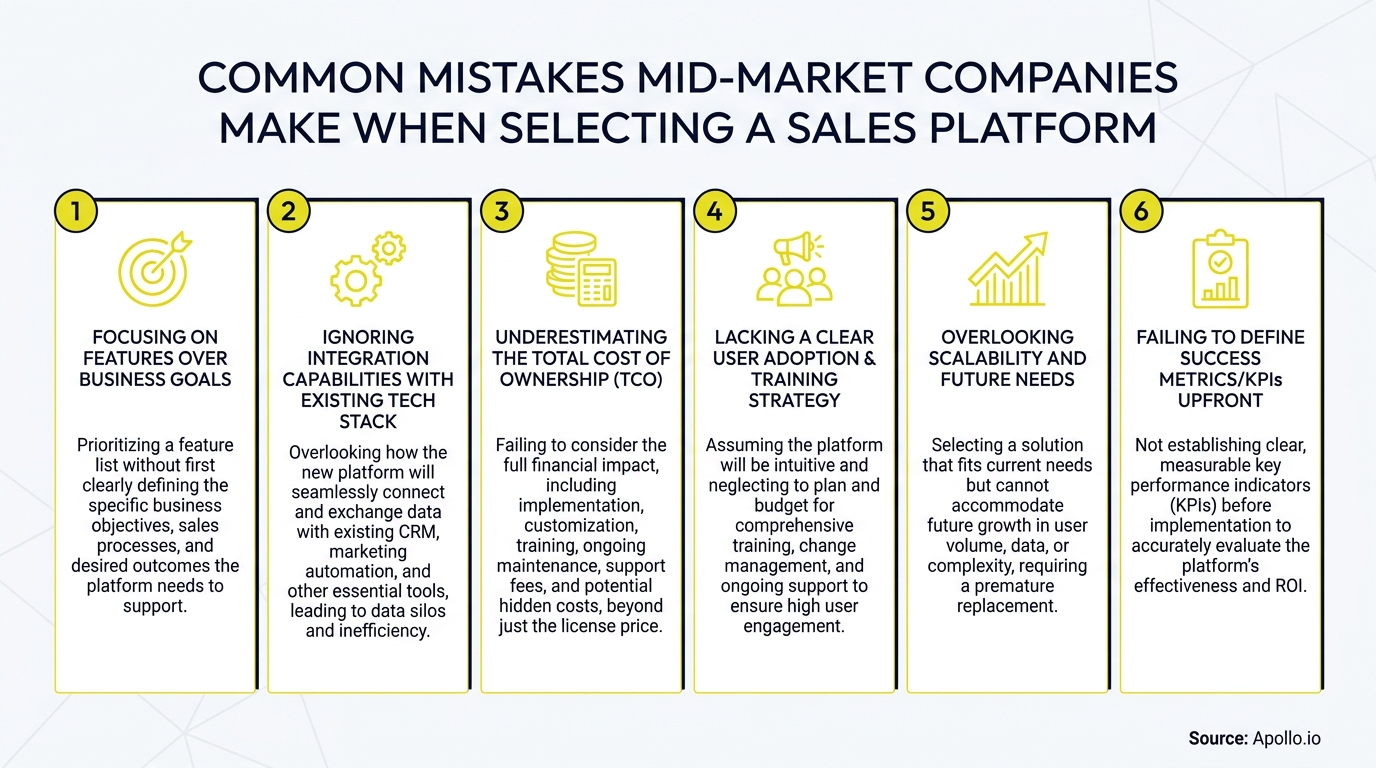
The most common mistakes fall into six categories: choosing by brand over fit, underweighting integration requirements, ignoring data readiness, buying AI features on weak foundations, skipping adoption planning, and failing to consolidate the tech stack.
| Mistake | Root Cause | Business Impact |
|---|---|---|
| Brand over fit | Demo bias, peer pressure | Low adoption, unused features |
| Underweighting integration | No pre-demo architecture review | Siloed data, broken workflows |
| Skipping data readiness | Assuming clean data exists | Inaccurate forecasts, lost revenue |
| Buying AI on bad data | Vendor AI demos use clean data | AI outputs are unreliable |
| No adoption plan | Training treated as post-go-live | Low rep utilization, shelfware |
| Stack sprawl | Adding vs. consolidating tools | Higher TCO, integration debt |
How Does Integration Failure Start at the Selection Stage?
Integration failure begins the moment a team skips a pre-demo architecture review. By the time a new platform is live and unable to sync with your MAP, ERP, or data warehouse, the contract is already signed.
As dmarkhudson.com notes, the lack of proper integration among sales, marketing, customer service, and analytics tools creates inefficiencies, data discrepancies, and a poor user experience. RevOps leaders consistently report this as the most painful post-purchase discovery.
Pre-demo integration checklist:
- Map every system the platform must connect to (CRM, MAP, ERP, CPQ, data warehouse, identity provider)
- Require native connectors — not just API availability — for your top three integrations
- Test a proof-of-concept sync with real data before finalizing vendor shortlist
- Confirm bidirectional sync capability, not just one-way data push
- Validate field-level mapping and object support for your existing data model
Struggling to keep pipeline data clean across disconnected tools? Apollo's deal management gives RevOps a unified view of every opportunity without stitching together separate systems.

Why Is Data Readiness a Selection Criterion, Not a Post-Go-Live Task?
Data readiness is a selection criterion because the platform you choose must be capable of enforcing the governance rules your data requires. Buying a platform and then cleaning data is backwards.
The platform selection should be gated by your current data maturity.
A Bain report published in April 2025 found that 70% of companies struggle to integrate their sales plays into CRM and revenue technologies. The underlying reason is rarely a feature gap. It's that data models, required fields, and routing rules weren't defined before the platform was selected.
Data readiness gate before selecting a platform:
- Audit current record completeness across contacts, accounts, and opportunities
- Define required fields and validation rules before vendor demos
- Assign a data owner role with governance authority
- Establish deduplication and enrichment standards as selection criteria
- Test the platform's ability to enforce those standards natively
Turn Funnel Gaps Into Qualified Pipeline
Pipeline forecasting a guessing game because marketing leads never convert? Apollo surfaces high-intent buyers and moves them to opportunity faster. Nearly 100K paying customers stopped guessing and started closing.
Start Free with Apollo →How Do RevOps Leaders Avoid Buying AI Features on Weak Data Foundations?
RevOps leaders avoid this mistake by requiring vendors to demonstrate AI features using the buyer's own data, not a curated demo environment. Vendor AI demos almost always run on clean, structured datasets that bear no resemblance to real-world CRM records.
The Salesforce State of Sales 2026 report highlighted that AI and AI agents are now a top growth tactic, but productivity gains are throttled by admin bottlenecks and data friction. Mid-market companies that buy AI capabilities without first resolving data model gaps end up with AI outputs that are unreliable or ignored by reps entirely. Explore how sales intelligence tools can help establish the data foundation AI requires before you evaluate platform-level AI features.
What Role Does Adoption Play in Platform Selection Decisions?
Adoption planning must happen during vendor evaluation, not after contract signature. Platforms with steep learning curves or poor role-based UX destroy ROI regardless of feature depth.
As Subskribe notes, successful adoption requires investing in comprehensive training programs and choosing solutions with intuitive user experiences that integrate naturally with existing systems. SDRs and AEs don't have time for platforms that require extensive configuration before they can prospect or log a call. During evaluation, require a live usability test with actual reps on actual workflows, not just an admin walkthrough.
Adoption evaluation checklist:
- Run a live rep usability test (not an admin demo) as part of PoC
- Require role-based onboarding documentation from the vendor
- Assess time-to-first-value for an SDR on day one
- Confirm in-app coaching or guided workflow support exists
Spending hours onboarding reps across disconnected tools? Apollo's multi-channel sales engagement platform puts prospecting, sequencing, and outreach in one workspace so reps hit the ground running.
How Can Mid-Market Teams Avoid Stack Sprawl During Platform Selection?
Mid-market teams avoid stack sprawl by requiring any new platform to demonstrably replace at least two existing tools, not just add capabilities alongside them. The question to ask in every vendor conversation is: what can we retire if we adopt this?
According to Everstage, companies frequently use redundant tools and face data silos, leading to slower onboarding and adoption of sales platforms. The consolidation promise must be validated with a deprecation plan and a migration cost estimate before signing. Customers who've made this work include teams like Predictable Revenue, who noted "We reduced the complexity of three tools into one," and Census, who reported "We cut our costs in half."
For teams comparing platform options, a head-to-head review of top sales engagement platforms can reveal which tools truly consolidate versus which add another layer to manage. Also review how sales automation software can eliminate manual workflows that currently require separate point solutions.
How Do You Select the Right Sales Platform for a Mid-Market Team in 2026?
The right selection process starts with a structured evaluation framework before any vendor demo. Feature checklists are the least reliable signal.
Workflow fit, data governance support, integration depth, and adoption design are the four criteria that determine whether a platform delivers ROI or becomes shelfware.
| Evaluation Pillar | What to Validate | How to Test |
|---|---|---|
| Integration depth | Native connectors, bidirectional sync | PoC with live data |
| Data governance | Field validation, deduplication, enrichment | Admin configuration walkthrough |
| Sales play operationalization | Stages, routing rules, cadence support | Map top 3 plays to platform build |
| Adoption design | Rep UX, onboarding, in-app guidance | Live rep usability test |
Mid-market RevOps leaders and sales managers evaluating platforms should also assess how well each solution supports the full sales funnel from prospecting through close, not just one stage in isolation. A platform that handles top-of-funnel but breaks at deal management creates the same fragmentation problem you're trying to solve.

Stop Making Expensive Platform Mistakes in 2026
The most avoidable mid-market platform mistakes share a common thread: decisions made on demos, not data. Reputation-based selection, skipped integration audits, and post-purchase adoption planning are the three fastest paths to shelfware and sunk costs.
Apollo gives B2B GTM teams from SDRs to revenue leaders a unified platform covering prospecting, engagement, enrichment, deal management, and AI-powered automation. Trusted by nearly 100K paying customers including Anthropic, Cyera, and Smartling, Apollo consolidates your sales tech stack so you stop managing tools and start closing deals. "Having everything in one system was a game changer" (Cyera).
Start Your Free Trial and see why 600K+ companies use Apollo as their all-in-one GTM platform.
Get ROI Clarity Before Next Quarter
ROI pressure killing your tool budget? Apollo delivers measurable pipeline impact fast — so justifying the spend is easy. Leadium 3x'd annual revenue. Your numbers could be next.
Start Free with Apollo →Don't miss these
Sales
Inbound vs Outbound Marketing: Which Strategy Wins?
Sales
What Is a Sales Funnel? The Non-Linear Revenue Framework for 2026
Sales
What Is a Go-to-Market Strategy? The 2026 GTM Playbook
See Apollo in action
We'd love to show how Apollo can help you sell better.
By submitting this form, you will receive information, tips, and promotions from Apollo. To learn more, see our Privacy Statement.
4.7/5 based on 9,690 reviews
