
What Are the Best Practices for Segmenting Leads Before Outreach in 2026?
Most outreach fails before the first message is sent. The problem is not the copy or the channel. It is sending to the wrong people at the wrong time with the wrong message. Segmenting leads before outreach is the fix, and in 2026, the rules have changed significantly. According to Gartner's March 2026 research, 67% of B2B buyers now prefer a rep-free experience, which means unsegmented outreach does not just underperform. It actively damages your pipeline. For SDRs, RevOps leaders, and AEs building effective lead generation programs, smarter segmentation is now a baseline requirement.

Apollo Turns Hours of Research Into Seconds
Tired of burning your best selling hours on manual lead research and dead-end contact data? Apollo surfaces verified prospects instantly, so your team spends time closing — not digging. Join 600K+ companies building pipeline faster.
Start Free with Apollo →Key Takeaways
- Suppressing low-fit leads before outreach matters more than personalizing a larger list.
- Buying committees average 13 internal stakeholders, meaning segment by role and influence type, not just job title.
- Buyers who contact a vendor first win the deal 77-81% of the time, so shortlist-aware segmentation is a competitive advantage.
- Businesses using lead segmentation generate 10-15% more revenue and see up to 50% higher conversion rates.
- AI-powered scoring improves qualification accuracy significantly, but clean data and human validation are required for reliable segments.
What Is Lead Segmentation Before Outreach?
Lead segmentation before outreach is the process of dividing your prospect list into distinct groups based on fit, intent, buying stage, and role before any sales or marketing contact is initiated. It is not the same as CRM tagging or post-contact categorization.
Segmentation happens upstream, before sequences are triggered. The goal is to ensure every message sent matches the specific context of the recipient, and to suppress contacts that do not yet meet the threshold for outreach at all.
According to Kompass, businesses employing segmentation report generating 10% to 15% more revenue and witnessing up to a 50% increase in conversion rates compared to those that do not. That delta is the business case for doing this properly.
What Are the Core Segmentation Dimensions for B2B Outreach?
Effective B2B lead segmentation uses four primary dimensions before any outreach is triggered. Each dimension narrows the list and sharpens the message track.
| Dimension | What to Evaluate | Outreach Implication |
|---|---|---|
| ICP Fit | Company size, industry, tech stack, revenue, geography | Suppress non-ICP; route ICP to appropriate tier |
| Buying Role | Economic buyer, champion, technical evaluator, blocker | Match message to influence type and likely objection |
| Journey Stage | Unaware, researching, shortlisting, deciding | Education content vs. proof vs. pricing vs. urgency |
| Intent Signal | Website visits, content downloads, competitor research, job postings | High-intent = SDR outreach; low-intent = nurture only |
Struggling to find and filter qualified leads at scale? Search Apollo's 230M+ contacts using 65+ filters to build precise segments before a single message goes out.
How Does Buying Committee Segmentation Change Your Outreach?
Buying committee segmentation means treating each account as a multi-stakeholder target rather than a single lead record. Forrester's 2024 Buyers' Journey Survey found that purchases involve an average of 13 people inside the organization, with 70% of purchases involving 3 or more departments.
Sending one generic message to the entire account ignores this reality entirely.
For RevOps leaders and AEs building account-based outreach, the practical approach is to map each account's known contacts to a buying role before assigning them to a sequence:
- Economic buyer: ROI, risk, and board-level business impact messaging
- Champion: Workflow improvement, peer proof, and internal selling support
- Technical evaluator: Security, integrations, implementation, and compliance questions
- End user: Day-to-day efficiency, ease of use, time savings
- Blocker: Address specific objections proactively; do not send generic value props
SDRs using sales intelligence tools can map these roles from contact data before the first touch, rather than discovering the buying committee structure mid-cycle.

What Is a Fit and Suppression Gate, and Why Does It Come First?
A fit and suppression gate is the first checkpoint in a lead segmentation decision tree: it filters out contacts who should not receive outreach at all before any personalization or sequencing decisions are made. This step is frequently skipped, and it is the most expensive omission. A Gartner 2025 sales survey found 73% of B2B buyers actively avoid suppliers that send irrelevant outreach.
Suppress a lead before outreach if any of the following apply:
- Company does not match ICP firmographic criteria (size, industry, revenue range)
- Contact role does not participate in purchasing decisions for your category
- Account is already a customer, in an active deal, or recently churned
- No intent signal exists and the account is not in an active buying cycle
- Contact engagement has gone cold for more than 90 days with no re-engagement trigger
Suppression is not rejection. It is routing to nurture until fit and intent align. This protects deliverability, sender reputation, and the buyer relationship simultaneously. Review bulk email best practices to understand how list quality directly affects inbox placement.
Turn Funnel Guesswork Into Pipeline Wins
Pipeline forecasting a guessing game because marketing leads never convert? Apollo's AI scoring surfaces only sales-ready prospects, so your pipeline reflects real revenue. Join 600K+ companies forecasting with confidence.
Start Free with Apollo →How Should SDRs Use Shortlist-Aware Segmentation?
Shortlist-aware segmentation means identifying accounts that are already in active buying mode before assigning outreach resources, because those accounts have the highest immediate conversion probability. Research from 6sense's 2025 Buyer Experience Report found that buyers contact the vendor they already intend to buy from, and the first vendor contacted wins the deal 77-81% of the time.
SDRs should prioritize accounts showing these shortlist-stage signals:
- Multiple stakeholders from the same account visiting pricing or comparison pages
- Recent content downloads on implementation, security, or ROI topics
- Job postings indicating a budget-holding hire in the relevant department
- Third-party intent data showing active research in your category
These accounts warrant direct SDR outreach with proof-focused messaging. Accounts without these signals belong in automated nurture sequences, not high-touch SDR cadences. This preserves SDR capacity for the moments where human engagement creates genuine value. For context on how to structure those calls, see cold calling tips for 2026.
When Does Personalization Hurt More Than It Helps?
Personalization hurts when it is based on assumptions rather than verified context. A Gartner 2025 survey found personalized marketing generated negative experiences for 53% of customers, making them 3.2x more likely to regret a purchase and 44% less likely to buy again.
The failure mode is passive personalization: inferring intent or pain from job title or firmographics alone, then crafting messages that feel presumptuous or incorrect.
The alternative is active personalization: gather context through content engagement, conversation history, or intent signals before customizing the message. Segment your list by what you actually know about each contact's situation, not what you assume based on their title. Data from Gradient Works shows personalized subject lines are 26% more likely to be opened, but only when the personalization is relevant and accurate. A wrong assumption delivered confidently performs worse than a neutral, relevant message.
Spending time manually researching contacts for personalization that misses the mark? Use Apollo's AI sales automation to build context-driven outreach at scale, grounded in verified data rather than guesswork.
How Do RevOps Teams Build a Repeatable Segmentation Process?
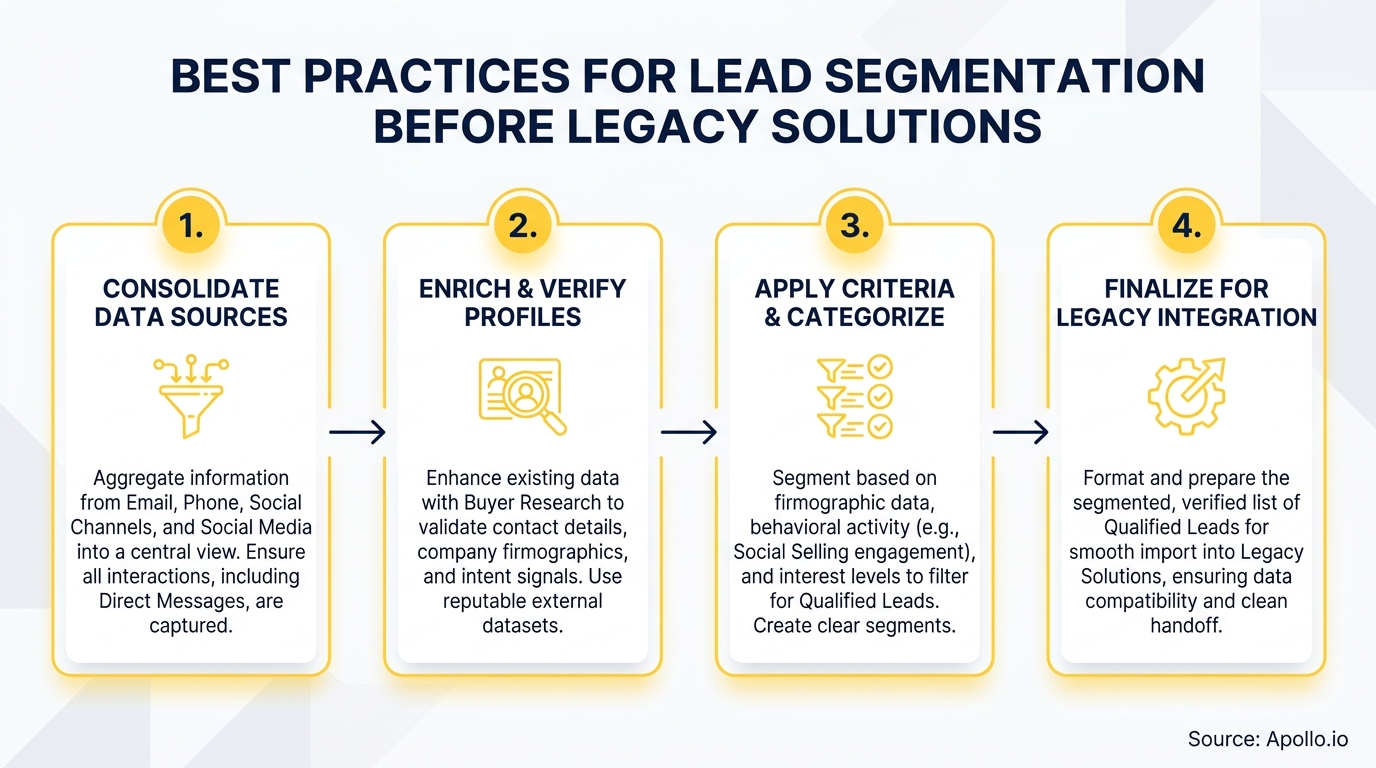
RevOps teams build repeatable lead segmentation by codifying the decision logic into a documented framework that SDRs, AEs, and marketing can all execute consistently. The framework should cover four steps in sequence: ICP fit check, suppression gate, buying-role mapping, and message track assignment.
Key governance rules to include:
- Define ICP criteria in writing, reviewed quarterly against closed-won data
- Validate AI-generated scores with rep feedback before automating outreach routing
- Assign a named owner for each segment to prevent drift and duplication
- Audit segment performance monthly: open rate, reply rate, meeting rate, and win rate by segment
- Align claim consistency across outreach, landing pages, and sales decks by segment
According to Martal, businesses that tailor strategies to specific customer segments achieve 15% annual profit growth on average, versus just 5% for those that do not. The gap is not in the strategy. It is in the execution infrastructure. RevOps leaders who treat segmentation as a governed process rather than a one-time list-building exercise see compounding returns across every channel. Explore how sales transformation led by RevOps turns segmentation from a tactic into a systematic growth driver.

Start Segmenting Smarter Before Your Next Outreach Campaign
The best practices for segmenting leads before outreach come down to one principle: earn the right to contact someone before you do. That means applying a suppression gate first, mapping buying roles at the account level, identifying shortlist-stage signals before assigning SDR resources, and personalizing only from verified context.
Apollo consolidates the tools needed to do all of this in one workspace. From building precise segments with 65+ filters across 230M+ contacts, to AI-assisted scoring, to multi-channel sequences that match each segment's message track, teams like Predictable Revenue have found that Apollo lets them reduce the complexity of three tools into one.
Stop building outreach lists. Start building outreach segments.
Start Your Free Trial and build your first segmented outreach campaign today.
Get Clear ROI From Day One With Apollo
ROI pressure killing your tool budget? Apollo delivers measurable pipeline impact fast — so you walk into every budget review with proof, not promises. Leadium 3x'd their revenue. You're next.
Start Free with Apollo →Don't miss these
Sales
Inbound vs Outbound Marketing: Which Strategy Wins?
Sales
What Is a Sales Funnel? The Non-Linear Revenue Framework for 2026
Sales
What Is a Go-to-Market Strategy? The 2026 GTM Playbook
See Apollo in action
We'd love to show how Apollo can help you sell better.
By submitting this form, you will receive information, tips, and promotions from Apollo. To learn more, see our Privacy Statement.
4.7/5 based on 9,690 reviews
