
What Are the Benefits of Multi-Channel Outreach (Email, Calls, Social Media)?
Email-only outreach is leaving pipeline on the table. According to research from Martal, B2B buyers now use an average of 10+ digital touchpoints before engaging with sales — covering email, phone, social media, and search. If your team only covers one of those channels, you're invisible for the other nine. This guide breaks down the real benefits of multi-channel outreach and how to execute it in 2026.
For teams building outbound programs, pairing strong B2B sales techniques with a coordinated channel strategy is what separates consistent pipeline from sporadic wins.

Verified Contacts, Zero Research Waste
Tired of burning hours tracking down emails that bounce and numbers that go nowhere? Apollo delivers 97% accurate business contacts so your reps spend time selling, not searching. Join 600K+ companies building pipeline that actually converts.
Start Free with Apollo →Key Takeaways
- Multi-channel outreach dramatically outperforms single-channel campaigns on engagement, conversion, and revenue metrics.
- Phone calls book the majority of sales meetings when embedded in a coordinated cadence — not used in isolation.
- Social media has shifted from brand building to a direct-response channel that warms prospects before email and calls land.
- Buyers who experience channel inconsistency are likely to switch suppliers — relevance governance is a retention tool, not just a prospecting tactic.
- SDRs and AEs who coordinate across channels within a single platform close the loop faster and with less manual work.
What Are the Core Benefits of Multi-Channel Outreach?
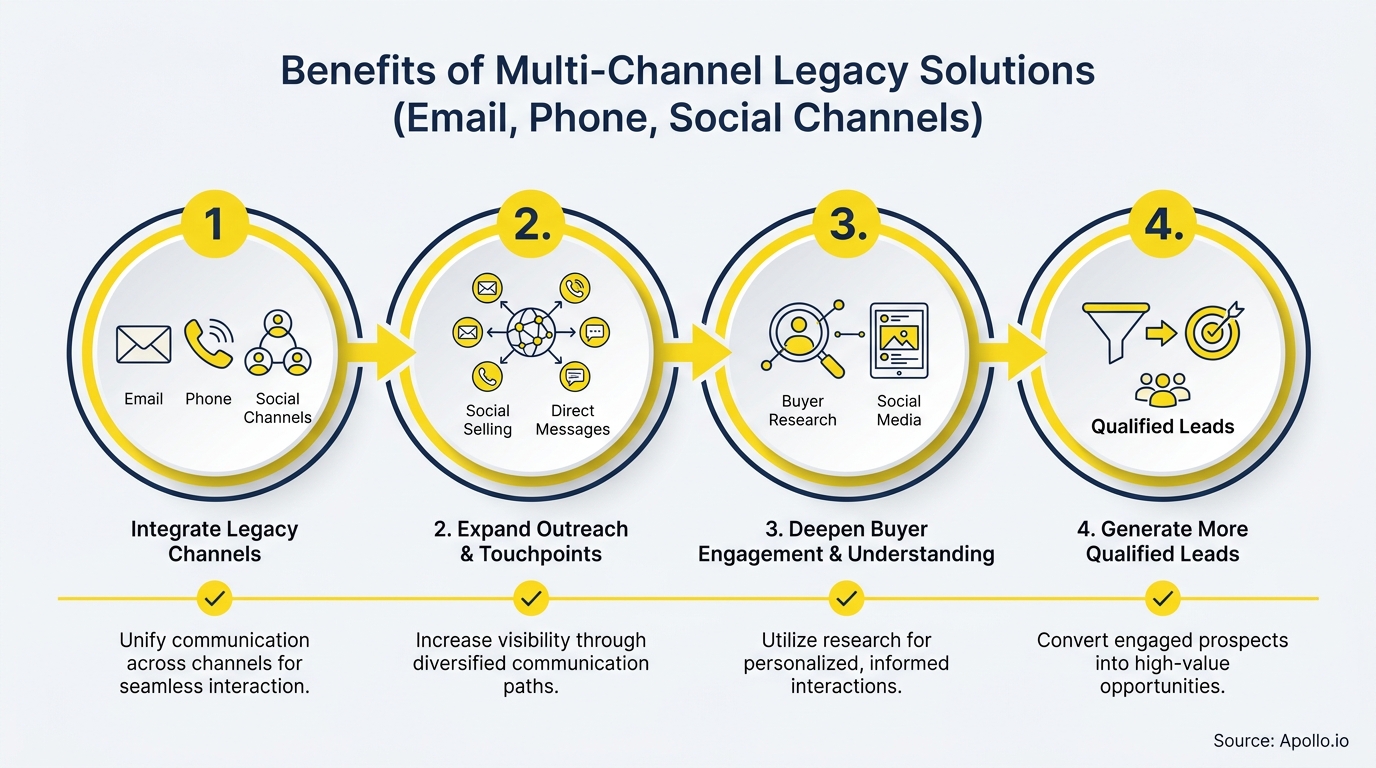
Multi-channel outreach increases pipeline velocity, reduces buyer churn risk, and accelerates vendor evaluation — all at once. Beehiiv reports that omnichannel campaigns generate an ROI almost 5x greater compared to single-channel campaigns. The three outcomes that matter most:
- Revenue velocity: More touchpoints across more channels compress the buying cycle. Buyers gather proof faster when email, calls, and social reinforce the same message.
- Reduced churn risk: McKinsey found more than half of B2B buyers are likely to switch suppliers if they don't receive a smooth cross-channel experience. Consistent outreach prevents that gap.
- Faster vendor evaluation: When buyers encounter your brand across multiple channels — social content, a well-timed email, a relevant call — they build confidence faster than through a single touchpoint.
Research from RevenueMemo confirms that 73% of consumers use multiple channels during their purchase journey, making single-channel outreach structurally misaligned with how buyers actually buy.
What Role Does Each Channel Play in a B2B Outreach Sequence?
Each channel serves a distinct job in the buyer journey. The mistake most teams make is treating them as interchangeable or running them in parallel without coordination.
| Channel | Primary Job | Buyer Stage | Key KPI |
|---|---|---|---|
| Deliver context, assets, and follow-up | Awareness to consideration | Open rate, reply rate | |
| Phone/Calls | Book meetings, qualify, handle objections | Consideration to decision | Connect rate, meetings booked |
| Social (professional networks) | Warm up, build credibility, surface intent | Pre-awareness to awareness | Engagement rate, profile views |
| Website/Content | Enable self-serve research and validation | Consideration to decision | Return visits, intent signals |
Phone is chronically underweighted in most outreach strategies. A Spring 2025 benchmark by memoryBlue analyzed 500,000+ calls, 1.4M emails, and 321,000 meetings and found that phone outreach booked 85% of sales meetings, compared with 8% from email and 7% from social. Email doesn't close the meeting — it primes the call. For practical guidance on maximizing that channel, see the best cold calling tips for 2026.
Turn Funnel Guesswork Into Pipeline You Trust
Pipeline forecasting a guessing game because leads stall before they ever become opportunities? Apollo surfaces in-market buyers at the right moment so your funnel stays full and your forecast stays honest. Join 600K+ companies that stopped guessing.
Schedule a Demo →How Do SDRs Execute a Coordinated Multi-Channel Cadence?
SDRs who coordinate across channels within a single workflow consistently outperform those running isolated campaigns. The key is sequencing channels so each touchpoint builds on the last — not repeating the same message in a different format.
A sales professional wrote on Redditthat layering social engagement before sending email transformed their results: "I started layering professional networks engagement before sending anything, just genuine comments on posts or reshares, nothing salesy. Then when the email lands a few days later, it's not truly cold anymore. They've seen the name, maybe even checked the profile already... We went from 2% reply rates to over 20% when we added video into the sequence after the initial professional networks touchpoints."
A practical cadence framework used by high-performing SDR teams:
- Day 1: Engage on social (comment, reshare relevant content) — no ask
- Day 3: Send personalized email referencing the social interaction or shared context
- Day 5: Call, referencing the email sent — warm, not cold
- Day 8: Follow-up email with a relevant resource or case study
- Day 12: Final call or social message with a direct meeting ask
A Reddit user shared a firsthand perspectiveon this sequencing approach: "Gone are the days when a cold call was the first or the only point of outreach... I typically reach out to prospects every 4-5 days over a 3-week period using the aforementioned methods."
Spending hours building these sequences manually? Automate your multi-channel sequences with Apollo's sales engagement platform — email, calls, and social steps in one coordinated workflow.

How Does Multi-Channel Outreach Prevent Irrelevant Outreach?
Relevance governance — ensuring each channel delivers the right message at the right moment — is the difference between multi-channel outreach that builds pipeline and multi-channel outreach that burns it. Gartner found that 73% of B2B buyers actively avoid suppliers that send irrelevant outreach.
More touchpoints without more relevance just accelerates opt-outs.
The fix is signal-based sequencing: trigger channel actions based on buyer behavior (email open, website visit, social engagement) rather than a fixed-day timer. This requires your CRM, engagement platform, and contact data to be in sync. For AEs managing active opportunities, effective sales meeting strategies depend on the same principle — meeting buyers where they are with context that's already relevant to their stage.
- Use intent signals to prioritize which accounts enter a sequence
- Adjust channel and message based on engagement (opens, clicks, profile views)
- Keep CRM notes current so every rep on the account has the same context
- Set channel fatigue rules — cap total touches per account per week
What Are the ROI Metrics for Multi-Channel vs. Single-Channel Outreach?
Multi-channel outreach consistently outperforms single-channel across every measurable metric. According to Firework, marketing campaigns using three or more channels achieve 287% higher purchase rates than single-channel campaigns. For RevOps leaders tracking pipeline efficiency, this is the clearest argument for investing in coordinated outreach infrastructure over adding more volume to a single channel.
Key benchmarks to track when running multi-channel programs:
- Meeting booked rate: Increases significantly when calls are preceded by social and email touchpoints
- Reply rate: Social-warmed email sequences outperform cold email sequences
- Cost per lead: Multichannel campaigns can reduce cost-per-lead vs. single-channel, according to data cited by Demand Gen Report
- Pipeline retention: Consistent cross-channel presence reduces mid-funnel drop-off from buyers going dark
For teams building out their measurement framework, demand gen metrics that drive revenue provides a practical starting point for attributing pipeline across channels.
How Can B2B Teams Run Multi-Channel Outreach Without Adding Tools?
The biggest operational barrier to multi-channel outreach is tool fragmentation — separate platforms for email, calls, and social create data silos, missed handoffs, and rep confusion. The solution is consolidating into a unified GTM platform where all channel activity feeds into one workspace.
Apollo brings email sequences, phone dialing, contact intelligence, and workflow automation into a single platform — so SDRs, AEs, and RevOps teams don't need to stitch together three separate tools to run a coordinated cadence. As Cyera put it: "Having everything in one system was a game changer." Predictable Revenue noted: "We reduced the complexity of three tools into one."
For a full comparison of sales engagement platforms, see Apollo vs. Outreach vs. Salesloft. For teams evaluating the broader stack, the best B2B marketing tools for 2026 covers the full landscape.
Running outreach across channels but struggling to find the right contacts? Search Apollo's 230M+ verified contacts with 65+ filters to build the right list before your first touchpoint.
Start Running Multi-Channel Outreach That Actually Converts
Multi-channel outreach is not about sending more messages — it's about meeting buyers where they are, with the right message, at the right stage. Email builds context.
Calls book meetings. Social warms the relationship before either lands.
Together, coordinated across a single workflow, they produce pipeline outcomes that no single channel can match.
Apollo gives B2B GTM teams — SDRs, AEs, RevOps, and revenue leaders — one unified platform to prospect, sequence, call, and track every touchpoint without the overhead of a fragmented stack. Start a free trial and run your first multi-channel sequence today.
Prove Pipeline ROI Before Next QBR
Budget approval stuck on unclear metrics? Apollo delivers measurable pipeline impact from day one — so your next QBR sells itself. Join 600K+ companies turning tool spend into revenue proof.
Start Free with Apollo →Don't miss these
Sales
Inbound vs Outbound Marketing: Which Strategy Wins?
Sales
What Is a Sales Funnel? The Non-Linear Revenue Framework for 2026
Sales
What Is a Go-to-Market Strategy? The 2026 GTM Playbook
See Apollo in action
We'd love to show how Apollo can help you sell better.
By submitting this form, you will receive information, tips, and promotions from Apollo. To learn more, see our Privacy Statement.
4.7/5 based on 9,690 reviews
