
What Are Techniques for A/B Testing Call Scripts or Voicemail Messages?
A/B testing call scripts and voicemail messages is the practice of running controlled experiments on individual script elements to identify which version drives more meetings, replies, or pipeline. Most sales teams skip this entirely, relying on gut instinct instead of data. According to B2B Rocket, only 17% of marketers regularly A/B test their content, which means disciplined testers hold a significant competitive edge. If you want to build stronger cold call scripts backed by real data, structured experimentation is the path.

Let Apollo Find Contacts While You Close
Tired of your reps burning hours on manual research instead of selling? Apollo surfaces verified contacts instantly so your team spends time closing, not digging. Start building pipeline today.
Start Free with Apollo →Key Takeaways
- Test one script variable at a time: opener, pain framing, CTA, objection response, or voicemail length.
- Voicemail A/B tests should measure downstream email replies and meetings booked, not just callback rate.
- Run each variant until you reach 50–100 connects per version before declaring a winner.
- Compliance guardrails (DNC suppression, caller ID health, approved claims) must be built into every test variant.
- AI can generate script variants faster, but statistically valid experiment design still requires human oversight.
What Is a Call Script A/B Test and Why Does It Matter?
A call script A/B test is a controlled experiment where two script variants (A and B) differ by exactly one element, and outcomes are tracked across a random, equal split of prospects. Research from SalesHive shows that A/B testing elements like openings, value propositions, and closes can boost conversion rates from an average of 2–3% to over 10%. That gap represents the difference between a struggling SDR team and one consistently hitting quota. The same logic applies to voicemail: small copy changes determine whether a prospect replies to your follow-up email or ignores you entirely.
For SDRs and BDRs running high-volume outbound, even a modest lift in connect-to-meeting rate compounds quickly across hundreds of weekly dials. Explore proven cold calling techniques alongside your test framework to layer in additional performance levers.
How Do You Design a Valid Call Script Experiment?
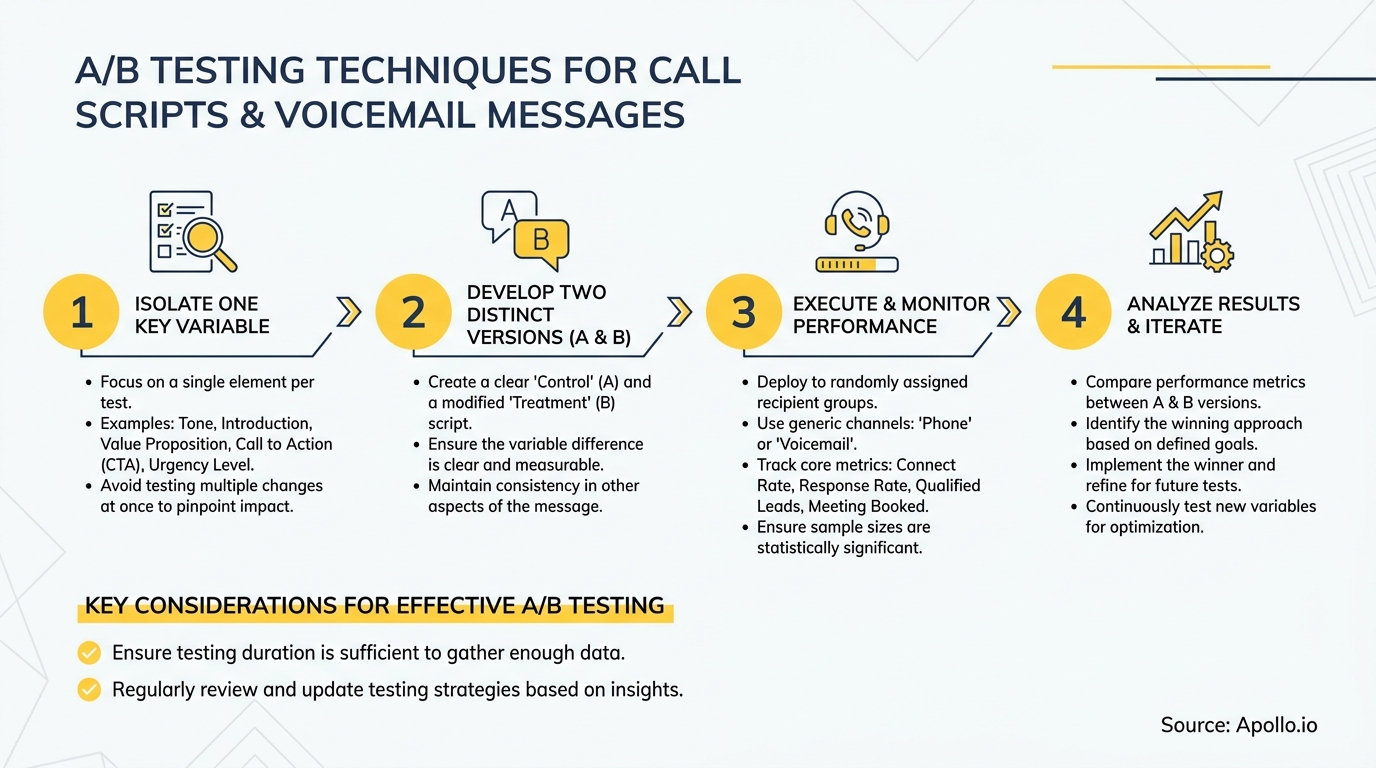
Valid call script experiment design requires defining one hypothesis, one primary metric, and a random prospect split before any calls are made. Follow this six-step framework:
- State one hypothesis: "Changing the opener from feature-first to problem-first will increase connect-to-meeting rate."
- Choose one primary metric: Connect-to-meeting rate, positive sentiment rate, or email reply rate (for voicemail).
- Randomize the split: Assign prospects to Variant A or B by alternating records, odd/even account IDs, or CRM-based random assignment. Never let reps self-select their variant.
- Set a minimum sample size: Run each variant until you reach at least 50–100 connects per version. For voicemail, track 100+ sends per variant before evaluating downstream email metrics.
- Define a run window: Cover at least one full week to account for day-of-week and time-of-day variation.
- QA rep compliance: Use conversation intelligence to verify reps delivered the approved variant, not a hybrid.
Skipping any of these steps introduces noise that makes results uninterpretable. AI tools can now generate script variants in seconds, but as Salesforce's 2026 State of Sales report notes, top performers still rely on disciplined experiment design to validate which AI-generated variant actually wins.
What Script Variables Should SDRs and BDRs Test First?
SDRs and BDRs should prioritize testing the opener and pain-point framing first, since these elements determine whether a prospect stays on the line at all. Use the matrix below to sequence your tests:
| Script Variable | Variant Examples | Primary Metric |
|---|---|---|
| Opener | Context-first vs. permission-first vs. trigger-first | Seconds-to-pitch / hang-up rate |
| Pain-point framing | Problem statement vs. outcome statement | Connect-to-conversation rate |
| CTA | "15-minute call" vs. "quick question" | Meeting booked rate |
| Objection response | Agree-and-redirect vs. proof-point vs. low-friction next step | Objection pass-through rate |
| Voicemail length | No voicemail vs. 15-sec context vs. 30-sec context + social proof | Email reply rate within 48 hours |
| Voicemail follow-up email | Reference voicemail vs. fresh email | Reply rate, meeting rate |
Note that Kixie confirms that small modifications in sales scripts, like changing a greeting, can significantly increase response rates. Start with the opener before testing deeper variables.
Spending hours crafting variants manually? Apollo's AI sales automation generates personalized outreach at scale, so your team tests more variants with less prep time.

How Should You Measure Voicemail A/B Tests?
Voicemail A/B tests should be measured primarily by downstream email reply rate and meetings booked, not by callback rate alone. Most teams judge voicemail performance by whether the prospect calls back.
That's the wrong metric. Voicemail works as a cross-channel priming signal: it increases the likelihood that a prospect opens and replies to the email that follows, even when they never return the call.
Use this attribution framework for voicemail-to-email measurement:
- Attribution window: Track email replies within 24–48 hours of voicemail delivery.
- Holdout group: Include a "no voicemail" control group in every test to measure incremental lift.
- Contamination control: Ensure prospects in Variant A do not receive Variant B emails. Tag contacts by variant in your CRM before the sequence begins.
- Sequence-level measurement: Measure outcomes at the full sequence level (call + voicemail + email), not the voicemail step in isolation.
For RevOps leaders building measurement infrastructure, clean CRM tagging and sequence-level attribution are prerequisites. Without them, you cannot isolate the voicemail variable from the email variable. Review your broader B2B sales techniques to ensure voicemail testing fits your overall multi-channel strategy.
Turn Weak Funnels Into Pipeline Gold
Quota pressure mounting while marketing leads stall before they ever reach your AEs? Apollo surfaces high-intent prospects ready to convert — not dead ends. Join 600K+ companies building predictable pipeline from the top down.
Start Free with Apollo →How Long Should You Run an A/B Test for Call Scripts?
Run each call script variant until you accumulate at least 50–100 connects per version, covering a minimum of one full week. Shorter tests produce false positives because they miss day-of-week variation (Tuesday and Wednesday typically outperform Monday and Friday for cold calls) and rep-level inconsistency.
Additional timing rules:
- Do not stop a test early because Variant B looks like it's winning on day two.
- Pause and restart if a major external event (product launch, company news) disrupts call behavior mid-test.
- For voicemail, extend the attribution window to 72 hours if your prospect list includes executives who check voicemail less frequently.
- Document the run dates, rep assignments, and prospect segment for each test in your CRM or a shared test log.
What Compliance Rules Apply When A/B Testing Call Scripts?
Every call script variant must comply with DNC registry requirements, FTC Telemarketing Sales Rule standards, and your organization's approved claims list. A script that wins on meeting rate but generates spam labels or DNC complaints is not a true winner.
The FTC has expanded TSR protections to cover B2B telemarketing calls, and the FCC removed over 1,200 non-compliant voice providers from its Robocall Mitigation Database in 2025, making caller ID health a measurable test variable.
Build these compliance checks into your variant QA checklist:
- Confirm DNC suppression is applied to both variant lists before dialing begins.
- Verify that all claims in both variants are pre-approved by legal or sales leadership.
- Monitor caller ID spam-label rates separately for each variant phone number pool.
- Include an opt-out mechanism in voicemail scripts where required.
- If using AI-generated voice, include required disclosures per applicable regulations.
Compliance metrics should sit alongside conversion metrics in your winner-selection criteria. A variant with a marginally lower meeting rate but zero spam labels may deliver better long-term pipeline than a high-converting script that damages caller reputation.
How Do Revenue Leaders Use Script Testing to Drive Predictable Pipeline?
Revenue leaders use ongoing call script A/B testing as a systematic process, not a one-time project, to build a library of validated talk-track modules. Each winning variant becomes a building block: a proven opener, a proven objection response, a proven voicemail hook.
Over time, this modular approach produces a script assembled entirely from tested components.
The operational model looks like this:
- Monthly cadence: One active test per script module per month.
- Winner deployment: Winning variants are promoted to the team playbook within one week of reaching significance.
- Signal-based rotation: Test different variants by buyer signal type (funding event, job change, pricing-page visit) rather than only by persona or industry.
- AI-assisted generation: Use AI to draft 3–5 variant hypotheses per module, then select the two most distinct for testing.
This system gives sales leaders the coaching data they need to improve rep performance at scale. Combine it with proven sales techniques to maximize the impact of every validated script module.
Ready to run multi-channel sequences with built-in tracking for every call, voicemail, and email step? Apollo's sales engagement platform automates sequences and captures the data you need to run clean A/B tests.

Start Testing Smarter in 2026
The techniques for A/B testing call scripts and voicemail messages come down to one discipline: test one variable at a time, measure the right outcomes, and run long enough to trust your results. SDRs gain better openers.
RevOps gains clean data for coaching decisions. Revenue leaders gain a repeatable system for lifting connect-to-meeting rates across the entire team.
Apollo gives B2B GTM teams a unified workspace to prospect, sequence, dial, and measure, all without stitching together multiple tools. As Predictable Revenue put it: "We reduced the complexity of three tools into one." Stop guessing which script works. Get Leads Now and build your first tested script from a database of 230M+ verified business contacts.
Prove Pipeline ROI Before Next QBR
ROI pressure killing your tool adoption? Apollo delivers measurable pipeline impact from day one — so budget approvals become easy. Leadium 3x'd annual revenue. Your CFO will notice.
Start Free with Apollo →Don't miss these
Sales
Inbound vs Outbound Marketing: Which Strategy Wins?
Sales
What Is a Sales Funnel? The Non-Linear Revenue Framework for 2026
Sales
What Is a Go-to-Market Strategy? The 2026 GTM Playbook
See Apollo in action
We'd love to show how Apollo can help you sell better.
By submitting this form, you will receive information, tips, and promotions from Apollo. To learn more, see our Privacy Statement.
4.7/5 based on 9,690 reviews
