
What Are Leads in Sales? Definition, Types, and Qualification Strategies
Sales leads are the lifeblood of revenue growth, yet most teams struggle with inconsistent definitions, misaligned handoffs, and poor qualification. In 2026, AI and hybrid selling are reshaping how SDRs, AEs, and RevOps teams identify, score, and convert leads into closed deals.
Understanding what sales leads are and how to manage them strategically separates top-performing teams from those missing quota.
Modern buyer lead strategies now blend data-driven prospecting with human touchpoints. According to Gartner, sellers who effectively partner with AI tools are 3.7 times more likely to meet their sales quotas.

Scale Quality Leads Without Adding Headcount
Generating qualified leads at scale shouldn't require hiring more reps. Apollo automates lead scoring and ICP targeting so your current team books 46% more meetings. Join 550K+ companies scaling smarter.
Start Free with Apollo →Key Takeaways
- Sales leads are potential customers who show interest in your product, moving from awareness to consideration through qualification stages.
- MQLs (Marketing Qualified Leads) and SQLs (Sales Qualified Leads) require clear SLA definitions to prevent misalignment and wasted effort.
- AI-powered lead scoring and hybrid selling strategies help SDRs and AEs prioritize high-value prospects and shorten sales cycles.
- Tool consolidation with all-in-one platforms reduces costs and complexity while improving lead data accuracy and team visibility.
- Modern B2B buyers prefer self-service research combined with strategic human interaction at decision points.
What Are Sales Leads?
Sales leads are individuals or organizations that have expressed interest in your product or service. They represent potential customers who fit your ideal customer profile and have taken actions indicating purchase intent, such as downloading content, requesting demos, or engaging with your outreach.
In B2B sales environments, leads progress through distinct qualification stages. A lead becomes more valuable as it moves from initial awareness to active consideration, eventually becoming sales-ready. This progression requires clear criteria that both marketing and sales teams agree upon.
Not all leads are created equal. Cold leads have minimal engagement, warm leads show moderate interest, and hot leads demonstrate strong buying signals.
Effective lead management focuses resources on prospects most likely to convert, maximizing ROI on prospecting efforts.
How Do MQLs and SQLs Differ in 2026?
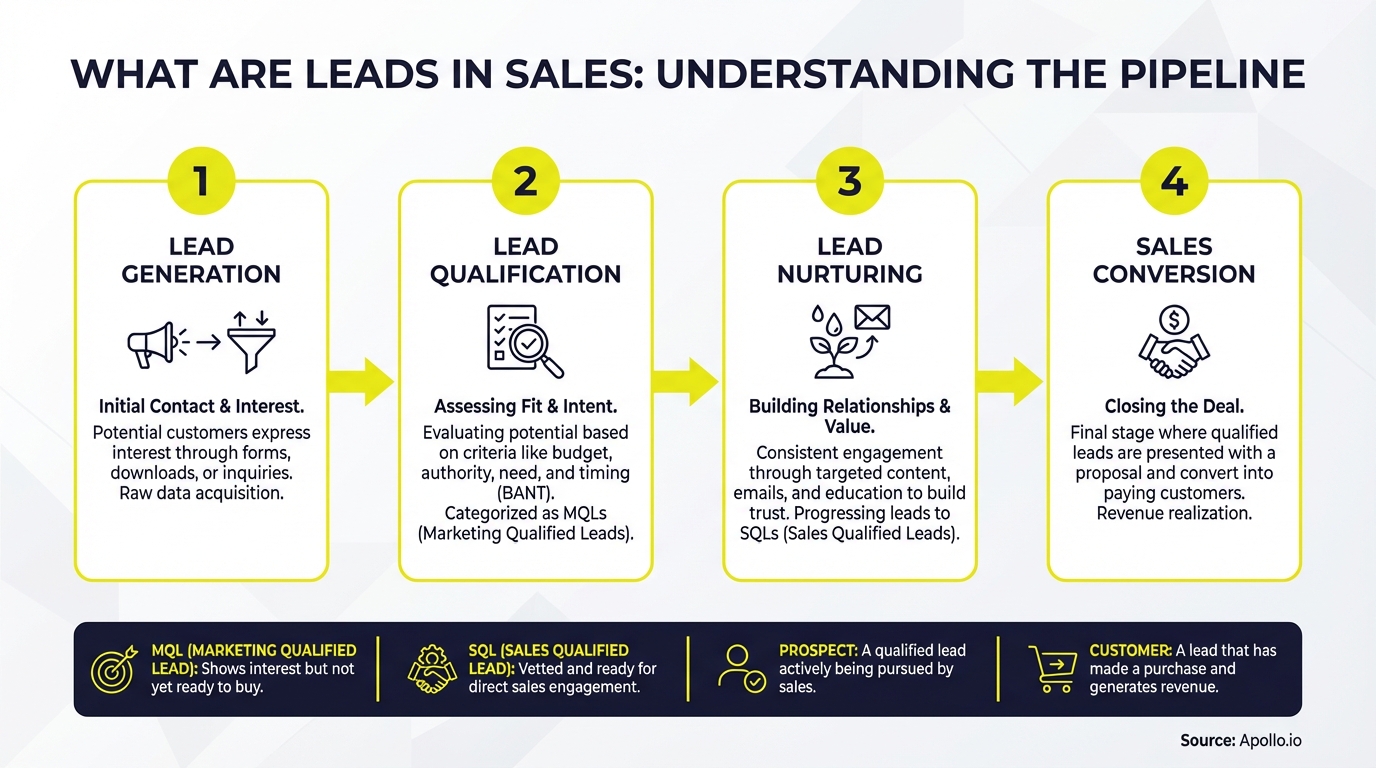
Marketing Qualified Leads (MQLs) meet specific engagement thresholds set by marketing teams. They've consumed content, attended webinars, or visited pricing pages multiple times.
SQLs (Sales Qualified Leads) have been vetted by sales and meet budget, authority, need, and timeline (BANT) criteria.
The MQL-to-SQL handoff causes friction when definitions lack precision. RevOps leaders now build SLA frameworks that specify scoring models, qualification questions, and response time commitments.
For example, an MQL might score 50+ points based on firmographic fit and engagement, while an SQL requires a discovery call confirming active budget and decision-maker involvement.

Struggling to align marketing and sales on lead definitions? Track lead progression in one workspace with Apollo's deal management system.

| Lead Type | Qualification Criteria | Owned By | Next Action |
|---|---|---|---|
| MQL | Engagement score, firmographic fit | Marketing | SDR outreach |
| SQL | BANT confirmed, pain point identified | Sales | AE discovery call |
| Opportunity | Proposal stage, active evaluation | AE | Demo, negotiation |
How Do SDRs Generate More Qualified Leads?
SDRs generate qualified leads through multi-channel prospecting that combines sales intelligence tools, personalized outreach, and strategic follow-up. In 2026, top-performing SDRs use AI to research prospects, identify buying signals, and craft contextual messaging that resonates with decision-makers.
The best SDRs focus on lead quality over quantity. They use intent data to prioritize accounts showing active research behavior, then engage with value-driven sequences across email, phone, and social channels. Research from Gitnux shows that 68% of B2B technology sales cycles take longer than four months to close, making early-stage qualification critical.
Key SDR activities include:
- Building targeted prospect lists using 65+ firmographic and technographic filters
- Crafting personalized sequences that address specific pain points
- Conducting discovery calls to validate fit before passing to AEs
- Tracking engagement metrics to refine messaging and timing
For SDRs managing hundreds of prospects, sales automation software eliminates manual tasks while maintaining personalization at scale.
Turn Forecast Chaos Into Revenue Certainty
Pipeline forecasting a guessing game? Apollo's real-time deal tracking and intent signals eliminate forecast surprises. Built-In increased win rates 10% with predictable pipeline visibility.
Start Free with Apollo →What Role Does AI Play in Lead Management?
AI transforms lead management by automating scoring, enrichment, and routing decisions that previously required manual review. Gartner predicts that 75% of B2B sales organizations will augment traditional sales playbooks with AI-guided selling solutions by 2025.
AI-powered platforms analyze buying signals, engagement patterns, and firmographic data to predict which leads will convert. They automatically enrich contact records with job changes, funding events, and technology stack information.
This gives AEs pre-meeting intelligence that shortens discovery cycles and improves close rates.
Tired of manually researching every prospect? Start free with Apollo's 224M+ verified business contacts and AI-powered enrichment.
AI applications in lead management include:
- Predictive lead scoring based on historical conversion patterns
- Automated data enrichment to maintain clean, current contact information
- Intelligent routing to match leads with the best-fit rep
- Conversation intelligence to extract insights from calls and emails
Why Do Sales Teams Consolidate Their Tech Stack?
Sales teams consolidate tools to reduce costs, eliminate data silos, and improve workflow efficiency. Managing leads across separate prospecting, engagement, and CRM platforms creates friction, duplicate data entry, and visibility gaps that hurt conversion rates.
All-in-one GTM platforms combine contact databases, sales engagement, and deal management in a single workspace. This consolidation typically replaces 3-5 separate tools, cutting subscription costs while giving RevOps teams a single source of truth for pipeline analytics.
Customer proof points demonstrate real impact:
- "We reduced the complexity of three tools into one" (Predictable Revenue)
- "We cut our costs in half" (Census)
- "Having everything in one system was a game changer" (Cyera)
For Sales Leaders managing growing teams, tool consolidation simplifies onboarding, reduces integration maintenance, and provides complete visibility into rep activity and pipeline health. Founders building outbound motions gain enterprise capabilities without enterprise budgets.
How Does Hybrid Selling Impact Lead Conversion?
Hybrid selling combines digital self-service with strategic human interaction at key decision points. McKinsey reports that hybrid selling is the dominant B2B sales strategy, with two-thirds of buyers preferring it over in-person interactions.
Modern buyers research independently before engaging sales. They consume content, compare vendors, and form opinions without rep involvement.
Sales teams must provide self-service resources (pricing calculators, ROI tools, comparison guides) while monitoring digital signals that indicate readiness for human conversation.
The hybrid model works when teams:
- Create educational content that supports early-stage research
- Use intent data to identify when prospects enter active evaluation
- Engage with personalized outreach at the right moment
- Offer flexible meeting formats (video, phone, in-person) based on buyer preference
Account Executives managing complex deals balance automated nurture sequences with strategic touchpoints. They let prospects self-educate, then add value through customized demos and stakeholder alignment conversations.
What Does Effective Lead Management Look Like?
Effective lead management requires clear ownership, consistent processes, and technology that connects prospecting through close. High-performing teams define lead stages, set qualification criteria, establish SLAs between marketing and sales, and measure conversion rates at each funnel stage.
The lead lifecycle typically includes:
- Generation: Inbound marketing, outbound prospecting, referrals, events
- Qualification: BANT assessment, pain point discovery, stakeholder mapping
- Nurturing: Multi-channel sequences, content delivery, relationship building
- Conversion: Proposal, negotiation, close
- Analysis: Win/loss review, feedback loop to improve targeting
RevOps leaders build dashboards tracking lead velocity, conversion rates by source, and rep performance metrics. They identify bottlenecks (slow response times, poor qualification, inadequate follow-up) and implement process improvements.
For teams struggling with pipeline visibility, modern sales funnel frameworks provide non-linear models that reflect actual buyer journeys. This helps AEs prioritize activities that move deals forward rather than following rigid stage gates.
Start Building Better Lead Management in 2026
Sales leads represent your future revenue, making lead management a strategic priority for every go-to-market team. The shift toward AI-assisted selling and hybrid buyer experiences requires updated processes, aligned definitions, and technology that consolidates prospecting, engagement, and deal tracking in one platform.
Top-performing SDRs, AEs, and RevOps teams focus on lead quality, use data to prioritize high-value prospects, and eliminate tool complexity that slows down their workflows. They leverage AI for research and scoring while maintaining the human touchpoints that build trust and close deals.
Ready to transform your lead management process? Schedule a Demo to see how Apollo consolidates your tech stack and accelerates pipeline growth.
Show Leadership Real Pipeline ROI In 30 Days
Budget approval stuck on unclear metrics? Apollo tracks every dollar to pipeline with real-time ROI dashboards. Built-In increased win rates 10% with measurable impact leadership actually approves.
Start Free with Apollo →Don't miss these
Sales
Inbound vs Outbound Marketing: Which Strategy Wins?
Sales
What Is a Sales Funnel? The Non-Linear Revenue Framework for 2026
Sales
What Is a Go-to-Market Strategy? The 2026 GTM Playbook
See Apollo in action
We'd love to show how Apollo can help you sell better.
By submitting this form, you will receive information, tips, and promotions from Apollo. To learn more, see our Privacy Statement.
4.7/5 based on 9,690 reviews
