
What Is B2B Sales? Definition, Process, and Proven Strategies
B2B sales is undergoing a seismic shift. Research by Gartner shows that 60% of organizations have already transitioned to data-driven selling, yet many teams still struggle with fragmented tools, conflicting buyer signals, and manual workflows that slow deals. The future belongs to sales teams that blend human insight with AI-powered intelligence across every channel.

Apollo Cuts Research Time From Hours To Seconds
Tired of spending 4+ hours daily hunting for contact info? Apollo delivers 224M verified contacts with 96% email accuracy instantly. Join 550K+ companies who stopped wasting time on manual research.
Start Free with Apollo →Key Takeaways
- B2B sales means selling products or services from one business to another, involving longer cycles and multiple decision-makers
- Hybrid selling (combining digital and human touchpoints) dominates in 2026, with buyers expecting seamless experiences across channels
- Data-driven selling replaces gut instinct, using verified contact data and intent signals to prioritize accounts
- 74% of buyer teams experience conflict during decisions, requiring sellers to build consensus across stakeholders
- All-in-one platforms like Apollo consolidate prospecting, engagement, and intelligence into one workspace
What Are B2B Sales?
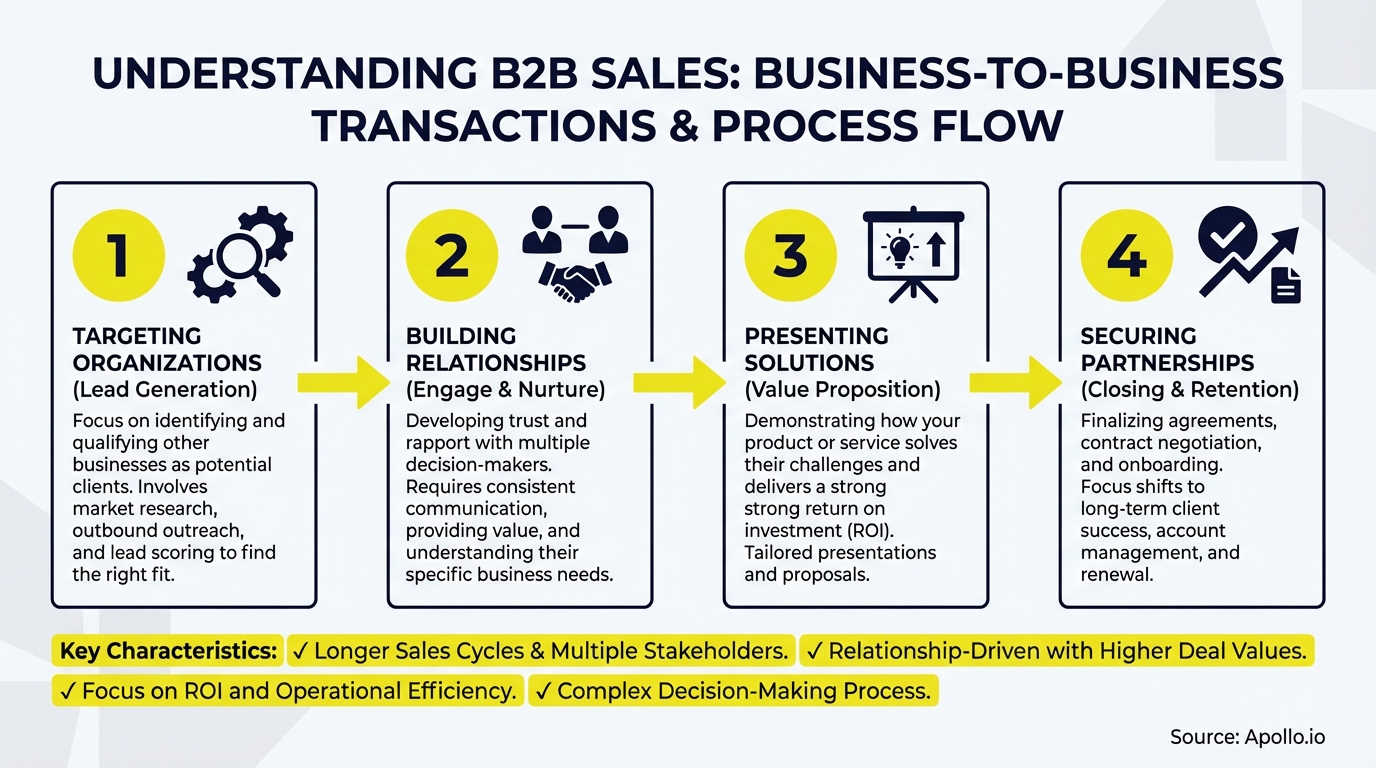
B2B sales (business-to-business sales) is the process of selling products, services, or solutions from one company to another company. Unlike B2C (business-to-consumer) sales, B2B transactions involve longer sales cycles, multiple stakeholders, and higher transaction values.
B2B sales typically includes selling software platforms to enterprises, manufacturing equipment to factories, consulting services to corporations, or raw materials to production companies. The buying process involves procurement teams, technical evaluators, financial approvers, and executive sponsors who must align on budget, timeline, and ROI.
How Does the B2B Sales Process Work in 2026?
The modern B2B sales process follows a hybrid model combining digital self-service with strategic human interaction. According to McKinsey, hybrid selling has become the dominant strategy, blending in-person meetings, remote video calls, and digital channels.
The typical process includes:

- Prospecting: SDRs and BDRs identify target accounts using intent data and verified contact databases
- Qualification: Teams assess fit based on budget, authority, need, and timeline (BANT framework)
- Discovery: Account Executives conduct needs analysis across stakeholder groups
- Proposal: Custom solutions address specific business challenges with ROI projections
- Negotiation: Legal, procurement, and finance teams review terms and pricing
- Closing: Contracts are signed after consensus across the buying committee
- Expansion: Customer success teams drive upsells and renewals
Struggling to find qualified leads? Search Apollo's 224M+ contacts with 65+ filters to identify decision-makers at your ideal accounts.

What Makes B2B Sales Different From B2C Sales?
B2B sales differs fundamentally from B2C in complexity, cycle length, and decision-making structure. B2C purchases are emotional and individual, while B2B buying is rational, committee-based, and focused on business outcomes.
| Factor | B2B Sales | B2C Sales |
|---|---|---|
| Decision Makers | Multiple stakeholders (avg 6-10 people) | Individual or household |
| Sales Cycle | 3-18 months for complex deals | Minutes to days |
| Deal Size | $10K to $10M+ annually | $10 to $10K one-time |
| Purchase Driver | ROI, efficiency, competitive advantage | Emotion, desire, convenience |
| Relationship | Long-term partnerships with renewals | Transactional with repeat purchases |
Data from Gartner indicates that 74% of B2B buyer teams experience unhealthy conflict during purchasing decisions, requiring sellers to facilitate consensus rather than simply pitch products.
Apollo Turns Forecast Chaos Into Revenue Clarity
Forecasting unreliable because deal stages aren't visible in real-time. Apollo tracks every prospect interaction automatically, giving you accurate pipeline visibility. Built-In boosted win rates 10% with Apollo's signals.
Start Free with Apollo →How Do SDRs and AEs Collaborate in B2B Sales?
SDRs (Sales Development Representatives) and AEs (Account Executives) form the core engine of modern B2B sales organizations. SDRs focus on top-of-funnel prospecting and qualification, booking meetings with decision-makers at target accounts. They use multi-channel sequences combining email, phone, and social outreach to generate pipeline.
AEs take qualified opportunities from SDRs and manage the full sales cycle through close. For Account Executives managing complex deals, success depends on deep discovery, ROI modeling, and navigating procurement processes.
High-performing teams use shared platforms where SDRs pass detailed research and engagement history to AEs, eliminating information gaps.
RevOps leaders increasingly consolidate tools to improve SDR-to-AE handoffs. "We reduced the complexity of three tools into one" reports Predictable Revenue after implementing unified platforms for prospecting, engagement, and deal management.
What Role Does Data Play in Modern B2B Sales?
Data-driven selling has replaced experience-based intuition as the foundation of successful B2B sales. Teams now use verified business contact databases, intent signals, technographic data, and engagement analytics to identify accounts showing buying signals.
Modern sales teams leverage:
- Contact data: Direct dials and business email addresses for decision-makers
- Firmographic filters: Company size, revenue, industry, and growth indicators
- Technographic intelligence: Current tech stack and integration opportunities
- Intent signals: Web activity indicating active research and buying behavior
- Engagement scoring: Email opens, link clicks, and content downloads
Tired of dirty data? Start free with Apollo's 224M+ verified contacts and 96% email accuracy to eliminate bounce rates and wasted outreach.
Sales intelligence platforms now integrate directly with CRMs, automatically enriching records and surfacing accounts that match your ideal customer profile. For founders building outbound programs, this eliminates manual research and accelerates time-to-first-meeting.
Why Is Tech Stack Consolidation Critical for B2B Sales Teams?
B2B sales teams historically managed 5-10 separate tools for prospecting, enrichment, engagement, dialers, meeting scheduling, and conversation intelligence. This fragmentation creates data silos, inflates costs, and slows rep productivity.
The shift to all-in-one platforms addresses three pain points:
- Cost reduction: Eliminate redundant subscriptions and per-seat licensing across multiple vendors
- Data consistency: Single source of truth prevents conflicting information across systems
- Workflow efficiency: Reps work in one interface instead of toggling between applications
Census cut their costs in half by consolidating their sales tech stack, while Cyera found that "having everything in one system was a game changer" for team adoption and pipeline visibility. Sales Leaders managing distributed teams benefit from unified reporting across prospecting, engagement, and deal stages.
For teams evaluating B2B marketing and sales tools, prioritize platforms offering native prospecting, multi-channel sequences, conversation intelligence, and AI-powered automation under one login.
Start Selling Smarter in 2026
B2B sales in 2026 demands a blend of human relationship-building and data-powered intelligence. The best teams consolidate their tech stack, empower SDRs with verified contact data, and give AEs the context they need to close deals faster.
As buying committees grow more complex and digital channels proliferate, success belongs to organizations that eliminate tool fragmentation and align around unified platforms.
Ready to transform your B2B sales process? Start free with Apollo to access 224M+ business contacts, AI-powered sequences, and conversation intelligence in one workspace. See why 550K+ companies trust Apollo to power their go-to-market engine.
Prove Apollo's ROI In Your First 30 Days
Budget approval stuck on unclear metrics? Apollo tracks every dollar impact—pipeline generated, meetings booked, deals closed. Built-In increased win rates 10% and ACV 10% with measurable Apollo insights.
Start Free with Apollo →Don't miss these
Sales
Inbound vs Outbound Marketing: Which Strategy Wins?
Sales
What Is a Sales Funnel? The Non-Linear Revenue Framework for 2026
Sales
What Is a Go-to-Market Strategy? The 2026 GTM Playbook
See Apollo in action
We'd love to show how Apollo can help you sell better.
By submitting this form, you will receive information, tips, and promotions from Apollo. To learn more, see our Privacy Statement.
4.7/5 based on 9,690 reviews
