
AI Features for SDRs That Dramatically Increase Efficiency
AI adoption among SDRs and BDRs has gone from optional to near-universal. According to a 6sense 2026 State of the BDR report, 99% of BDRs now report using AI, up from 62% in 2025. But volume alone does not drive quota attainment. The SDRs winning in 2026 are those using AI to work smarter across every bottleneck in their workflow, from prospecting and research to outreach, call summaries, and CRM hygiene. If you want to understand what sales intelligence tools and AI features actually move the needle, this breakdown is for you.

Let Apollo Find Your Next Buyer
Tired of your reps burning hours on manual research instead of selling? Apollo surfaces verified contacts instantly so your team spends time closing, not hunting. Join 600K+ companies building pipeline on autopilot.
Start Free with Apollo →Key Takeaways
- AI features tied most directly to SDR efficiency are prospecting research, outreach personalization, call summaries, and lead prioritization — not data entry or deal prediction.
- Sellers who partner effectively with AI are significantly more likely to meet quota, making AI competency a core SDR skill, not just a productivity perk.
- Data quality is the silent bottleneck: AI tools underperform when CRM data is stale, incomplete, or siloed.
- The SDR AI stack is shifting from single-purpose tools toward unified platforms that consolidate prospecting, engagement, and conversation intelligence in one workspace.
- Measuring AI impact requires separating time-saved KPIs from revenue KPIs — both matter, but they require different tracking.
What AI Features Are Available for SDRs to Increase Efficiency?
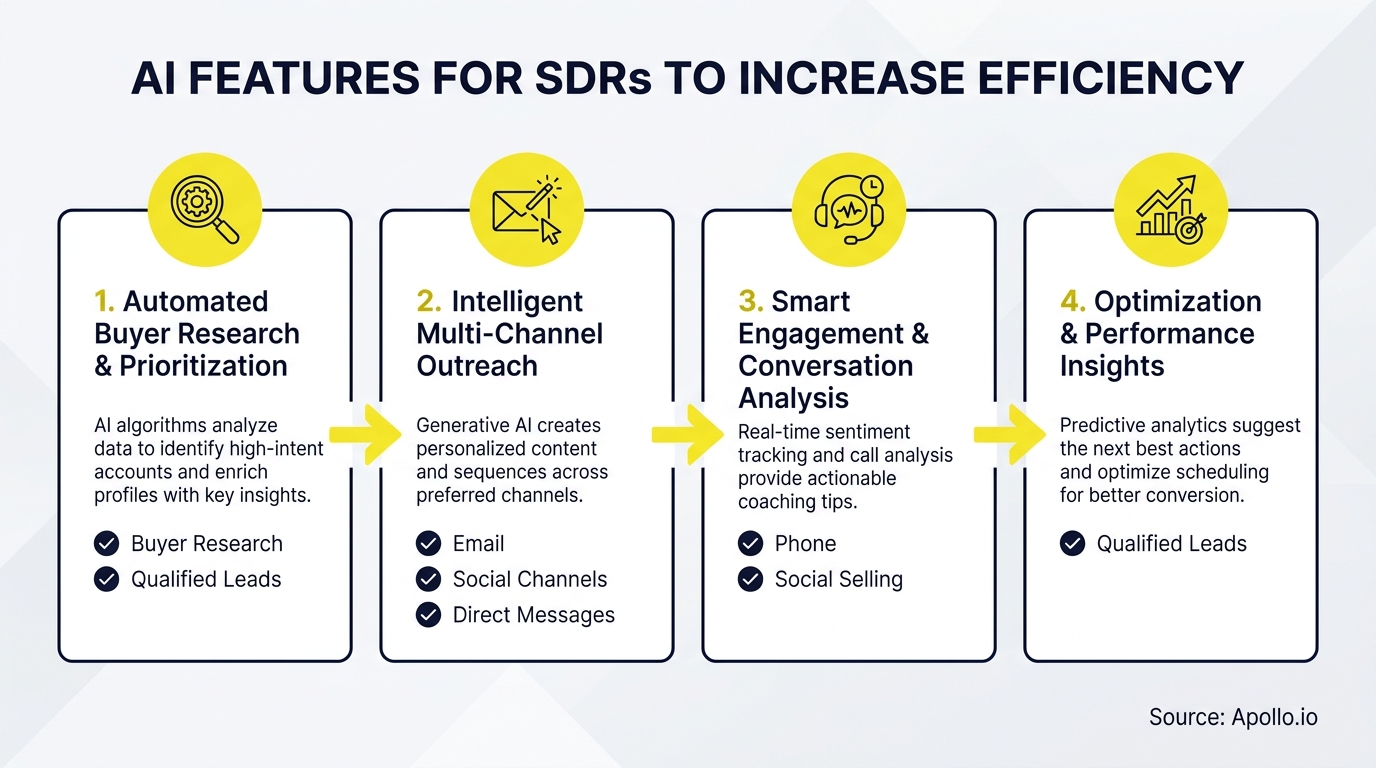
The AI features most available and impactful for SDR efficiency in 2026 span six workflow categories: autonomous prospecting, lead prioritization, personalized outreach, call intelligence, CRM automation, and coaching. Each addresses a distinct bottleneck in the SDR day. According to Salestools.io, AI identifies ideal customer profiles from vast databases and surfaces buyer intent signals to reveal in-market accounts — compressing hours of manual research into minutes.
| SDR Bottleneck | AI Feature Category | What It Does | Adoption Level |
|---|---|---|---|
| Account research | Autonomous prospecting agents | Builds ICP-matched lists, surfaces intent signals, ranks prospects | High (growing rapidly) |
| Lead prioritization | AI lead scoring | Scores leads using behavioral signals and intent data in real time | High |
| Outreach creation | Generative email and sequence AI | Drafts personalized emails, subject lines, and follow-up sequences | Very high (70%+ usage) |
| Post-call admin | Call summary and note automation | Transcribes calls, generates summaries, captures next steps | Very high (62–71%) |
| CRM data entry | Automated CRM logging | Syncs call notes, updates fields, logs activity without manual input | Low (14%) |
| Rep development | AI-powered coaching | Analyzes calls for talk patterns, objection handling, and coaching gaps | Moderate (24%) |
How Do SDRs Use AI for Prospecting and Lead Prioritization?
AI prospecting features help SDRs build targeted lists and identify in-market accounts without switching between multiple tools. Research from Custom Market Insights confirms that AI scores and qualifies leads using behavioral signals and intent data in real time, allowing SDRs to focus on high-value prospects rather than cold lists.
Struggling to find qualified leads fast enough? Search Apollo's 230M+ contacts with 65+ filters to surface your best-fit accounts in seconds.
Key prospecting AI capabilities SDRs should use:
- ICP-based list building: Define firmographic and technographic criteria; AI generates a qualified list automatically.
- Intent signal monitoring: Detects accounts actively researching your category, so SDRs prioritize warm accounts over cold ones.
- Account ranking and tiering: Scores and sorts accounts by likelihood to convert, helping SDRs allocate time to top-tier targets first.
- Buyer identification: Surfaces verified decision-makers and buying committee members within target accounts.
How Does AI Improve SDR Outreach and Personalization?
AI outreach features generate personalized email copy, subject lines, and multi-touch sequences at scale, using account context, persona data, and intent signals as inputs. As noted by MarketsandMarkets, generative AI creates contextual emails at scale, optimizing tone, engagement, and personalization — a task that previously required significant SDR time per account.
The highest-adopted SDR AI features are in this category. SDRs now use AI for email and engagement content automation at rates exceeding 70%, making it the most mature AI use case in the workflow. For tips on what makes outreach land, see the best email subject lines for sales and pair them with AI-generated body copy tailored to each persona.
- Generative email drafts: First-draft emails personalized to role, industry, and recent trigger events.
- Sequence automation: Multi-step, multi-channel cadences built from templates and adapted per prospect.
- Subject line optimization: AI tests and recommends subject lines based on engagement patterns.
- Follow-up generation: Context-aware follow-ups that reference prior touches or prospect behavior.
Spending hours writing individual outreach messages? Automate your sequences with Apollo's multi-channel engagement platform and send personalized outreach at scale.
Turn Funnel Gaps Into Pipeline Wins
Tired of watching MQLs stall before they ever reach your reps? Apollo surfaces in-market buyers with verified contact data so your team reaches the right prospects before the window closes. 600K+ companies trust Apollo to build real pipeline.
Start Free with Apollo →What AI Features Help SDRs After Sales Calls?
AI call intelligence features automatically transcribe, summarize, and analyze sales calls, eliminating the post-call admin burden that pulls SDRs out of active selling time. Skaled notes that conversation intelligence tools analyze sales calls to provide actionable feedback for rep coaching and track conversation trends across the team.
Post-call AI features to prioritize:
- Automated call summaries: AI generates a concise recap of the call, key topics, and agreed next steps.
- CRM auto-logging: Pushes call outcomes, notes, and follow-up tasks directly into the CRM without manual entry.
- Talk track analysis: Flags which messaging resonated or fell flat, helping SDRs refine their approach.
- Coaching triggers: Surfaces coachable moments for managers reviewing rep call patterns.
For SDRs building cold call confidence, pairing call intelligence with proven cold call scripts creates a feedback loop that improves performance over time. Apollo's AI call assistant handles call summaries and next steps automatically, so reps stay focused on the conversation, not the notes.

Why Does Data Quality Determine AI SDR Performance?
Data quality is the prerequisite that determines whether every other AI feature actually works. Salesforce's 2026 State of Sales report found that 74% of sales teams with AI are prioritizing data hygiene, and 51% of sales leaders with AI say tech silos delay or limit AI initiatives.
AI outreach tools write better emails when account data is current. AI scoring models rank leads more accurately when CRM fields are populated.
AI call summaries sync correctly when contact records are clean.
RevOps leaders building or auditing an AI SDR stack should validate these data prerequisites first:
- Contact records include verified business email and direct phone numbers.
- Account fields (industry, size, tech stack) are current and consistent.
- CRM activity logs reflect recent touches, not just initial outreach.
- Intent and engagement data flows into the same system SDRs use daily.
See how AI fits into broader sales transformation initiatives — data infrastructure is always the foundation. Teams using Apollo report consolidating contact data, enrichment, and engagement in one platform, eliminating the silos that degrade AI output. As Census put it: "We cut our costs in half."
How Should SDRs Measure the Impact of AI on Efficiency?
SDRs should measure AI impact across two distinct KPI categories: time-saved metrics and revenue-linked metrics. Time savings confirm the tool is working.
Revenue metrics confirm the tool is worth keeping. A Gartner survey of 1,026 B2B sellers found that sellers who effectively partner with AI are 3.7x more likely to meet quota — which means AI efficiency must eventually translate into pipeline and bookings, not just hours saved.
| KPI Type | Metric to Track | AI Feature Responsible |
|---|---|---|
| Time-saved | Hours per week on research | Prospecting agents, account research AI |
| Time-saved | Minutes per call on post-call admin | Call summary and CRM auto-logging |
| Time-saved | Time to first personalized touch | Generative outreach AI |
| Revenue-linked | Meeting-to-opportunity conversion rate | Lead scoring, intent prioritization |
| Revenue-linked | Quota attainment vs. pre-AI baseline | Full AI workflow integration |
| Revenue-linked | Reply and engagement rates | Personalized outreach AI |
For a broader framework on how performance metrics connect to revenue, see sales performance management strategy and factors that affect sales outcomes.

How Can SDRs Get Started With AI Efficiency Tools in 2026?
SDRs get the fastest results from AI by starting with the highest-adoption, lowest-complexity features first, then expanding into agent-based workflows as data quality and governance catch up. The clearest path: start with AI outreach personalization and call summaries, then layer in prospecting agents and lead scoring once your CRM data is clean enough to trust.
For teams evaluating platforms, the key question is consolidation: does the tool replace multiple point solutions or add another integration to manage? As Predictable Revenue put it: "We reduced the complexity of three tools into one." Apollo combines prospecting intelligence, sales engagement, AI-powered messaging, and conversation intelligence in a single workspace — cutting the tech stack complexity that slows AI adoption. Compare leading options in the Apollo vs. Outreach vs. Salesloft platform comparison to see how unified platforms stack up against point solutions. For enterprise GTM teams, see the 2026 AI platform guide for enterprise sales solutions.
Ready to put every AI feature for SDR efficiency into one platform? Request a demo of Apollo and see how 2M+ users consolidate prospecting, outreach, and conversation intelligence in a single workspace.
Prove Pipeline ROI With Apollo
Budget approval stuck on unclear metrics? Apollo delivers measurable pipeline impact from day one — 46% more meetings, trackable results your leadership can't ignore. Start seeing ROI before the trial ends.
Start Free with Apollo →Don't miss these
Sales
Inbound vs Outbound Marketing: Which Strategy Wins?
Sales
What Is a Sales Funnel? The Non-Linear Revenue Framework for 2026
Sales
What Is a Go-to-Market Strategy? The 2026 GTM Playbook
See Apollo in action
We'd love to show how Apollo can help you sell better.
By submitting this form, you will receive information, tips, and promotions from Apollo. To learn more, see our Privacy Statement.
4.7/5 based on 9,690 reviews
