
How to Drive Fast Sales Team Adoption of a New Engagement Platform
Most sales engagement platform rollouts fail quietly. Reps log in once, get overwhelmed, and revert to spreadsheets.
The tool collects dust while leadership wonders why pipeline hasn't moved. The fix isn't better training decks — it's a structured adoption-first deployment that delivers visible value inside 30 days.
Choosing the right platform is only half the battle. Whether you're evaluating options or have already deployed, understanding how top sales engagement platforms compare sets the foundation for a faster, higher-confidence rollout.

Research Less, Close More With Apollo
Tired of burning hours verifying contact info instead of selling? Apollo delivers accurate business contacts instantly, so your team spends time closing — not chasing. Join 600K+ companies building pipeline faster.
Start Free with Apollo →Key Takeaways
- Integration-first deployments drive faster adoption — connect CRM, calendar, and email before training advanced features.
- Role-based critical path workflows (3–5 weekly tasks per persona) cut friction and accelerate time-to-value for SDRs, AEs, and RevOps alike.
- Data hygiene is a gating factor: automation only works when contact and account data is clean from day one.
- Measure activation, depth-of-use, and workflow completion — not just logins — to catch adoption gaps early.
- Consolidating your tech stack into one platform removes tool confusion and compounds adoption gains over time.
Why Do Sales Engagement Platform Rollouts Fail?
Platform rollouts fail because teams treat deployment as a one-time training event rather than a sustained adoption program. Sales reps spend a significant portion of their time on non-selling work, which means every new tool competes for attention in an already fragmented day.
When a platform doesn't fit into existing workflows immediately, reps abandon it.
According to Persistence Market Research, companies implementing sales engagement platforms report a 25% average increase in productivity — but only when adoption actually sticks. That uplift disappears entirely when reps skip the platform after week one.
The adoption gap is measurable. A WorkRamp study found a 33% reduction in new hire ramp-up time through structured sales enablement — a gain that depends entirely on reps actually using the platform as designed.
What Is the Integration-First Adoption Framework?
The integration-first framework means connecting your engagement platform to CRM, calendar, and email before rolling out any advanced features. Reps adopt tools they can use without switching contexts.
If they have to leave their inbox or CRM to log an activity, they won't log it.
Rollout sequence that works:
- Week 1–2: Connect CRM sync, calendar integration, and email tracking. Validate data flows.
- Week 3–4: Launch 2–3 pre-built sequences for top workflows (cold outreach, follow-up, re-engagement). Tie them to existing ICP filters.
- Month 2: Enable call logging, conversation intelligence, and reporting dashboards.
- Month 3: Introduce AI-assisted features (messaging suggestions, next-best-action) once baseline habits are set.
Spending hours on manual outreach while juggling three separate tools? Automate your sequences with Apollo's multichannel engagement platform — one workspace for prospecting, outreach, and pipeline.
The 2026 Salesforce State of Sales report found that high-performing sales teams are significantly more likely to prioritize data hygiene (79% vs. 54% of average performers) — confirming that clean CRM data isn't a nice-to-have, it's the gating factor for automation ROI.

What Are the Critical Path Workflows for SDRs and AEs?
Critical path workflows are the 3–5 platform tasks each role must complete every week to generate value. Define these before launch and build the platform around them — not the other way around.
| Role | Critical Path Workflows | Success Signal |
|---|---|---|
| SDR/BDR | Enroll prospects in sequence, log call outcomes, book meetings via platform | Meetings booked per week trending up |
| AE | Send follow-up sequences post-demo, track email opens, update deal stage | Deal stage velocity improving |
| RevOps | Monitor sequence completion rates, audit CRM sync, review adoption dashboards | Data completeness score above threshold |
SDRs benefit most from pre-built sales sequences with proven structures they can launch on day one. AEs benefit from structured sales meeting workflows that connect platform activity to deal progression. Both personas need role-specific onboarding — not the same generic walkthrough.
Research from Optif.ai shows teams using sales engagement platforms see a 15% increase in meetings booked on average. SDRs hit that number faster when they start with a single working sequence rather than building from scratch.
Turn Weak Funnels Into Pipeline Gold
Tired of watching marketing leads stall before they ever reach your pipeline? Apollo surfaces high-intent prospects and arms your team with verified contacts that actually convert. 600K+ companies stopped guessing and started closing.
Start Free with Apollo →How Do You Measure Adoption Before It Becomes a Problem?
Measure adoption using three metrics: activation rate (did reps complete setup and launch their first sequence?), depth-of-use (are they using more than one feature weekly?), and workflow completion rate (are sequences running to completion, or stalling at step 2?). Logins alone tell you nothing.
Build a simple weekly dashboard tracking:
- Sequences enrolled vs. sequences completed per rep
- Call tasks completed vs. skipped
- CRM sync errors or data gaps flagged
- Meetings booked directly through the platform
Instrument friction hotspots early. If reps consistently skip a step in a sequence, that step is either unclear or adds no perceived value. Fix the workflow, not the rep. Gartner predicts that organizations with AI-driven sales enablement will achieve approximately 40% faster sales stage velocity than those using traditional enablement methods by 2029 — but only when in-workflow coaching is tied to measurable behavior change, not feature completion checklists.
Track customer engagement metrics alongside internal adoption metrics. If platform usage rises but reply rates stay flat, the sequences need work — not more rep training.
How Does Tech Stack Consolidation Accelerate Adoption?
Consolidating your tech stack accelerates adoption because reps learn one system instead of three. Tool sprawl is the silent adoption killer: reps context-switch between a data tool, an email tool, and a dialer, and nothing gets used consistently.
Teams that consolidate onto a unified platform see compounding adoption gains. As Predictable Revenue put it: "We reduced the complexity of three tools into one." Census reported: "We cut our costs in half." Cyera noted: "Having everything in one system was a game changer."
Apollo serves B2B GTM teams from early-stage companies through enterprise, unifying prospecting, multi-step sales sequences, calling, and deal management in one workspace. For RevOps leaders managing integration overhead, fewer vendors means fewer sync failures, fewer data gaps, and a faster path to reliable reporting.
Tired of maintaining a fragmented stack that slows your team down? See how Apollo's AI sales automation consolidates your GTM workflow into a single platform your reps will actually use.
What Does a 30-60-90 Day Adoption Plan Look Like?
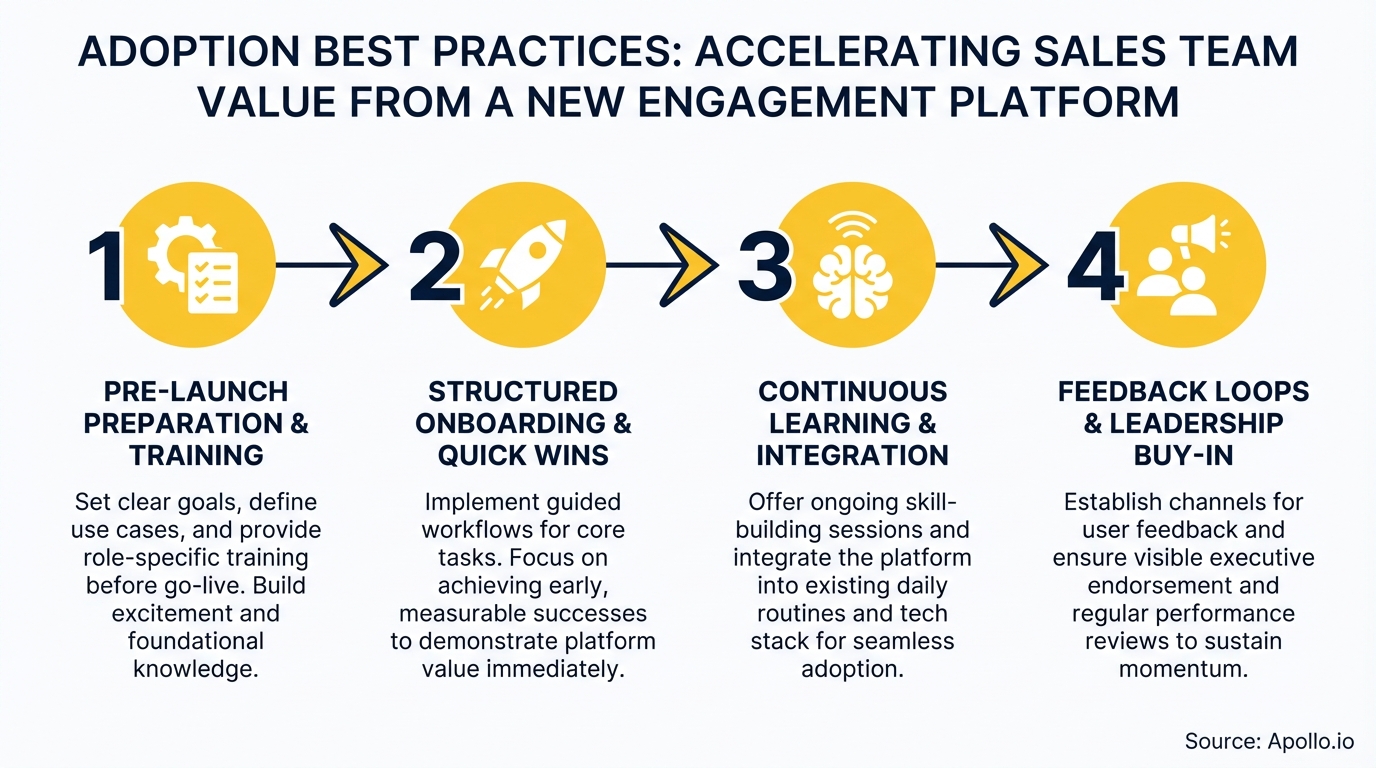
A 30-60-90 day adoption plan structures rollout into three phases: quick wins, habit formation, and optimization. Each phase has a clear owner, measurable output, and a defined go/no-go checkpoint before advancing.
| Phase | Focus | Key Actions | Success Criteria |
|---|---|---|---|
| Days 1–30 | Integration + first sequence live | CRM sync, data hygiene sprint, 1 sequence per role launched | 80%+ of reps enrolled at least one prospect |
| Days 31–60 | Habit formation + measurement | Weekly adoption dashboard review, manager coaching loops, sequence A/B testing | Depth-of-use score improving week-over-week |
| Days 61–90 | AI features + governance | Enable AI-assisted messaging, define sequence governance, run ROI review | Meetings booked and pipeline generated attributable to platform |
For building effective sales cadences, the 30-day mark is the right time to run your first reply-rate analysis and retire underperforming sequences. Don't wait 90 days to iterate.

How Do You Get Lasting Value from a Sales Engagement Platform in 2026?
Lasting value comes from treating adoption as an ongoing operating rhythm, not a launch event. Set quarterly adoption reviews, tie platform activity to quota attainment in your coaching conversations, and continuously rationalize your stack to remove tools that overlap with what your engagement platform already does.
The market is moving fast. Enterprise sales solutions in 2026 are increasingly AI-native, embedding guidance directly inside the rep's workflow rather than requiring separate training sessions. Teams that adopt this model — starting with a small set of high-value workflows and expanding from there — consistently outperform those that launch with full feature sets and no governance.
Apollo's platform is trusted by nearly 100K paying customers, including Anthropic, Smartling, and Redis, who use it to consolidate prospecting, outreach, and pipeline management into one system. If your team is ready to move from scattered tools to a unified GTM workflow, schedule a demo with Apollo and see how fast your team can reach time-to-value.
Prove Pipeline ROI From Day One
ROI pressure killing your tool adoption? Apollo delivers measurable pipeline impact fast — so budget justification writes itself. Leadium 3x'd annual revenue. Your CFO will notice.
Start Free with Apollo →Don't miss these
Sales
Inbound vs Outbound Marketing: Which Strategy Wins?
Sales
What Is a Sales Funnel? The Non-Linear Revenue Framework for 2026
Sales
What Is a Go-to-Market Strategy? The 2026 GTM Playbook
See Apollo in action
We'd love to show how Apollo can help you sell better.
By submitting this form, you will receive information, tips, and promotions from Apollo. To learn more, see our Privacy Statement.
4.7/5 based on 9,690 reviews
