
How to Choose the Right Sales System Software for Your Team
Sales teams in 2026 face a critical challenge: juggling 5-8 disconnected tools drains productivity and inflates costs. According to Cirrus Insight, the CRM software market alone was valued at approximately $71 billion in 2023, yet most teams still patch together separate systems for prospecting, engagement, and deal management. The result? Inconsistent data, wasted time, and missed revenue targets. Modern sales system software consolidates these workflows into one unified platform, giving SDRs, AEs, and RevOps leaders a single workspace to find prospects, run outreach, and close deals faster.

Scale Pipeline Without the Manual Grind
Tired of your reps burning hours on research instead of closing deals? Apollo surfaces verified contacts and automates outreach so your team scales without the busywork. Join 550K+ companies building predictable pipeline.
Start Free with Apollo →Key Takeaways
- Sales system software unifies prospecting, engagement, and deal management in one platform, cutting costs and eliminating tool-switching overhead
- AI-powered workflows automate repetitive tasks like data enrichment and email sequencing, freeing reps to focus on high-value conversations
- Unified systems deliver consistent buyer experiences by syncing messaging across channels and ensuring data accuracy at every touchpoint
- RevOps teams gain real-time visibility into pipeline health and rep performance through centralized analytics dashboards
- Modern platforms replace 3-5 separate tools, delivering measurable time savings and lower total cost of ownership
What Is Sales System Software?
Sales system software is a unified platform that manages the entire revenue workflow, from prospecting to close. It combines contact databases, multi-channel engagement tools, pipeline tracking, and analytics in one system.
Unlike legacy CRM setups that require integrations with separate data providers and outreach tools, modern sales systems deliver everything in a single workspace.
The category includes core capabilities like contact search and enrichment, automated email and call sequences, meeting scheduling, deal management, and forecasting. Leading platforms add AI layers for tasks like email drafting, call summarization, and lead scoring. Research from SkyQuest Technology shows the sales enablement software market reached $6.21 billion in 2024, reflecting strong demand for integrated systems.
For SDRs and BDRs, this means one login to find prospects, launch sequences, and book meetings. For Account Executives, it means pre-call intelligence and deal tracking in the same place they manage outreach.
For RevOps, it means clean data and unified reporting without stitching together exports from multiple tools.
Why Do Sales Teams Need Unified System Software in 2026?
Disconnected tools create three critical problems. First, data silos force reps to manually transfer information between systems, introducing errors and inconsistencies.
Second, context-switching between platforms wastes productive selling time. Third, fragmented tech stacks make it nearly impossible for RevOps to track true pipeline health or attribution.
Buyer expectations have also shifted dramatically. Modern B2B buyers self-serve through most of their research before engaging sales.
They expect consistent messaging across every touchpoint, yet 69% report inconsistencies between vendor websites and what sellers tell them.
Unified sales systems solve this by maintaining a single source of truth for contact data, messaging templates, and deal status.
AI adoption is now mainstream, with 87% of sales organizations using some form of AI for prospecting, forecasting, or content generation. But AI only works when it has access to clean, unified data. Fragmented systems feed AI models incomplete information, producing unreliable outputs. Tired of managing multiple tools and paying for overlapping features? Consolidate your tech stack with Apollo's all-in-one GTM platform.
What Are the Core Components of Sales System Software?
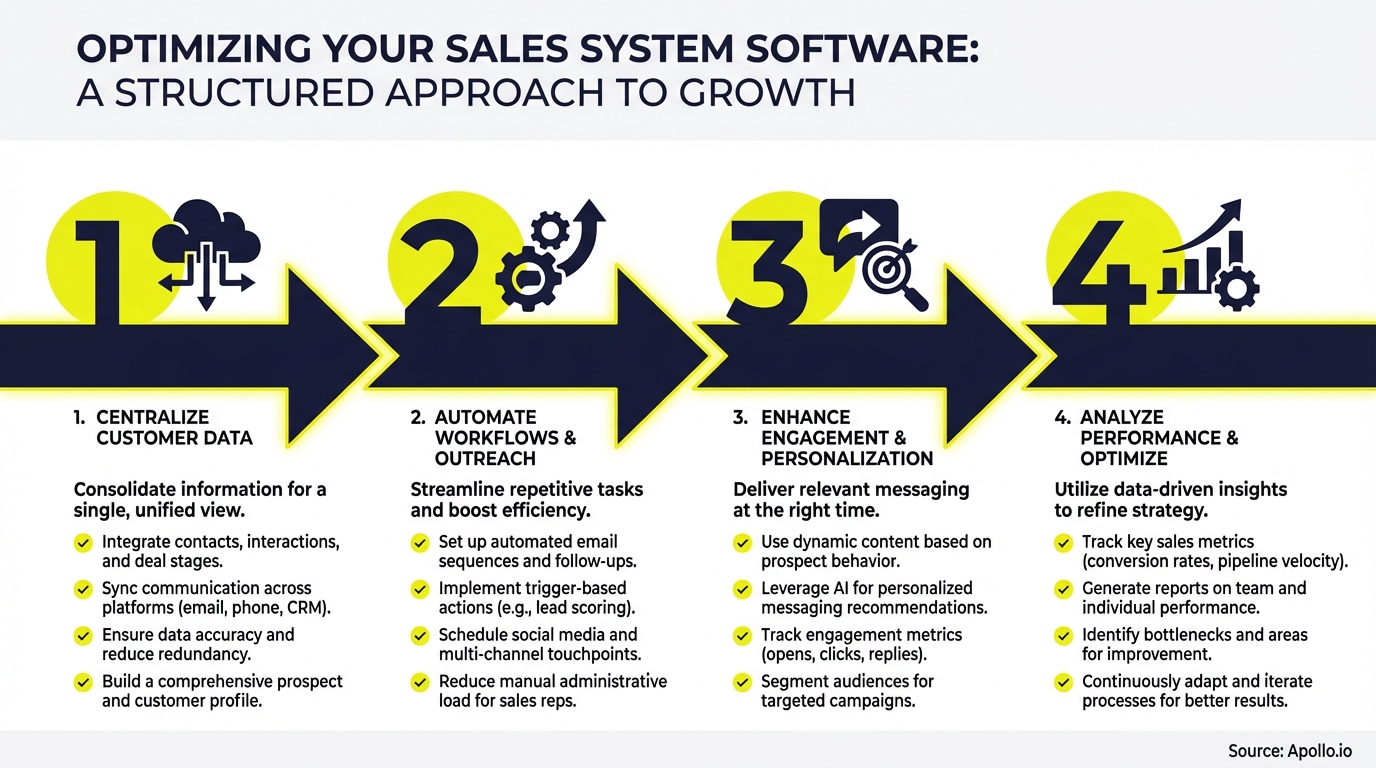
Modern sales systems integrate five essential components. Each addresses a specific workflow stage while sharing data across the entire platform.
Contact Database and Enrichment
A verified B2B contact database with automated enrichment capabilities. Reps search by job title, company size, industry, and technology usage to build targeted prospect lists.
Real-time enrichment adds missing phone numbers, email addresses, and firmographic data without manual lookup.
Multi-Channel Engagement
Automated sequences that combine email, phone, and social outreach.
Reps create templated workflows with personalization variables, A/B testing, and trigger-based actions.
AI assistants draft personalized messages and suggest optimal send times based on historical performance data.
Meeting and Call Management
Calendar scheduling tools that eliminate back-and-forth emails, plus AI-powered call recording and summarization. Conversation intelligence surfaces key topics, competitor mentions, and next steps automatically.
This gives Account Executives complete context before every prospect interaction.
Deal and Pipeline Tracking
Visual pipeline management with customizable stages, deal scoring, and forecasting. RevOps leaders see real-time metrics on pipeline coverage, conversion rates, and rep performance. Deal management software centralizes opportunity tracking and surfaces at-risk deals before they stall.
Analytics and Reporting
Unified dashboards showing activity metrics, conversion funnels, and revenue attribution. Sales leaders identify bottlenecks, coach reps on specific skills, and forecast with confidence.
Custom reports replace manual spreadsheet exports from multiple tools.
Turn Funnel Guesswork Into Pipeline Clarity
Tired of watching marketing leads stall before they ever reach your pipeline? Apollo surfaces in-market buyers and arms your team with the intelligence to act fast. 550K+ companies stopped guessing and started closing.
Start Free with Apollo →How Do SDRs and AEs Use Sales System Software Differently?
SDRs focus on top-of-funnel activities: building prospect lists, running outreach sequences, and booking qualified meetings. They spend most of their time in the prospecting and engagement modules.
Modern systems let SDRs search 224M+ contacts with 65+ filters, launch multi-touch sequences, and track response rates without leaving the platform.
Account Executives prioritize deal progression and relationship management. They use pre-meeting intelligence to research prospects, track deal stages through visual pipelines, and coordinate with internal stakeholders. AEs rely on conversation intelligence to review past calls and identify patterns across successful deals. Struggling to keep your pipeline full of qualified opportunities? Build pipeline faster with Apollo's AI-powered prospecting and engagement tools.
Both roles benefit from shared context. When an SDR books a meeting, the AE inherits complete interaction history: every email sent, call made, and content piece shared.
This eliminates redundant discovery questions and creates smoother handoffs. Sales Leaders and RevOps teams use the same platform to coach reps, analyze win rates, and optimize processes based on real performance data.

What ROI Should Teams Expect from Modern Sales Systems?
Tool consolidation delivers immediate cost savings. Teams replacing 3-5 separate subscriptions with one unified platform typically reduce total software spend.
Census reported cutting costs in half after consolidating tools. Beyond direct savings, unified systems eliminate hidden costs like integration maintenance, duplicate data cleanup, and rep training across multiple platforms.
Time savings compound quickly. Reps save hours per week by eliminating context-switching, manual data entry, and tool-to-tool exports.
Cyera's team noted that having everything in one system was a game changer for productivity. Predictable Revenue reduced the complexity of three tools into one, streamlining their entire revenue workflow.
Revenue impact comes from faster ramp times, higher activity levels, and better conversion rates. New hires become productive in weeks instead of months when they only need to learn one platform. Sales automation software lets reps focus on conversations instead of administrative tasks. Clean, unified data improves lead scoring accuracy and helps teams prioritize the highest-value opportunities.
How Should RevOps Leaders Evaluate Sales System Software?
Start with data quality and coverage. Verify database size, accuracy rates, and update frequency.
Test search filters and enrichment capabilities with your specific ICP criteria. Poor data quality undermines every downstream workflow, from segmentation to personalization.

Assess workflow integration depth. The best systems connect prospecting, engagement, and deal management in a single user experience, not just through API integrations.
Look for features like one-click prospect-to-sequence workflows and automatic activity logging. Evaluate how the platform handles handoffs between SDRs and AEs.
Examine AI capabilities and governance. Modern systems embed AI throughout the platform, from email drafting to call summarization. Verify that AI features use your specific data context, not generic models. Check for controls around AI-generated content approval and brand voice consistency. According to Grand View Research, the sales enablement platform market is projected to reach $12.78 billion by 2030, with AI integration driving much of that growth.
Consider total cost of ownership beyond seat licenses. Factor in implementation time, training requirements, data migration costs, and ongoing maintenance.
Unified platforms typically deliver faster time-to-value than patchwork stacks requiring custom integrations. Review vendor roadmaps to ensure the platform keeps pace with emerging capabilities like agentic AI workflows.
Unify Your Sales System and Cut Your Tech Stack in 2026
Sales system software has evolved from basic CRM functionality to comprehensive revenue platforms that unify prospecting, engagement, and deal management. Teams at every stage benefit: SDRs book more meetings with less manual research, Account Executives close deals faster with complete buyer context, and RevOps leaders gain visibility into true pipeline health.
The shift to unified systems reflects broader market trends: AI becoming standard across sales workflows, buyers demanding consistent experiences, and organizations prioritizing ROI over feature checklists. Platforms that consolidate multiple tools into one workspace deliver measurable time savings, lower costs, and cleaner data.
For teams evaluating options in 2026, prioritize platforms that combine verified contact data, multi-channel engagement, AI-powered workflows, and deal management in a single user experience. Test how well the system handles your specific use cases, from outbound prospecting to enterprise deal cycles. The right sales system software becomes your competitive advantage, freeing reps to focus on what matters most: building relationships and closing revenue.
Ready to replace your fragmented tech stack with a unified platform? Start a Trial with Apollo and see how 90K+ paying customers consolidate prospecting, engagement, and deal management in one workspace.
Prove Pipeline ROI Without the Wait
Budget approval stuck on unclear metrics? Apollo delivers measurable pipeline impact from day one — real meetings, real revenue, real proof. Leadium 3x'd annual revenue. Your CFO wants numbers. Apollo gives you them.
Start Free with Apollo →Don't miss these
Sales
Inbound vs Outbound Marketing: Which Strategy Wins?
Sales
What Is a Sales Funnel? The Non-Linear Revenue Framework for 2026
Sales
What Is a Go-to-Market Strategy? The 2026 GTM Playbook
See Apollo in action
We'd love to show how Apollo can help you sell better.
By submitting this form, you will receive information, tips, and promotions from Apollo. To learn more, see our Privacy Statement.
4.7/5 based on 9,690 reviews
