
Sales Spreadsheet: Best Practices for Revenue Tracking and Forecasting
Sales spreadsheets remain the backbone of revenue operations in 2026, despite the proliferation of specialized sales tools. According to Markets and Markets, 66% of companies still utilize spreadsheet-based forecasting. While spreadsheets offer flexibility and familiarity, they're increasingly strained by complex buying committees, data quality issues, and the need for real-time collaboration. Modern sales teams need to understand both the enduring value of spreadsheets and when to evolve beyond them with integrated sales analytics platforms.

Scale Quality Lead Gen With Apollo's AI
Tired of slow lead generation limiting your pipeline? Apollo's AI Research Agent finds your exact ICP at scale with 96% email accuracy. Built-In increased win rates 10% using Apollo's scoring and signals.
Start Free with Apollo →Key Takeaways
- Sales spreadsheets are still used by 66% of companies for forecasting, but manual data entry creates accuracy issues
- AI-powered spreadsheet features (Excel Agent Mode, Google Sheets AI) are transforming traditional workflows in 2026
- Poor data quality from spreadsheets costs B2B organizations an average of 12% of revenue
- Modern sales teams benefit from hybrid approaches that combine spreadsheet flexibility with automated data enrichment
- RevOps leaders are consolidating tech stacks by moving from disconnected spreadsheets to unified platforms
What Is a Sales Spreadsheet?
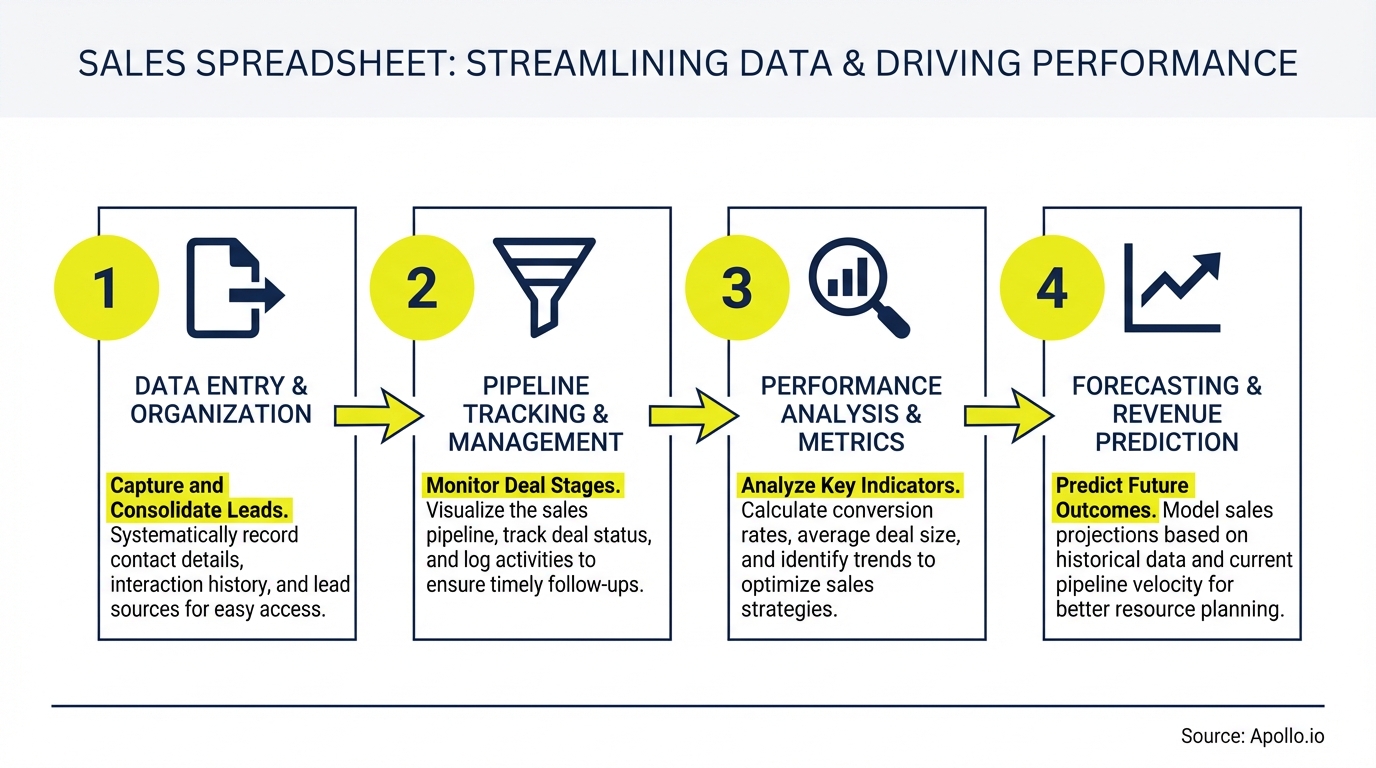
A sales spreadsheet is a grid-based document (typically Excel or Google Sheets) used to track, analyze, and manage sales data. It serves as a lightweight alternative to full CRM systems, containing information about prospects, deals, activities, forecasts, and pipeline metrics.
Sales spreadsheets typically include columns for contact details, company information, deal stage, value, close date, and next actions.
The versatility of spreadsheets makes them popular across sales roles. SDRs use them for prospect tracking and outreach logging. Account Executives maintain deal status and forecast projections. Sales Leaders build territory models and quota assignments. Research from Nockpoint shows that Excel remains the most widely used planning application, employed by 52% of organizations.
Why Do Sales Teams Still Use Spreadsheets in 2026?
Sales spreadsheets persist because they offer unmatched flexibility and zero learning curve. Teams can customize layouts instantly, build complex formulas, and share files without software procurement. According to Sellers Commerce, nearly half of smaller businesses (those with fewer than 10 employees) continue to forgo CRM adoption, often due to limited budgets, lack of technical expertise, or reliance on simpler tools like spreadsheets.
Key reasons for continued spreadsheet usage include:
- No subscription costs: Excel and Google Sheets come bundled with existing software licenses
- Instant customization: Teams can modify structure without developer support or admin permissions
- Universal familiarity: Every business professional knows basic spreadsheet operations
- Ad-hoc analysis: Quick pivots, filters, and formulas for territory planning and commission calculations
- Offline access: Work continues without internet connectivity
In 2026, Microsoft's Excel Agent Mode and Google's AI-enhanced Sheets functions have extended spreadsheet relevance by adding natural-language formula generation and automated data summarization.
What Are the Critical Problems with Sales Spreadsheets?
While familiar and flexible, sales spreadsheets create significant revenue risks through data quality issues, version control chaos, and manual entry errors. Marketing LTB reports that poor data quality costs B2B organizations an average of 12% of their revenue.
Major spreadsheet challenges include:
- Manual data entry errors: Typos, outdated information, and inconsistent formatting plague accuracy
- Version control nightmares: Multiple copies circulating via email create conflicting truth sources
- Limited collaboration: Simultaneous editing conflicts and no audit trail for changes
- No integration: Disconnected from email, calendar, and communication tools
- Scalability limits: Performance degrades with large datasets (10,000+ rows)
- Security vulnerabilities: Sensitive deal data shared via email attachments
Research from Demand Gen Report shows that approximately 75% of survey respondents in a 2025 report estimated that at least 10% of their lead data is inaccurate, outdated, or non-compliant.
Tired of manual data entry killing your forecast accuracy? Start free with Apollo's 224M+ verified contacts and automatic data enrichment.
Turn Forecast Guesswork Into Revenue Clarity
Pipeline forecasting a guessing game? Apollo's real-time deal tracking and lead scoring give you accurate visibility into every stage. Built-In boosted win rates 10% using Apollo's signals and guidance.
Start Free with Apollo →How Do RevOps Leaders Modernize Sales Spreadsheets?
RevOps leaders in 2026 take a hybrid approach that preserves spreadsheet flexibility while eliminating data quality risks. Rather than forcing full CRM migration, they implement data enrichment layers and two-way sync connections.
This strategy maintains the familiar spreadsheet interface while ensuring data accuracy and real-time updates.
Modern spreadsheet optimization strategies include:
- Automated data enrichment: API connections that populate contact details, company data, and firmographics
- CRM sync layers: Bidirectional updates between spreadsheets and systems of record
- Validation rules: Drop-down lists, data types, and conditional formatting to enforce consistency
- Template standardization: Company-wide formats with locked columns and pre-built formulas
- Cloud collaboration: Google Sheets or Office 365 for real-time multi-user editing
- Version control: Named versions, change logs, and rollback capabilities
For Account Executives managing complex deals, Apollo's deal management platform provides spreadsheet-like flexibility with built-in data accuracy and pipeline visibility.

What Sales Spreadsheet Templates Work Best in 2026?
Effective sales spreadsheet templates in 2026 balance simplicity with functionality.
The best templates include clear column headers, data validation rules, conditional formatting for visual pipeline stages, and separate tabs for different sales functions.
Templates should support both individual contributor workflows and leadership reporting needs.
| Template Type | Primary Users | Key Columns | Best For |
|---|---|---|---|
| Prospect Tracker | SDRs, BDRs | Name, Company, Title, Email, Phone, Status, Last Touch, Next Action | Outbound prospecting campaigns |
| Pipeline Manager | Account Executives | Deal Name, Company, Value, Stage, Close Date, Probability, Owner | Opportunity tracking and forecasting |
| Activity Log | All Sales Roles | Date, Contact, Activity Type, Outcome, Notes, Follow-up Date | Call logging and email tracking |
| Territory Plan | Sales Leaders | Account Name, Segment, Owner, ARR, Renewal Date, Health Score | Account assignment and quota allocation |
| Commission Calculator | Sales Ops | Rep Name, Quota, Attainment %, Base, Variable, Total Comp | Compensation planning and tracking |
Teams should integrate these templates with modern sales tech stacks to automate data population and reduce manual entry.
When Should Sales Teams Move Beyond Spreadsheets?
Sales teams should transition from spreadsheets to integrated platforms when data quality issues impact revenue, collaboration breaks down across departments, or manual processes consume selling time. The tipping point typically occurs at 10-15 sales reps or when forecast accuracy falls below 80%.
Clear signals it's time to evolve include:
- Forecast misses: According to Challenger, only 20% of sales organizations achieved forecasts within 5% of projections, while 43% missed their goal by 10% or more
- Data entry time: Reps spending more than 30 minutes daily on manual updates
- Version conflicts: Multiple spreadsheet copies causing confusion about current pipeline state
- Integration needs: Requiring data from email, calendar, and communication platforms
- Reporting delays: Leadership waiting days for consolidated reports
- Compliance risks: Inability to track data access and changes for audit purposes
For growing teams, platforms like Apollo consolidate prospect data, engagement tracking, and pipeline management into one workspace. "We reduced the complexity of three tools into one," reports Collin Stewart from Predictable Revenue. This consolidation approach maintains spreadsheet-like flexibility while eliminating data quality issues and manual entry work.

Move Beyond Spreadsheet Limitations
Sales spreadsheets remain valuable for their flexibility and familiarity, but modern revenue teams need more than static grids. The future belongs to hybrid approaches that preserve spreadsheet simplicity while adding automated data enrichment, real-time collaboration, and seamless integration with your tech stack.
RevOps leaders in 2026 focus on tool consolidation rather than adding complexity. Instead of maintaining disconnected spreadsheets alongside multiple point solutions, they're adopting unified platforms that deliver spreadsheet-like usability with enterprise-grade data quality. "Having everything in one system was a game changer," notes the team at Cyera.
Ready to eliminate manual data entry while keeping the flexibility you need? Start free with Apollo and discover how 90K+ sales teams consolidate their tech stack without sacrificing control.
Prove Apollo's ROI In Your First 30 Days
Budget approvals stuck on unclear metrics? Apollo tracks every touchpoint from prospect to closed deal, showing exactly what's working. Built-In increased win rates 10% and ACV 10% using Apollo's signals and guidance.
Start Free with Apollo →Don't miss these
Sales
Inbound vs Outbound Marketing: Which Strategy Wins?
Sales
What Is a Sales Funnel? The Non-Linear Revenue Framework for 2026
Sales
What Is a Go-to-Market Strategy? The 2026 GTM Playbook
See Apollo in action
We'd love to show how Apollo can help you sell better.
By submitting this form, you will receive information, tips, and promotions from Apollo. To learn more, see our Privacy Statement.
4.7/5 based on 9,690 reviews
