
What Is Sales Proposal Automation? Benefits, Tools, and Best Practices for 2026
Sales proposal automation is no longer a competitive advantage — it's the new baseline. The proposal management software market is expected to reach $3.22 billion in 2026, according to The Business Research Company. Meanwhile, proposal workloads keep climbing: Responsive.io reports that 77% of bid and proposal professionals experienced a workload increase in the past year. Teams that don't automate are falling behind fast. Understanding how sales automation works is the first step toward reclaiming that time.

Apollo Turns Research Hours Into Pipeline
Tired of burning your best selling hours on manual lead research and dead-end contact data? Apollo surfaces verified contacts instantly so your team sells instead of searches. Join 550K+ companies building predictable pipeline.
Start Free with Apollo →Key Takeaways
- Sales proposal automation uses software to generate, personalize, and send proposals — cutting manual effort and cycle time across your entire pipeline.
- AEs and RevOps leaders report measurable gains in win rates and productivity when AI is embedded in the proposal workflow.
- Governance and content quality — not just speed — are the primary ROI drivers in 2026.
- A 90-day implementation plan with clear KPI benchmarks prevents the "proof-of-concept trap" that stalls most automation projects.
- Connecting proposal automation to your CRM and deal management system turns proposals into a measurable revenue channel.
What Is Sales Proposal Automation?
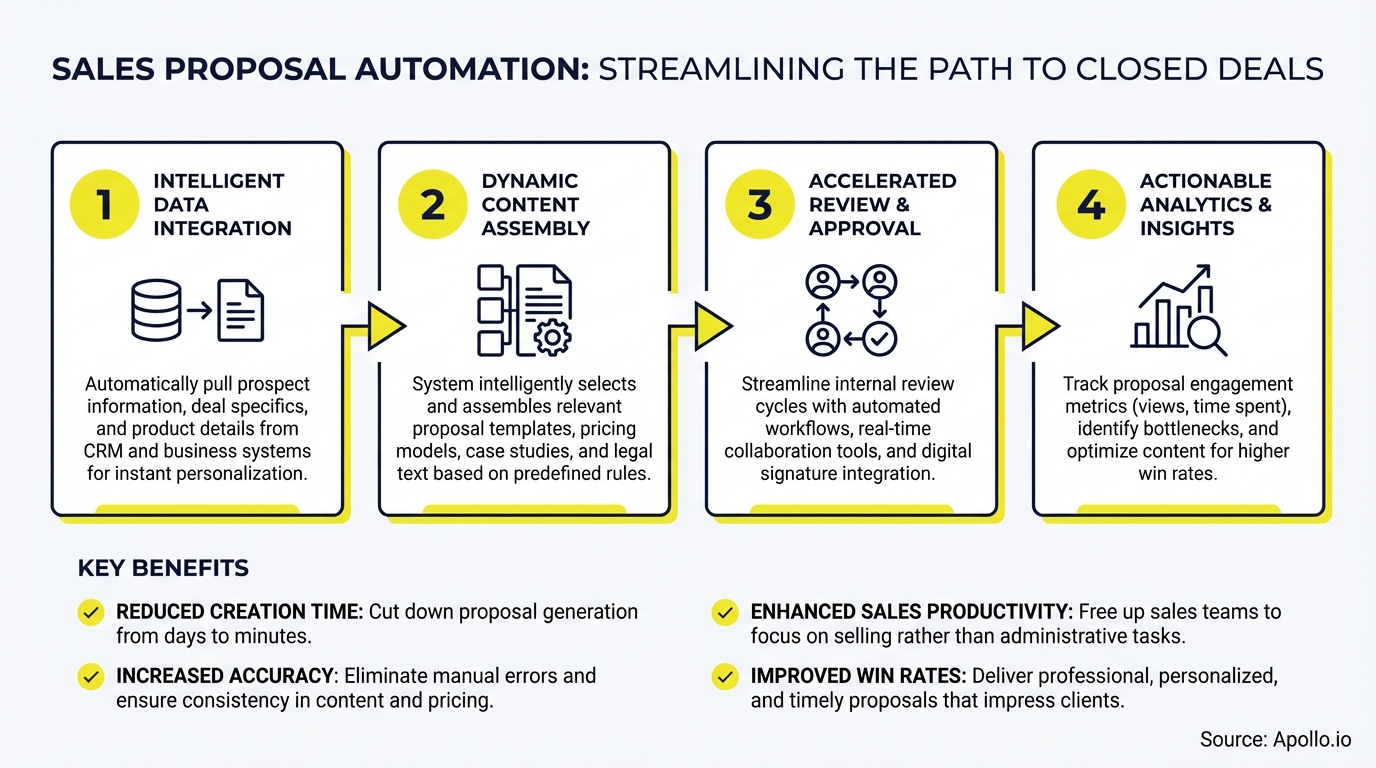
Sales proposal automation is the use of software to streamline the creation, personalization, delivery, and tracking of sales proposals.
It replaces manual document assembly with templated workflows, pre-approved content libraries, AI-assisted drafting, and CRM-connected data pulls.
Proposal automation is not the same as document generation or mail merge. Where document generation simply fills in names and dates, proposal automation orchestrates the full workflow: content selection, pricing logic, compliance review, approval routing, delivery, and analytics. The distinction matters because teams often underinvest in governance and integration when they mistake one for the other.
Key components in a complete proposal automation system:
- Content library: Approved, version-controlled blocks (case studies, pricing tiers, security questionnaires)
- Template engine: Role- and deal-stage-specific proposal structures
- CRM integration: Auto-populates contact, company, and deal data
- AI drafting layer: Generates first drafts from deal context and approved content
- Approval and audit trail: Routes proposals through required reviewers with version history
Why Does Sales Proposal Automation Matter in 2026?
The market signals are clear. According to Business Research Insights, the global sales proposal automation software market was USD 7.87 billion in 2024 and is expected to reach USD 15.86 billion by 2033. Budget is flowing into this category because the ROI is measurable — and the cost of inaction is rising.
Consider the workload reality: the average B2B sales cycle stretched to 6.5 months in 2023, per TryKondo's B2B Sales Report. Every week a proposal sits unfinished or undelivered extends that cycle further. Automation compresses the proposal stage without sacrificing quality — when done with proper governance.
The 2026 shift is also structural. AI features in proposal platforms are moving from opt-in experiments to default capabilities.
Governance — content approval rules, audit trails, data quality controls — is now the gating factor between teams that scale and teams that stall.
How Do AEs and RevOps Leaders Use Proposal Automation?
For Account Executives, proposal automation eliminates the hours spent assembling slides, pulling pricing from spreadsheets, and chasing approvals.
AEs can launch a customized, on-brand proposal in minutes by selecting a template, confirming CRM-populated fields, and triggering the approval workflow.
RevOps leaders use proposal automation differently: as a data system. Every proposal becomes a trackable event — sent, opened, time-on-section, accepted, declined. This feeds sales analytics and pipeline forecasting with real buyer engagement signals rather than rep-reported guesses.
| Role | Primary Use Case | Key Metric |
|---|---|---|
| Account Executive | Fast, personalized proposal creation | Proposal-to-close cycle time |
| RevOps | Pipeline analytics and content governance | Content reuse rate, win rate by template |
| Sales Leader | Consistency, compliance, and coaching | Approval turnaround time, proposal quality score |
| Founder / CEO | Faster deal cycles, lower headcount dependency | Revenue per rep, ramp time |
Struggling to build pipeline before proposals even get sent? Build and qualify your pipeline with Apollo's AI-powered pipeline builder so your AEs only send proposals to high-fit opportunities.
Turn Funnel Guesswork Into Closed Deals
Tired of watching marketing leads die before they ever reach your pipeline? Apollo surfaces quality prospects and real buying signals so your team stops chasing dead ends. Over 550K+ companies now forecast with confidence.
Schedule a Demo →What Are the Core Benefits of Sales Proposal Automation?
The benefits fall into three measurable categories: speed, quality, and governance.

- Speed: Sales teams that automate manual tasks save an average of 6 hours per week per representative, according to Reporder Management. For proposal-heavy roles, that reclaimed time goes directly to customer-facing activity.
- Quality: Consistent templates and approved content libraries eliminate the version-control chaos that causes errors, outdated pricing, and off-brand messaging in proposals.
- Governance: Audit trails, approval workflows, and content versioning reduce legal and compliance risk — critical for enterprise deals involving security questionnaires or regulatory requirements.
- Win rate improvement: Companies that use AI in their sales process experience a 15% increase in win rates and a 14% increase in productivity, per AI-Bees.
- Analytics: Proposal tracking surfaces which content sections buyers spend time on — intelligence that sharpens future proposals and informs sales pitch techniques.
How Do You Implement Sales Proposal Automation in 90 Days?
Most proposal automation projects fail at proof-of-concept because teams skip governance setup and jump straight to AI generation. A phased 90-day blueprint prevents that.
Days 1–30: Foundation
- Audit existing proposals: identify top 5 templates by deal type
- Establish content library with approved blocks (pricing, case studies, security)
- Map CRM fields that should auto-populate into proposals
- Define approval routing rules and required reviewers per deal size
Days 31–60: Integration and Piloting
- Connect proposal tool to CRM and sales workflow automation platform
- Run a pilot with 3–5 AEs on one deal type
- Measure baseline: proposal creation time, approval turnaround, open rates
- Validate AI-drafted content against approved library — never skip human review
Days 61–90: Scale and Govern
- Roll out to full team with role-based training
- Publish a KPI dashboard: cycle time, content reuse rate, win rate by template
- Assign a content owner for quarterly library reviews
- Set a governance policy: no AI-generated content ships without one human approval step
This phased approach directly addresses the risk Gartner flagged: at least 30% of GenAI projects are abandoned after proof-of-concept due to poor data quality and unclear business value. Starting with governance — not generation — keeps your project on track.
Spending too much time on manual outreach while proposals sit in draft? Automate your full sales workflow with Apollo's AI sales automation platform and free your AEs for high-value deal work.
What Should You Look for in a Sales Proposal Automation Tool?
Vendor selection should be KPI-driven, not feature-driven. Evaluate tools against the outcomes you need, not the demo they show.
| Evaluation Criterion | What to Verify |
|---|---|
| CRM integration depth | Bi-directional sync, not just data import |
| Content governance | Approval workflows, version control, audit trail |
| AI generation controls | Can you restrict AI to approved library content only? |
| Analytics | Proposal-level engagement data (opens, time-on-section) |
| Security and compliance | Data residency options, access controls, SSO support |
| Pricing transparency | Per-seat vs. usage-based — model total cost at scale |
Connecting proposal automation to a broader sales workflow and CRM automation system ensures proposals don't sit in a silo. The strongest setups trigger follow-up sequences automatically when a proposal is opened, flagged, or expired — turning a document event into a pipeline signal.

Start Automating Your Sales Proposals Today
Sales proposal automation in 2026 is a revenue operations discipline, not a document shortcut. The teams winning on proposals are the ones with governed content libraries, CRM-connected workflows, and KPI dashboards that treat every proposal as a measurable performance event.
Apollo's AI sales automation platform connects prospecting, engagement, and deal management in one unified workspace — so your AEs spend less time on manual tasks and more time closing. As Cyera's team put it: "Having everything in one system was a game changer."
Start a free trial with Apollo and build the automated sales workflow your proposals deserve.
Apollo Proves ROI Before Budget Asks
ROI pressure killing tool adoption? Apollo delivers measurable pipeline impact fast — so your next budget conversation is a formality, not a fight. Leadium 3x'd their revenue. You're next.
Start Free with Apollo →Don't miss these
Sales
Inbound vs Outbound Marketing: Which Strategy Wins?
Sales
What Is a Sales Funnel? The Non-Linear Revenue Framework for 2026
Sales
What Is a Go-to-Market Strategy? The 2026 GTM Playbook
See Apollo in action
We'd love to show how Apollo can help you sell better.
By submitting this form, you will receive information, tips, and promotions from Apollo. To learn more, see our Privacy Statement.
4.7/5 based on 9,690 reviews
