
Sales Planning Software: Definition, Features, and Best Practices
Sales teams waste hours juggling spreadsheets, CRM updates, and forecasting tools that don't talk to each other. Sales planning software consolidates territory management, quota setting, pipeline forecasting, and performance tracking into one platform. According to Gartner's CRM forecast analysis, the sales software market will grow at a 12.8% CAGR through 2029, driven by AI integration and demand for unified sales automation software.

Scale Your Team Without The Growing Pains
Tired of inconsistent processes slowing down your growing team? Apollo standardizes workflows and automates lead research so every rep performs like your best. Join 550K+ companies scaling efficiently.
Start Free with Apollo →Key Takeaways
- Sales planning software centralizes territory design, quota planning, and forecasting in one workspace, replacing 3-5 disconnected tools.
- AI-powered platforms deliver predictive insights, automated data enrichment, and real-time pipeline visibility for faster decision-making.
- RevOps teams report significant time savings and improved forecast accuracy when consolidating their tech stack.
- Modern solutions integrate with CRMs to sync data automatically, eliminating manual updates and spreadsheet chaos.
- Effective implementation requires data readiness planning, change management, and clear governance frameworks.
What Is Sales Planning Software?
Sales planning software is a platform that helps sales leaders design territories, set quotas, forecast revenue, and track team performance. It replaces manual spreadsheets and disconnected tools with automated workflows and real-time analytics.
The software connects to your CRM and other data sources to provide a single source of truth for planning decisions.
Core capabilities include territory mapping, quota allocation, capacity planning, pipeline forecasting, and performance dashboards. Modern platforms add AI-driven recommendations for territory balance, predictive analytics for quota achievement, and automated alerts when deals slip.
Sales leaders use these tools to align resources with revenue targets and adjust plans as market conditions change.
How Does Sales Planning Software Work?
Sales planning software pulls data from your CRM, marketing automation, and business intelligence systems. It analyzes account data, historical performance, and market signals to recommend territory assignments and quota distributions.
The platform then tracks actuals against plan, flagging gaps and suggesting rebalancing actions.
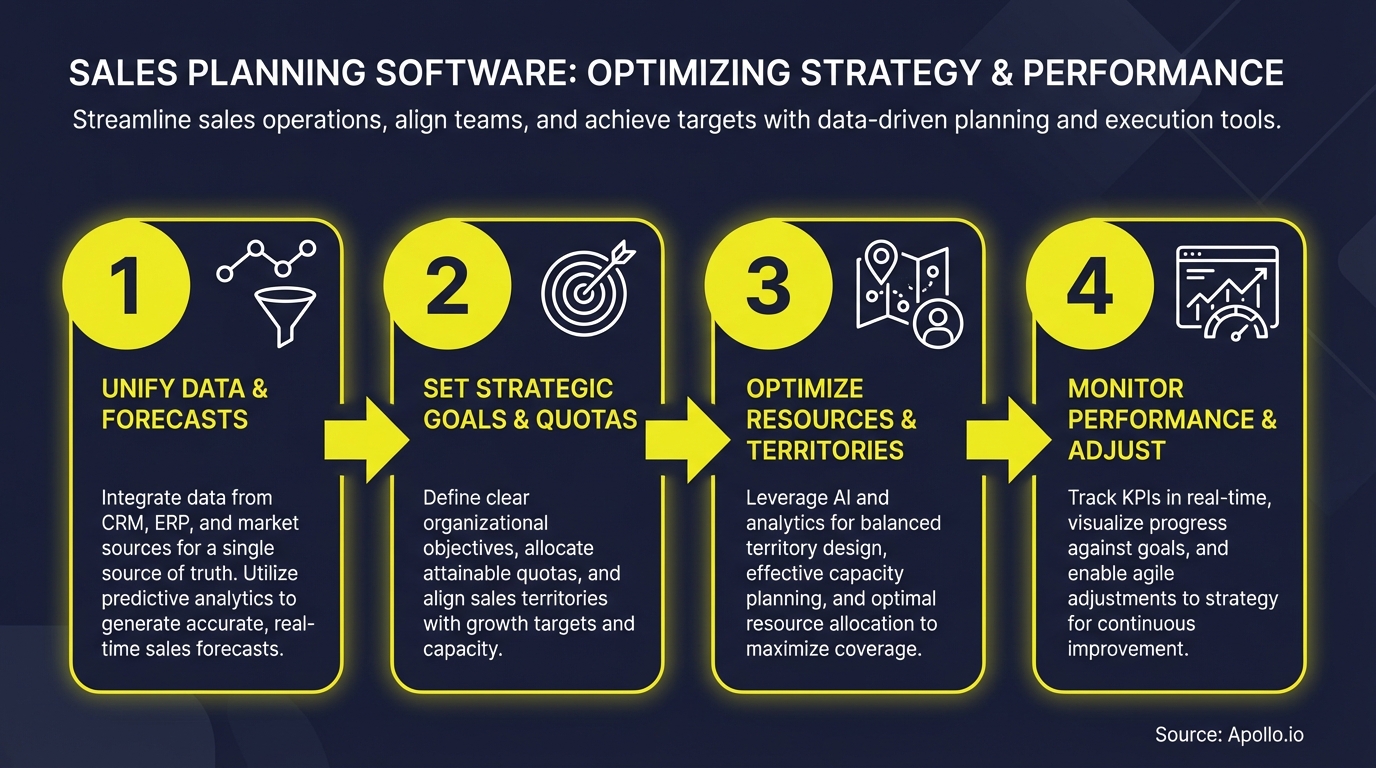
The workflow starts with data integration. The software syncs contacts, accounts, opportunities, and closed deals from your CRM.
Next, you define planning parameters like sales regions, team structure, and revenue targets. The system applies optimization algorithms to balance territories by potential, workload, and coverage.
Finally, it monitors execution through dashboards showing quota attainment, pipeline health, and forecast accuracy.

Struggling to maintain accurate pipeline visibility across teams? Get real-time deal tracking and forecasting with Apollo's deal management platform.
Why Do Sales Leaders Need Planning Software in 2026?
Sales organizations face mounting pressure to do more with less while hitting aggressive growth targets. Data from Gartner's B2B marketing research shows that 92% of businesses are investing in AI-powered software to improve operational efficiency. Manual planning methods can't keep pace with market volatility, distributed teams, and complex buyer journeys.
Key drivers include:
- Revenue predictability: Accurate forecasting helps leaders allocate budgets and resources confidently.
- Territory optimization: Balanced assignments prevent account overlap and maximize coverage.
- Quota fairness: Data-driven quota setting reduces disputes and improves rep morale.
- Faster replanning: Market shifts require quick territory adjustments that spreadsheets can't handle.
- Tech stack consolidation: Unified platforms replace separate tools for territory management, quota planning, and forecasting.
RevOps leaders report measurable improvements in forecast accuracy and time savings when moving from spreadsheets to purpose-built platforms. For example, Census cut costs in half by consolidating sales tools, while Cyera found that having everything in one system was a game changer for team alignment.
What Features Should Sales Planning Software Include?
Effective sales planning software combines territory design, quota management, forecasting, and analytics in one workspace. Look for platforms that integrate seamlessly with your CRM and provide both strategic planning tools and tactical execution dashboards.
| Feature Category | Core Capabilities | Business Impact |
|---|---|---|
| Territory Management | Geographic mapping, account assignment, workload balancing, what-if scenarios | Eliminates coverage gaps, reduces overlap, optimizes rep capacity |
| Quota Planning | Top-down and bottom-up modeling, historical analysis, quota allocation, approval workflows | Fair quota distribution, faster planning cycles, reduced rep disputes |
| Pipeline Forecasting | AI-driven predictions, scenario modeling, risk assessment, deal scoring | Improved forecast accuracy, early risk identification, confident commitments |
| Performance Analytics | Real-time dashboards, quota attainment tracking, trend analysis, drill-down reporting | Data-driven coaching, proactive interventions, transparent accountability |
| CRM Integration | Bi-directional sync, automated data updates, field mapping, conflict resolution | Single source of truth, eliminated manual entry, consistent data across systems |
Advanced platforms include AI sales tools that predict territory performance, recommend quota adjustments, and surface at-risk deals automatically. Integration with conversation intelligence and sales coaching software creates a complete planning and execution ecosystem.
Stop Guessing—Get Real-Time Pipeline Clarity
Missing in-market buyers while competitors close deals? Apollo reveals which prospects are ready to buy right now with intent signals and visitor tracking. Built-In increased win rates 10% with Apollo's scoring.
Start Free with Apollo →How Do Account Executives Benefit From Planning Software?
Account Executives gain clearer territory visibility, better pipeline insights, and more predictable quota attainment when their organization uses sales planning software. The platform eliminates confusion about account ownership and provides real-time data on deal progress and forecast status.
AEs see specific benefits:
- Territory clarity: Know exactly which accounts you own and where boundaries exist.
- Pipeline health checks: Dashboards show coverage ratios, deal velocity, and risk factors.
- Forecast confidence: AI-powered predictions help you commit to numbers you can hit.
- Performance benchmarking: Compare your results against team averages and top performers.
- Mobile access: Review territory data and update forecasts from anywhere.
For Account Executives managing complex enterprise deals, integrated platforms provide pre-meeting intelligence and account insights that shorten sales cycles. Tools like conversation intelligence software capture deal context that feeds back into planning systems for better forecasting.
What Implementation Steps Ensure Planning Software Success?
Successful deployments follow a phased approach: data preparation, pilot testing, full rollout, and ongoing optimization. Sales leaders who skip data cleansing or change management face adoption challenges and inaccurate insights.
Phase 1: Data Readiness (Weeks 1-2)
- Audit CRM data quality and completeness
- Standardize account fields, opportunity stages, and territory definitions
- Map data fields between source systems and planning platform
- Establish governance rules for data ownership and updates
Phase 2: Pilot Program (Weeks 3-6)
- Select one region or team for initial rollout
- Configure territory boundaries and quota allocations
- Train pilot users on core workflows and dashboards
- Gather feedback and refine configurations
Phase 3: Full Deployment (Weeks 7-10)
- Roll out to remaining teams with staggered onboarding
- Integrate with supporting systems (BI tools, compensation platforms)
- Establish reporting cadences and review processes
- Document best practices and create training resources
Phase 4: Continuous Improvement (Ongoing)
- Monitor adoption metrics and user satisfaction
- Refine territory boundaries based on performance data
- Add new data sources and automation rules
- Expand use cases (capacity planning, compensation modeling)
Spending hours building territories in spreadsheets every quarter? Streamline your go-to-market planning with Apollo's unified revenue operations platform.
How Should Sales Leaders Evaluate Planning Software Options?
Start by defining your must-have capabilities based on team size, sales model, and planning complexity. Create a scorecard that weights factors like ease of use, integration capabilities, AI features, and total cost of ownership.
Key evaluation criteria:
- CRM compatibility: Native integrations with Salesforce, HubSpot, or your existing CRM
- User experience: Intuitive interface that reduces training time and increases adoption
- Scalability: Supports your current team size and future growth plans
- AI capabilities: Predictive analytics, automated recommendations, anomaly detection
- Customization: Flexible workflows, custom fields, and configurable dashboards
- Support and training: Onboarding resources, documentation, and responsive customer success
- Total cost: Subscription fees, implementation costs, and ongoing maintenance expenses
Request demos that focus on your specific use cases rather than generic feature tours. Test the platform with your actual data during proof-of-concept trials.
Talk to reference customers in similar industries and company sizes to understand real-world performance.
Consider consolidation opportunities. Predictable Revenue reduced the complexity of three tools into one, while Census cut costs in half by replacing multiple point solutions. Look for platforms that combine territory management, quota planning, forecasting, and sales analytics capabilities.
Start Planning Smarter in 2026
Sales planning software transforms territory management, quota setting, and forecasting from manual chores into strategic advantages. The right platform consolidates your tech stack, improves forecast accuracy, and gives your team clear visibility into performance and pipeline health.
Focus on solutions that integrate seamlessly with your CRM, provide AI-driven insights, and scale with your organization. Successful implementations prioritize data quality, change management, and ongoing optimization.
Sales leaders who invest in purpose-built planning tools report faster planning cycles, fairer quota distributions, and more predictable revenue outcomes.
Ready to consolidate your sales tech stack and accelerate pipeline growth? Try Apollo Free and discover how an all-in-one GTM platform replaces 3-5 separate tools while delivering 224M+ verified contacts, AI-powered automation, and complete deal visibility in one workspace.
Prove Apollo's ROI In Your First 30 Days
Budget approval stuck on unclear metrics? Apollo tracks every dollar spent to pipeline generated with built-in ROI dashboards. Customer. io achieved 50% YoY growth with measurable impact.
Start Free with Apollo →Don't miss these
Data
How to Structure a Marketing Team That Actually Drives Revenue in 2026
Data
Solving Data Synchronization Headaches Across Multiple Business Systems
Data
What Marketing Metrics Should B2B Teams Track in 2026?
See Apollo in action
We'd love to show how Apollo can help you sell better.
By submitting this form, you will receive information, tips, and promotions from Apollo. To learn more, see our Privacy Statement.
4.7/5 based on 9,690 reviews
