
What Are Sales Pipeline Management Tools? RevOps Playbook for 2026
Most sales teams don't have a pipeline problem — they have a governance problem. Deals stall, forecasts miss, and data goes stale because no one owns the definitions, the data fields, or the workflows inside their deal management software. The result: wasted spend on tools that never reach their potential.
This playbook covers what sales pipeline management tools actually do, how to govern them properly, and how RevOps leaders can build a stack that scales — from prospecting through close.

Apollo Turns Research Into Revenue
Tired of your reps burning hours verifying contact info instead of closing deals? Apollo surfaces accurate, ready-to-work leads instantly. Join 550K+ companies building predictable pipeline without the manual grind.
Start Free with Apollo →Key Takeaways
- Sales pipeline management tools track, automate, and forecast every deal from first touch to closed-won — but only work when governed with clear ownership and data standards.
- A Bain & Company survey found 70% of companies fail to effectively integrate sales plays into CRM and revenue technologies, leaving most of their tool investment unrealized.
- RevOps leaders need role-based dashboards: reps need activity metrics, managers need conversion rates, and finance needs forecast accuracy.
- AI adoption in pipeline tools is accelerating fast, but Gartner reports only 23% of CSOs own AI selection — creating governance gaps that slow deployment.
- Consolidating your sales tech stack into one platform cuts integration overhead and improves data quality across every pipeline stage.
What Are Sales Pipeline Management Tools?
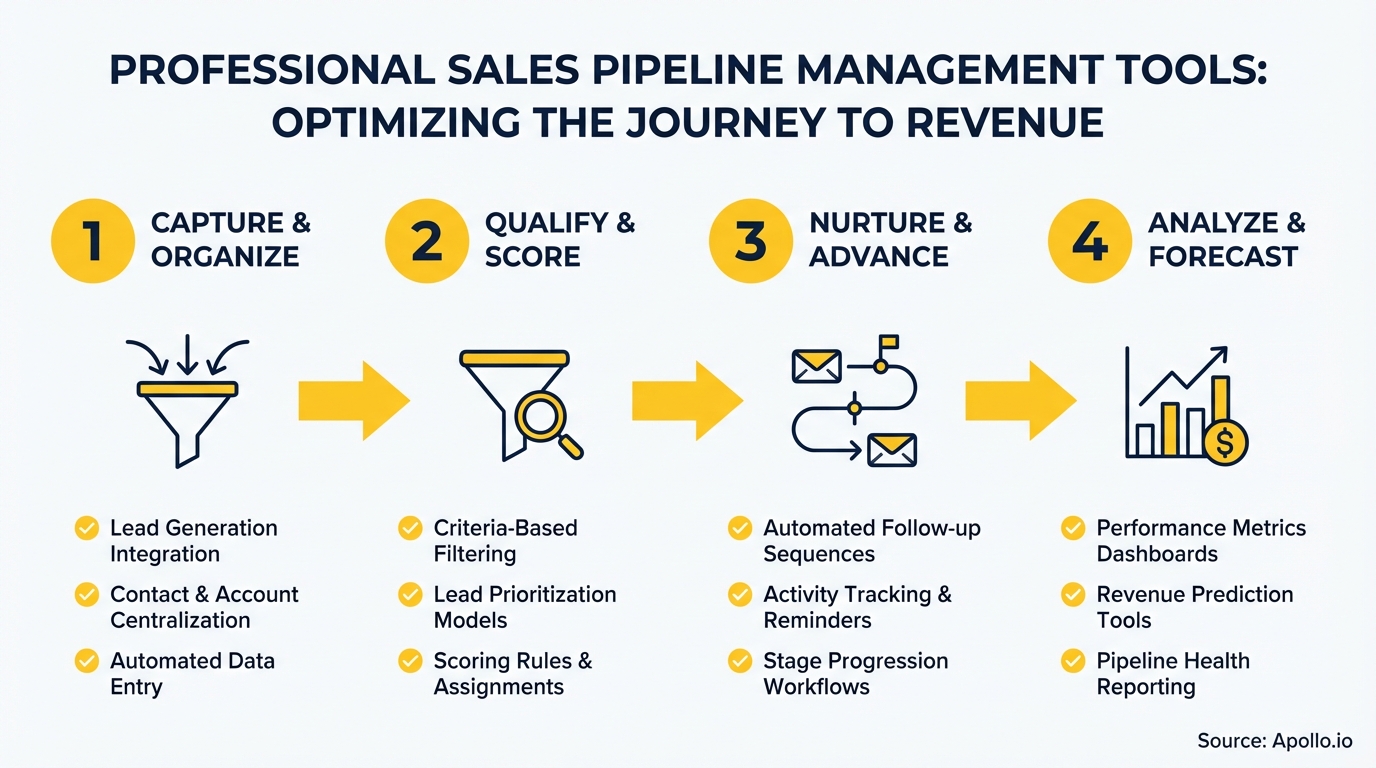
Sales pipeline management tools are software platforms that help teams track, prioritize, and advance deals through defined stages — from lead qualification to closed revenue. They combine CRM data, engagement automation, forecasting, and analytics into a unified workflow.
These tools are distinct from basic CRMs. A CRM stores contact records. A pipeline management tool actively surfaces which deals need action, flags at-risk opportunities, and gives managers real-time visibility into team performance. According to MarketsandMarkets, 78% of sales teams report improved pipeline management and deal tracking through automation.
Core capabilities to look for:
- Stage-based deal tracking with defined entry and exit criteria
- Forecasting with weighted probability and historical trend analysis
- Activity logging tied automatically to deals and contacts
- Alerts and signals for deal velocity changes or stalled opportunities
- CRM and engagement integrations for a single source of truth
The market reflects this demand. Market Research Future projects the Sales Pipeline Management Software Market will reach $14.05 billion by 2035, growing at a 7.52% CAGR from 2025 to 2035.
Why Is Pipeline Governance the Missing Layer?
Buying a pipeline tool is easy. Getting value from it requires governance: agreed definitions, data ownership, and enforcement.
Without this layer, even the best tool degrades into a reporting liability.
A Gartner survey of 243 CSOs found 49% say Sales and Marketing define a qualified lead differently. That single misalignment corrupts stage counts, conversion rates, and forecast accuracy across every downstream report.
Build governance around four pillars:
| Pillar | What It Covers | Owner |
|---|---|---|
| Data Definitions | Lead, MQL, SQL, opportunity stage criteria | RevOps + Marketing |
| Field Ownership | Required fields, picklist hygiene, data entry SLAs | RevOps |
| Automation Policy | What triggers sequences, stage moves, and alerts | RevOps + Sales Ops |
| Forecast Rules | Commit vs. best-case definitions, rollup logic | Sales Leadership + Finance |
Without documented stage exit criteria, reps advance deals based on gut feel. Governance converts that gut feel into a repeatable process that drives measurable sales performance.
How Do RevOps Leaders Build a Forecasting Stack?
Forecasting is the highest-stakes output of your pipeline tool. Xactly's 2024 Sales Forecasting Benchmark Report found 98% of respondents struggle to formulate a forecast — meaning the problem is almost universal, and almost always a process failure, not a data failure.
A reliable forecasting stack requires four connected capabilities:
- Stage-weighted pipeline view — probability assigned by stage, not rep optimism
- Deal inspection cadence — weekly manager reviews with mandatory field updates
- Variance tracking — comparing called forecast to actual close, every period
- Audit trail — timestamped history of stage changes for post-mortem analysis
For finance alignment, export a snapshot of pipeline at the start of each quarter and compare it to close data at the end. That delta tells you where your stage conversion rates are broken. Pair this with sales analytics to identify patterns across rep, segment, and product line.
Struggling to track deals across a fragmented stack? Get complete pipeline visibility with Apollo's deal management — one workspace for every stage from prospect to close.
Turn Funnel Guesswork Into Pipeline Wins
Pipeline forecasting a guessing game because marketing leads never convert? Apollo surfaces high-intent prospects that actually become opportunities. Join 90K paying customers building pipeline they can predict.
Schedule a Demo →What Role-Based Dashboards Should Each Team Use?
One pipeline dashboard does not serve everyone. The metrics that help an SDR prioritize their day are different from what a VP of Sales needs for a board call.
Role-based reporting is the difference between dashboards people use and dashboards people ignore.
| Role | Primary KPIs | Dashboard Focus |
|---|---|---|
| SDR / BDR | Meetings booked, sequences active, reply rate | Daily activity and sequence performance |
| Account Executive | Deal velocity, stage conversion, close date accuracy | Open opportunities and next steps |
| Sales Manager | Team pipeline coverage, rep forecast vs. actual | Team health and deal inspection |
| RevOps | Data completeness, stage duration, tool adoption | Pipeline hygiene and process compliance |
| Finance / Leadership | Forecast accuracy, revenue by segment, CAC | Revenue outlook and variance analysis |
For Account Executives managing active deals, stage duration is the most actionable metric — it shows exactly where deals get stuck. SDRs benefit most from sequence-level data that connects outreach activity to meetings booked.
Build dashboards that answer one clear question per role, and you'll see adoption climb.

How Should Teams Govern AI in Pipeline Management Tools?
AI features are now standard in most pipeline tools — but adoption is lagging. Gartner reports that only 23% of CSOs are accountable for AI selection, while 68% only provide inputs or are informed.
That governance gap means AI pilots stall and never reach standard process.
Data from CloudApps shows AI adoption in sales surged from 39% in 2023 to 81% in 2025 — but high adoption rates don't guarantee value realization without clear ownership.
To govern AI effectively in your pipeline stack:
- Assign a named owner for each AI feature (scoring, summarization, forecasting)
- Define acceptable use — which AI outputs require human review before action
- Audit AI recommendations quarterly against actual outcomes
- Set data quality gates — AI models are only as good as the fields feeding them
Pairing AI governance with the right AI sales tools means your team spends less time on admin and more time on deals that are actually closeable.
How Do SDRs and AEs Get More Value from Pipeline Tools Daily?
Pipeline tools deliver the most value when individual contributors use them as their primary workspace — not as a reporting obligation. SDRs and AEs are often the last to feel the benefit because tools are configured for managers, not sellers.
For SDRs, the highest-value use cases are automated lead routing, sequence triggers tied to deal stage, and real-time alerts when a prospect engages. This removes the manual work of figuring out who to contact next. Connecting prospecting tools directly to your pipeline means new contacts flow into sequences without rep intervention.
For AEs, the value is deal-level intelligence: knowing which deals are aging, which have missing next steps, and which contacts haven't been touched in two weeks. The average B2B sales win rate sits at 21%, according to Gradient Works — meaning most deals are already lost. Better pipeline tools help AEs focus energy on the deals that are actually winnable.
Spending too much time switching between tools to find pipeline data? Build and manage your entire pipeline in Apollo — prospecting, sequences, and deal tracking in one place.
Which Sales Pipeline Management Tool Should You Use in 2026?
The right tool depends on your team's maturity and where your biggest pipeline leaks are. Most teams that struggle with pipeline management don't need a more complex tool — they need fewer tools, better integrated.
A Bain & Company survey of 1,200+ senior commercial executives found 70% fail to effectively integrate their sales plays into CRM and revenue technology tools, with only about 20% having realized full value. The integration problem is the pipeline problem.
When evaluating sales pipeline management tools, prioritize:
- Native engagement + CRM in one platform — eliminates sync errors and data lag
- AI-assisted deal scoring that surfaces risk without requiring manual review
- Role-based reporting out of the box, not just custom report builders
- Workflow automation that enforces process without rep friction
- Open integrations for finance, CPQ, and data warehouse connections
Apollo consolidates prospecting, engagement, and pipeline management into a single platform. As Collin Stewart of Predictable Revenue put it: "We reduced the complexity of three tools into one." And from the team at Cyera: "Having everything in one system was a game changer." Explore how to build a sales tech stack that scales revenue without adding complexity.

Conclusion: Build a Pipeline That Runs on Governance, Not Hope
Sales pipeline management tools only work when the humans using them agree on definitions, own their data, and follow a consistent process. The best tool in the wrong governance structure will underperform a simpler tool with clear ownership.
Start with governance — define your stages, assign data owners, and set forecast rules. Then layer in automation and AI with named accountability.
Finally, give every role a dashboard that answers their specific question, not a generic view built for a QBR.
Apollo gives teams a unified platform to prospect, engage, manage deals, and forecast — without the overhead of managing five separate tools. Ready to streamline your pipeline? Try Apollo free and see what a consolidated pipeline stack feels like.
Prove Pipeline ROI With Apollo
Budget approval stuck on unclear metrics? Apollo surfaces measurable pipeline impact fast — so you walk into every review with proof, not promises. Leadium 3x'd their revenue. Your turn.
Start Free with Apollo →Don't miss these
Sales
Inbound vs Outbound Marketing: Which Strategy Wins?
Sales
What Is a Sales Funnel? The Non-Linear Revenue Framework for 2026
Sales
What Is a Go-to-Market Strategy? The 2026 GTM Playbook
See Apollo in action
We'd love to show how Apollo can help you sell better.
By submitting this form, you will receive information, tips, and promotions from Apollo. To learn more, see our Privacy Statement.
4.7/5 based on 9,690 reviews
