
Sales Performance Metrics That Actually Drive Revenue Growth
Sales teams in 2026 face mounting pressure to hit quota while buyers increasingly prefer self-service experiences. Gartner reports 61% of B2B buyers now prefer rep-free buying experiences. The sales leaders who win measure what matters, adapt to hybrid selling models, and leverage AI-powered platforms to consolidate their tech stack. This guide shows you exactly which sales performance metrics drive revenue in 2026 and how to implement them across your team.

Apollo Finds Verified Contacts In Seconds
Tired of spending hours hunting for accurate contact info? Apollo delivers 224M+ verified contacts with 96% email accuracy. Join 550K+ companies who eliminated manual research.
Start Free with Apollo →Key Takeaways
- Sales performance metrics measure activities, pipeline health, revenue outcomes, and efficiency to identify what drives quota attainment
- Leading indicators like activity metrics and pipeline velocity predict future performance, while lagging indicators confirm results
- AI-powered GTM systems consolidate data from prospecting, engagement, and deal management into one workspace for real-time visibility
- Top performers track metrics across the full funnel from prospecting through close, not just revenue outcomes
- RevOps teams use unified platforms to eliminate data silos and maintain single source of truth for forecasting accuracy
What Are Sales Performance Metrics?
Sales performance metrics are quantifiable measurements that track how effectively sales teams convert prospects into customers. They measure activities (calls, emails), pipeline health (opportunities, deal velocity), revenue outcomes (closed deals, quota attainment), and efficiency (cost per acquisition, sales cycle length). These metrics help sales leaders identify coaching opportunities, forecast accurately, and allocate resources to high-performing activities.
According to Gartner, 60% of B2B sales organizations have transitioned to data-driven selling approaches that integrate sales processes, applications, data, and analytics into unified practices. This shift requires tracking metrics across the entire go-to-market motion, not just final revenue numbers.
Why Do Sales Performance Metrics Matter in 2026?
Sales performance metrics provide the foundation for predictable revenue growth. They transform subjective gut feelings into objective insights that drive strategic decisions.
For SDRs and BDRs, metrics reveal which prospecting activities generate qualified pipeline. For Account Executives, metrics show which deals need attention and where to focus closing efforts.
The stakes are higher in 2026. Research by McKinsey shows top-performing B2B companies generate 2.5 times higher gross margins per dollar invested in sales compared to lower performers. The difference? Rigorous measurement of sales performance management activities tied directly to revenue outcomes.
Struggling to track metrics across multiple tools? Unify your pipeline visibility with Apollo's all-in-one platform.
What Sales Performance Metrics Should Teams Track?
Effective sales organizations track metrics across four categories: activity metrics, pipeline metrics, revenue metrics, and efficiency metrics. The specific metrics you prioritize depend on your sales motion, deal size, and growth stage.
What Activity Metrics Predict Pipeline Growth?
Activity metrics measure the daily actions that create pipeline. These leading indicators predict future revenue performance before deals close.
| Activity Metric | What It Measures | Target Benchmark |
|---|---|---|
| Outbound Calls | Daily prospecting volume | 50-80 calls per SDR |
| Emails Sent | Outreach consistency | 100+ personalized emails daily |
| Meetings Booked | Qualification effectiveness | 8-12 meetings per week |
| Follow-up Rate | Lead nurturing discipline | 5-7 touches per sequence |
SDRs using AI-powered platforms report booking meetings faster by automating research and personalizing outreach at scale. Sellers who partner with AI tools are 3.7 times more likely to meet quota, according to Gartner research.

What Pipeline Metrics Drive Forecast Accuracy?
Pipeline metrics track deal progression and health. RevOps teams use these to forecast revenue and identify bottlenecks.
- Pipeline Coverage Ratio: Total pipeline value divided by quota (target 3-4x coverage)
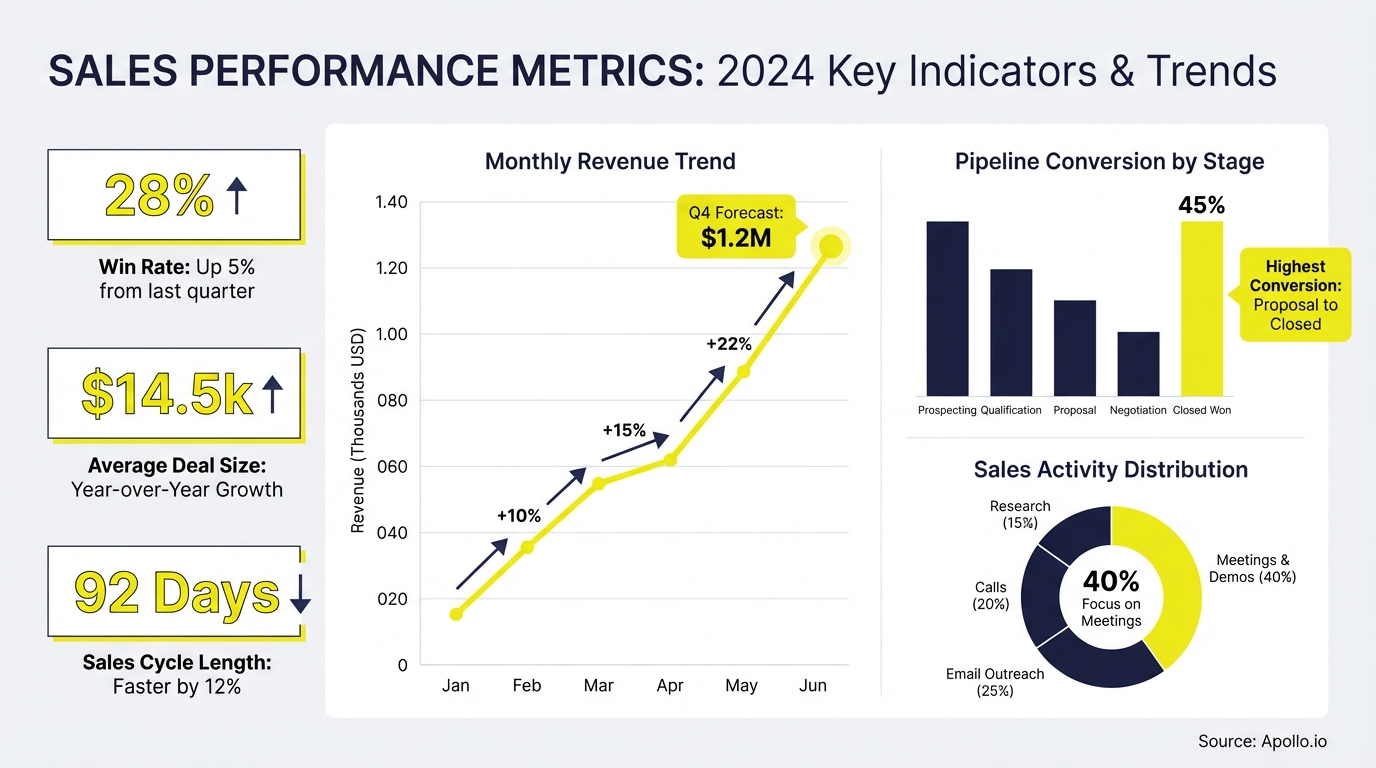
- Win Rate: Percentage of opportunities that close (industry average 15-25%)
- Average Deal Size: Mean contract value across closed deals
- Sales Velocity: (Opportunities × Win Rate × Average Deal Size) ÷ Sales Cycle Length
- Stage Conversion Rates: Percentage of deals advancing from each pipeline stage
For B2B sales organizations, tracking pipeline metrics in real-time enables dynamic forecasting and resource allocation. Teams that maintain clean pipeline data make more accurate predictions and avoid last-minute scrambles.
What Revenue Metrics Confirm Performance?
Revenue metrics are lagging indicators that confirm whether your activities and pipeline translated into results.
- Quota Attainment: Percentage of reps hitting their number (target 60-70% of team)
- Revenue Per Rep: Total revenue divided by number of sellers
- Customer Acquisition Cost (CAC): Total sales and marketing spend divided by new customers
- Customer Lifetime Value (LTV): Average revenue per customer over entire relationship
- LTV:CAC Ratio: Healthy ratio is 3:1 or higher
What Efficiency Metrics Optimize Sales Operations?
Efficiency metrics reveal how effectively your team converts time and resources into revenue.
- Sales Cycle Length: Average days from first contact to closed deal
- Time to Productivity: Days until new reps hit 100% of quota
- Lead Response Time: Minutes between lead capture and first contact
- Activities Per Opportunity: Touches required to advance deals
Founders and CEOs building outbound motions find that tracking efficiency metrics reveals opportunities to consolidate tools and eliminate wasted effort. As one Census customer noted, "We cut our costs in half" by moving to an all-in-one platform.
Find Buyers Ready To Close With Apollo
Missing in-market prospects while competitors strike first? Apollo reveals buying signals and tracks website visitors so you reach decision-makers at the perfect moment. Built-In boosted win rates 10% with Apollo's intent data.
Start Free with Apollo →How Do Sales Leaders Track Metrics Effectively?
Tracking sales performance metrics requires clean data, unified systems, and clear reporting cadences. The challenge in 2026 is that most teams use separate tools for prospecting, engagement, and deal management, creating data silos and manual reporting burdens.
Sales leaders who win consolidate their tech stack into platforms that automatically capture activities, track pipeline changes, and surface insights. This eliminates the spreadsheet gymnastics that waste RevOps time and create forecast inaccuracies.
Tired of stitching together data from multiple tools? Unify your go-to-market data in Apollo's single workspace.
What Systems Enable Real-Time Metric Tracking?
Effective metric tracking requires integration across your sales stack. Modern platforms connect prospecting databases, engagement sequences, conversation intelligence, and CRM data into unified dashboards.
Key system requirements include:
- Automatic activity logging from email, phone, and social channels
- Real-time pipeline updates synced across tools
- Customizable dashboards for different roles (SDRs, AEs, managers)
- AI-powered insights that surface anomalies and opportunities
Teams using AI sales tools report significant productivity gains. Apollo customers like Cyera note that "having everything in one system was a game changer" for tracking metrics without manual data entry.
How Do SDRs Use Metrics to Book More Meetings?
SDRs who consistently hit quota track leading indicators daily and adjust their approach based on what works. They monitor outreach volume, response rates, and meeting conversion rates to optimize their prospecting motion.
Top-performing SDRs use metrics to:
- Identify which channels (email, phone, social) generate highest response rates
- Test messaging variations and double down on winners
- Prioritize accounts based on engagement signals
- Adjust daily activities to maintain pipeline coverage targets
The shift to data-driven prospecting requires tools that surface these insights automatically. Modern sales development teams leverage platforms that track every touchpoint and recommend next actions based on what drives meetings.
What Metrics Do Account Executives Track to Close Faster?
Account Executives managing deals focus on pipeline velocity metrics that reveal deal health and momentum. They track stage progression, engagement levels, and competitive dynamics to identify at-risk opportunities early.
Critical AE metrics include:
- Deal Engagement Score: Frequency and recency of prospect interactions
- Multi-Threading: Number of stakeholders engaged per opportunity
- Stage Duration: Time spent in each pipeline stage vs. historical averages
- Next Action Clarity: Defined next steps with dates and owners
AEs using data-driven coaching platforms receive real-time guidance on which deals need attention and what actions accelerate close rates. This replaces guesswork with objective prioritization.
Start Tracking Sales Performance Metrics That Drive Revenue
Sales performance metrics transform how teams operate in 2026. The organizations that win measure activities, pipeline health, revenue outcomes, and efficiency across unified platforms.
They eliminate tool sprawl, maintain clean data, and surface insights that help every rep perform like a top performer.
For sales leaders building predictable revenue engines, the choice is clear: consolidate your tech stack into platforms that automatically track what matters. As Predictable Revenue found, "We reduced the complexity of three tools into one" by moving to an all-in-one solution.

Ready to track metrics without manual reporting? Start prospecting with Apollo's free plan and get real-time visibility across your entire sales motion.
Prove Apollo's ROI In Your First 30 Days
Budget approval stuck on unclear metrics? Apollo tracks every dollar impact—pipeline generated, time saved, deals closed. Customer. io achieved 50% YoY growth with measurable automation ROI.
Start Free with Apollo →Don't miss these
Sales
Inbound vs Outbound Marketing: Which Strategy Wins?
Sales
What Is a Sales Funnel? The Non-Linear Revenue Framework for 2026
Sales
What Is a Go-to-Market Strategy? The 2026 GTM Playbook
See Apollo in action
We'd love to show how Apollo can help you sell better.
By submitting this form, you will receive information, tips, and promotions from Apollo. To learn more, see our Privacy Statement.
4.7/5 based on 9,690 reviews
