
Sales Organization Structure: Models, Roles, and Best Practices
Your sales organization structure determines who owns each stage of the revenue engine, from prospecting to closing to expansion. In 2026, the traditional model is breaking. Google just flattened management layers in its ad sales org. Microsoft consolidated sales, marketing, and ops under one commercial umbrella. The shift reflects a hard truth: B2B sales organizations with too many layers, unclear ownership, and misaligned incentives can't move fast enough to compete.

Apollo Turns Research Hours Into Pipeline
Tired of your reps burning the day on manual research instead of selling? Apollo surfaces verified contacts instantly, so your team spends time closing — not hunting. Join 550K+ companies building predictable pipeline.
Start Free with Apollo →Key Takeaways
- Sales organization structure defines roles, territories, and reporting lines that drive accountability and revenue execution
- Flatter org models with wider manager spans improve speed and agility in 2026's AI-driven GTM environment
- RevOps alignment eliminates silos between sales, marketing, and customer success for measurable revenue impact
- Role clarity reduces seller overwhelm and improves quota attainment when responsibilities are tightly scoped
- Modern structures balance specialization with consolidation to optimize coverage and cost efficiency
What Is Sales Organization Structure?
Sales organization structure is the framework that defines roles, reporting relationships, territories, and accountability across your revenue team. It determines who prospects, who closes, who manages accounts, and how these functions coordinate to hit targets.
The structure you choose impacts speed to market, cost per deal, rep productivity, and forecast accuracy.
In 2026, effective structures prioritize role clarity over complexity. Organizations that simplify seller roles are 4.5x more likely to be top performers.
The best designs answer three questions: Who owns which stage of the buyer journey? How wide are manager spans?
Where does sales end and customer success begin?
Why Does Sales Organization Structure Matter in 2026?
Your org structure directly impacts whether reps hit quota. Ebsta reports that in 2024, an average of 69% of sales representatives are falling short of their quota. Poor structure creates confusion about ownership, duplicated effort, and gaps in coverage.
According to Salesgenie, highly aligned companies grow 19% faster and are 15% more profitable. Structure determines alignment. When sales and marketing report to separate executives with conflicting KPIs, handoffs break down. When territories overlap without clear rules of engagement, reps compete instead of collaborate.
The 2026 reality: companies are removing layers to increase speed. Google's ad sales org eliminated middle management to accelerate decisions.
Flatter structures mean wider manager spans, more frontline empowerment, and fewer approval checkpoints that slow deals.
Turn Weak Leads Into Pipeline Wins
Pipeline forecasting a guessing game because marketing leads never convert? Apollo surfaces verified, in-market contacts so your team stops chasing dead ends and starts closing. Join 550K+ companies building predictable revenue.
Start Free with Apollo →What Are the Common Sales Organization Models?
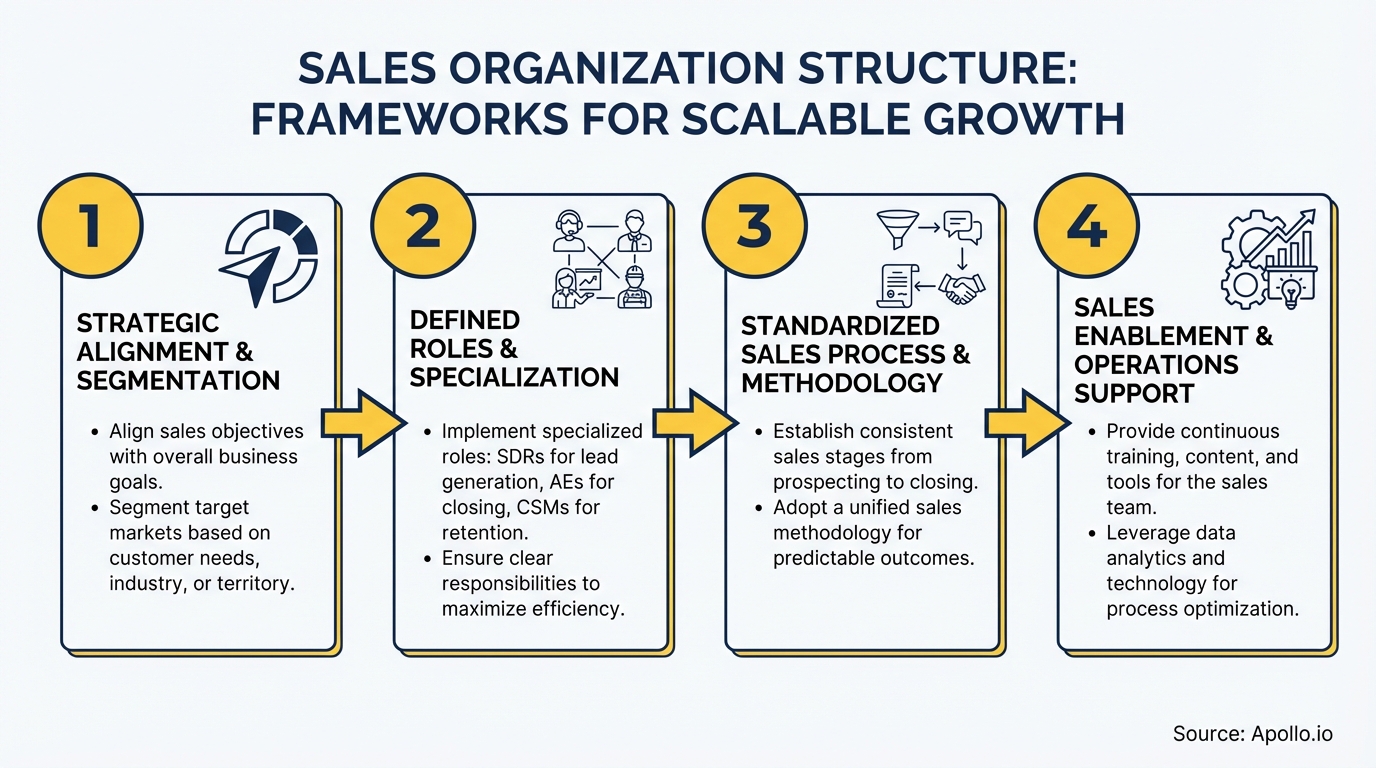
Sales organizations typically follow one of five core models, each optimized for different growth stages and market conditions:
| Model | Structure | Best For | Key Benefit |
|---|---|---|---|
| Island Model | Individual reps own full sales cycle | Early-stage startups, simple products | Speed and autonomy |
| Assembly Line | SDRs → AEs → CSMs in sequence | High-volume transactional sales | Specialization at scale |
| Pod Model | Cross-functional teams (SDR + AE + CSM) per segment | Mid-market, product-led growth | Tight collaboration and accountability |
| Geographic | Teams organized by region or territory | International expansion, local relationships | Market proximity and cultural fit |
| Vertical/Industry | Specialists aligned to industries (healthcare, fintech, etc.) | Complex enterprise sales, regulated markets | Deep domain expertise |
Many organizations blend models. A common hybrid: geographic territories with vertical specialists who support AEs on strategic deals.
The key is clarity about who owns what, with documented RACI (Responsible, Accountable, Consulted, Informed) for each stage.
How Do Sales Leaders Build Role Clarity?
Role clarity starts with tight job definitions. Sales Leaders building org structures in 2026 must answer: What does this role NOT do?
Overlap creates conflict. Gaps create lost deals.
The best structures define boundaries as clearly as responsibilities.
Start with lifecycle stages and map ownership:
- Prospecting: Who identifies accounts, researches contacts, and initiates outreach?
- Qualification: Who runs discovery, validates fit, and books meetings?
- Closing: Who presents demos, negotiates terms, and signs contracts?
- Expansion: Who manages renewals, upsells, and cross-sells?
For example, if SDRs own prospecting and qualification, define the exact handoff criteria: qualified meeting = confirmed budget, authority, need, and timeline. Without documented handoff triggers, AEs reject leads and SDRs waste effort on unqualified accounts. Sales operations teams enforce these definitions through CRM workflows and stage-gate approvals.
Struggling to track pipeline across a complex org structure? Get complete visibility into every deal stage with Apollo's unified pipeline tracking.

How Does RevOps Integration Change Sales Structure?
Revenue Operations (RevOps) breaks down silos by unifying sales, marketing, and customer success under shared systems, data, and goals. Research from CETdigit shows that by 2025, Gartner predicts that 75% of the highest-growth companies will have some form of RevOps model in place.
RevOps integration changes reporting lines. Instead of sales reporting to a VP Sales and marketing reporting to a CMO with different targets, both report to a Chief Revenue Officer (CRO) accountable for end-to-end revenue.
This structural shift aligns incentives: marketing gets credit for pipeline influenced, not just MQLs generated. Sales shares responsibility for customer retention, not just new logos.
Operationally, RevOps owns:
- Shared definitions: What qualifies as a Marketing Qualified Lead vs Sales Qualified Lead?
- Tech stack consolidation: One CRM, one source of truth, fewer integrations to maintain
- Process standardization: Consistent lead routing, opportunity stages, and forecasting methodology
- Analytics governance: Unified dashboards tracking funnel conversion, velocity, and win rates
For Founders and CEOs building revenue engines, RevOps eliminates the finger-pointing when deals stall. Clear ownership and shared accountability replace functional silos.
What Are the Emerging Trends in Sales Org Design for 2026?
Three structural trends are reshaping sales organizations in 2026:
1. Flatter hierarchies with wider manager spans. Google's decision to remove management layers reflects a broader shift. Companies are cutting "managers of managers" roles to speed decisions and reduce cost. The trade-off: individual managers now coach 8-12 reps instead of 5-7. This requires stronger enablement, clearer playbooks, and sales analytics to identify coaching opportunities at scale.
2. Commercial org consolidation (sales + marketing + ops unified).
Microsoft's move to combine commercial teams under one leader mirrors what many B2B companies are doing. When AI and automation blur the lines between marketing automation and sales engagement, unified leadership prevents duplication and accelerates execution.
The challenge: defining new roles for the middle layer (who owns content, campaigns, sequences?).
3. SDR model redesign and AI-augmented prospecting.
Market data shows meaningful SDR headcount reductions in 2025. The volume-outreach model (100 cold calls per day) is being replaced by AI-augmented workflows where technology handles research, list building, and initial contact, while human SDRs focus on high-signal accounts and complex qualification.
Organizations are testing pod models where one SDR supports multiple AEs with hyper-targeted outbound instead of broad top-of-funnel generation.
Spending too much time on manual prospecting? Let Apollo's 224M+ contact database and 65+ filters handle your lead research.
How Do You Restructure a Sales Organization Without Breaking Execution?
Restructuring while maintaining revenue requires a phased approach with clear success metrics at each stage:
Phase 1: Diagnose structural gaps (2-4 weeks). Map current state: who owns what, where handoffs break, which territories overlap.
Interview reps, managers, and RevOps to identify pain points. Quantify the cost: How many hours per week do AEs spend on work that should be handled by SDRs or ops?
What percentage of pipeline stalls due to unclear ownership?
Phase 2: Design target state with stakeholder input (2-3 weeks). Build the future org chart, define roles, document RACI for each stage.
Pressure-test with managers: Can they coach this many reps? Do handoff criteria make sense?
Will comp plans align with new responsibilities? Get buy-in before announcing changes.
Phase 3: Pilot with one segment (1 quarter). Test the new structure in a contained environment (one region, one vertical, one product line).
Measure impact: pipeline velocity, conversion rates, rep satisfaction. Iterate based on feedback before rolling out company-wide.
Phase 4: Full rollout with tight change management (1-2 quarters). Communicate the "why" repeatedly. Sales trainers run workshops on new processes. Managers hold weekly check-ins to surface confusion early. Track leading indicators (activity levels, pipeline coverage) to ensure the transition doesn't crater short-term execution.
The biggest mistake: restructuring without updating systems, comp plans, and sales tech stack to match. If your CRM still reflects the old org chart and territories, reps will revert to old behaviors.
Conclusion
Sales organization structure in 2026 prioritizes speed, clarity, and alignment over layers and complexity. The best structures answer who owns each stage, how wide manager spans should be, and where AI augments versus replaces human work.
Organizations that simplify roles, flatten hierarchies, and unify revenue teams through RevOps models execute faster and hit targets more consistently.
For RevOps leaders and Sales Leaders redesigning org charts, the work starts with documenting current state, quantifying structural gaps, and piloting new models before full rollout. Role clarity reduces seller overwhelm.
Tight handoff criteria eliminate pipeline leaks. Unified commercial leadership aligns incentives across marketing, sales, and customer success.
Ready to build a revenue engine that scales? Get Leads Now.
Prove Pipeline ROI From Day One
Budget approval stuck on unclear metrics? Apollo delivers measurable pipeline impact fast — so your team justifies every dollar with confidence. Leadium 3x'd annual revenue. Start yours today.
Start Free with Apollo →Don't miss these
Sales
Inbound vs Outbound Marketing: Which Strategy Wins?
Sales
What Is a Sales Funnel? The Non-Linear Revenue Framework for 2026
Sales
What Is a Go-to-Market Strategy? The 2026 GTM Playbook
See Apollo in action
We'd love to show how Apollo can help you sell better.
By submitting this form, you will receive information, tips, and promotions from Apollo. To learn more, see our Privacy Statement.
4.7/5 based on 9,690 reviews
