
GTM Engineer Jobs: Market Growth, Salaries, and Career Paths in 2026
The GTM Engineer job market is experiencing explosive growth as B2B companies confront a fundamental shift in buyer behavior. Modern buyers prefer self-serve digital experiences, yet most revenue teams still operate with disconnected tools and manual handoffs that create friction at every stage.
According to Bloomberry, the number of GTM engineering jobs surged by 205% year-over-year in 2025. This isn't a temporary hiring spike — it's a category-defining moment as companies realize they need dedicated revenue systems architects who can translate strategy into execution.
This article explores the GTM Engineer job landscape in depth, covering market demand, compensation benchmarks, required skills, and career trajectories. For a complete overview of the role itself, see our comprehensive guide on GTM Engineer.

Apollo Eliminates 4+ Hours Of Daily Research
Tired of spending 4+ hours daily hunting for contact info? Apollo delivers 224M verified contacts with 96% email accuracy instantly. Join 550K+ companies who stopped manual prospecting.
Start Free with Apollo →Key Takeaways
- GTM Engineer hiring more than doubled year-over-year, with over 3,000 job postings by January 2026
- Industry compensation for GTM Engineers ranges from $132,000 to $241,000 with specialized AI skills commanding premium pay
- The role bridges revenue strategy and technical execution, requiring SQL/Python skills alongside GTM expertise
- Companies prioritize candidates with data quality governance, automation architecture, and CRM orchestration experience
- Career progression paths lead to Director of Revenue Operations, VP of GTM Systems, or Chief Revenue Officer roles
What Is Driving GTM Engineer Job Demand?
GTM Engineer roles exist because revenue operations became too complex for traditional ops teams to manage alone. Sales teams drowning in tool sprawl need someone who can architect unified systems that actually work.
Three market forces are accelerating hiring:
First, buyer behavior shifted dramatically toward digital-first experiences. Research by Gartner in 2024 found that 61% of B2B buyers prefer an overall rep-free buying experience, which demands sophisticated routing logic, self-serve qualification flows, and instrumented handoffs that most companies haven't built yet.
Second, data quality and relevance became competitive differentiators. The same Gartner study revealed that 73% of B2B buyers actively avoid suppliers who send irrelevant outreach, creating urgent demand for professionals who can implement ICP scoring, enrichment governance, and message-to-market fit at scale.
Third, AI adoption accelerated faster than implementation capacity. Sales leaders expect agents to handle research and content generation, but the bottleneck is integration, data hygiene, guardrails, and measurement — work that lands squarely on GTM Engineering teams.
How Fast Is The GTM Engineer Job Market Growing?
The numbers tell a clear story: this is one of the fastest-growing roles in B2B tech. Data from Brookings Register shows that hiring for GTM engineering roles doubled year-over-year for the past two years, with job postings jumping from over 1,400 in mid-2025 to more than 3,000 by January 2026.
The broader Revenue Operations category provides additional context. Research from Agents for Hire indicates the RevOps workforce grew from approximately 5,800 professionals in January 2022 to over 150,000 by 2024, with GTM Engineers representing the technical specialization within that expansion.
This growth reflects a permanent shift in how companies structure revenue teams. GTM Engineers aren't replacing existing roles — they're filling a gap that traditional Sales Ops, Marketing Ops, and RevOps professionals weren't equipped to address.
What Do GTM Engineer Jobs Actually Pay?
Compensation varies significantly based on experience level, technical skills, and company stage. According to GTM Engineer Club, typical total compensation for GTM Engineers in the US ranges from $132,000 to $241,000, with a median of $176,000.
AI specialization commands a premium. Data from Captivate Talent shows that individual contributors with specialized skills, especially in AI, saw a 23% increase in earnings in 2025 as companies competed for talent who could implement agentic workflows and LLM-powered automation.
The compensation structure typically breaks down into base salary, performance bonus, and equity. Early-stage startups often offer lower base salaries ($110K-$140K) with meaningful equity packages, while public companies and well-funded growth-stage firms pay higher base compensation ($150K-$200K) with smaller equity grants.
| Experience Level | Base Salary Range | Total Compensation |
|---|---|---|
| Junior (0-2 years) | $90K - $120K | $110K - $140K |
| Mid-Level (3-5 years) | $130K - $170K | $160K - $200K |
| Senior (6+ years) | $170K - $210K | $210K - $280K |
For detailed salary insights by region and company size, see our dedicated guide on gtm engineer salary.
What Skills Do GTM Engineer Jobs Require?
GTM Engineer positions demand a hybrid skill set that most traditional ops roles don't develop. You need equal fluency in revenue strategy and technical implementation — understanding both why a system should work a certain way and how to actually build it.
The technical foundation starts with SQL and Python for data manipulation, API integration skills for connecting disparate systems, and comfort with modern data stacks (CRMs, data warehouses, reverse-ETL tools). Many roles also require experience with workflow automation platforms, JavaScript for custom implementations, and increasingly, prompt engineering for AI-powered workflows.
The strategic side requires deep GTM knowledge: understanding buyer journeys, ICP definition, lead scoring methodologies, pipeline stages, and revenue attribution models. You need to diagnose why conversion rates drop, identify which signals predict deal velocity, and design experiments that actually move revenue metrics.
Struggling to find qualified candidates with this unique skill combination? Search Apollo's 224M+ contacts with 65+ filters to identify professionals with both technical and GTM expertise.
How Do GTM Engineer Jobs Differ From RevOps Roles?
The titles often get used interchangeably, but they represent distinct functions. RevOps professionals maintain existing systems, run reports, and coordinate cross-functional processes.
GTM Engineers build the systems that RevOps teams then operate.
Think of it this way: RevOps monitors your CRM data quality and runs monthly pipeline reviews. A GTM Engineer architects the automated enrichment workflows that keep your CRM clean and builds the scoring model that determines which deals get prioritized in those pipeline reviews.
The skill requirements reflect this difference. RevOps roles emphasize project management, stakeholder alignment, and operational excellence.
GTM Engineer positions require programming ability, systems architecture thinking, and data engineering fundamentals.
For a detailed comparison of responsibilities and career paths, read our analysis of gtm engineer vs revops.
What Does A Typical GTM Engineer Job Description Include?
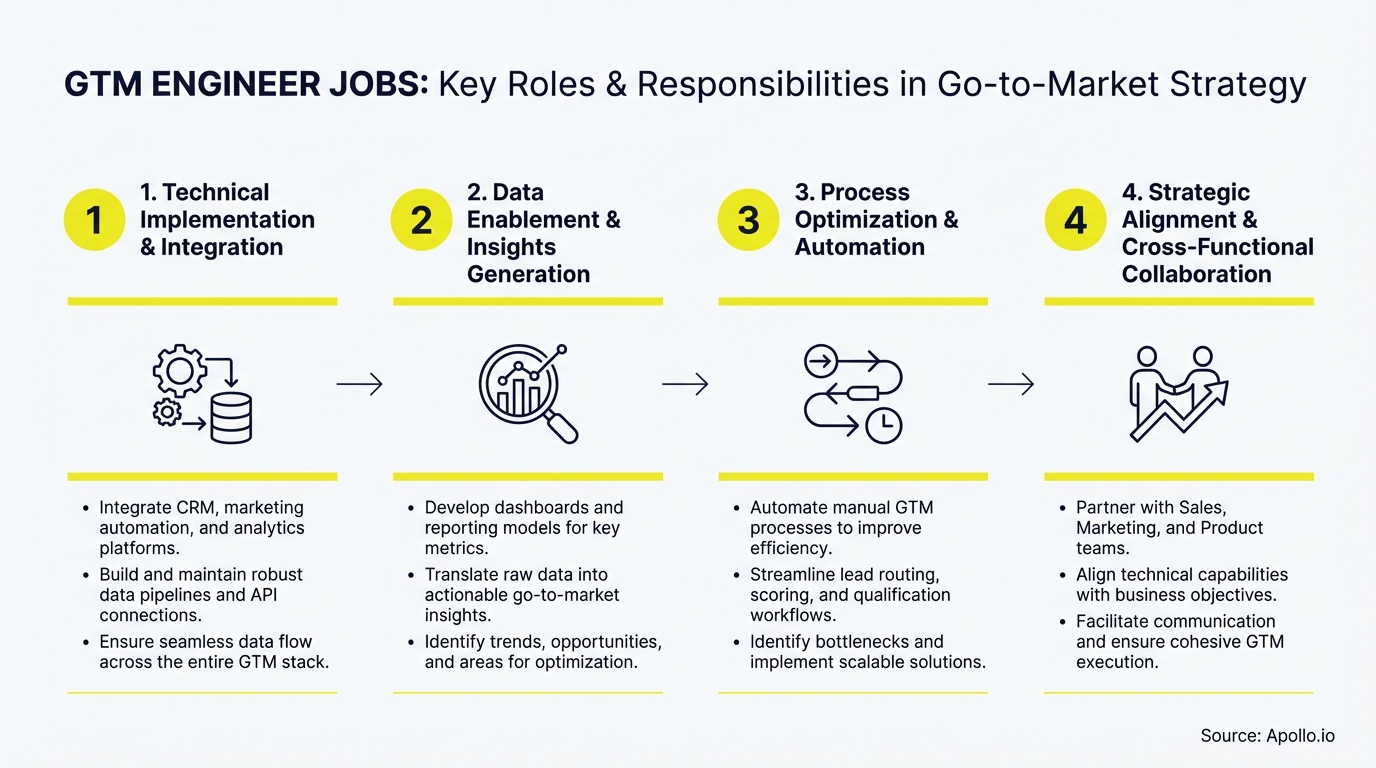
Most GTM Engineer job postings follow a similar pattern, though the specific tools and projects vary by company. The core responsibilities center on building, maintaining, and optimizing revenue systems.
Common requirements include designing and implementing data pipelines between marketing automation, CRM, data warehouse, and third-party enrichment sources. You'll build custom scoring models based on firmographic, behavioral, and intent signals, then create automated workflows that route accounts to the right reps at the right time.
Many positions also involve email deliverability management (domain configuration, mailbox warmup, spam rate monitoring), integration maintenance, and data governance frameworks. Increasingly, roles include AI implementation work: configuring LLM prompts for account research, building review workflows for AI-generated content, and measuring the accuracy of automated personalization.
For complete job description templates with specific responsibilities and qualifications, see our guide on gtm engineer job description.

Which Companies Are Hiring GTM Engineers?
Hiring patterns break down into three categories based on company maturity and revenue model.
High-growth B2B SaaS companies (Series B through pre-IPO) represent the largest hiring segment. These organizations scaled past the point where manual processes work but haven't yet built the infrastructure that public companies maintain.
They need GTM Engineers to architect systems that support aggressive growth targets without proportional headcount expansion.
Public enterprise software companies hire GTM Engineers to modernize legacy systems and implement AI-powered workflows. These roles often focus on migration projects, consolidating tech stacks, and building internal tools that product teams won't prioritize.
Emerging AI-first companies represent a newer hiring category. These organizations need GTM Engineers who can implement agentic workflows from day one, designing systems where AI handles research and drafting while humans focus on judgment and relationship-building.
How Do You Break Into GTM Engineering?
Most successful GTM Engineers come from one of three background paths. The first is sales operations professionals who taught themselves SQL and Python to solve problems their vendors couldn't address.
You spent years frustrated by tool limitations and eventually learned to code your way around them.
The second path starts in data engineering or analytics roles, then adds GTM domain knowledge. You understand data pipelines and transformation logic, then learn revenue operations context by working closely with sales and marketing teams.
The third route comes through customer success engineering or solutions consulting, where you implemented complex integrations for clients and realized you preferred building systems to managing relationships.
Regardless of starting point, the transition requires demonstrable technical skills. Build a portfolio of automation projects: a custom lead scoring implementation, an enrichment workflow that improved data quality, or a sequence testing framework that increased reply rates.
Companies hire based on what you've built, not just what you claim to know.
For a complete roadmap including skills to develop and projects to build, see our guide on how to become a gtm engineer.
Turn Forecast Guesswork Into Revenue Certainty
Can't see where deals actually stand in real time. Apollo unifies your pipeline data with verified contacts and buying signals across 224M+ prospects. Built-In improved win rates 10% with Apollo's intelligence.
Start Free with Apollo →What Career Progression Do GTM Engineers Follow?
Career paths typically follow one of three tracks depending on your interests and strengths.
The technical leadership track progresses from GTM Engineer to Senior GTM Engineer to Staff/Principal GTM Engineer, eventually reaching Director or VP of Revenue Systems. This path emphasizes deep technical expertise, architecture decisions, and building increasingly sophisticated automation systems.
The operational leadership track moves from GTM Engineer to Manager of Revenue Operations to Director of RevOps to VP of Revenue Operations or Chief Revenue Officer. This progression trades hands-on technical work for team leadership, cross-functional coordination, and strategic planning.
The product track transitions from GTM Engineer to Product Manager for revenue tools, leveraging your understanding of what sales teams actually need to build or buy better solutions. Some GTM Engineers also move into founder roles, building the tools they wished existed.
| Career Stage | Typical Title | Key Responsibilities |
|---|---|---|
| Entry (0-2 years) | GTM Engineer / Junior GTM Engineer | Execute defined projects, maintain existing integrations, support data quality initiatives |
| Mid (3-5 years) | Senior GTM Engineer | Design system architecture, implement complex automation, own key workflows end-to-end |
| Senior (6-8 years) | Staff/Principal GTM Engineer | Set technical strategy, evaluate vendor decisions, mentor junior engineers |
| Leadership (8+ years) | Director/VP Revenue Systems | Build and lead teams, align systems strategy with business objectives, manage vendor relationships |
What Tools Do GTM Engineer Jobs Require?
The expected gtm tech stack varies by company, but certain categories appear in nearly every job description. You need proficiency with CRM platforms (Salesforce or HubSpot most commonly), data warehouse experience (Snowflake, BigQuery, or Redshift), and familiarity with reverse-ETL tools that sync data back to operational systems.
Workflow automation platforms like Zapier or Make appear frequently, though many companies now expect programming skills to build custom solutions rather than relying on no-code tools. SQL is essentially non-negotiable — you'll query data daily to diagnose issues, validate implementations, and measure outcomes.
API integration experience matters more than specific tools since you'll constantly connect systems that weren't designed to work together. Documentation skills help too: the best GTM Engineers build systems other people can maintain.
For teams looking to operationalize this role, Apollo offers the GTM Engineering (GTME) Program — a 12-week engagement where a dedicated Go-to-Market Engineer builds, implements, and optimizes a complete GTM system around your strategy, so your team can execute at velocity without stitching together a dozen tools.

How Should Companies Write GTM Engineer Job Postings?
Effective job descriptions balance technical requirements with GTM context. Too many postings read like generic engineering roles with "sales operations" tacked on, which attracts the wrong candidates.
Start by explaining the business problem, not the tool list. Instead of "seeking a GTM Engineer to manage our Salesforce instance," try "our AEs spend 40% of their time on data entry and manual research; we need a GTM Engineer to build automation that gives them those hours back."
Be specific about technical expectations. Don't just list "SQL" — clarify whether you need someone who can write basic SELECT statements or someone who optimizes complex queries with CTEs and window functions.
The same applies to programming: are you expecting Python scripts for one-off analysis or production-grade code that runs in automated workflows?
Include real projects from your first 90 days. Candidates want to know if they'll spend their time on strategic systems work or firefighting data quality issues.
Both are valid, but they attract different people.
What Challenges Do GTM Engineers Face In Their Jobs?
The biggest challenge isn't technical — it's organizational. GTM Engineers sit between sales, marketing, customer success, and product teams, each with competing priorities and different definitions of success.
You'll spend significant time negotiating requirements, managing stakeholder expectations, and explaining why certain requests aren't technically feasible.
Data quality issues create constant friction. You'll build an elegant scoring model only to discover that 30% of your CRM records have null values in critical fields.
Companies with poor data hygiene often blame the systems rather than addressing root causes.
Tool sprawl and technical debt accumulate faster than most teams can address them. Every new vendor promises easy integration, but you inherit the maintenance burden when the initial implementation team moves on.
The result is fragile systems held together by brittle connections that break whenever vendors ship updates.
Finally, measuring impact proves difficult. When conversion rates improve, was it your new scoring model, the messaging changes marketing made, or the AEs who got better at discovery calls?
Attribution is hard, which makes it challenging to demonstrate ROI on your work.
What Does The Future Hold For GTM Engineer Jobs?
The role is evolving from systems integrator toward AI workflow architect. Companies increasingly expect GTM Engineers to implement agentic systems where AI handles research, drafting, and routine decisions while humans focus on judgment calls and relationship-building.
This shift demands new skills: prompt engineering, LLM fine-tuning, and designing human-in-the-loop workflows that maintain quality while capturing efficiency gains. The GTM Engineers who thrive will understand both the technical implementation of AI systems and the strategic question of where human judgment adds most value.
The compensation trend points upward as demand continues outpacing supply. Companies that previously hired one RevOps generalist now build dedicated GTM Engineering teams with specialized skills in data architecture, automation engineering, and AI implementation.
One certainty: the job won't disappear even as AI improves. Someone needs to configure the AI, maintain the systems, and ensure the automated workflows actually align with business strategy.
That's the GTM Engineer's enduring value proposition.
How Can Companies Build Effective GTM Engineering Teams?
Start with one strong GTM Engineer before building a team. This person establishes patterns, documents systems, and creates the foundation that future hires will extend.
Hiring multiple junior engineers simultaneously without senior leadership leads to inconsistent implementations and technical debt.
Define clear ownership boundaries between GTM Engineering and adjacent roles. Who owns CRM configuration versus who owns data pipeline architecture?
When does a project belong to GTM Engineering versus IT or data engineering? Ambiguity creates conflict and slows execution.
Invest in documentation and knowledge sharing from day one. GTM Engineers leave companies, and undocumented systems become maintenance nightmares.
The best teams treat internal documentation as seriously as customer-facing deliverables.
Need tools that support your GTM Engineering initiatives? Explore Apollo's unified go-to-market platform designed to consolidate your tech stack and give GTM Engineers a single system to architect around.
Ready To Launch Your GTM Engineering Career Or Build Your Team?
The GTM Engineer job market represents one of the fastest-growing opportunities in B2B tech, with demand far outpacing supply as companies realize they need dedicated revenue systems architects. Whether you're a professional looking to break into the role or a company building your GTM Engineering function, the path forward starts with understanding both the technical requirements and the strategic context.
For job seekers, focus on building demonstrable technical skills through portfolio projects that show you can solve real revenue problems. For employers, write job descriptions that clearly articulate the business impact you expect, not just a laundry list of tools.
Ready to build the data foundation and automation workflows that GTM Engineers need to succeed? Start Your Free Trial with Apollo's comprehensive platform and experience the power of integrated prospecting, enrichment, and engagement in one solution that eliminates the tool sprawl holding your revenue team back.
Prove Apollo's Value In Your First 30 Days
Budget approval stuck on unclear metrics? Apollo delivers measurable pipeline impact from day one—224M verified contacts, 96% email accuracy, and real-time ROI tracking. Built-In increased win rates 10% and ACV 10%.
Start Free with Apollo →Don't miss these
Revenue Operations
Top Market Intelligence Tools for B2B Teams in 2026
Revenue Operations
Sales Operations Analyst Salary: 2026 Compensation Guide and Benchmarks
Revenue Operations
Sales Compensation Software: How to Automate Commission Management
See Apollo in action
We'd love to show how Apollo can help you sell better.
By submitting this form, you will receive information, tips, and promotions from Apollo. To learn more, see our Privacy Statement.
4.7/5 based on 9,690 reviews
