
What Is the Sales Life Cycle? Stages, Benchmarks, and 2026 Strategies
The sales life cycle is the repeatable sequence of stages a seller moves through to convert a prospect into a paying customer. Every B2B team has one, but in 2026, the traditional linear model is under pressure. According to a Gartner survey, 61% of B2B buyers now prefer a rep-free buying experience, meaning buyers self-educate long before your team enters the picture. Understanding and adapting the sales life cycle to this new reality is how modern GTM teams build predictable revenue. For a complementary view on engaging customers across their journey, see what lifecycle marketing actually involves.

Research Less, Close More With Apollo
Tired of burning hours verifying contact info instead of selling? Apollo delivers 230M+ accurate business contacts so your team spends time closing, not chasing. Nearly 100K companies have already made the switch.
Start Free with Apollo →Key Takeaways
- The sales life cycle has 7 core stages, from prospecting to post-sale, but buyers move through them non-linearly in 2026.
- B2B sales cycles vary dramatically by deal size: SMB deals close in 1-3 months, enterprise deals often take 6-18 months.
- 61% of B2B buyers prefer self-serve discovery, so reps must add value at qualification, consensus-building, and risk-reduction stages.
- AI agents now handle early-funnel work (research, outreach, routing), shifting SDR focus toward meeting quality over activity volume.
- Post-purchase value realization is now a lifecycle stage, not an afterthought: retention and expansion begin at close.
What Are the 7 Stages of the Sales Life Cycle?
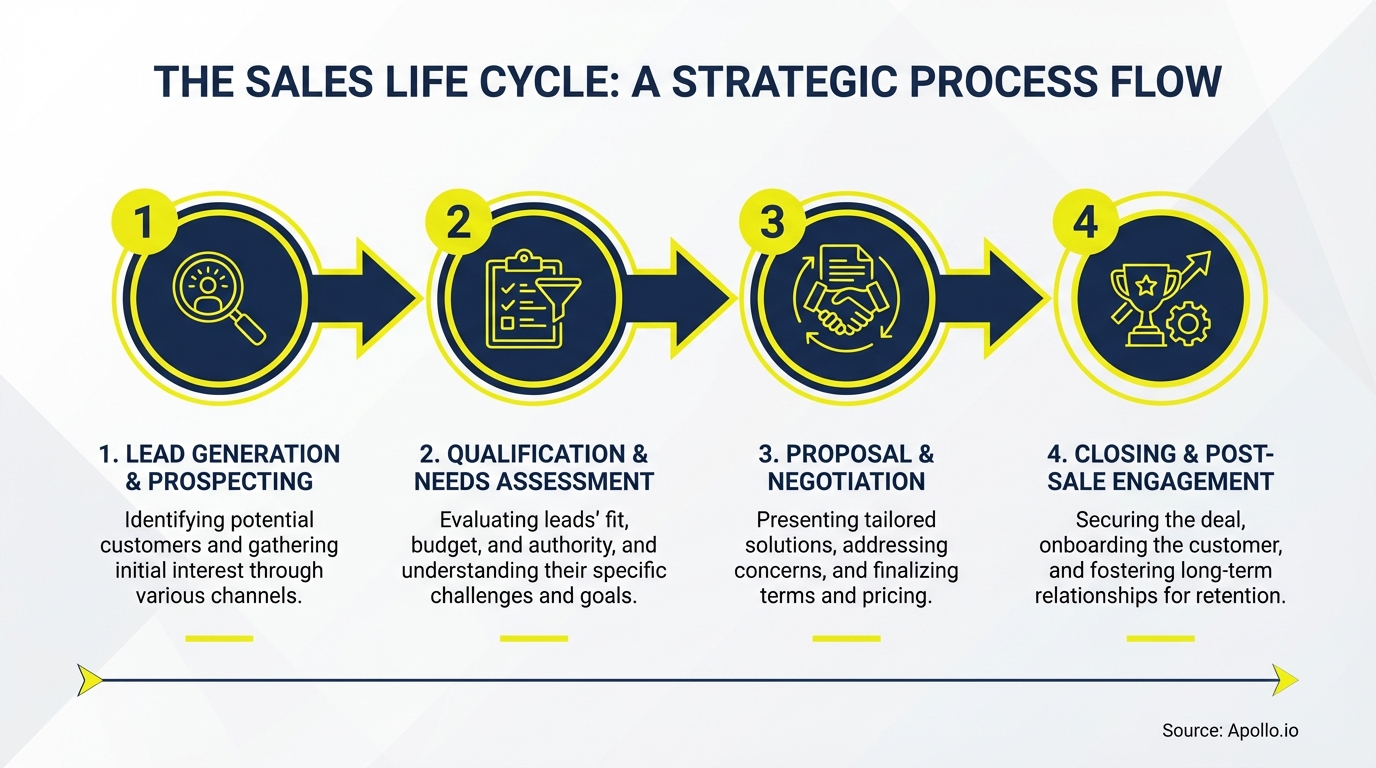
The sales life cycle is the structured path from identifying a potential buyer to closing the deal and managing the relationship post-sale. Unlike the buyer's journey (which describes what the buyer experiences), the sales life cycle describes what the seller must do at each step.
| Stage | Primary Activity | Key Owner |
|---|---|---|
| 1. Prospecting | Identify and build a target account list | SDR / BDR |
| 2. Qualification | Confirm budget, authority, need, timing (BANT) | SDR / AE |
| 3. Discovery | Uncover pain points, stakeholders, and success criteria | AE |
| 4. Presentation | Deliver a tailored solution pitch or demo | AE / SE |
| 5. Handling Objections | Address risk, pricing, and competitive concerns | AE |
| 6. Closing | Negotiate terms and secure signed agreement | AE / Sales Leader |
| 7. Post-Sale | Onboarding, value realization, expansion | CS / AE |
These stages are not always sequential. Buyers re-enter earlier stages after new stakeholders join, budgets shift, or security reviews surface.
Designing your lifecycle to handle re-entry points is as important as defining the stages themselves.
How Long Does the Sales Life Cycle Take?
Cycle length depends heavily on deal size and complexity. According to Landbase, SMB transactions typically close in 1-3 months, mid-market deals extend 3-6 months, and enterprise agreements often require 6-12 months or longer. For software specifically, Aexus reports that B2B software sales cycles range from 3-6 months for mid-market solutions and 9-18 months for enterprise deals.
Deal value compounds the difference. Data from SalesO shows deals under $1,000 close in 25 days, while deals over $500,000 take 270 days. For AEs managing a mixed pipeline, this means stage definitions and exit criteria must be calibrated by segment, not applied uniformly.
How Has the Sales Life Cycle Changed in 2026?
Three forces are reshaping the lifecycle right now. First, buyers self-educate earlier and delay seller contact.
Second, AI agents are taking over early-funnel execution. Third, buying groups have grown larger and more cross-functional, adding procurement, IT, legal, and finance as formal lifecycle participants.
- Rep-free discovery: Buyers research independently and engage reps only when they're near a decision. Your prospecting and qualification motions must adapt to meet late-stage intent signals, not cold outreach assumptions.
- AI in the early funnel: Salesforce's 2026 State of Sales report notes that 94% of sales leaders already using AI agents say they're critical for meeting business demands. Prospecting, research, and routing are increasingly agent-owned tasks.
- Multi-stakeholder consensus: More participants mean more objection loops. Building stakeholder maps and providing role-specific content (for economic buyers, champions, IT, procurement) is no longer optional for enterprise deals.
Struggling to identify the right contacts in a buying group? Search Apollo's 230M+ contacts with 65+ filters to find every stakeholder in your target accounts.

How Do SDRs and AEs Manage Their Roles in the Life Cycle?
In most B2B GTM teams, the lifecycle splits between two owners: SDRs handle stages 1-2 (prospecting and qualification), and AEs own stages 3-6 (discovery through close). The handoff between them is where most revenue leaks.
For SDRs: The job in 2026 is less about raw activity volume and more about signal quality. Use intent data and AI research tools to prioritize accounts showing buying behavior. A well-qualified meeting handed to an AE is worth far more than ten cold dials to unqualified contacts. Explore how sales automation software can handle routine research and sequencing so SDRs focus on high-value conversations.
For AEs: Discovery and objection-handling are where human judgment creates the most value. Buyers who use supplier-provided digital tools alongside a rep are 1.8x more likely to complete a high-quality deal than those who self-serve alone (Gartner). AEs should come to discovery calls with account research, stakeholder mapping, and a mutual action plan. For complex deals, see enterprise sales strategies for closing mega deals.
Turn Funnel Guesswork Into Pipeline Clarity
Tired of watching quality leads stall before they ever reach your pipeline? Apollo surfaces in-market buyers with precision targeting so your team acts on real signals, not gut instinct. Nearly 100K paying customers stopped forecasting blind.
Start Free with Apollo →What Is the Non-Linear Sales Life Cycle and Why Does It Matter?
A non-linear sales life cycle acknowledges that buyers loop back, pause, re-evaluate, and re-engage at different stages rather than progressing in a straight line. This is the reality for most B2B deals in 2026, especially those involving multiple stakeholders.
Common re-entry triggers include:
- A new economic buyer or champion joins the evaluation
- A security or legal review surfaces after a verbal agreement
- Budget cycles reset and the deal pauses mid-negotiation
- A competitor proposal arrives during the objection stage
The practical fix is to treat each re-entry as a new mini-discovery. Confirm that success criteria, stakeholders, and timelines still match your understanding before advancing again. Sales analytics tools help RevOps teams track where deals stall most often, so they can build stage-specific enablement for the highest-friction loops.
How Do You Shorten the Sales Life Cycle Without Sacrificing Deal Quality?
Shortening cycle length requires removing friction at specific stages, not rushing the buyer. The highest-leverage interventions are:
- Better qualification upfront: A misqualified prospect will drag through every stage. Use a structured framework (MEDDIC, BANT, SPICED) and enforce it at handoff.
- Stakeholder mapping early: Identify all buying group members in stage 3, not stage 5. Late stakeholder surprises are the leading cause of deal delays.
- Proof assets at evaluation: Case studies, ROI calculators, and instrumented pilots reduce the back-and-forth in stages 4-5. Buyers who can verify outcomes self-close faster.
- Mutual action plans: A shared timeline with clear owner-assigned milestones keeps both sides accountable and prevents indefinite stalls.
Spending too much time on manual follow-up between stages? Automate multi-channel sequences with Apollo to keep deals moving without dropping the ball.
For teams building or refining their pitch approach at stage 4, these proven sales pitch techniques directly address the presentation and objection stages of the lifecycle.
What Happens After the Sale? Post-Purchase Value Realization
The sales life cycle does not end at close. In 2026, the post-sale phase is a revenue stage in its own right.
Retention, expansion, and referrals all originate here, and they depend on whether the customer achieves measurable value in the first 90 days.
A practical post-purchase checklist includes:
- Kickoff call within 5 business days of contract signing
- Defined success metrics agreed upon before onboarding begins
- 30/60/90-day check-ins with value milestones mapped to each
- Expansion conversation triggered by first value milestone, not renewal date
RevOps leaders should connect post-sale outcomes to lifecycle data in their CRM. If deals that close faster have lower 90-day retention, cycle compression may be hurting quality. Use deal management software to track lifecycle stage data alongside post-sale health scores in one workspace.
How Do You Measure and Optimize the Sales Life Cycle?
The metrics that matter most for lifecycle optimization are stage conversion rates, average time-in-stage, and win rate by segment. These tell you where deals are dying and how long they're taking to advance.
| Metric | What It Tells You |
|---|---|
| Stage conversion rate | Where prospects drop off most often |
| Average time-in-stage | Which stages create bottlenecks |
| Win rate by deal size | Where your ICP fit is strongest |
| Cycle length by segment | How to set realistic forecast timelines |
| Post-sale expansion rate | Whether lifecycle quality drives LTV |
Teams consolidating their sales tech stack see the biggest gains here. As Cyera notes, "Having everything in one system was a game changer." When prospecting data, engagement history, deal stages, and post-sale notes live in one platform, RevOps can trace a deal's full lifecycle without stitching together five dashboards. For a deeper look at building the right foundation, see how to build a sales tech stack that scales revenue.

Start Optimizing Your Sales Life Cycle Today
The sales life cycle is your team's operating system for revenue. Define clear stages, assign ownership, track the right metrics, and build re-entry plays for the non-linear moments that slow every deal down.
In 2026, the teams winning are those that automate early-funnel work, focus human effort on consensus and risk reduction, and treat post-sale as a growth stage.
Apollo gives SDRs, AEs, and RevOps teams a single platform to prospect, engage, manage deals, and measure lifecycle performance without juggling multiple tools. As Predictable Revenue put it: "We reduced the complexity of three tools into one." Start a free trial and run your entire sales life cycle from one workspace.
Prove Pipeline ROI With Apollo
ROI pressure killing your next budget approval? Apollo delivers measurable pipeline impact your leadership can't argue with. Leadium 3x'd their annual revenue — your CFO wants numbers like that.
Start Free with Apollo →Don't miss these
Sales
Inbound vs Outbound Marketing: Which Strategy Wins?
Sales
What Is a Sales Funnel? The Non-Linear Revenue Framework for 2026
Sales
What Is a Go-to-Market Strategy? The 2026 GTM Playbook
See Apollo in action
We'd love to show how Apollo can help you sell better.
By submitting this form, you will receive information, tips, and promotions from Apollo. To learn more, see our Privacy Statement.
4.7/5 based on 9,690 reviews
