
Sales Lead Generation Techniques That Drive Revenue Growth
Sales lead generation remains the lifeblood of B2B revenue growth in 2026. According to Sopro, 91% of marketers rank lead generation as their top priority in 2025, emphasizing its role in revenue growth. Yet Martal Group reports that 45% of B2B companies reported that generating enough leads was a significant marketing challenge in 2024. The gap between priority and execution has never been wider. Modern lead generation strategies require precision targeting, multi-channel engagement, and data-driven personalization to cut through buyer noise and deliver pipeline results.

Stop Chasing Dead Leads—Find Verified Contacts
Tired of wasting hours hunting for contact info? Apollo delivers 224M contacts with 96% email accuracy. Join 550K+ companies closing more deals with verified data.
Start Free with Apollo →Key Takeaways
- Content marketing drives 74% of B2B lead generation success when aligned with buyer consensus needs
- Omnichannel strategies using 10+ touchpoints outperform single-channel approaches in 2026
- Relevance engineering reduces buyer avoidance by targeting specific ICP scenarios and pain points
- Self-serve assets meet the 61% of buyers who prefer rep-free evaluation experiences
- Consolidated platforms eliminate tool complexity and accelerate SDR productivity
What Are Sales Lead Generation Techniques?
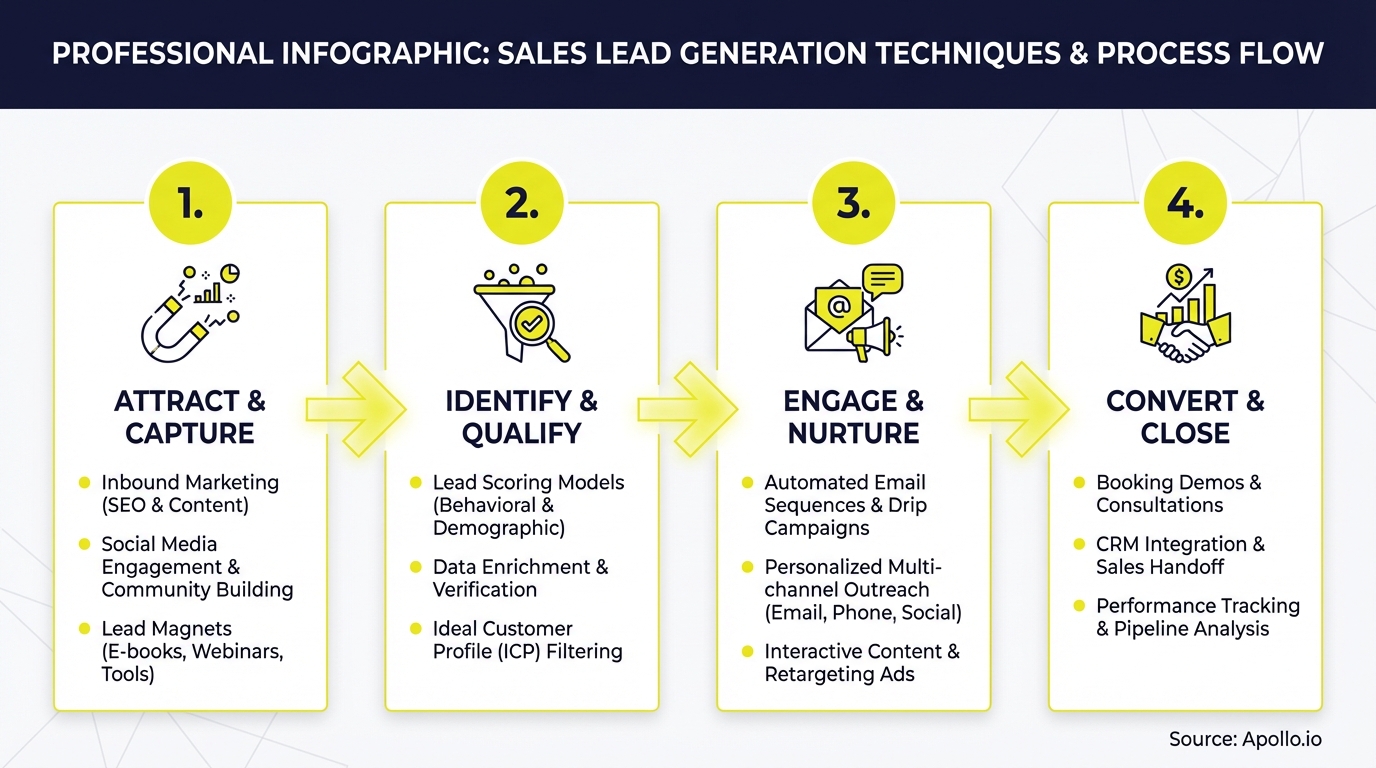
Sales lead generation techniques are systematic methods for identifying, attracting, and qualifying potential customers who match your ideal customer profile. These techniques combine data intelligence, content strategy, and multi-channel outreach to move prospects from awareness to sales-ready conversations.
In 2026, effective lead generation requires precision over volume.
Modern techniques focus on three core pillars: targeted prospecting using verified contact databases, personalized engagement across email, phone, and social channels, and automated nurturing sequences that qualify leads based on behavior. Data-driven prospecting has replaced spray-and-pray tactics as buyers demand relevance.
Struggling to find qualified leads? Search Apollo's 224M+ contacts with 65+ filters to build targeted prospect lists.
How Do SDRs Generate Leads in 2026?
SDRs generate leads by combining account research, multi-channel sequences, and personalized messaging that addresses specific buyer pain points. The process starts with ICP-aligned prospecting, followed by contextual outreach that demonstrates understanding of the prospect's business challenges.
Successful SDRs layer intent signals, trigger events, and stakeholder mapping into their workflows.
Top-performing SDRs use consolidated platforms that combine contact data, engagement tools, and pipeline tracking in one workspace. This eliminates context-switching between prospecting databases, email tools, and CRMs. Teams report significant time savings when everything lives in a single system. Outbound prospecting strategies that integrate research, outreach, and follow-up in unified workflows consistently outperform fragmented approaches.
What Tools Do SDRs Use for Lead Generation?
SDRs rely on sales intelligence platforms that provide verified contact data, email sequencing, call automation, and activity tracking. The best tools offer native integrations with CRM systems and real-time data enrichment.
Look for platforms with advanced filtering, intent signals, and built-in compliance features.
| Tool Category | Core Capabilities | SDR Use Case |
|---|---|---|
| Contact Database | Verified emails, phone numbers, job titles | Build targeted prospect lists by ICP criteria |
| Engagement Platform | Email sequences, call automation, social outreach | Execute multi-channel campaigns at scale |
| Intelligence Tools | Intent signals, trigger events, tech stack data | Prioritize accounts showing buying signals |
| Pipeline Management | Activity tracking, conversion metrics, forecasting | Monitor lead progression and quota attainment |
What Is Consensus-Driven Lead Generation?
Consensus-driven lead generation creates content and messaging that addresses multiple stakeholders in the buying committee. Rather than targeting a single champion, this approach provides resources for finance, IT, operations, and executive buyers.
Each stakeholder receives tailored content that answers their specific objections and success criteria.
Gartner research shows 74% of B2B buyer teams demonstrate unhealthy conflict during purchase decisions. Consensus-driven techniques preempt this conflict by equipping your champion with stakeholder-specific business cases, ROI calculators, and implementation guides. This accelerates deal velocity and reduces no-decision outcomes. Lead nurturing strategies that map content to buying committee roles consistently outperform single-threaded approaches.
How to Build Stakeholder-Specific Content
- Finance Stakeholders: ROI models, TCO comparisons, payment terms explainers
- IT/Security: Technical architecture docs, security certifications, integration guides
- End Users: Feature demos, training resources, adoption playbooks
- Procurement: Vendor qualification forms, contract templates, reference lists
- Executive Buyers: Strategic business cases, competitive positioning, success metrics
Turn Unreliable Forecasts Into Revenue Clarity
Pipeline forecasting a guessing game? Apollo delivers real-time deal visibility and intent signals that make your numbers predictable. Built-In increased win rates 10% with Apollo's scoring.
Start Free with Apollo →Why Use Omnichannel Lead Generation?
Omnichannel lead generation reaches prospects across email, phone, social platforms, content hubs, and events with coordinated messaging. McKinsey data shows B2B customers use an average of 10 interaction channels in their buying journey.
Single-channel strategies miss prospects where they actually research and evaluate solutions.
Effective omnichannel approaches maintain message consistency while adapting format and tone to each channel. Email provides detailed value propositions, phone calls enable real-time objection handling, social engagement builds relationship credibility, and content assets demonstrate thought leadership.
The key is orchestration: each touchpoint should reference and reinforce previous interactions.
Spending hours on manual outreach? Automate your multi-channel sequences with Apollo's engagement platform.
What Channels Generate the Most B2B Leads?
| Channel | Best For | Key Metric |
|---|---|---|
| Email Sequences | Scalable personalized outreach | Open rate, reply rate |
| Phone Outreach | High-value accounts, complex sales | Connect rate, meeting booked |
| Social Selling | Relationship building, thought leadership | Engagement rate, profile views |
| Content Marketing | Inbound demand generation, SEO | MQL conversion, organic traffic |
| Events/Webinars | Brand awareness, pipeline acceleration | Attendance rate, follow-up meetings |
How to Engineer Relevance in Lead Generation
Relevance engineering maps your ICP characteristics to specific personas, scenarios, trigger events, and pain points. This framework ensures every outreach message addresses a real business problem the prospect is actively experiencing.
Gartner found 73% of B2B buyers actively avoid suppliers that send irrelevant outreach.
Start by defining your ICP using firmographic data (industry, company size, technology stack) and behavioral signals (recent funding, leadership changes, product launches). Then build persona profiles for each buying committee role with specific pain points, success metrics, and objections.
Finally, map trigger events (hiring spikes, tech stack changes, competitive losses) to personalized messaging sequences.
For Sales Leaders managing distributed teams, relevance engineering creates repeatable frameworks that new reps can execute without extensive training. Automated lead generation systems encode these frameworks into workflows that scale across your organization.
What Are Effective Lead Generation Triggers?
- Hiring Signals: New VP of Sales, SDR team expansion, RevOps leader hired
- Funding Events: Series A-C rounds, PE acquisition, IPO filing
- Technology Changes: CRM migration, new tech stack additions, platform consolidation
- Business Milestones: New market entry, product launch, office expansion
- Competitive Moves: Incumbent contract renewal, competitor churn, negative reviews
What Self-Serve Assets Accelerate Lead Generation?
Self-serve assets enable prospects to evaluate your solution without sales interaction. Gartner research shows 61% of B2B buyers prefer an overall rep-free buying experience.
These assets include ROI calculators, pricing explainers, implementation timelines, technical documentation, and customer success stories.

The most effective self-serve content answers the three questions buyers research independently: "Does this solve my problem?", "Can I afford it?", and "Can I implement it successfully?" Provide concrete answers with specific examples, customer data, and transparent pricing. RevOps leaders report that self-serve content reduces sales cycle length by prequalifying leads and eliminating early-stage objections.
How Do AEs Use Lead Generation Techniques?
Account Executives use lead generation techniques to build pipeline in their territory and expand existing accounts. Unlike SDRs who focus on volume prospecting, AEs conduct deep account research, map buying committees, and orchestrate multi-threaded engagement strategies.
Their techniques emphasize quality over quantity.

Top AEs combine intent signals with relationship mapping to identify expansion opportunities and competitive displacement scenarios. They leverage customer success stories from similar accounts, conduct executive business reviews that uncover new use cases, and build champion networks that provide referrals. Lead generation tools that provide account-level intelligence and buying committee visibility are essential for AE workflows.
Start Generating Better Leads in 2026
Sales lead generation techniques have evolved from volume-based tactics to precision strategies that prioritize relevance, consensus-building, and omnichannel engagement. The teams winning in 2026 combine verified contact data, personalized messaging, and consolidated technology platforms that eliminate tool complexity.
Success requires three foundational elements: accurate prospect data that reduces wasted outreach, automated workflows that scale personalization across channels, and unified platforms that keep your entire team aligned. Organizations that consolidate their tech stack report significant cost savings and faster rep ramp times.
As one RevOps leader shared: "Having everything in one system was a game changer" (Cyera).
Ready to transform your lead generation results? Get leads now with Apollo's all-in-one sales platform.
Prove Apollo ROI In Your First 30 Days
Budget approval stuck on unclear metrics? Apollo tracks every dollar spent to pipeline generated—with real-time dashboards that show exact ROI. Customer. io achieved 50% YoY growth with measurable automation impact.
Start Free with Apollo →Don't miss these
Sales
Inbound vs Outbound Marketing: Which Strategy Wins?
Sales
What Is a Sales Funnel? The Non-Linear Revenue Framework for 2026
Sales
What Is a Go-to-Market Strategy? The 2026 GTM Playbook
See Apollo in action
We'd love to show how Apollo can help you sell better.
By submitting this form, you will receive information, tips, and promotions from Apollo. To learn more, see our Privacy Statement.
4.7/5 based on 9,690 reviews
