
Sales Funnel Management: How to Track and Optimize Every Stage
Modern B2B buyers make purchasing decisions long before they ever speak with sales. They research, compare, and often choose a vendor while your team is still waiting for that first meeting. If your funnel management strategy doesn't account for this shift, you're losing deals before they begin. Effective sales funnel management in 2026 requires visibility into every stage, from anonymous browsing to closed-won, with systems that ensure consistency across every touchpoint.

Find Verified Contacts In Seconds With Apollo
Tired of spending 4+ hours daily hunting for contact info? Apollo delivers 224M+ verified contacts with 96% email accuracy. Join 550K+ companies who eliminated manual research.
Start Free with Apollo →Key Takeaways
- Buyers complete most of their research before engaging with sales, making early-stage funnel optimization critical for revenue growth
- Consistency between marketing content and sales messaging directly impacts conversion rates and buyer trust
- Effective funnel management requires unified data, stage-specific engagement strategies, and continuous optimization based on conversion metrics
- Modern teams use all-in-one platforms to eliminate data silos and maintain visibility across every funnel stage
What Is Sales Funnel Management?
Sales funnel management is the systematic process of tracking, analyzing, and optimizing every stage prospects move through from initial awareness to closed deal. It involves monitoring lead flow, identifying conversion bottlenecks, ensuring consistent messaging, and coordinating activities between marketing and sales teams. According to ElectrIQ, only 34% of companies regularly optimize their sales funnel, leaving significant revenue on the table.
Effective funnel management goes beyond simple pipeline tracking. It requires visibility into the "dark funnel" where prospects research anonymously, alignment between what your website promises and what sellers deliver, and stage-appropriate engagement that respects buyer preferences. Research from SerpSculpt shows the median B2B conversion rate across all industries is 2.9%, highlighting the importance of optimization at every stage.
Why Do Sales Teams Struggle with Funnel Management?
Sales teams face three critical challenges that undermine funnel effectiveness. First, visibility gaps prevent teams from understanding buyer behavior before prospects fill out forms.
Second, messaging inconsistencies between marketing materials and sales conversations erode buyer trust. Third, disconnected tools create data silos that make it impossible to track prospects across stages.

The cost of poor funnel management is measurable. Dashly reports that average landing page conversion rates are 2.35%, but the top 25% convert at 5.31% or more. That performance gap represents millions in lost revenue for scaling teams. For RevOps leaders, fragmented tech stacks make attribution nearly impossible, while Sales Leaders lose coaching opportunities when they can't see where deals stall.

Struggling to track prospects across multiple tools? Get complete pipeline visibility with Apollo's unified deal management platform.
How Do You Build an Effective Funnel Management System?
Building a funnel management system starts with defining clear stage criteria and conversion metrics. Map your sales funnel stages to actual buyer behaviors, not arbitrary internal labels. Each stage should have specific entry criteria, exit criteria, and target conversion rates based on industry benchmarks.
Next, establish data governance rules that ensure consistency. Every lead should have complete, accurate contact information and clear engagement history. According to MarketJoy, the average Lead to MQL conversion rate is 22%, but this varies dramatically based on data quality and lead source. SDRs waste hours researching prospects when enrichment isn't automated.
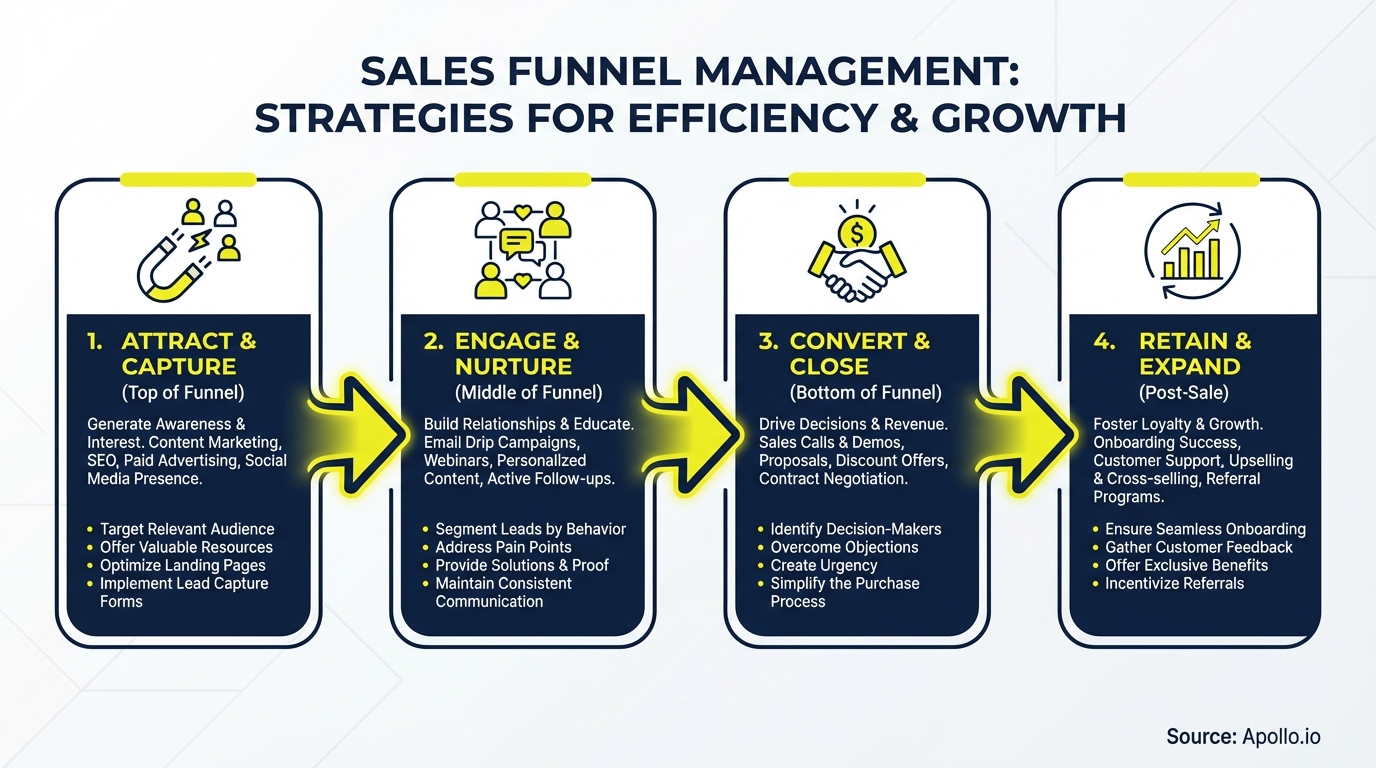
Finally, implement stage-specific engagement strategies:
- Awareness: Educational content, thought leadership, SEO-optimized resources
- Consideration: Product comparisons, case studies, ROI calculators
- Decision: Custom demos, pricing discussions, technical validation
- Negotiation: Contract reviews, executive alignment, implementation planning
Turn Forecast Chaos Into Revenue Confidence
Missing deals because your pipeline data is always outdated? Apollo gives you real-time deal visibility and accurate forecasting. Built-In improved win rates 10% with Apollo's signals.
Start Free with Apollo →What Metrics Should RevOps Teams Track?
RevOps teams need visibility into both volume metrics and velocity metrics across every funnel stage. Volume metrics show how many prospects enter and exit each stage, while velocity metrics reveal how long prospects spend at each stage and where deals stall.
| Metric Category | Key Indicators | Optimization Focus |
|---|---|---|
| Top-of-Funnel | Lead volume, source quality, MQL conversion rate | Traffic sources, content effectiveness, form optimization |
| Mid-Funnel | SQL conversion, meeting booking rate, demo completion | Qualification criteria, outreach relevance, discovery process |
| Bottom-Funnel | Proposal-to-close rate, deal velocity, average deal size | Pricing strategy, competitive positioning, negotiation skills |
| Cross-Stage | Overall conversion rate, time-to-close, win rate by source | Process bottlenecks, handoff quality, attribution accuracy |
For Account Executives managing complex deals, stage-to-stage conversion rates reveal exactly where opportunities fall apart. Sales Leaders use these metrics to identify coaching opportunities and optimize resource allocation across the team.
How Do SDRs Improve Early-Stage Conversion Rates?
SDRs improve conversion by focusing on relevance, timing, and personalization. Start with accurate contact data and company intelligence to ensure every outreach message addresses real business challenges. Use sales analytics to identify high-intent signals like job changes, funding events, or technology adoption patterns.
Multi-channel sequences that combine email, phone, and social outreach convert better than single-channel approaches. SDRs should personalize the first touchpoint based on specific prospect research, then use automation for follow-up sequences. The goal is consistent, relevant engagement without manual repetition.
Spending hours on manual prospecting? Search Apollo's 224M+ contacts with 65+ filters and build targeted lists in minutes.
What Role Does Technology Play in Funnel Management?
Technology consolidates data, automates repetitive tasks, and provides visibility across every funnel stage. Modern teams replace 3-5 separate tools with unified platforms that combine contact data, engagement tracking, pipeline management, and analytics in one workspace.
As one customer shared: "We reduced the complexity of three tools into one" (Predictable Revenue).
The right technology stack enables:
- Unified data: Single source of truth for contact information, engagement history, and deal status
- Automated workflows: Trigger-based sequences that move prospects through stages without manual intervention
- Real-time visibility: Dashboards showing funnel health, conversion rates, and pipeline forecast
- Cross-team alignment: Shared definitions, consistent handoff processes, and attribution clarity
For Founders and CEOs building outbound motion, tool consolidation delivers immediate cost savings and faster team ramp time. "We cut our costs in half" (Census) by moving from multiple point solutions to an integrated platform.
Conclusion: Build a Funnel Management System That Scales
Effective sales funnel management in 2026 requires more than pipeline tracking. It demands visibility into pre-contact buyer behavior, consistency between marketing and sales messaging, and unified data systems that eliminate silos.
Teams that optimize conversion rates at every stage consistently outperform competitors who focus only on top-of-funnel volume.
Start by establishing clear stage definitions, implementing data governance rules, and tracking both volume and velocity metrics. Use technology to automate repetitive tasks while maintaining the personalization that modern buyers expect.
Focus on relevance over frequency, and continuously test and optimize your approach based on conversion data.
Ready to streamline your funnel management? Schedule a Demo to see how Apollo consolidates your sales tech stack into one unified platform for prospecting, engagement, and pipeline management.
Prove Apollo's ROI In Your First 30 Days
Budget approval stuck on unclear metrics? Apollo delivers measurable pipeline impact from day one. Built-In increased win rates 10% and ACV 10% using Apollo's signals and guidance.
Start Free with Apollo →Don't miss these
Sales
Inbound vs Outbound Marketing: Which Strategy Wins?
Sales
What Is a Sales Funnel? The Non-Linear Revenue Framework for 2026
Sales
What Is a Go-to-Market Strategy? The 2026 GTM Playbook
See Apollo in action
We'd love to show how Apollo can help you sell better.
By submitting this form, you will receive information, tips, and promotions from Apollo. To learn more, see our Privacy Statement.
4.7/5 based on 9,690 reviews
