
What Is Sales Funnel Analysis? A Complete B2B Framework for 2026
Most B2B sales funnels leak revenue at every stage, and teams rarely know exactly where or why. Sales funnel analysis is the discipline of measuring conversion rates, identifying drop-off points, and fixing the specific gaps that cost you pipeline. If you want to understand what a sales funnel is and how to make it perform, this framework covers the full journey from first touch to closed-won and beyond.
The stakes are higher than ever. According to Madison Logic, 90% of B2B buying journeys are now completed before any sales interaction. That means your funnel analysis must extend well into the self-serve and digital evaluation layers, not just rep-led stages.

Research Less, Pipeline More With Apollo
Tired of your reps burning hours verifying contact info instead of selling? Apollo delivers accurate, ready-to-contact leads so your team spends time closing, not researching. Join 600K+ companies building predictable pipeline.
Start Free with Apollo →Key Takeaways
- Sales funnel analysis identifies exactly where prospects drop off and what content or action would have kept them moving.
- Modern B2B funnels require post-MQL analysis, including evaluation, procurement, contracting, and onboarding stages.
- Trust signals like reviews, security documentation, and consistent messaging are now conversion-critical at every stage.
- RevOps-led funnel governance, with a single source of truth for stage definitions, prevents metric inconsistency across teams.
- AI-powered pipeline tools consolidate funnel data into one workspace, replacing fragmented point solutions.
What Is Sales Funnel Analysis?
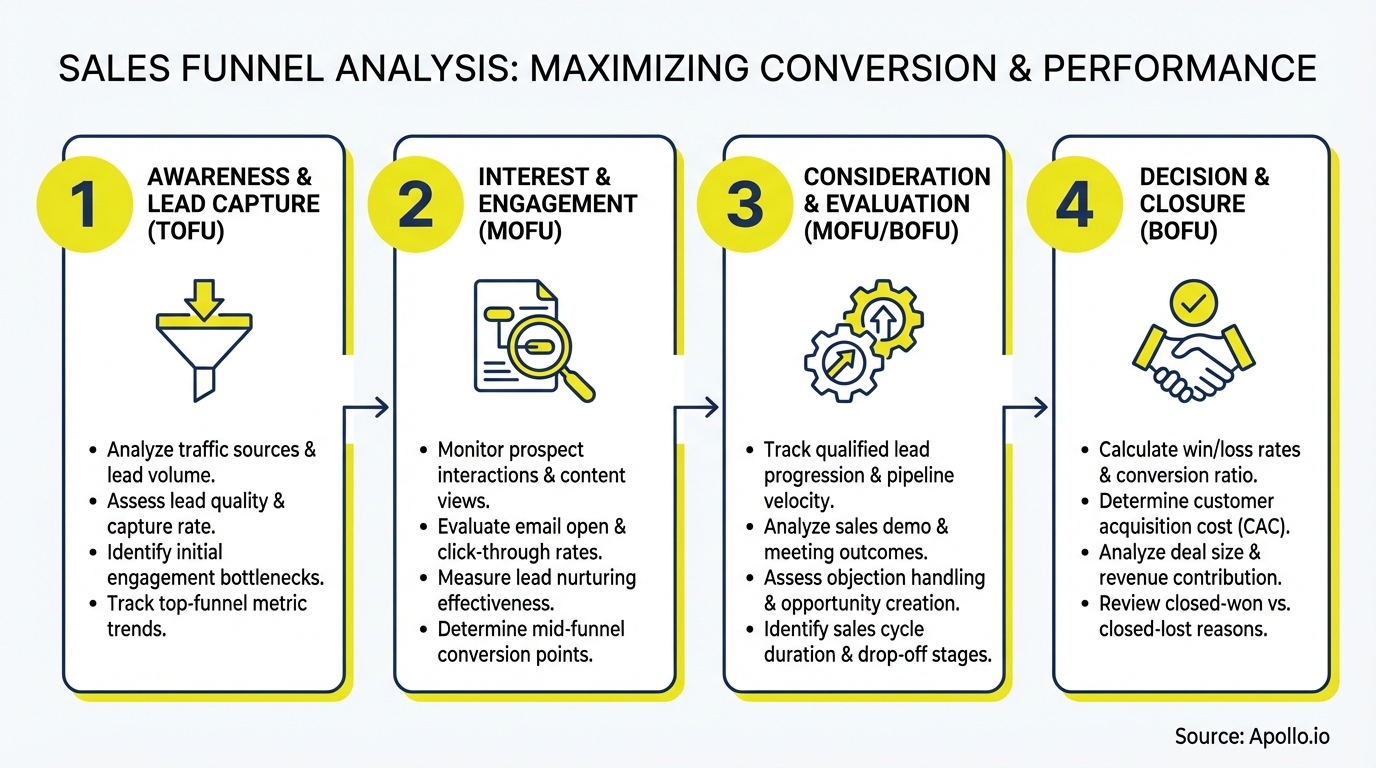
Sales funnel analysis is the process of tracking how prospects move through each stage of your pipeline, measuring conversion rates between stages, and diagnosing why deals stall or exit. It answers three questions: Where are we losing people?
Why are we losing them? What do we change?
A complete B2B sales funnel includes awareness, interest, evaluation, intent, procurement, and post-sale onboarding. Most teams only analyze the top three stages. That leaves the highest-friction, highest-value stages unmeasured. Research from Dreamdata shows the average B2B customer journey now lasts 211 days, with the majority of that time spent without direct interaction with the company. Your analysis needs to cover all 211 days.
What Are the Core Metrics for Sales Funnel Analysis?
Effective funnel analysis starts with consistent, cross-functional metric definitions. Without shared definitions for MQL, SQL, and stage conversions, your data will contradict itself across CRM, marketing automation, and BI tools.
| Funnel Stage | Key Metric | What to Measure |
|---|---|---|
| Awareness | Visitor-to-lead rate | Content engagement, organic reach |
| Interest (MQL) | MQL conversion rate | Form fills, demo requests, content downloads |
| Evaluation (SQL) | SQL-to-opportunity rate | Discovery calls booked, qualification scores |
| Intent/Proposal | Proposal-to-close rate | Proposals sent vs. deals won |
| Procurement | Contract cycle time | Days from verbal agreement to signed contract |
| Post-Sale | Time-to-value | Onboarding completion, early activation |
For deeper insight into how analytics drives each of these stages, see how sales analytics drives revenue growth.
Turn Weak Funnels Into Pipeline Gold
Pipeline forecasting a guessing game because quality leads never materialize? Apollo surfaces in-market buyers the moment they're ready, turning top-of-funnel gaps into real opportunities. Nearly 100K paying customers stopped guessing and started closing.
Start Free with Apollo →Why Do B2B Sales Funnels Stall?
Deal stalls are the most underanalyzed problem in B2B selling. They happen at predictable points and have identifiable causes.
Mapping stalls by stage lets you build content and process interventions before deals go cold.
- Top of funnel: Irrelevant outreach repels qualified buyers. Buyers self-educate heavily before engaging, so generic messaging signals poor fit.
- Mid-funnel: Inconsistent information between your website and your reps creates distrust. When buyers compare what they read online to what they hear from sellers, contradictions stall decisions.
- Late-stage: Procurement and legal reviews extend cycles without active deal management. Security documentation gaps block enterprise sign-off.
- Post-decision: Buyers who feel unsupported after signing become churn risks and negative references. This stage is almost never included in standard funnel analysis.
Struggling to keep deals from going dark? Apollo's deal management tools give you complete pipeline visibility so you can spot stalled opportunities and act before they close lost.
How Do RevOps Leaders Build a Funnel Analysis Framework?
RevOps leaders are uniquely positioned to own funnel analysis because they sit at the intersection of marketing, sales, and customer success data. According to Arovy, organizations with RevOps grow revenue nearly three times faster. The framework below is what high-performing RevOps teams implement.
- Define stage entry and exit criteria. Every team must use the same definitions. Document them in a shared playbook and enforce them in your CRM.
- Instrument every handoff. Track the timestamp and owner at each stage transition. Gaps in handoff data are where analysis breaks down.
- Build a cohort view. Analyze deals by the month they entered each stage. This reveals seasonal patterns and the impact of process changes over time.
- Map trust signals by stage. Identify which reviews, security docs, case studies, or comparison pages buyers need at each decision point. Missing assets equal lost conversions.
- Run a monthly stall review. Pull every deal that has not advanced in 14+ days. Categorize by stage and root cause. Assign specific interventions.
For SaaS-specific funnel frameworks, see how to build a SaaS sales funnel that converts.

How Do SDRs and AEs Use Funnel Analysis to Hit Quota?
Funnel analysis is not just a RevOps or leadership exercise. SDRs and AEs use stage-level data to prioritize their time and personalize their outreach.
For SDRs: Funnel data shows which lead sources convert to SQLs at the highest rate. Instead of working every lead equally, SDRs can focus on the channels and personas that consistently progress. SalesGlobe estimates 70-80% of the B2B buying process happens before a buyer contacts a sales rep, which means SDR outreach lands in a highly researched context. Relevance is everything.
For Account Executives: Stage conversion data reveals which objections appear most often at the proposal and procurement stages. AEs can prepare specific responses, case studies, and security documentation in advance rather than scrambling when a deal stalls. See how enterprise AEs use data to close mega deals for a real-world perspective.
Spending hours manually tracking which prospects are ready to advance? Apollo's AI-powered pipeline builder surfaces your highest-priority opportunities automatically, so SDRs and AEs focus on the conversations that move the number.

How Does AI Change Sales Funnel Analysis in 2026?
AI is moving funnel analysis from static dashboards to real-time, action-oriented intelligence. Instead of reviewing a report weekly, teams receive automated signals when a deal shows stall patterns, when a prospect's engagement drops, or when a cohort's conversion rate falls below baseline.
According to Landbase, AI adoption among sales teams reached 43% in 2024, with 92% of sales teams planning increased AI investment in 2026. The teams moving fastest are using AI to consolidate their funnel data into one workspace rather than stitching together reports from five separate tools.
Apollo's unified GTM platform brings prospecting data, engagement signals, pipeline tracking, and conversation intelligence into a single workspace. As Cyera put it: "Having everything in one system was a game changer." That consolidation is what makes real-time funnel analysis operationally possible for growing teams. Explore which AI sales tools actually close more deals to see how the landscape has shifted.
Start Analyzing Your Funnel with Apollo
Sales funnel analysis only improves revenue when it drives action at every stage. The framework is straightforward: define your stages, instrument your handoffs, map trust signals to each decision point, and build a monthly stall review process.
The teams that do this systematically outperform those that rely on instinct.
Apollo gives B2B GTM teams the data, engagement tools, and pipeline visibility to run this entire process from one platform. Over 600K companies use Apollo to prospect smarter, engage faster, and close more deals without the complexity of a fragmented tech stack. Start your free trial today and see where your funnel is leaking.
Prove Pipeline ROI With Apollo
Budget approval stuck on unclear metrics? Apollo gives sales teams measurable pipeline impact from day one. Leadium 3x'd their annual revenue — see your ROI before the next board meeting.
Start Free with Apollo →Don't miss these
Sales
Inbound vs Outbound Marketing: Which Strategy Wins?
Sales
What Is a Sales Funnel? The Non-Linear Revenue Framework for 2026
Sales
What Is a Go-to-Market Strategy? The 2026 GTM Playbook
See Apollo in action
We'd love to show how Apollo can help you sell better.
By submitting this form, you will receive information, tips, and promotions from Apollo. To learn more, see our Privacy Statement.
4.7/5 based on 9,690 reviews
