
How to Write Sales Follow Up Emails That Get Responses
Most sales professionals send a first email and wait. Yesware reports that 44% of salespeople give up after just one follow-up attempt, yet Peak Sales Recruiting found that 80% of sales require five to twelve follow-up attempts after the initial contact. The disconnect is clear: persistence wins deals, but most reps quit early. A well-structured sales follow-up email bridges the gap between first contact and closed revenue.

Apollo Finds Contacts While You Close Deals
Tired of spending 4+ hours daily hunting for contact info? Apollo delivers 224M verified contacts with 96% email accuracy. Join 550K+ companies who replaced manual research with automated prospecting.
Start Free with Apollo →Key Takeaways
- 80% of sales require five to twelve follow-ups, but 44% of salespeople quit after one attempt
- Follow-up emails increase response rates by 11% and can boost replies by nearly 50% when sent strategically
- Approximately 70% of responses come from the second to fourth email in a sequence
- B2B buying groups now include 5 to 16 people, requiring forwardable content that helps internal alignment
- 2026 deliverability rules (SPF, DKIM, DMARC) mean follow-up cadence is now an infrastructure problem, not just a copy problem
What Is a Sales Follow-Up Email?
A sales follow-up email is a message sent after initial contact to re-engage prospects, move deals forward, or recover stalled conversations. It serves multiple functions: reminding prospects of your value, addressing objections, sharing new information, or simply staying top-of-mind until timing aligns.
Research from Artisan shows that sending just one follow-up can increase the average response rate by nearly 50%. Yet most reps treat follow-ups as an afterthought rather than a systematic revenue driver.
For SDRs managing high-volume outbound, follow-ups determine whether your pipeline grows or stalls. For Account Executives closing complex deals, they keep multi-stakeholder conversations alive across long sales cycles.
The best follow-ups don't just ask "Did you see my last email?" They add value, address specific pain points, and make it easy for prospects to take the next step.
Why Do Most Sales Follow-Up Emails Fail?
Most follow-up emails fail because they focus on the seller's needs, not the buyer's. Generic "just checking in" messages get ignored because they offer no new value. Data from Instantly shows that approximately 70% of responses are generated by the second to fourth email in a follow-up series, but only if each message brings fresh perspective.
Common failure patterns include:
- No new information: Repeating the same pitch without adding context, case studies, or relevant insights
- Wrong timing: Following up too quickly (appearing pushy) or too slowly (losing momentum)
- Single-threaded approach: Ignoring that B2B buying groups now include 5 to 16 people who need different information
- Deliverability issues: Missing SPF/DKIM/DMARC authentication causes emails to land in spam, especially after Microsoft Outlook's May 2025 enforcement updates
RevOps leaders report that deliverability has become as important as copy quality. If your follow-ups never reach the inbox, your cadence strategy is irrelevant.
How Do SDRs Write Effective Follow-Up Emails?
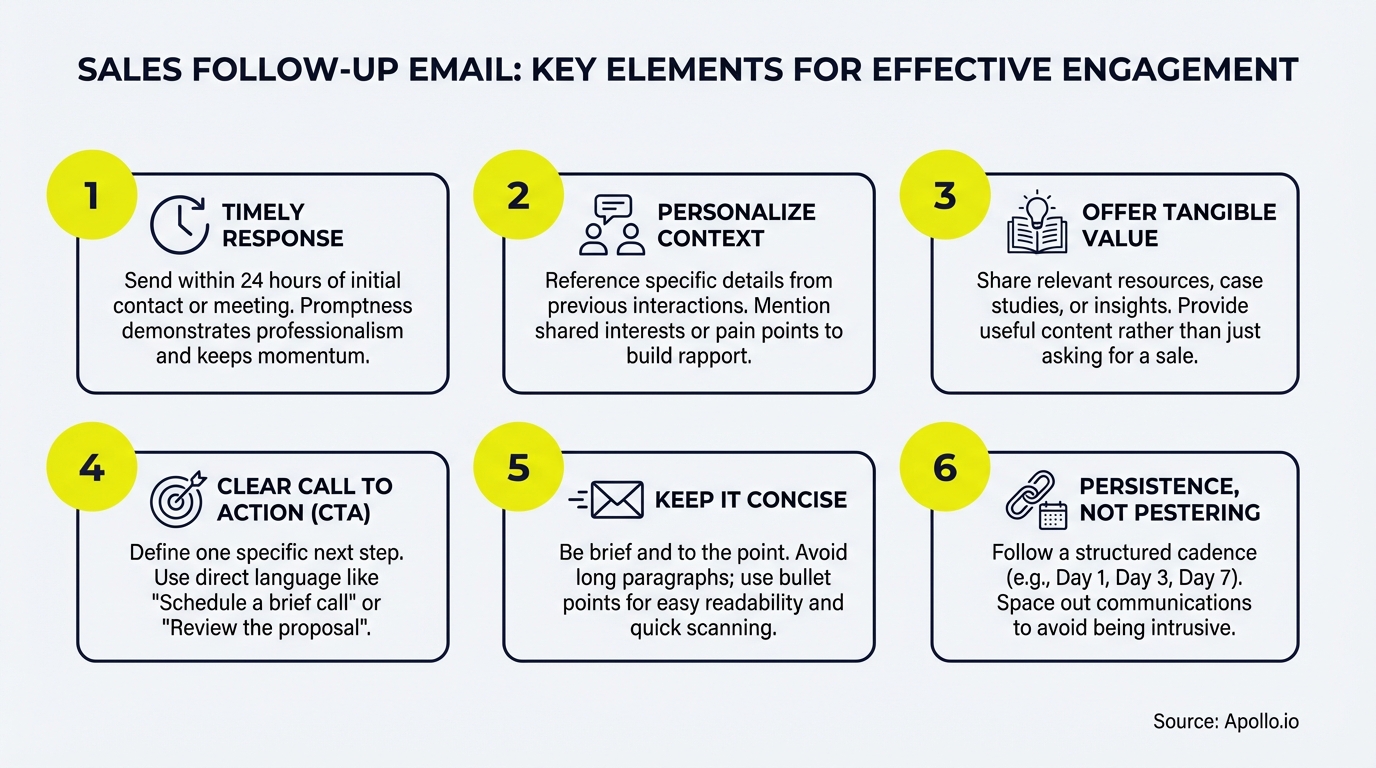
SDRs who consistently book meetings use a structured approach that treats each follow-up as a mini sales conversation. The goal is to provide incremental value while making it easy for prospects to respond.
Start with context and value: Reference the previous touchpoint and introduce one new piece of relevant information. This could be a case study, industry trend, or specific feature that addresses their known pain point. Value-based messaging outperforms generic check-ins.
Use the 3-5 touch rule: 2026 benchmarks show diminishing returns after the fourth or fifth email, with increased unsubscribe and complaint rates. Structure your sequence: (1) Introduction, (2) Value-add follow-up, (3) Different angle or case study, (4) Final breakup email offering to close the loop.
Make it forwardable: B2B buyers forward your email to 5-16 other stakeholders. Include a one-paragraph executive summary at the top that explains who you are, what you solve, and why it matters. This helps your champion sell internally without rewriting your message.
Struggling to manage multi-touch sequences across hundreds of prospects? Automate your follow-up cadences with Apollo's multi-channel engagement platform.
What Are the Best Follow-Up Email Templates for 2026?
Effective templates adapt to different scenarios while maintaining personalization.
Here are proven frameworks that work across industries.
After Initial Outreach (No Response)
Subject:
Quick question about [specific pain point]
Body: [First name], I sent a note last week about [specific challenge]. I came across [relevant industry insight/case study] and thought of your team at [company]. [One-sentence value prop]. Worth a 15-minute conversation? [Calendar link]
After Demo or Meeting
Subject: [
Company name] next steps + [specific resource]
Body: [First name], thanks for the conversation yesterday. Based on your focus on [specific goal], I've attached [relevant case study/ROI calculator]. For your team's review, here's a one-page summary: [bullet points covering key benefits, implementation timeline, pricing overview]. Next step: [specific action with owner and deadline]. Let me know if you need anything for your internal discussions.
Final Breakup Email
Subject:
Closing the loop
Body: [First name], I've reached out a few times about [solution]. I don't want to clutter your inbox, so I'll assume the timing isn't right. If things change, here's my calendar: [link]. Otherwise, I'll close this loop on my end. Thanks for your time.
For more ready-to-use templates, check out sales email templates that get responses in 2026.

How Should Account Executives Follow Up on Complex Deals?
Account Executives managing enterprise deals face longer cycles and larger buying committees. Your follow-ups must equip champions to sell internally while keeping executive sponsors engaged.
Package governance assets: After proposal or security review stages, send emails with attached ROI memos, risk FAQs, and mutual action plans. These forwardable assets help procurement, finance, and security teams get answers without scheduling more meetings.
Reference multi-channel touchpoints: Your follow-up email should connect the dots across in-person meetings, remote demos, and self-serve resources. Example: "Following up on last week's technical deep-dive, here's the architecture doc your team requested, plus a recorded walkthrough for your security lead."
Track attribution and next steps: Each follow-up should clarify what happens next, who owns it, and when. Use language like: "Next milestone: Security questionnaire completion by [date].
Owner: [name]. I'll check in on [specific date] to address any blockers."
For AEs managing multiple complex deals, enterprise sales strategies provide additional frameworks for navigating long cycles.
See Every Deal Stage In Real Time With Apollo
Pipeline forecasting a guessing game? Apollo gives you live visibility into every deal stage so you can forecast with confidence. Built-In boosted win rates 10% with Apollo's scoring.
Start Free with Apollo →What Operational Playbook Do High-Performing Teams Use?
Sales Leaders and RevOps teams that treat follow-ups as a system (not just copy) outperform teams that leave it to individual rep discretion. Here's the operational framework top teams implement in 2026.

| Component | Standard | Why It Matters |
|---|---|---|
| Response-Time SLA | Within 5 minutes for inbound leads | Speed-to-lead research shows 100x higher contact rates when responding within 5 minutes vs. 30 minutes |
| Sequence Length | 3-5 touches max for cold outbound | Diminishing returns after touch 4, with increased unsubscribe risk |
| Deliverability Infrastructure | SPF, DKIM, DMARC authentication + complaint rate monitoring | Microsoft Outlook (May 2025) and Gmail/Yahoo rules now reject emails with authentication failures |
| Channel Mix | Email + phone + social after touch 3 | Multi-channel sequences prevent email fatigue and match hybrid buying preferences |
| Content Governance | Approved templates + AI draft review | CRMs now auto-generate follow-ups; governance prevents compliance and brand risk |
Tired of juggling multiple tools for sequencing, deliverability, and tracking? Apollo consolidates your sales tech stack with AI-powered automation that handles follow-ups, enrichment, and engagement in one workspace.
How Do You Measure Follow-Up Email Performance?
Measuring follow-up effectiveness requires tracking both engagement metrics and revenue outcomes. Here's what high-performing teams monitor in 2026.
Core engagement metrics:
- Reply rate by touch number (track which follow-ups drive responses)
- Meeting-booked rate (the metric that actually matters for SDRs)
- Unsubscribe and complaint rates (early warning for sequence problems)
- Time-to-response (how long prospects take to reply after each touch)
Revenue attribution:
- Pipeline generated by follow-up stage (which touches create opportunities)
- Deal velocity by follow-up cadence (shorter cycles with optimized sequences)
- Win rate correlation (do more/fewer follow-ups impact close rates)
According to Salesgenie, follow-up emails, in general, increase the chance of a response by 11%. But top performers measure beyond reply rates to understand which follow-ups actually create pipeline.
For additional measurement frameworks, explore how sales analytics drive revenue growth.
Start Sending Follow-Ups That Actually Convert
The data is clear: 80% of sales require five to twelve follow-ups, yet most salespeople quit after one or two attempts. The winners in 2026 aren't just sending more emails.
They're building systematic follow-up processes that combine better copy, deliverability infrastructure, multi-channel sequencing, and forwardable content designed for buying committees.
For SDRs, this means structured 3-5 touch sequences with value-add messaging at each stage. For Account Executives, it means packaging governance assets that help champions sell internally.
For Sales Leaders and RevOps teams, it means treating follow-up as an operational discipline with clear SLAs, authentication standards, and measurement frameworks.
The tools exist to automate and scale this approach. Apollo consolidates prospecting, engagement, and pipeline management into one platform, eliminating the need for separate tools while providing the data quality and deliverability infrastructure that modern follow-up strategies require.
Teams using Apollo report significant time savings and improved response rates because everything works together in a single workspace.
Ready to transform your follow-up process? Request a Demo to see how Apollo helps teams book more meetings, shorten sales cycles, and close more deals with systematic follow-up sequences.
Prove Apollo's Value In Your First Week
Budget approval stuck on unclear metrics? Apollo tracks every activity to pipeline dollar so you justify spend with real numbers. Built-In increased win rates 10% and ACV 10% using Apollo's scoring.
Start Free with Apollo →Don't miss these
Sales
Inbound vs Outbound Marketing: Which Strategy Wins?
Sales
What Is a Sales Funnel? The Non-Linear Revenue Framework for 2026
Sales
What Is a Go-to-Market Strategy? The 2026 GTM Playbook
See Apollo in action
We'd love to show how Apollo can help you sell better.
By submitting this form, you will receive information, tips, and promotions from Apollo. To learn more, see our Privacy Statement.
4.7/5 based on 9,690 reviews
