
How to Choose the Right Sales Engagement Solution for Your Team
Modern sales teams face a critical challenge: buyers expect digital-first interactions while avoiding traditional sales reps. A sales engagement solution enables teams to orchestrate multi-channel outreach at scale while maintaining personalization and relevance. The right platform consolidates prospecting, sequencing, and analytics into one workspace, cutting tool costs and accelerating revenue growth.

Research Less, Pipeline More With Apollo
Tired of burning hours hunting down emails that bounce and numbers that go nowhere? Apollo delivers verified business contacts so your reps spend time selling, not searching. Join 550K+ companies building predictable pipeline.
Start Free with Apollo →Key Takeaways
- Sales engagement solutions automate multi-channel outreach while maintaining personalized buyer experiences across email, phone, and social channels
- Modern platforms integrate AI agents, data enrichment, and conversation intelligence to reduce manual work and improve targeting accuracy
- Tool consolidation saves teams thousands monthly by replacing separate prospecting, sequencing, and analytics platforms
- Governance frameworks prevent irrelevant outreach that drives 73% of buyers to actively avoid suppliers
- Committee-forwardable content kits address the reality that B2B deals involve 6 to 10 decision-makers
What Is a Sales Engagement Solution?
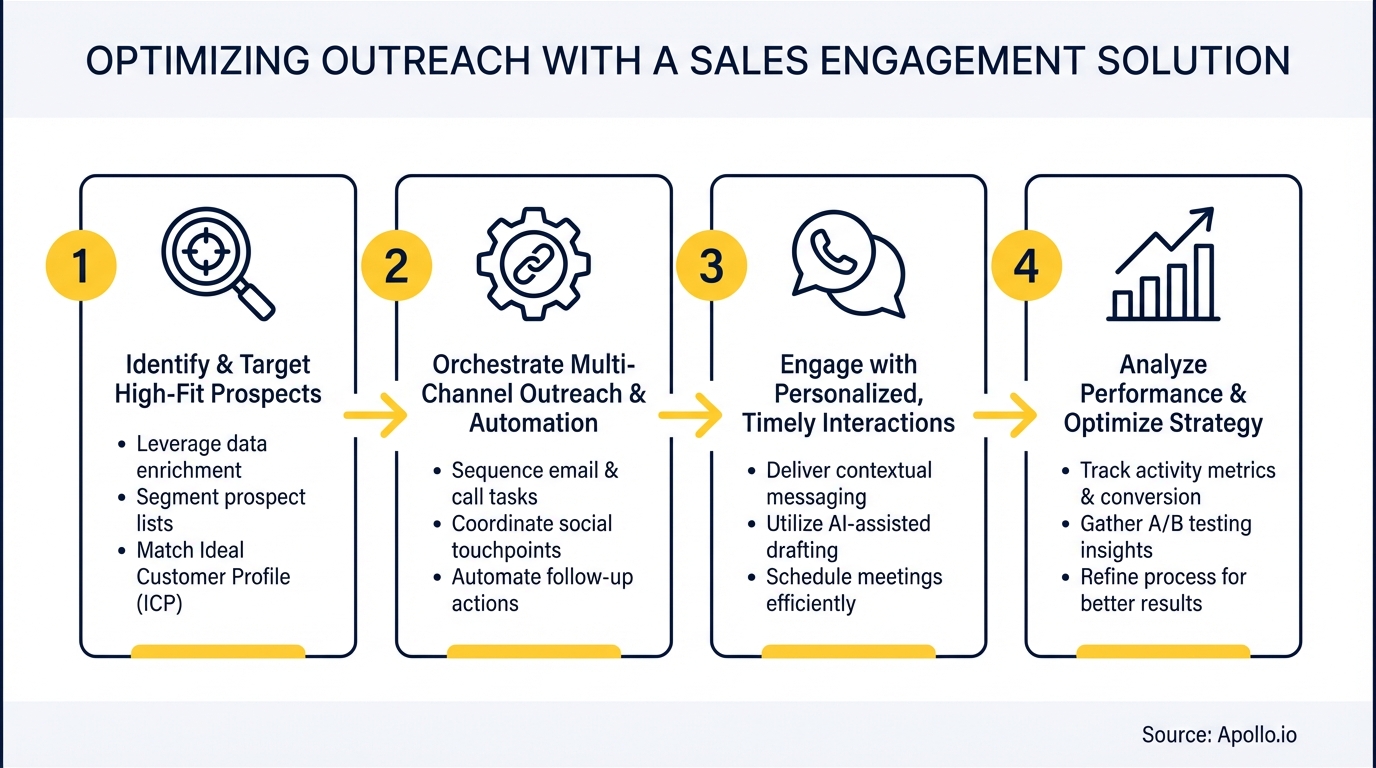
A sales engagement solution is a platform that automates and orchestrates multi-channel outreach sequences across email, phone, and social channels. It enables sales teams to engage prospects at scale while tracking every interaction in a centralized workspace.
Unlike CRMs that store customer data or sales enablement tools that provide content libraries, engagement platforms execute the actual outreach motion.
According to SalesStar, 80% of B2B sales interactions between suppliers and buyers are expected to occur in digital channels. This shift makes engagement platforms essential infrastructure for reaching buyers where they prefer to interact. The best solutions combine prospecting databases, sequence automation, AI-powered personalization, and analytics in one system.
How Does It Differ From CRM and Sales Enablement Tools?
Sales engagement solutions sit between your CRM and sales enablement stack. Your CRM (Salesforce, HubSpot) stores account and opportunity data.
Your enablement tools (content libraries, training platforms) provide resources. Your engagement platform executes the outreach workflows that move prospects through your pipeline.
The boundaries matter for tool consolidation. Teams that try to force CRMs into engagement workflows or use separate prospecting, sequencing, and dialing tools face integration headaches and data silos. Modern platforms like Apollo consolidate these capabilities, reducing complexity and cost.
Why Do Sales Teams Need Engagement Solutions in 2026?
Buyer behavior has fundamentally changed. Research from IV Lead shows 96% of prospects conduct their own research before engaging with a human sales representative, and 71% prefer to do their own research rather than talk to a rep. This creates a paradox: buyers avoid reps but still need guidance through complex purchase decisions.
Sales engagement solutions solve this by enabling asynchronous, value-first communication at scale. Instead of cold calls interrupting busy executives, SDRs can deliver relevant insights through sequenced touchpoints that prospects consume on their schedule.
When prospects do engage, reps have complete context about prior interactions and demonstrated interests.
What Problems Do They Solve for SDRs and Account Executives?
For SDRs, engagement platforms eliminate manual prospecting and outreach tasks. Instead of researching contacts, copying email addresses into spreadsheets, and manually sending follow-ups, SDRs build targeted sequences once and let automation handle execution.
This shifts focus from administrative work to strategic targeting and message optimization.
Account Executives benefit from pre-meeting intelligence and deal acceleration tools. When an AE inherits a qualified lead, they see the complete engagement history, which messages resonated, and which stakeholders are involved. For complex deals involving 6 to 10 decision-makers (according to Dring.ai), engagement platforms help orchestrate multi-threaded outreach across buying committees.

What Are the Core Capabilities of Modern Sales Engagement Solutions?
Effective sales engagement solutions combine six core capabilities that work together to accelerate pipeline. Each capability addresses a specific friction point in the buyer journey, from initial discovery through closed-won deals.
| Capability | What It Does | Business Impact |
|---|---|---|
| Prospecting Database | Verified business contact data with 65+ filters for targeting | Reduces research time, improves list quality |
| Multi-Channel Sequencing | Automated email, phone, and social touchpoints with personalization | Increases reply rates, maintains consistency |
| AI Agents & Automation | Research automation, content generation, next-step recommendations | Frees reps for high-value activities |
| Data Enrichment | Real-time contact updates, intent signals, trigger events | Improves targeting accuracy, timing |
| Conversation Intelligence | Call recording, transcription, coaching insights | Accelerates rep ramp, improves win rates |
| Analytics & Attribution | Sequence performance, channel effectiveness, revenue tracking | Optimizes resource allocation, proves ROI |
The emergence of agentic AI in 2025-2026 is transforming how these capabilities work together. Instead of tools that assist with drafting, modern platforms deploy AI agents that autonomously research accounts, identify stakeholders, generate personalized messaging, and recommend optimal next steps based on engagement patterns.
How Do AI Agents Change Sales Engagement Workflows?
AI agents shift engagement from manual sequencing to autonomous execution. Rather than reps building sequences step-by-step, they define targeting criteria and value propositions, then let AI agents handle research, personalization, and timing optimization.
The agent monitors responses, adjusts messaging based on engagement signals, and escalates qualified conversations to human reps.
This doesn't replace sales reps but changes what they spend time on. Instead of administrative tasks, SDRs focus on refining targeting strategies, coaching AI agents on messaging frameworks, and having high-value conversations with engaged prospects.
For teams struggling with capacity constraints, AI agents effectively multiply output without proportional headcount increases.
Turn Funnel Guesswork Into Closed Deals
Forecasts feel like fiction when leads stall and pipeline data goes stale. Apollo surfaces high-intent prospects the moment they're ready to buy. Top revenue teams use Apollo to build pipeline they can actually forecast.
Schedule a Demo →How Do Sales Leaders Build Governance Frameworks That Prevent Irrelevant Outreach?
Irrelevant outreach actively harms pipeline. Buyers don't just ignore generic messages, they actively avoid suppliers who send them.
The solution isn't sending less outreach but sending more relevant outreach through governance frameworks that enforce quality standards before sequences launch.
Effective governance starts with ICP definitions that go beyond firmographics. Define not just company size and industry but specific trigger events (funding rounds, leadership changes, technology adoption) that indicate purchase intent.
Map persona-based value hypotheses that articulate why each role cares about your solution. Build QA checklists that verify every sequence includes personalization tokens, relevant case studies, and clear next-step CTAs.
What Should Sequence Guardrails Include?
Sequence guardrails prevent common mistakes that damage sender reputation and waste prospect attention. Set maximum touchpoint limits (typically 6-8 touches over 2-3 weeks for cold outbound).
Require minimum wait times between touches (48-72 hours for email, 5-7 days for phone). Mandate A/B testing for subject lines and opening paragraphs to continuously improve performance.
For teams using multi-channel sequences, establish channel-specific rules. Email should lead with value and include easy opt-out mechanisms. Phone calls should reference prior email context. Social touches should engage with prospect content before pitching. These guardrails maintain professionalism while maximizing response rates.
Struggling to maintain message consistency across channels? Apollo's unified engagement platform keeps email, phone, and social outreach aligned.
How Do You Build Committee-Forwardable Content for Multi-Stakeholder Deals?
B2B purchases rarely involve single decision-makers. When your champion needs to build internal consensus across 6-10 stakeholders, generic sales decks fail.
Committee-forwardable content kits provide role-specific assets that champions can confidently share with CFOs, IT leaders, and end-users without requiring rep involvement.
Build content packs that address each stakeholder's specific concerns. For CFOs, create one-page ROI calculators with industry-specific benchmarks.
For security teams, provide compliance documentation and architecture diagrams. For end-users, develop quick-start guides and video walkthroughs.
Package these assets in easily shareable formats (PDFs, unlisted YouTube videos, dedicated microsite URLs) that don't require form fills or gate-keeping.
What Content Formats Work Best in Sales Sequences?
The shift toward asynchronous buying favors shorter, more consumable content formats. One-pagers outperform 20-slide decks. 90-second video explanations beat 30-minute webinars for initial awareness.
Interactive ROI calculators drive more engagement than static spreadsheets. Each asset should deliver value in under 3 minutes of prospect time.
For sequence integration, create content progression paths that match buying stages. Early touches share educational content (industry trend reports, framework explainers).
Middle touches provide social proof (customer case studies, comparison guides).
Late touches offer decision support (implementation timelines, contract templates).
Tag content by buyer stage and persona to enable dynamic sequence personalization.
What Metrics Actually Matter for Sales Engagement Success?
Most teams track vanity metrics (emails sent, calls logged) that don't correlate with revenue. Focus instead on conversion metrics at each pipeline stage.
What percentage of targeted accounts engage with sequences? What percentage of engaged accounts book meetings?
What percentage of meetings convert to opportunities? What percentage of opportunities close?
According to Emarsys, 81% of surveyed customers state that customer experience is a competitive differentiator. This makes engagement quality metrics critical. Track reply sentiment (positive vs. negative responses), opt-out rates by sequence, and time-to-first-response. If prospects consistently opt out or reply negatively, your messaging needs refinement regardless of volume metrics.
How Do You Attribute Revenue to Engagement Activities?
Revenue attribution connects engagement activities to closed deals, proving ROI and guiding resource allocation. Implement multi-touch attribution that credits sequences throughout the buyer journey, not just first or last touch.
Track which sequences generate pipeline, which channels drive meetings, and which messaging frameworks correlate with closed-won deals.
For teams using sales analytics platforms, build custom reports that segment performance by rep, sequence type, industry, and company size. Identify patterns like "enterprise deals require 12+ touchpoints" or "healthcare prospects respond best to peer comparison content." Use these insights to optimize targeting and messaging continuously.
Need better visibility into what's actually driving pipeline? Track sequence-to-revenue attribution with Apollo's deal management.
How Should Teams Implement a Sales Engagement Solution?
Successful implementations follow a phased approach that balances quick wins with long-term optimization. Phase 1 (weeks 1-4) focuses on data migration, user training, and launching pilot sequences with a small team subset.
Phase 2 (weeks 5-8) expands to full team rollout, establishes governance frameworks, and builds content libraries. Phase 3 (weeks 9-12) optimizes based on performance data, integrates AI agents, and scales successful playbooks.
Assign clear ownership across three roles. Sales Operations owns platform configuration, data hygiene, and integration management.
Sales Enablement owns training, content creation, and best practice documentation. Front-line managers own adoption enforcement, coaching, and performance optimization.
Without dedicated ownership, platforms become shelfware that teams work around rather than embrace.
What Are Common Implementation Mistakes to Avoid?
The biggest mistake is treating implementation as a one-time project rather than continuous optimization. Teams that launch sequences and never iterate miss performance improvements.
Establish monthly sequence reviews that analyze conversion rates, identify underperforming touchpoints, and test new messaging variations.
Another common error is over-automating too quickly. Start with simpler sequences that combine automation with manual personalization.
As reps build confidence and governance frameworks prove effective, gradually increase automation sophistication. Rushing to full automation before establishing quality standards produces high-volume, low-relevance outreach that damages brand reputation.
How Does Tool Consolidation Impact Sales Engagement ROI?
Sales teams typically cobble together 5-7 separate tools for prospecting, sequencing, enrichment, dialing, analytics, and meeting scheduling. Each tool requires separate contracts, integrations, training, and administrative overhead.
This fragmentation creates data silos, workflow friction, and substantial cost overhead.
Tool consolidation addresses these inefficiencies by combining core capabilities in one platform. Teams using Apollo report "We reduced the complexity of three tools into one" (Predictable Revenue) and "We cut our costs in half" (Census).
Beyond direct cost savings, consolidation eliminates integration maintenance, reduces training time for new hires, and provides unified analytics across the entire engagement workflow.
What Should Teams Look for in an All-in-One Platform?
Evaluate platforms based on capability depth, not just breadth. An all-in-one platform that offers shallow versions of every feature creates new problems rather than solving existing ones.
Look for platforms that excel at core engagement workflows (prospecting, sequencing, analytics) while offering strong integrations for specialized needs.
For growing teams, prioritize platforms that scale from startup to enterprise without requiring migration. Apollo serves companies at every stage, from growing startups to mid-market and enterprise organizations, with consistent data quality and feature access across all tiers.
This eliminates the painful platform migrations that disrupt productivity and reset adoption progress.

Start Building More Effective Sales Engagement Workflows
Sales engagement solutions have evolved from simple email sequencing tools to comprehensive revenue platforms that consolidate prospecting, multi-channel outreach, AI automation, and analytics. The teams winning in 2026 are those that combine platform capabilities with governance frameworks, committee-ready content, and continuous optimization based on performance data.
The buyer preference for digital self-serve interactions isn't reversing. Success requires platforms that enable asynchronous, value-first engagement at scale while maintaining the personalization and relevance that prevents prospects from actively avoiding your outreach.
Tool consolidation amplifies ROI by eliminating integration overhead and providing unified visibility across the entire engagement motion.
Ready to consolidate your sales tech stack and accelerate pipeline growth? Request a Demo to see how Apollo's all-in-one platform replaces 3-5 separate tools while improving targeting accuracy, response rates, and deal velocity.
Prove Pipeline ROI With Apollo
Budget approval stuck on unclear metrics? Apollo delivers measurable pipeline impact your leadership can see — faster. Leadium 3x'd their annual revenue. Start your free trial and show ROI from day one.
Start Your Free Trial →Don't miss these
Sales
Inbound vs Outbound Marketing: Which Strategy Wins?
Sales
What Is a Sales Funnel? The Non-Linear Revenue Framework for 2026
Sales
What Is a Go-to-Market Strategy? The 2026 GTM Playbook
See Apollo in action
We'd love to show how Apollo can help you sell better.
By submitting this form, you will receive information, tips, and promotions from Apollo. To learn more, see our Privacy Statement.
4.7/5 based on 9,690 reviews
