
What Is a Sales Deck Template and How Do You Build One That Closes Deals in 2026?
A sales deck template is a pre-structured presentation framework that guides prospects through your value proposition, proof points, and next steps.
But in 2026, a static slide deck is no longer enough.
According to Landbase, approximately 75% of B2B buyers prefer a sales experience without direct interaction with sales representatives.
Your deck needs to work without you in the room.
For AEs, SDRs, and RevOps teams under pipeline pressure, that means building a self-serve, governance-ready deck system, not just downloading a pretty template.
Pair your deck with a strong sales presentation template focused on ROI to ensure every slide earns its place.

Research Less, Close More With Apollo
Tired of your reps burning hours verifying contact info instead of selling? Apollo delivers accurate, ready-to-use business contacts so your team spends time closing, not chasing. Join 600K+ companies building real pipeline.
Start Free with Apollo →Key Takeaways
- A modern sales deck template must function as a self-serve decision aid, not just a meeting prop.
- Personalized decks consistently outperform generic ones. Messaging alignment between your deck and website builds buyer trust.
- Structure your template around an executive value snapshot: one slide for ROI, one for value, one for risk.
- AEs and SDRs should use modular slide systems so they can adapt quickly by persona, industry, and deal stage.
- AI-native templates with locked brand regions and a proof library are becoming standard in 2026.
What Is a Sales Deck Template?
A sales deck template is a reusable presentation structure that standardizes how your team communicates value to prospects.
It defines the slide order, messaging hierarchy, proof requirements, and visual guidelines reps follow for every deal.
Think of it as a governed starting point, not a fill-in-the-blank form.
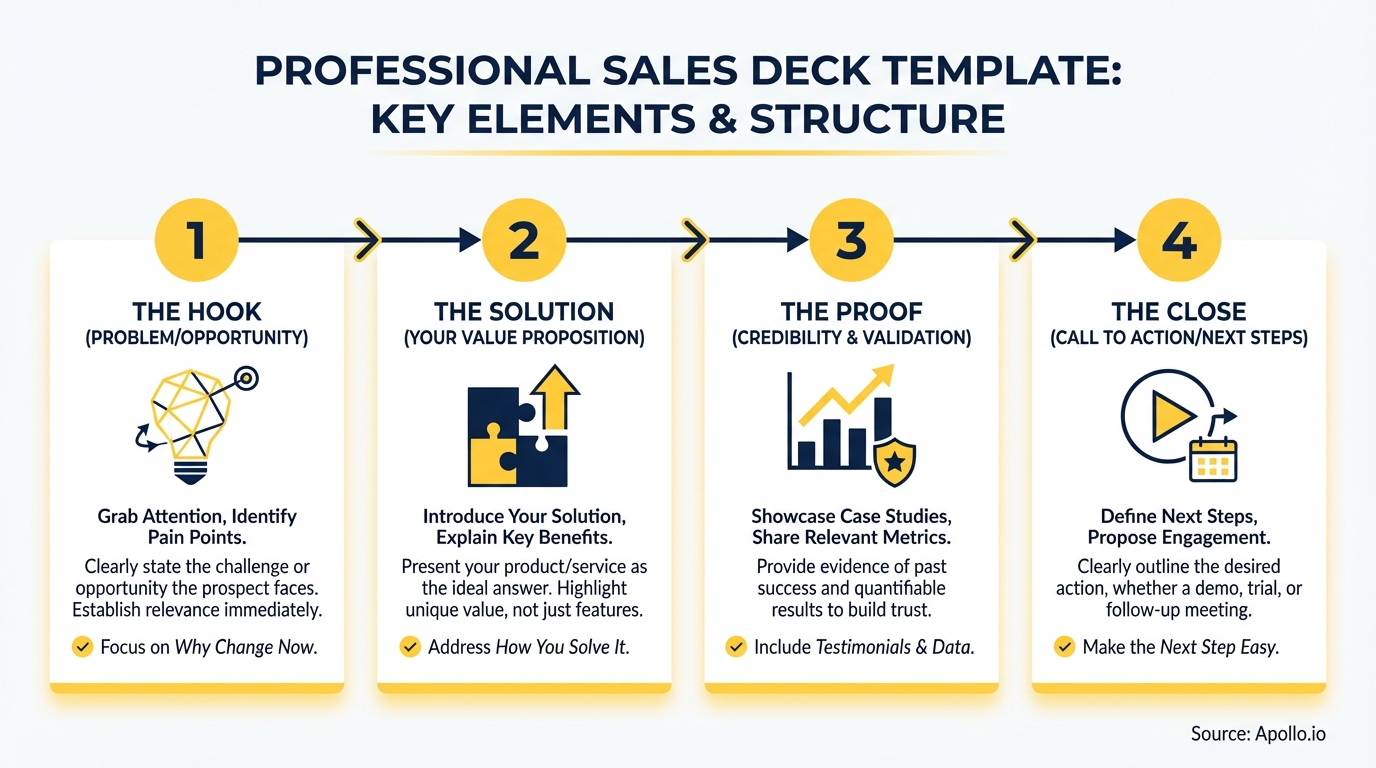
A strong template covers: problem framing, solution positioning, social proof, ROI case, and a clear call to action.
According to GTMnow, visual presentations are 43% more persuasive than bullet-point ones, and over 65% of people learn best visually.
Structure and design are not cosmetic choices.
What Slides Should Every Sales Deck Template Include?
A high-converting B2B sales deck template follows a proven sequence.
Each slide should answer one specific buyer question.
| Slide | Buyer Question It Answers | Content to Include |
|---|---|---|
| 1. Problem | Do you understand my situation? | Industry pain, cost of inaction, status quo risk |
| 2. Solution | What do you actually do? | One-sentence positioning, key capabilities |
| 3. Value Proposition | Why should I care? | Core benefit, differentiated outcome |
| 4. Social Proof | Who else has done this? | Customer logos, case study headline, quote |
| 5. ROI / Business Case | What's the return? | Outcome metrics, time-to-value, cost comparison |
| 6. Risk Mitigation | What if it doesn't work? | Onboarding support, SLAs, security/compliance info |
| 7. Next Steps | What do I do now? | Clear CTA, timeline, contact info |
For deals involving senior stakeholders, add an Executive Value Snapshot as slides 2a–2c: one slide on value, one on ROI, one on risk. Semrush reports that B2B buyers consume an average of 13 pieces of content before making a purchase. Your deck is one piece of a longer journey, so make each slide count independently.

How Do AEs and SDRs Adapt a Sales Deck Template by Persona?
Account Executives closing enterprise deals need a different deck than SDRs booking discovery calls.
A modular template system solves this.
Build a master deck with locked brand elements, then define which slides are swappable by role, industry, or deal stage.
- SDRs: Use a shorter 4-5 slide version focused on problem + social proof + meeting CTA. Skip the ROI slide until discovery is complete.
- AEs: Use the full 7-slide version with a customized ROI slide and industry-specific case study. For enterprise sales, add an executive sponsor slide with a business impact summary.
- RevOps: Maintain the master template with version control. Enforce the proof library so every claim links to a verified source.
Research from Vibe shows personalized presentations can improve win rates by up to 50% over generic slides.
Modular templates make personalization scalable without starting from scratch every time.
Struggling to reach the right contacts before your deck even lands? Find verified decision-makers with Apollo's 230M+ contact database and 65+ filters so your deck reaches the people who can actually say yes.
Turn Funnel Gaps Into Pipeline Wins
Pipeline forecasting a guessing game? Apollo surfaces in-market buyers with real-time signals so your team stops chasing cold leads and starts closing warm ones. Join 600K+ companies building predictable revenue.
Start Free with Apollo →What Is a Proof Library and Why Does Every Sales Deck Template Need One?
A proof library is a centralized, approved set of claims, case study snippets, customer quotes, and data points that reps can pull into their decks. Every claim in a slide links back to a verified source, either a published case study, a third-party report, or a customer-approved quote.
This matters because inconsistency kills deals. When buyers see different numbers on your deck than on your website, trust erodes.
Your proof library also future-proofs your deck for AI-assisted editing. As AI tools like Copilot and Gemini for Slides become standard, locked proof blocks prevent AI from hallucinating or overwriting verified claims.
- Map each claim in your deck to a source URL
- Flag outdated statistics quarterly for refresh
- Keep customer quotes in a separate approved asset file
- Align deck language with your website's exact product descriptions
Pair your deck proof system with sales analytics to identify which proof points actually correlate with closed deals.

How Do You Build a Rep-Free, Self-Serve Sales Deck?
A rep-free sales deck is designed to be forwarded internally and evaluated without a seller present. This is the fastest-growing use case for sales decks in 2026.
Build yours with these embedded elements:
- FAQ slide: Answer the top 5 objections directly in the deck (pricing, security, implementation timeline, integrations, support)
- Pricing rationale slide: Not necessarily a price list, but a framing of value tiers and what drives cost
- Implementation scope slide: Timeline, onboarding steps, and what the buyer needs to provide
- Next steps with async options: Link to a demo recording, a self-serve trial, or a scheduling page
For teams using sales email templates to follow up after sending a deck, embed the deck link in a trackable sequence so you know when the prospect reopens it and which slides they spend time on.
Ready to turn deck opens into booked meetings automatically? Apollo's multi-channel sales engagement platform lets you trigger follow-up sequences the moment a prospect engages with your content.
What Makes a Sales Deck Template AI-Native in 2026?
AI-native templates are structured so AI tools can reliably edit, personalize, and generate content without breaking brand rules.
The shift from static downloads to governed AI pipelines is the defining trend in sales enablement this year.
To make your template AI-ready:
- Use master slides with locked fonts, colors, and logo placement
- Define placeholder labels clearly (e.g., [CUSTOMER_INDUSTRY_STAT], [CASE_STUDY_QUOTE])
- Store approved content blocks in a shared library an agent can reference
- Set rules for which slides are dynamic (proof, ROI, industry) vs. static (brand, legal)
The emerging model in agentic enablement pulls CRM context, deal stage, and persona data to auto-populate the right slides before a rep reviews. Teams building toward this model should also invest in a sales tech stack that connects CRM signals to content generation workflows. Pair this with AI sales tools that surface deal context in real time.
How Do You Start Using a Sales Deck Template Today?
A strong sales deck template is the foundation of repeatable revenue.
Build it once, govern it well, and your entire GTM team benefits: SDRs book more meetings, AEs close faster, and RevOps maintains a single source of truth.
Start with the 7-slide core structure above.
Add a proof library, a rep-free FAQ section, and modular persona variants.
Then connect your deck to your broader sales motion with Apollo's free outbound sales resource kit, which includes email scripts, call frameworks, and templates that work alongside your deck at every stage of the funnel.
Apollo brings prospecting, engagement, and pipeline management into one unified platform, so your deck never works in isolation.
As Cyera's team put it: "Having everything in one system was a game changer." Get Leads Now and start building a deck-to-close motion that scales.
Prove Pipeline ROI With Apollo
Budget approval stuck on unclear pipeline metrics? Apollo delivers measurable deal velocity and booking gains your leadership can't ignore. Leadium 3x'd their revenue — start your free trial today.
Start Free with Apollo →Don't miss these
Sales
Inbound vs Outbound Marketing: Which Strategy Wins?
Sales
What Is a Sales Funnel? The Non-Linear Revenue Framework for 2026
Sales
What Is a Go-to-Market Strategy? The 2026 GTM Playbook
See Apollo in action
We'd love to show how Apollo can help you sell better.
By submitting this form, you will receive information, tips, and promotions from Apollo. To learn more, see our Privacy Statement.
4.7/5 based on 9,690 reviews
