
Sales Database Management Software: A Complete Guide for Revenue Teams
Sales database management software centralizes customer and prospect information, enabling sales teams to track interactions, manage pipelines, and close deals faster. In 2026, AI-powered platforms are transforming how SDRs, AEs, and RevOps teams work by consolidating multiple tools into one unified system. According to Gartner's 2024 CRM market analysis, the CRM sales software market grew by 12.2% to $25.7 billion, driven by functional expansion and AI adoption. Modern sales teams need integrated sales tech stacks that eliminate data silos and reduce tool sprawl.

Scale Quality Lead Gen With Apollo's AI
Generating qualified leads at scale slower than expected. Apollo's AI Research Agent finds your exact ICP 46% faster while your team focuses on closing. Join 550K+ companies building predictable pipeline.
Start Free with Apollo →Key Takeaways
- Sales database management software consolidates customer data, eliminating 3-5 separate tools and cutting costs in half.
- AI integration reduces research time for SDRs by automating prospecting, enrichment, and sequence personalization.
- Cloud-based platforms provide real-time pipeline visibility for RevOps leaders and sales managers tracking team performance.
- 96% email accuracy and 224M+ verified contacts enable AEs to focus on selling instead of data cleanup.
- Unified systems like Apollo help teams book 46% more meetings through AI-powered research and messaging.
What Is Sales Database Management Software?
Sales database management software is a centralized platform that stores and organizes customer and prospect data across the entire sales cycle. It tracks contact information, interaction history, deal stages, and engagement metrics in one accessible location.
Unlike disconnected point solutions, modern platforms integrate prospecting, enrichment, outreach, and pipeline management.
These systems serve as the single source of truth for sales teams. SDRs use them to identify qualified leads, AEs track deal progression, and RevOps leaders analyze performance metrics. Research by Gartner shows that by 2027, 95% of seller research workflows will begin with AI, up from less than 20% in 2024. This shift makes database quality and AI integration critical competitive advantages.
How Does Sales Database Management Software Work?
Sales database management software operates through four core functions: data capture, enrichment, organization, and activation. The platform automatically captures contact information from multiple sources including web forms, email signatures, and third-party integrations.
Data enrichment fills missing fields like job titles, company size, and direct phone numbers using verified business contact databases.
Organization features include custom fields, tags, lists, and segmentation filters that help teams categorize prospects by industry, revenue, or buying signals. Activation tools like automated sequences and multi-channel outreach turn static data into revenue-generating conversations. Advanced platforms layer AI on top to score leads, suggest next actions, and personalize messaging at scale.
Turn Forecast Chaos Into Revenue Certainty
Pipeline forecasting a guessing game? Apollo's real-time deal intelligence shows exactly where every opportunity stands. Built-In increased win rates 10% with Apollo's visibility and scoring.
Start Free with Apollo →Why Do Sales Teams Need Database Management Software in 2026?
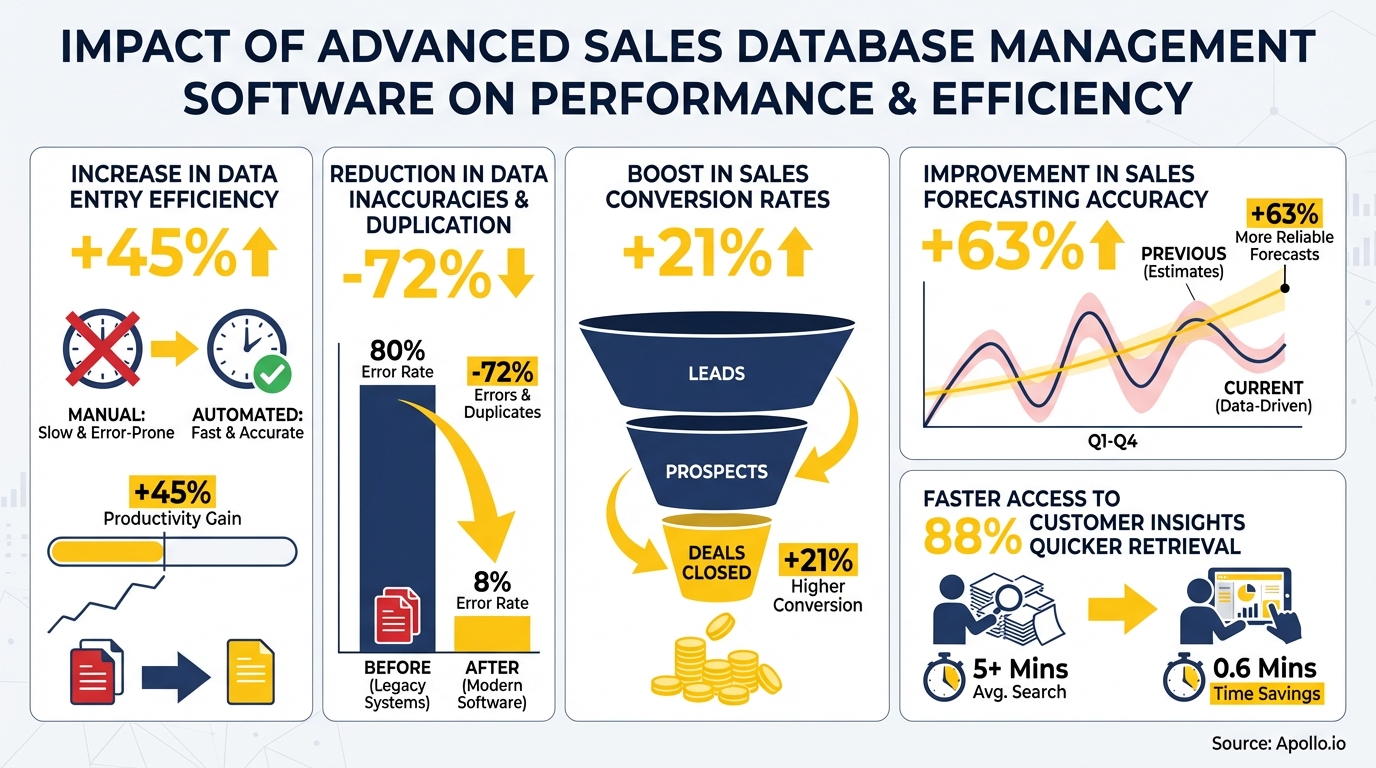
Sales teams need database management software because manual processes cannot scale with modern buyer expectations and market complexity. Disconnected tools create data silos where SDRs waste hours copying information between systems, AEs lose track of deal context, and sales leaders lack visibility into pipeline health. Data from CRM.org indicates the CRM market will reach $129 billion by 2028, reflecting sustained demand for unified solutions.

Tool consolidation delivers measurable ROI. Census cut costs in half by replacing multiple vendors with one platform.
Predictable Revenue reduced complexity from three tools into one unified workspace. RevOps teams gain real-time forecasting accuracy, while founders eliminate expensive tool sprawl that drains budgets without improving outcomes.
How Do SDRs Use Sales Database Software to Book More Meetings?
SDRs use sales database software to identify ideal prospects, automate research, and execute multi-channel sequences that drive meetings. Advanced search filters let SDRs query 224M+ contacts by job title, company size, technology stack, hiring signals, and 65+ other criteria.
This precision targeting replaces hours of manual prospecting with seconds of filtered results.
AI-powered features automate time-consuming tasks. Research agents surface relevant company news, recent funding rounds, and personalization hooks. Sequence automation handles email cadences, task reminders, and follow-up timing. Struggling to find qualified leads? Search Apollo's 224M+ contacts with 65+ filters to build targeted lists in minutes instead of hours. Teams using AI research agents report booking 46% more meetings through better personalization and timing.
What Features Should RevOps Leaders Prioritize?
RevOps leaders should prioritize data quality, integration capabilities, reporting accuracy, and workflow automation when evaluating sales database management software. Data quality starts with verification systems that maintain 96% email accuracy and real-time enrichment that keeps contact information current.
Poor data quality costs teams hours in bounced emails and wasted outreach efforts.

Integration with existing CRM, marketing automation, and conversation intelligence platforms eliminates manual data entry and ensures consistency across systems. Reporting dashboards should provide pipeline visibility, activity metrics, conversion rates, and team performance benchmarks. Workflow automation reduces admin burden through automatic lead routing, task creation, and performance tracking that scales with team growth.
How Can Sales Leaders Implement Database Software Successfully?
Sales leaders can implement database software successfully by following a phased approach focused on data migration, team training, and continuous optimization. Start with data cleanup by deduplicating records, standardizing formats, and enriching incomplete profiles before migration.
Import historical data in stages, validate accuracy, and establish governance rules for data entry and maintenance.
Team training should cover core workflows like list building, sequence creation, and pipeline management through role-specific sessions. SDRs need prospecting and outreach training, while AEs focus on deal tracking and forecasting. Sales managers require reporting and coaching capabilities. Build optimization into weekly reviews by analyzing metrics, testing new features, and gathering feedback. Cyera's team found that having everything in one system was a game changer for coordination and efficiency.
Try Apollo Free
Sales database management software has evolved from simple contact storage to AI-powered revenue engines that consolidate your entire GTM tech stack. Modern platforms eliminate tool sprawl, improve data quality, and accelerate sales cycles through intelligent automation.
For SDRs booking more meetings, AEs closing faster, and RevOps leaders gaining pipeline visibility, unified systems deliver measurable ROI through cost savings and productivity gains.
Apollo provides 224M+ verified business contacts, AI-powered research and messaging, and complete pipeline management in one workspace. Teams using Apollo report 46% more meetings booked, 35% higher booking rates, and significant cost reductions versus maintaining separate tools. Try Apollo Free and experience how tool consolidation transforms your sales process.
Prove Apollo's ROI In Your First 30 Days
Budget approval stuck on unclear metrics? Apollo tracks every dollar—from prospect to close. Built-In increased win rates 10% and ACV 10% with measurable pipeline impact.
Start Free with Apollo →Don't miss these
Sales
Inbound vs Outbound Marketing: Which Strategy Wins?
Sales
What Is a Sales Funnel? The Non-Linear Revenue Framework for 2026
Sales
What Is a Go-to-Market Strategy? The 2026 GTM Playbook
See Apollo in action
We'd love to show how Apollo can help you sell better.
By submitting this form, you will receive information, tips, and promotions from Apollo. To learn more, see our Privacy Statement.
4.7/5 based on 9,690 reviews
