
Sales Content: Definition, Types, and Best Practices
Modern B2B buyers expect to research, evaluate, and often purchase without speaking to a sales rep. Yet most sales teams still rely on generic pitch decks and outdated collateral that buyers ignore. Sales content is the strategic collection of assets that guides prospects through self-serve research while equipping reps to accelerate deals when human interaction happens. When done right, it transforms how sales productivity scales across your entire go-to-market motion.

Research Less, Pipeline More With Apollo
Tired of burning hours verifying contact info instead of closing deals? Apollo delivers 96% accurate emails and verified business numbers so your team sells from minute one. Join 550K+ companies building predictable pipeline.
Start Free with Apollo →Key Takeaways
- Sales content includes both buyer-facing self-serve assets and rep-facing enablement materials that work together across channels.
- According to Spekit, most B2B buyers are 70% through their buying journey before speaking with a seller, making early-stage content critical.
- Research from iCumulus shows 50% of all prospect engagement is generated with just 10% of sales enablement content.
- Effective sales content requires governance, lifecycle management, and channel-native formats to prevent buyer avoidance and deal stalls.
- Modern sales teams consolidate content operations into unified platforms to reduce tool sprawl and maintain consistency at scale.
What Is Sales Content?
Sales content is any asset that helps prospects make purchase decisions or enables sales teams to advance deals. It spans two distinct categories: buyer-facing materials (case studies, ROI calculators, product sheets) that prospects consume independently, and rep-facing enablement (talk tracks, objection handlers, competitive battle cards) that sellers use during conversations.
The best sales content systems recognize that buyers toggle between self-serve research and human-assisted evaluation, so assets must work across both contexts.
This includes everything from early-awareness blog posts and educational webinars to late-stage security questionnaires and implementation roadmaps. Email personalization strategies rely heavily on having the right content available at the right buying stage. The key distinction: sales content directly supports revenue outcomes, unlike general marketing content focused on awareness or brand building.
Why Does Sales Content Matter in 2026?
B2B buying behavior has fundamentally shifted toward rep-free experiences. Buyers now control the evaluation process, conducting deep research before engaging sellers. According to Extu, infographics and blogs (65%), webinars and digital events (52%), and white papers and ebooks (50%) are the top content formats B2B buyers find most appealing. Without strategic sales content, your team remains invisible during the critical early research phase when buyers form vendor preferences.
The stakes are higher than ever. Irrelevant outreach drives buyers away, deals stall due to missing consensus-building materials, and reps waste time recreating assets that already exist somewhere in the organization. Sales Leaders managing distributed teams need centralized, governed content systems to maintain message consistency while enabling localized customization. RevOps leaders recognize that content fragmentation creates data blind spots that prevent accurate sales analytics and forecasting.

What Are the Core Types of Sales Content?
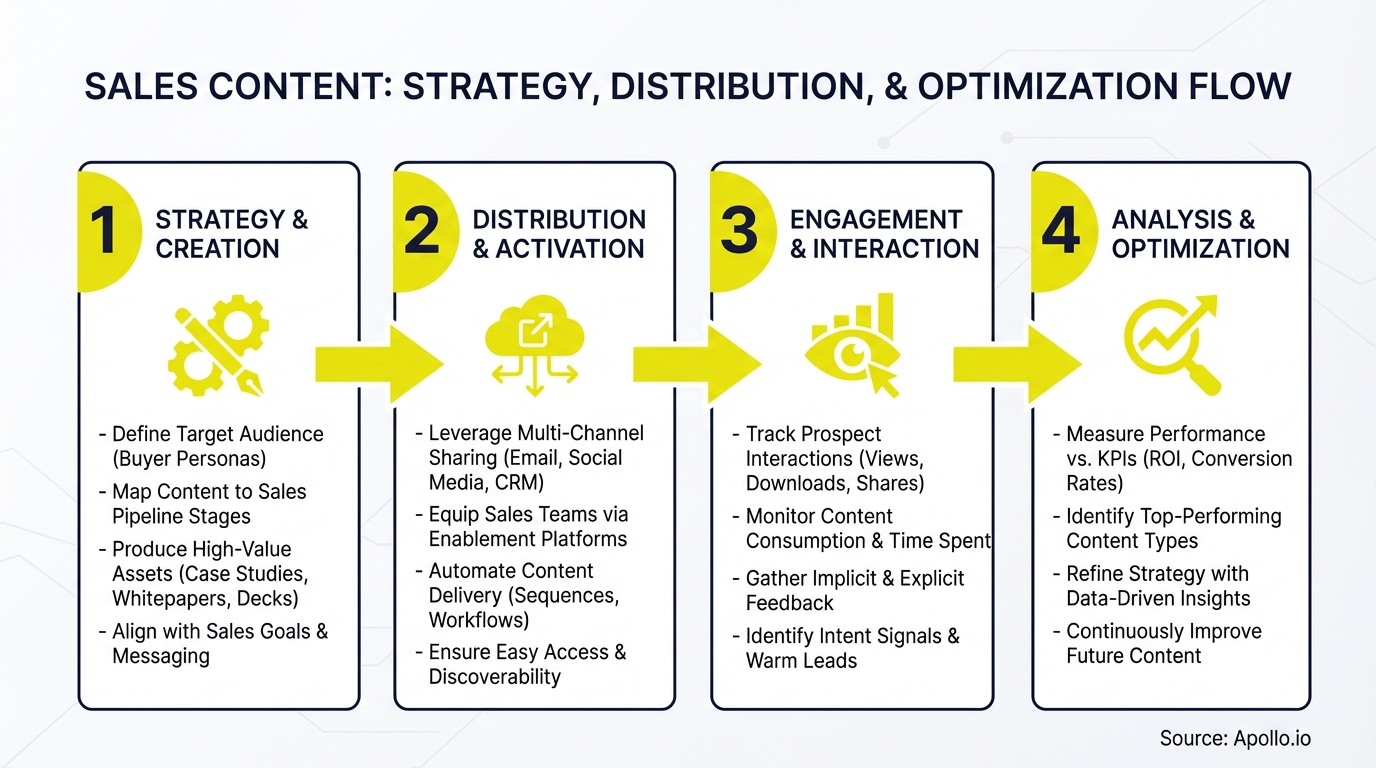
Effective sales content architecture separates assets by audience and buying stage. Each type serves a specific function in the revenue engine.
Buyer-Facing Self-Serve Content
These assets enable prospects to research, evaluate, and build internal business cases without rep involvement:
- Discovery content: Educational blogs, industry benchmarks, trend reports, problem-focused webinars
- Evaluation content: Product comparison sheets, ROI calculators, interactive demos, pricing transparency pages
- Decision content: Customer case studies, security documentation, implementation timelines, contract templates
- Expansion content: Use case libraries, integration guides, training resources, community forums
Rep-Facing Enablement Content
These assets equip sellers to have more effective conversations and accelerate deal velocity:
- Prospecting tools: Outreach sequences, pitch techniques, personalization frameworks, trigger event playbooks
- Discovery frameworks: Qualification checklists, needs assessment templates, stakeholder mapping tools
- Presentation materials: Customizable demo environments, value proposition decks, whiteboarding templates
- Negotiation assets: Objection response guides, competitive battle cards, pricing justification tools, mutual action plans
Struggling to organize scattered content across multiple tools? Centralize your go-to-market content with Apollo's unified platform.
Turn Funnel Guesswork Into Pipeline Clarity
Tired of watching marketing leads stall before they ever reach your pipeline? Apollo surfaces high-intent prospects and keeps your funnel moving with real-time intelligence. 550K+ companies finally know exactly where their next deal is coming from.
Start Free with Apollo →How Do SDRs and AEs Use Sales Content Differently?
SDRs focus on top-of-funnel content that sparks interest and books meetings. They rely heavily on pattern-interrupt messaging, industry-specific pain points, and quick-hit value propositions. According to Excelerate360, 90% of leading marketers state that personalization significantly contributes to business profitability. SDRs need modular content they can mix and match based on persona, industry, and trigger events.
Account Executives operate in evaluation and decision stages where buyers demand deeper proof. AEs need customer stories that match the prospect's industry and use case, ROI models that quantify business impact, and technical documentation that addresses implementation concerns. They also require objection handling frameworks for common sticking points around pricing, security, and competitive alternatives. The best content systems give AEs the flexibility to customize presentations while maintaining brand and legal compliance.
What Is an Omnichannel Sales Content Strategy?
Omnichannel sales content means creating channel-native formats of your core narratives. The same value proposition appears as a self-serve blog post, a rep-delivered demo, and an in-person workshop depending on buyer preference.
Each format preserves the underlying message while adapting to channel constraints and audience expectations.
| Channel | Content Format | Buyer Expectation | Rep Involvement |
|---|---|---|---|
| Digital Self-Serve | Interactive calculators, comparison charts, video demos | Complete autonomy, instant access | Zero (tracked for signals) |
| Remote/Virtual | Screen-share presentations, collaborative docs, recorded workshops | Guided but flexible, time-efficient | Moderate (on-demand expertise) |
| In-Person | Whiteboard sessions, executive briefings, hands-on workshops | Deep customization, relationship building | High (strategic guidance) |
Modern buyers expect seamless transitions between channels. A prospect might start with a self-serve ROI calculator, then request a virtual demo, then attend an in-person executive briefing.
Your content system must support this fluidity without creating disconnected experiences or forcing reps to start from scratch at each transition.
How Do You Prevent Deal Stalls with Content?
Deal stalls happen when buyers lack the internal ammunition to build consensus, justify budget, or navigate procurement. The solution is proactive stall-breaker content that addresses common blockers before they derail momentum.
Create mutual action plans that map out each stakeholder's role, required approvals, and timeline milestones.
Develop risk assessment templates that help buyers evaluate implementation complexity, change management requirements, and resource needs.
Build business case templates with pre-populated industry benchmarks and ROI formulas.
Prepare security and compliance documentation that answers common IT and legal questions without requiring custom responses.
For high-ticket sales, executive alignment decks that connect your solution to strategic initiatives prevent last-minute scope creep.
Losing deals to stalled pipeline stages? Track and unblock deals with Apollo's deal management tools.
What Does Sales Content Governance Look Like?
Content governance prevents the chaos of outdated collateral, off-brand messaging, and duplicated efforts. Start with a clear taxonomy that categorizes content by buyer stage, persona, industry, and use case.
Establish ownership by assigning content DRIs (directly responsible individuals) for each category who maintain accuracy and freshness.
Implement expiration dates on time-sensitive content like competitor comparisons, pricing sheets, and product roadmaps. Create approval workflows that route new content through legal, product, and sales leadership before publication. Build a centralized content repository with robust search and tagging so reps can find the right asset in seconds, not hours. According to NYT Licensing, 71% of B2B marketers reported that content marketing has become more important to their organization in the last year. This increased importance demands better governance systems.
Track content performance with usage analytics, engagement metrics, and win rate correlation. Retire low-performing assets and double down on what drives pipeline.
For distributed teams, establish localization guidelines that allow regional customization while protecting core brand standards. The goal is enabling velocity without sacrificing quality or compliance.

Start Building Revenue-Driving Sales Content
Sales content in 2026 is a strategic system, not a collection of random files. Modern buyers demand self-serve options backed by expert human guidance when needed.
Your content must work across digital, remote, and in-person channels while maintaining governance and measurability. The teams that win are consolidating fragmented content operations into unified platforms that give reps instant access to the right asset for every buyer scenario.
Apollo consolidates your sales content, data, and engagement tools into one workspace. SDRs access personalized outreach sequences, AEs pull customer proof stories, and Sales Leaders track which content actually drives pipeline. "We reduced the complexity of three tools into one," says Collin Stewart from Predictable Revenue. Stop juggling disconnected systems and scattered content libraries. Try Apollo Free and build a revenue-driving content engine that scales with your team.
Apollo Turns Pipeline Into Proof
Budget approval stuck on unclear metrics? Apollo delivers measurable pipeline impact your leadership will approve on sight. Leadium 3x'd their revenue — your ROI case just got a lot easier to make.
Start Free with Apollo →Don't miss these
Sales
Inbound vs Outbound Marketing: Which Strategy Wins?
Sales
What Is a Sales Funnel? The Non-Linear Revenue Framework for 2026
Sales
What Is a Go-to-Market Strategy? The 2026 GTM Playbook
See Apollo in action
We'd love to show how Apollo can help you sell better.
By submitting this form, you will receive information, tips, and promotions from Apollo. To learn more, see our Privacy Statement.
4.7/5 based on 9,690 reviews
