
What Are Sales Coaching Programs? Framework, ROI, and Best Practices for 2026
Quota attainment is at a crisis point. Data from Kixie shows only 16% of sales reps hit their quota in 2024, down from 53% in 2012. Sales coaching programs are the most direct lever for reversing that trend. The best programs go beyond courses and worksheets: they tie coaching to measurable revenue outcomes through structured cadences, certification gates, and platform-enabled analytics. This guide covers how to build one that actually moves the number. For a deeper look at supporting tools, see our breakdown of sales coaching software features and vendors.

Scale Your Team Without the Chaos
Tired of inconsistent processes slowing your reps down? Apollo standardizes prospecting across your entire team with verified contacts and automated workflows. Nearly 100K paying customers grow faster without adding headcount.
Start Free with Apollo →Key Takeaways
- Companies with formal sales coaching programs experience 28% higher win rates, according to verified industry research.
- Effective programs are measurement-first: they tie every coaching activity to pipeline, win rate, or quota attainment metrics.
- Certification gates and field observations outperform course completion as readiness indicators.
- SDRs, AEs, and RevOps leaders each need distinct coaching tracks aligned to their specific revenue motions.
- Platform consolidation — combining coaching, engagement, and analytics in one workspace — dramatically improves adoption and ROI visibility.
What Are Sales Coaching Programs?
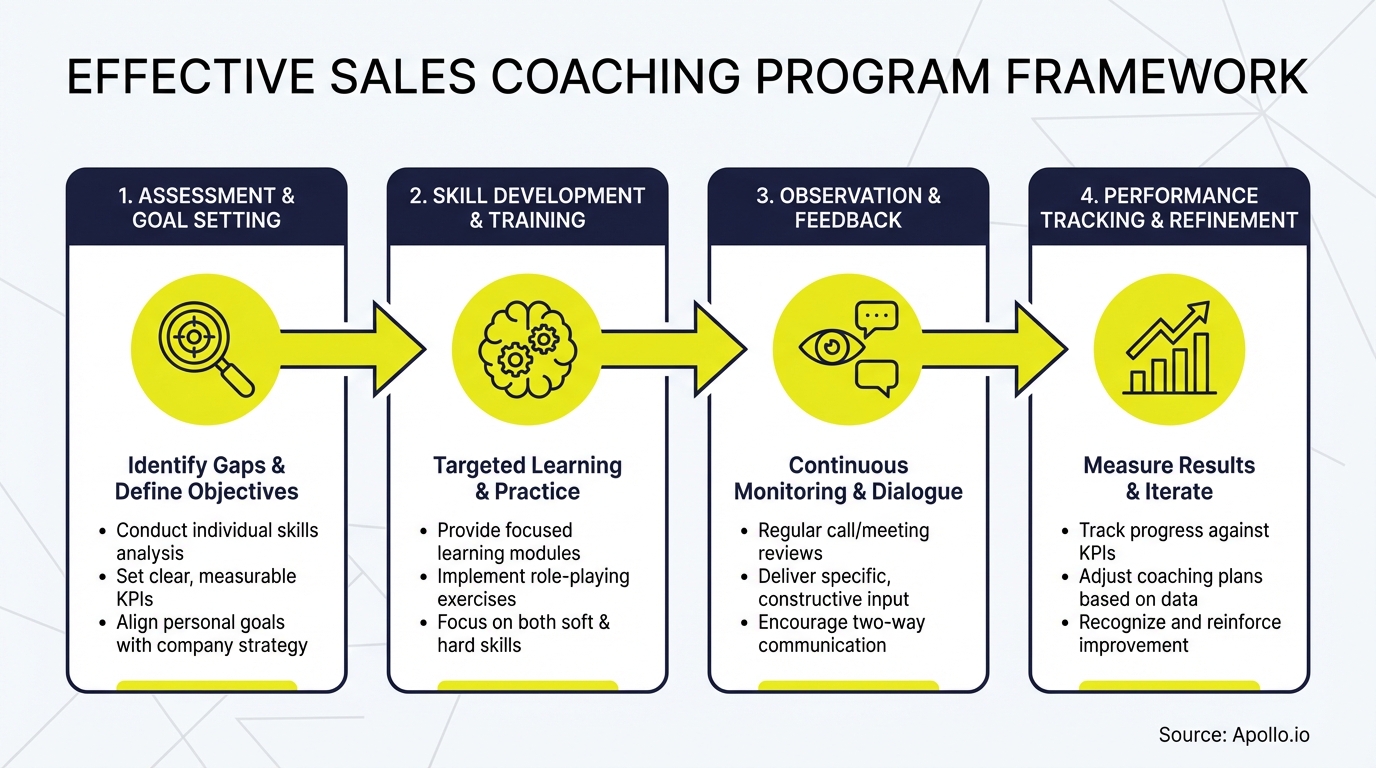
Sales coaching programs are structured systems for improving rep performance through ongoing skill development, observed practice, feedback loops, and measurable outcomes. They differ from one-time sales training in a critical way: training delivers knowledge, while coaching drives behavioral change over time.
A complete program includes four components:
- Cadence: Regular 1:1s, call reviews, and pipeline walkthroughs on a defined schedule
- Content: Talk tracks, objection libraries, and video frameworks reps use in real calls
- Certification gates: Field observations and assessed milestones before reps advance to key buyer interactions
- Measurement: Win rate, quota attainment, and pipeline attribution tracked back to coaching activities
Research from Scorecard Sales shows organizations partnering with top sales training companies achieve 32% higher win rates and 28% higher quota attainment in B2B performance. The ROI case is clear — the gap is in execution.
Why Do Sales Coaching Programs Fail Without Measurement?
Most programs fail because they measure activity instead of outcomes. Tracking call counts or course completions does not tell you whether coaching is improving revenue performance.
A measurement-first program instruments the entire coaching cycle:
| Coaching Activity | Lagging Metric to Track | Leading Indicator |
|---|---|---|
| 1:1 pipeline review | Win rate by rep | Stage conversion rate |
| Call recording review | Quota attainment | Talk-to-listen ratio |
| Objection drilling | Deal cycle length | Objection response score |
| Certification gate | Time to first deal | Field observation pass rate |
According to Valuecore, companies that provide quality sales coaching see 7% greater annual revenue growth. That outcome requires connecting coaching inputs to revenue data inside your CRM — not just inside a learning management system.
Struggling to see which reps need coaching and why? Sales analytics platforms surface the performance gaps that coaching programs need to target.
How Do SDRs and AEs Benefit Differently from Coaching Programs?
Different roles need different coaching tracks. Applying the same program to every seller dilutes impact. Here is how coaching focus should differ by role:
- SDRs/BDRs: Focus on prospecting sequencing, cold outreach personalization, and objection handling at the top of funnel. Key metric: meetings booked per week. Pair coaching with structured sales onboarding to accelerate ramp time.
- Account Executives: Focus on discovery depth, multi-stakeholder navigation, and late-stage deal management. Key metric: win rate and average deal size. AEs benefit from call recording review and pitch technique feedback.
- RevOps Leaders: Coaching here targets process adoption — CRM hygiene, attribution accuracy, and pipeline reporting integrity. RevOps-coached teams ensure coaching data flows into dashboards correctly.
- Sales Leaders/Managers: Coach-the-coach tracks build manager capability to run consistent 1:1s, observe field calls, and deliver actionable feedback. This layer is where most programs break down.
Need better visibility into AE pipeline health before each coaching session? Apollo's deal management tools give managers real-time deal context without manually pulling CRM reports.

What Does a High-Impact Sales Coaching Cadence Look Like?
A cadence is the operational backbone of any coaching program. Without a defined rhythm, coaching becomes reactive and inconsistent. Here is a proven weekly and monthly cadence structure:
- Weekly: 30-minute 1:1 per rep (pipeline review + one skill focus), one call recording debrief per team
- Bi-weekly: Group skill session on a shared gap (e.g., discovery questions, pricing objections)
- Monthly: Performance review against quota and win rate benchmarks, coaching plan adjustment
- Quarterly: Certification gate — field observation of a live or simulated call before rep advances to new buyer tier
This structure reflects what high-performing organizations actually do. Sales productivity research consistently shows that structured, recurring coaching outperforms ad-hoc feedback by a wide margin. Pair your cadence with Apollo's AI call assistant to automatically surface call summaries, key moments, and next steps — so managers spend cadence time coaching, not note-taking.
Turn Funnel Guesswork Into Predictable Pipeline
Tired of watching quality leads stall before they ever become opportunities? Apollo surfaces in-market buyers with precision targeting so your team acts on real signals, not hunches. Nearly 100K paying customers stopped guessing and started closing.
Start Free with Apollo →How Should Sales Coaching Programs Use AI in 2026?
AI has shifted from a nice-to-have to a core component of effective coaching programs. The most practical applications in 2026:
- Call analysis: AI flags coaching moments (missed objections, filler language, low discovery depth) automatically across every recorded call — not just the ones managers choose to review manually
- Personalized outreach feedback: AI reviews email and sequence copy against ICP data, flagging personalization gaps before messages send
- Rep readiness scoring: AI aggregates activity, conversion, and skill assessment data into a readiness score managers use to prioritize coaching time
- Talk track generation: AI drafts objection responses and discovery questions tailored to specific personas, giving reps ready-made material to practice
For a full breakdown of where AI fits in the enablement stack, see AI sales enablement implementation and ROI. Teams adopting AI-powered coaching workflows report measurable improvements in meeting conversion rates and rep ramp time.

How Do You Build the Right Tech Stack for Sales Coaching Programs?
A coaching program is only as good as the data and tools supporting it. Most teams run into a common problem: coaching insights live in one tool, pipeline data lives in another, and call recordings are in a third.
That fragmentation kills adoption.
The most effective coaching stacks consolidate around a unified GTM platform. As Collin Stewart at Predictable Revenue put it: "We reduced the complexity of three tools into one." The core components you need in one workspace:
- Contact and account intelligence (for pre-call prep and rep context)
- Call recording and conversation analytics (for coaching moment identification)
- Sales engagement automation (for sequence performance data)
- Deal management and pipeline tracking (for coaching prioritization)
- CRM integration (for attribution and revenue tie-back)
See how leading teams structure this in our sales tech stack playbook for scaling revenue. Spending too much time switching between tools before each coaching session? Apollo's unified GTM platform brings prospecting, engagement, call intelligence, and pipeline data into one workspace — so coaching prep takes minutes, not an hour of tab-switching.
How Do You Measure the ROI of Sales Coaching Programs?
ROI measurement requires connecting coaching investments to revenue outcomes. Track these metrics at the program level:
| Metric | How to Measure | Benchmark |
|---|---|---|
| Win rate change | CRM won/lost data pre vs. post program | 28–32% improvement (formal programs) |
| Quota attainment rate | % of reps hitting 100% of quota | Industry average: 16% (2024) |
| Ramp time | Days from hire to first closed deal | Track vs. pre-program baseline |
| Revenue growth rate | YoY revenue per coached cohort | 7% greater annual growth (coached teams) |
A data from Hyperbound confirms companies with formal coaching programs experience 28% higher win rates. Tie those win rate gains back to specific coaching interventions (call reviews, objection drills, certification gates) to build an internal ROI case for continued investment.
Start Building a Coaching Program That Moves Revenue
Effective sales coaching programs share three traits: they are structured with a defined cadence, measurement-first with revenue metrics tied to every activity, and platform-enabled so coaching data and pipeline data live together. SDRs, AEs, and sales managers all need distinct tracks — and all of them benefit from AI-assisted call analysis and personalized feedback loops.
Apollo gives GTM teams the unified platform to make coaching data-driven: conversation intelligence, deal management, pipeline analytics, and AI-powered outreach automation in one workspace. Start Prospecting with Apollo and build a coaching-to-revenue feedback loop that actually closes the quota gap.
Prove Pipeline ROI With Apollo
Budget approval stuck on unclear metrics? Apollo delivers measurable pipeline impact your leadership can see from day one. Leadium 3x'd their annual revenue — your ROI story starts here.
Start Free with Apollo →Don't miss these
Sales
Inbound vs Outbound Marketing: Which Strategy Wins?
Sales
What Is a Sales Funnel? The Non-Linear Revenue Framework for 2026
Sales
What Is a Go-to-Market Strategy? The 2026 GTM Playbook
See Apollo in action
We'd love to show how Apollo can help you sell better.
By submitting this form, you will receive information, tips, and promotions from Apollo. To learn more, see our Privacy Statement.
4.7/5 based on 9,690 reviews
