
Sales Call Recording: How to Capture, Analyze, and Close More Deals
Sales call recording has evolved from a simple compliance tool into a revenue-driving asset. Modern sales teams capture, analyze, and leverage call data to coach reps, refine messaging, and close deals faster. According to Business Research Insights, the global conversation intelligence platform market size was projected at USD 4.54 billion in 2026 and is anticipated to reach USD 41.78 billion by 2035, with a compound annual growth rate (CAGR) of 28% from 2026 to 2035. Yet most teams still struggle with governance, ROI measurement, and integration into their revenue workflows. This article answers the questions sales leaders, RevOps teams, and AEs ask most: what sales call recording actually delivers, how to implement it compliantly, and how to turn recordings into pipeline acceleration.

Build Pipeline Faster With Apollo
Tired of hours lost to manual research while your pipeline stalls? Apollo surfaces verified contacts and automates outreach so your team spends time selling, not searching. Join 550K+ companies generating predictable pipeline.
Start Free with Apollo →Key Takeaways
- Sales call recording captures conversations for coaching, compliance, and revenue intelligence, driving measurable performance improvements when implemented with clear governance
- Research from Kixie shows sales representatives who receive coaching within 24 hours of a call are 2.5 times more likely to improve their performance compared to those with delayed feedback
- Modern recording systems integrate with CRM, revenue intelligence, and AI assistants to automate note-taking, surface deal risks, and generate follow-up content
- Compliance requires explicit consent, secure storage, clear retention policies, and role-based access controls to protect sensitive data
- ROI comes from reduced admin time, faster rep ramp, improved win rates, and consolidated tech stacks that replace multiple point solutions
What Is Sales Call Recording?
Sales call recording is the practice of capturing audio or video from sales conversations for analysis, coaching, compliance, and training purposes. These recordings create a searchable, reusable asset that teams use to identify winning behaviors, train new hires, resolve disputes, and feed AI-driven insights into CRM and revenue operations systems.
Unlike manual note-taking, recordings preserve the full context of objections, competitive mentions, pricing discussions, and buyer signals that reps often miss or forget.
Modern call recording solutions go beyond simple audio capture. They transcribe conversations in real time, tag key moments (competitor mentions, pricing objections, next steps), and integrate with sales analytics platforms to surface patterns across hundreds of calls. For SDRs and AEs, this means less time writing notes and more time acting on insights. For sales leaders, it means visibility into what's actually happening in the field, not just what reps report in pipeline reviews.
Why Do Sales Teams Record Calls?
Sales teams record calls to accelerate rep performance, ensure compliance, and extract revenue intelligence that would otherwise disappear after the call ends. The primary drivers include coaching at scale, protecting against legal disputes, onboarding new hires faster, and feeding conversation data into forecasting and pipeline inspection workflows.
Coaching becomes scalable when managers can review actual calls instead of relying on self-reported summaries. Research from Kixie found that sales representatives who receive coaching within 24 hours of a call are 2.5 times more likely to improve their performance compared to those with delayed feedback. Recordings also protect teams during contract disputes by providing an auditable record of what was promised. For RevOps leaders, call data feeds into revenue intelligence systems that flag at-risk deals, identify successful talk tracks, and inform territory planning.
How Do AEs Use Call Recordings to Close Deals Faster?
Account Executives use call recordings to prepare for follow-up conversations, align internal stakeholders, and surface buying signals they missed during live calls. AEs managing complex enterprise deals often review recordings before multi-threading into new departments or preparing executive briefings.
The recordings reveal which features resonated, which objections remain unaddressed, and which competitors the buyer is evaluating.
AEs also share snippets with solutions engineers, customer success teams, and legal to accelerate deal progression. Instead of summarizing a 45-minute discovery call in Slack, an AE can send a timestamped link to the exact moment a buyer described their integration requirements. This reduces miscommunication and keeps deals moving. Struggling to keep deals moving after discovery? Apollo's AI Call Assistant auto-generates summaries, next steps, and CRM updates from every call.

How Does Sales Call Recording Work?
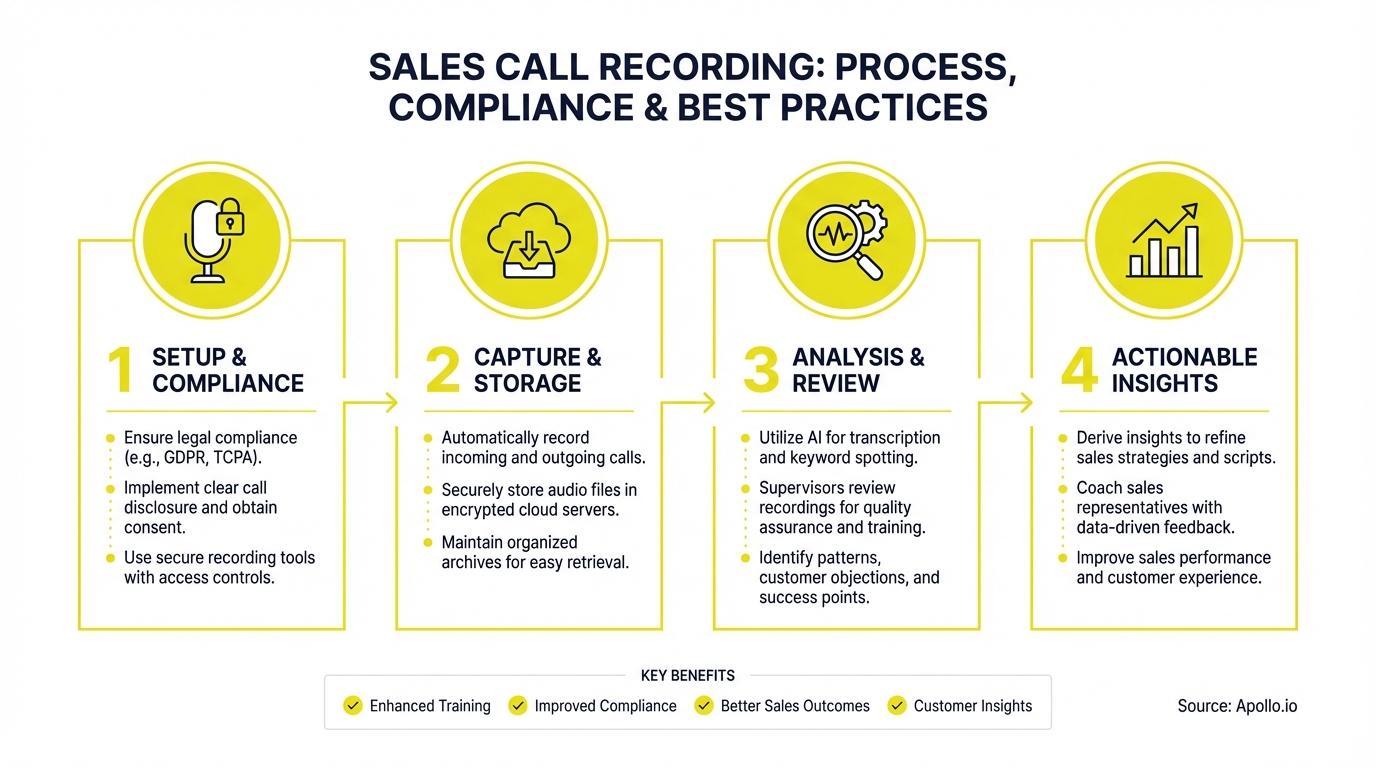
Sales call recording systems capture audio or video from phone calls, video meetings, or web conferencing platforms, then store, transcribe, and analyze the content. The technical implementation varies by channel: VoIP dialers record directly through the telephony stack, while meeting platforms use native recording features or third-party integrations.
The workflow typically follows this sequence:
- Consent notification: The system announces recording or displays a visual indicator to all participants
- Audio/video capture: The platform records the conversation in real time, storing it in cloud or on-premise infrastructure
- Transcription: Speech-to-text engines convert audio to searchable text, often with speaker identification and timestamping
- Analysis: AI models tag moments (objections, competitors, pricing, action items) and extract structured data
- Integration: Key insights flow into CRM, revenue intelligence platforms, and coaching tools for action
For teams using AI call assistants, this process happens automatically. The system joins calls, records with consent, transcribes in real time, and pushes summaries and next steps directly into CRM records without manual data entry.
Turn Funnel Guesswork Into Pipeline Wins
Tired of marketing leads that never convert and forecasts built on stale data? Apollo surfaces in-market buyers with verified contact data so your team engages the right prospects at right moment. Join 550K+ companies building predictable pipeline.
Start Free with Apollo →What Are the Compliance Requirements for Recording Sales Calls?
Compliance for sales call recording depends on jurisdiction, industry regulations, and the nature of the call. The foundational requirement is consent: one-party consent states (where only one participant must agree) or two-party consent states (where all participants must agree) determine notification obligations.
Federal rules like the FTC's Telemarketing Sales Rule add disclosure requirements for outbound calling programs.
Key compliance elements include:
- Consent disclosure: Explicit notification at the start of the call, either verbal or through recorded announcements
- Data retention policies: Clear rules for how long recordings are kept, when they're deleted, and who can access them
- Access controls: Role-based permissions that limit who can listen to, download, or share recordings
- Redaction capabilities: Tools to remove sensitive data (credit card numbers, SSNs, health information) from transcripts and audio
- Vendor agreements: Data Processing Agreements (DPAs) that define how third-party platforms handle, store, and protect recordings
According to SNS Insider, around 50-60% of companies leverage call recording solutions to detect and prevent fraud in customer interactions, highlighting the dual role of recordings in both compliance and risk management. For outbound teams, the FTC's 3% abandonment rate threshold creates an operational constraint that affects dialing cadence, disclosure timing, and recording practices.
How Do Sales Leaders Measure ROI from Call Recording?
Sales leaders measure call recording ROI by tracking time savings, coaching impact, win rate improvements, and tech stack consolidation. The most direct metric is admin time reclaimed: reps who previously spent 15-20 minutes per call writing CRM notes now spend that time prospecting or advancing deals.
For a team of 10 AEs making 5 calls per day, that's 12-15 hours per week redirected to revenue-generating activities.
Coaching impact appears in faster ramp times and quota attainment. New hires who review top performer calls during onboarding reach productivity benchmarks weeks faster than those trained only through role-play.
Win rate improvements come from surfacing successful talk tracks and eliminating ineffective ones. RevOps teams track these metrics:
- Time-to-CRM update: Minutes saved per call by auto-populating fields from transcripts
- Ramp time reduction: Days or weeks saved in new hire onboarding
- Coaching velocity: Number of reps receiving feedback within 24 hours of calls
- Win rate delta: Percentage point improvement in deals where key behaviors (identified via recording analysis) are present
- Tool consolidation savings: Cost reduction from replacing standalone note-taking, transcription, and coaching platforms
According to Abacum, companies with mature Revenue Operations (RevOps) functions typically grow revenue three times faster than those without. Call recording becomes a foundational data layer for RevOps teams building predictable, scalable revenue engines. Tired of juggling multiple tools for calling, recording, and CRM updates? Apollo consolidates your entire GTM workflow into one platform.
What Features Should Sales Teams Look for in Recording Software?
Sales teams should prioritize call recording software that integrates natively with their CRM, offers real-time transcription, provides AI-driven insights, and includes robust compliance controls. The table below outlines essential features and their business impact:
| Feature | Business Impact | Who Benefits Most |
|---|---|---|
| Native CRM integration | Eliminates manual data entry, auto-logs calls and notes | AEs, SDRs, RevOps |
| Real-time transcription | Searchable conversation history, instant keyword detection | Sales leaders, enablement teams |
| AI-powered insights | Surfaces objections, competitors, action items automatically | AEs, sales managers |
| Role-based access controls | Protects sensitive data, ensures compliance | RevOps, legal, security teams |
| Multi-channel support | Records phone, video, and web meetings in one system | Hybrid sales teams |
| Redaction tools | Removes PII and sensitive data from transcripts | Compliance, legal teams |
| Coaching workflows | Managers tag moments, leave feedback, track improvement | Sales managers, enablement |
For teams building a modern sales tech stack, the goal is consolidation. Instead of paying for separate dialer, transcription, coaching, and revenue intelligence tools, look for platforms that bundle these capabilities. As the team at Predictable Revenue found: "We reduced the complexity of three tools into one."
How Do SDRs Use Call Recordings to Book More Meetings?
SDRs use call recordings to refine their pitch, handle objections more effectively, and learn from top performers. New SDRs listen to recordings of successful cold calls to understand pacing, tonality, objection handling, and how to navigate gatekeepers.
Instead of guessing what works, they hear exactly how experienced reps position value in the first 30 seconds.
Recording analysis also reveals pattern failures. If an SDR's connect rate is high but meeting conversion is low, managers review recordings to identify where the pitch breaks down. Common issues include weak value propositions, failure to qualify, or poor discovery questions. Managers create coaching playlists of both successful and unsuccessful calls, then work with SDRs to practice specific improvements. For more strategies on cold calling frameworks that actually book meetings, review proven approaches from top-performing SDRs.
Conclusion: Turn Sales Call Recordings into Revenue Intelligence
Sales call recording in 2026 is no longer about storing audio files for compliance. It's about building a revenue intelligence system that captures every customer interaction, extracts actionable insights, and feeds those insights into coaching, forecasting, and pipeline management workflows.
Teams that implement call recording with clear governance, measurable ROI frameworks, and tight CRM integration see faster ramp times, higher win rates, and consolidated tech stacks that reduce costs.
The path forward requires addressing three pillars: governance (consent, retention, access controls), integration (CRM, revenue intelligence, coaching platforms), and adoption (manager training, rep enablement, stakeholder alignment). Start with a pilot program focused on one team or use case, measure impact rigorously, and scale only after proving ROI. Ready to consolidate your sales tools and turn every call into actionable revenue intelligence? Request a Demo to see how Apollo's all-in-one platform replaces multiple tools while capturing, analyzing, and acting on every sales conversation.
Prove Pipeline ROI With Apollo
ROI pressure killing your tool budget? Apollo delivers measurable pipeline impact your leadership can see — faster wins, verified contacts, and outreach that converts. Leadium 3x'd revenue. You're next.
Start Free with Apollo →Don't miss these
Sales
Inbound vs Outbound Marketing: Which Strategy Wins?
Sales
What Is a Sales Funnel? The Non-Linear Revenue Framework for 2026
Sales
What Is a Go-to-Market Strategy? The 2026 GTM Playbook
See Apollo in action
We'd love to show how Apollo can help you sell better.
By submitting this form, you will receive information, tips, and promotions from Apollo. To learn more, see our Privacy Statement.
4.7/5 based on 9,690 reviews
