
What Is a Sales Business Plan Template? Build a Buyer-Centric B2B Sales Plan in 2026
Most sales business plan templates were built for a world that no longer exists.
They assume reps drive every conversation, buyers wait to be contacted, and annual plans hold up under pressure.
In 2026, none of those assumptions are safe.
According to Corporate Visions, 61% of B2B buyers prefer a rep-free buying experience, and 73% actively avoid suppliers that send irrelevant outreach.
Your sales plan template needs to reflect that reality from page one.
Pair this with a solid sales email strategy and you have the foundation for a modern GTM motion.

Scale Pipeline Without the Manual Grind
Tired of your reps burning hours on research instead of selling? Apollo surfaces verified contacts and automates outreach so your team scales without adding headcount. Join 600K+ companies building predictable pipeline.
Start Free with Apollo →Key Takeaways
- A modern sales business plan template must account for digital-first, rep-free buyer preferences rather than rep-led funnels.
- ICP-based relevance governance prevents wasted outreach and protects pipeline quality.
- Confidence-building content (ROI models, peer proof, validation assets) reduces self-service purchase regret.
- RevOps alignment, shared KPI definitions, and measurement trust are non-negotiable sections in a 2026 sales plan.
- Apollo consolidates prospecting, engagement, pipeline, and data into one platform, cutting your tech stack and accelerating plan execution.
What Is a Sales Business Plan Template?
A sales business plan template is a structured framework that defines your target market, revenue goals, go-to-market strategy, team responsibilities, and performance metrics.
It translates company objectives into an executable sales motion.
In 2026, the best templates go further: they include ICP governance rules, digital channel strategy, buyer enablement assets, and measurement guardrails.
Research from marketingltb.com shows that 93% of B2B buying processes begin with online research, which means your plan must start with digital presence, not cold calls.
A complete sales business plan template covers:
- ICP and persona definitions with firmographic, technographic, and behavioral criteria
- Revenue targets broken down by segment, channel, and quarter
- Go-to-market motions including outbound, inbound, and self-serve pathways
- Content and messaging governance to prevent irrelevant outreach
- KPIs and attribution logic with shared definitions across sales, marketing, and RevOps
- Tech stack and tooling requirements, consolidated where possible
How Do SDRs and RevOps Leaders Use a Sales Plan Template?
SDRs use a sales business plan template to prioritize accounts, govern outreach sequences, and stay within ICP boundaries.
A well-structured template tells an SDR which triggers justify outreach, which personas to contact at each stage, and which messages are approved.
This prevents the spray-and-pray approach that damages sender reputation and burns pipeline.
RevOps leaders use the same template to enforce shared definitions, track conversion rates by segment, and identify process gaps before they become revenue problems.
According to The Smarketers, 58% of B2B companies cite process misalignment as their primary growth barrier in 2026.
A unified sales plan template solves that by giving every function a single source of truth for ICP, stages, and SLAs.
For Account Executives managing complex deals, the template provides qualification criteria, champion-building playbooks, and deal-stage exit criteria that reduce forecast risk.
Struggling to find the right accounts to target? Search Apollo's 230M+ contacts with 65+ filters to build ICP-qualified lists in minutes.
Turn Funnel Guesswork Into Real Pipeline
Tired of watching marketing leads stall before they ever reach your pipeline? Apollo surfaces high-intent buyers and moves them toward opportunity. Nearly 100K paying customers stopped guessing and started closing.
Start Free with Apollo →What Sections Belong in a Modern B2B Sales Plan Template?
The table below outlines every section a 2026-ready sales plan template should include, with the owner and primary output for each.
| Section | Owner | Primary Output |
|---|---|---|
| ICP and Persona Definitions | RevOps / Marketing | Approved target segments, exclusion rules |
| Revenue Goals and Quotas | Sales Leadership | Quarterly targets by rep, segment, channel |
| Go-to-Market Motions | Sales + Marketing | Outbound, inbound, and self-serve playbooks |
| Confidence-Building Content Layer | Marketing / Enablement | ROI models, case studies, security packets |
| Measurement and Attribution | RevOps | KPI tree, attribution model, reporting cadence |
| Omnichannel CX Checklist | Marketing / CS | Digital journey map, channel quality standards |
| Tech Stack and Tooling | RevOps / IT | Approved tools, integration requirements |
| Budget and Efficiency Guardrails | Finance / RevOps | Stop/start/continue decisions, CAC targets |
For teams building out their sales presentation templates and sales sheet templates alongside the plan, these sections provide the messaging governance and audience definitions that make those assets consistent.

How Do You Build the ICP and Relevance Governance Section?
Relevance governance is the most overlooked section in most sales plan templates.
It defines which accounts qualify for outreach, which triggers must be present before contact, and which suppression rules prevent irrelevant messages.
Without it, outreach volume increases while response rates collapse. The ICP definition should include firmographic criteria (industry, company size, geography), technographic signals (current tools, integrations), and behavioral triggers (content engagement, pricing page visits, job postings).
Suppression rules are equally important. Define which personas are off-limits without a champion introduction, which accounts are in a nurture-only status, and how long a contact must be inactive before re-engagement is permitted. This is not optional governance: it is the mechanism that protects pipeline quality and preserves sender reputation at scale. Reference your sales analytics data to validate ICP criteria against actual win rates before locking in definitions.
What Is the Confidence-Building Content Layer and Why Does It Matter?
The confidence-building content layer is a set of decision-support assets designed to reduce purchase regret in self-serve buying journeys. Buyers who complete purchases without rep involvement face higher uncertainty at the moment of commitment.
Your sales plan must allocate resources to create and distribute these assets proactively.
Core confidence-building assets include:
- ROI calculators with customer-specific inputs and benchmark comparisons
- Peer proof assets: case studies, G2 reviews, reference customer programs
- Implementation validation content: onboarding checklists, time-to-value benchmarks
- Security and compliance packets: pre-built documentation for procurement review
- Comparison frameworks: honest feature matrices buyers use in evaluation
Organizations with strong sales and marketing alignment consistently outperform those without it. Research from Brainstorm Club shows that organizations with strong sales and marketing alignment achieve 208% higher marketing revenue than those with poor alignment. A unified content layer is how alignment becomes tangible. To see how sales performance management frameworks connect to content investment, explore how leading teams tie asset creation to pipeline stage conversion.

How Do Sales and RevOps Teams Build Measurement They Can Trust?
Measurement trust is a structural problem, not a reporting problem.
The fix starts in the sales plan template itself: define every KPI before the quarter begins, assign a single owner per metric, and document the data source and calculation method.
When definitions are shared across sales, marketing, and RevOps, attribution disputes drop and leadership confidence in the numbers rises.
A functional KPI tree for a B2B sales plan includes:
- Leading indicators: qualified meetings booked, ICP accounts contacted, sequence reply rates
- Pipeline metrics: pipeline coverage ratio, stage conversion rates, average deal size by segment
- Revenue metrics: new ARR, expansion ARR, CAC, and payback period
- Efficiency metrics: cost per qualified opportunity, rep ramp time, quota attainment distribution
Spending too much time reconciling pipeline data across disconnected tools? Build and track your pipeline in one place with Apollo's AI-powered pipeline builder.
As Cyera put it, "Having everything in one system was a game changer." Use your sales tech stack audit to identify which tools can be retired once a unified platform handles prospecting, engagement, and pipeline tracking together.
What Does a Complete Sales Business Plan Template Look Like?
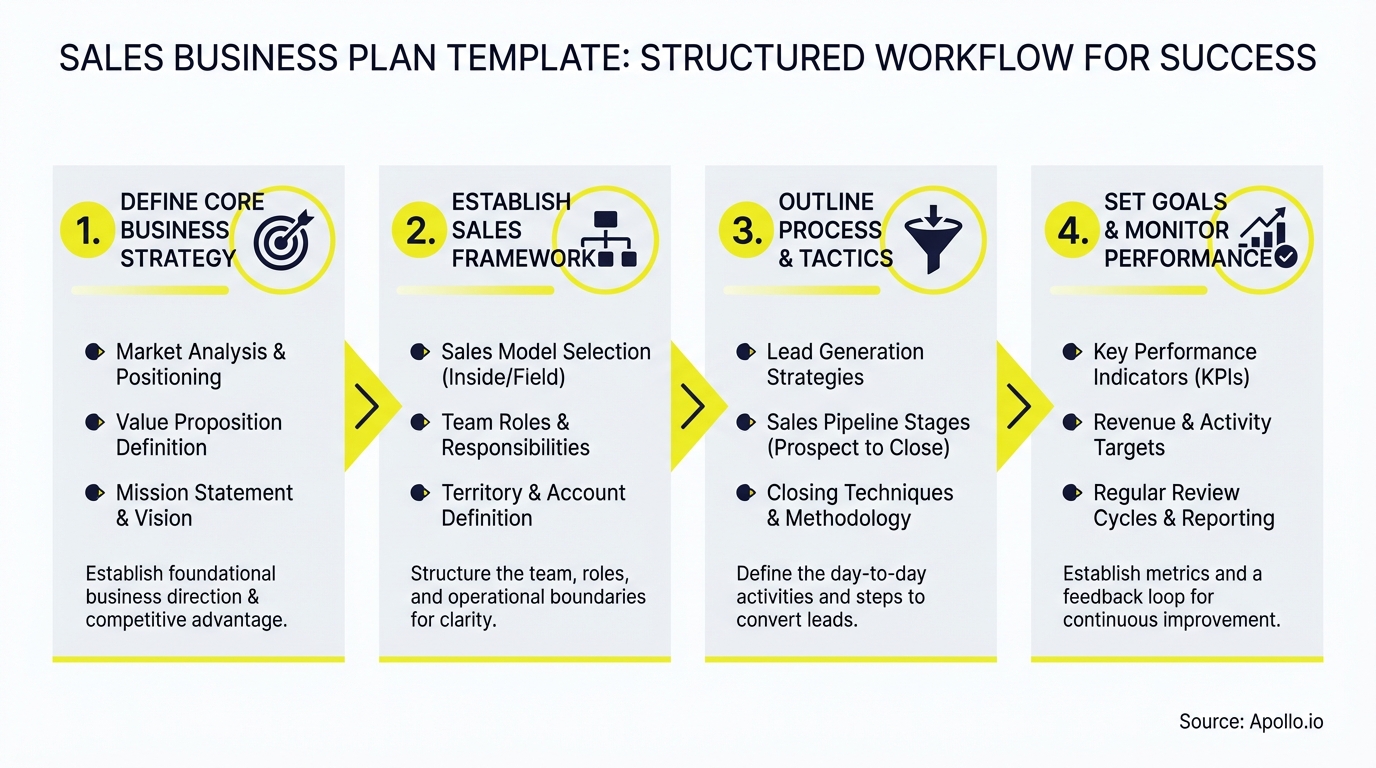
A complete, fill-in-the-blank sales business plan template follows this structure.
Adapt each section to your segment, team size, and go-to-market motion.
- Executive Summary: One-paragraph summary of revenue target, primary segment, and key strategy for the period.
- ICP Definition: Firmographic, technographic, and behavioral criteria. Include suppression rules and exclusion criteria.
- Revenue Goals: Total target, broken by new business, expansion, and channel. Quarterly milestones.
- GTM Motions: Outbound sequence playbooks, inbound routing rules, self-serve enablement paths.
- Confidence-Building Assets: List of required content assets by buyer stage. Owner and due date for each.
- Measurement Framework: KPI tree with definitions, owners, data sources, and reporting cadence.
- Budget and Efficiency Guardrails: Stop/start/continue decisions. CAC ceiling by segment. Content reuse policy.
- Tech Stack: Approved tools by function. Integration requirements. Consolidation targets.
For teams pursuing enterprise sales motions, add a section for executive access strategy and multi-threaded account plans. For SMB-focused teams, review small business sales software options that support plan execution without adding overhead.
How Do You Execute a Sales Business Plan Without Adding More Tools?
Execution is where most sales plans fail.
The template creates clarity; the tooling either accelerates or buries it.
In 2026, the trend is clear: teams are consolidating tools rather than adding them. "We reduced the complexity of three tools into one" (Predictable Revenue). "We cut our costs in half" (Census). Fewer integrations mean cleaner data, faster ramp, and less time spent reconciling systems instead of selling.
Apollo serves as the unified execution layer for every section of a B2B sales plan: ICP-qualified prospecting with 230M+ contacts, multi-channel engagement sequences, AI-powered pipeline tracking, and deal management, all in one platform. SDRs, AEs, RevOps leaders, and founders use Apollo to execute their plan without managing a fragmented stack. Explore sales automation capabilities and the sales kickoff framework to align your team on the plan before the quarter begins.
Ready to put your sales business plan into action? Start Free with Apollo and run your entire GTM motion from one platform.
Prove Pipeline ROI With Apollo
ROI pressure killing your tool budget? Apollo delivers measurable pipeline impact from day one. Leadium 3x'd annual revenue — see your returns fast.
Start Free with Apollo →Don't miss these
Sales
Inbound vs Outbound Marketing: Which Strategy Wins?
Sales
What Is a Sales Funnel? The Non-Linear Revenue Framework for 2026
Sales
What Is a Go-to-Market Strategy? The 2026 GTM Playbook
See Apollo in action
We'd love to show how Apollo can help you sell better.
By submitting this form, you will receive information, tips, and promotions from Apollo. To learn more, see our Privacy Statement.
4.7/5 based on 9,690 reviews
