
Sales Best Practices That Drive Revenue in 2026
Sales teams in 2026 face a fundamental shift: buyers increasingly want to research, evaluate, and decide without sales reps. Modern sales best practices now balance self-serve buyer journeys with strategic human touchpoints, relevance-driven outreach, and AI-powered efficiency. The old playbook of high-volume cold calling and generic email blasts is dead. Teams that win build omnichannel systems designed for buyer autonomy while proving measurable ROI on every tool and tactic.

Get Verified Contacts That Actually Connect
Tired of burning hours on leads that go nowhere? Apollo surfaces accurate business contacts so your team spends time selling, not searching. Join 550K+ companies building predictable pipeline.
Start Free with Apollo →Key Takeaways
- Focus on relevance over volume: 73% of B2B buyers actively avoid suppliers sending irrelevant outreach
- Build self-serve buying paths: 61% of buyers prefer rep-free experiences for research and evaluation
- Consolidate your tech stack: Modern platforms eliminate the need for 3-5 separate tools while cutting costs
- Use AI strategically: Sales professionals using AI daily are twice as likely to exceed targets
- Design for buying committees: 86% of B2B purchases stall without clear stakeholder alignment
What Are Sales Best Practices in 2026?
Sales best practices are proven strategies and systems that drive predictable revenue growth while adapting to modern buyer behavior. In 2026, these practices center on buyer-led journeys, omnichannel engagement, and AI-enabled productivity.
The core shift: build for self-serve first, then layer in strategic human interaction.
Modern best practices include tightly defined ICP targeting, relevance-based outreach, modular content for buying committees, and measurable AI adoption. Sopro.io reports that AI is directly reshaping sales performance, lifting productivity by up to 40% and reducing sales cycles by a quarter. Teams must now prove ROI on every process change and technology investment.
Why Do Traditional Sales Tactics Fail Today?
Volume-based prospecting and generic messaging actively damage pipeline in 2026. Buyers use an average of 10 interaction channels during their journey, expect personalized experiences, and conduct extensive independent research before engaging sales.
Traditional spray-and-pray tactics trigger buyer avoidance rather than interest.
The data is clear: 73% of B2B buyers actively avoid suppliers who send irrelevant outreach, and 61% prefer a rep-free buying experience overall. Teams still using outdated sales cadence approaches built on interruption rather than value see declining response rates and damaged brand reputation. The buyer now controls the buying process, not the seller.
How Do SDRs Generate Pipeline With Relevance-Based Outreach?
SDRs in high-performing teams abandon mass outreach for signal-based targeting. They identify prospects showing buying intent through job changes, funding events, technology adoption, or content engagement, then craft contextually relevant messages.
This approach generates qualified meetings instead of spam complaints.
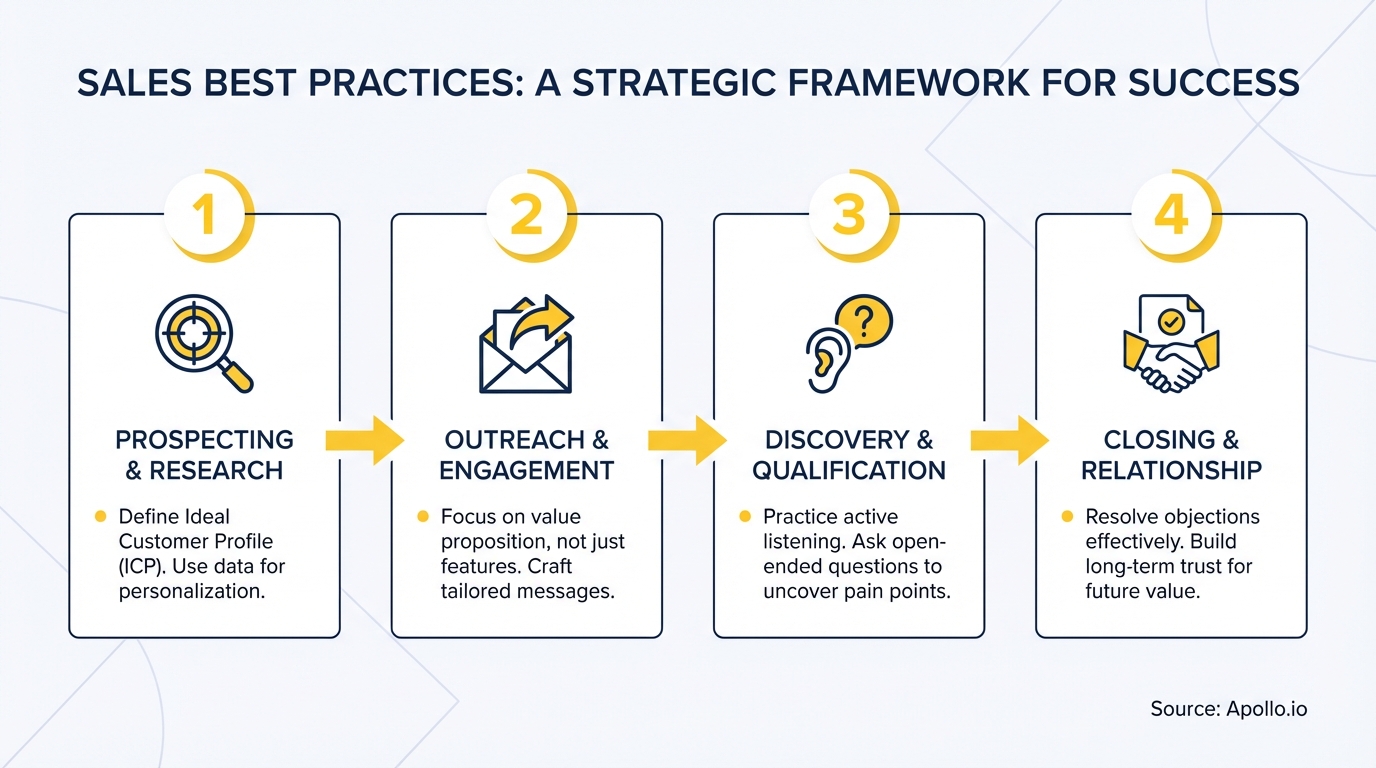
The playbook: define a tight ICP with firmographics and behavioral signals, research each account for specific context, personalize the first touch with relevant insight, and sequence across email, phone, and social channels. Struggling to find qualified leads? Search Apollo's 224M+ contacts with 65+ filters to build targeted lists in minutes, not hours.
Trinity42 found that sales teams leveraging AI see a 50% increase in leads and appointments. Modern SDRs use AI to identify intent signals, generate personalized research, and optimize messaging while maintaining the human judgment that converts prospects.
Turn Funnel Guesswork Into Real Pipeline
Tired of watching marketing leads stall before they ever reach your pipeline? Apollo surfaces in-market buyers at the right moment so your team acts on real signals, not gut feel. 550K+ companies have stopped guessing.
Start Free with Apollo →What Self-Serve Content Do Buyers Need?
Buyers in 2026 expect complete self-serve paths through awareness, consideration, and evaluation stages. They want transparent pricing, interactive demos, detailed documentation, customer proof, and stakeholder-specific resources available without gating or sales conversations.
Teams that provide frictionless access convert faster and at higher rates.
Essential self-serve assets include:
- Problem framing content: Blog posts, guides, and calculators that help buyers diagnose their challenges
- Product education: Video demos, feature documentation, and use case libraries
- Evaluation tools: Comparison grids, ROI calculators, and implementation timelines
- Proof assets: Case studies, customer quotes, and third-party reviews organized by industry and use case
- Buying committee resources: Stakeholder memos, executive summaries, and technical deep-dives
These assets must work across channels with consistent messaging. Buyers notice when your website claims differ from rep narratives or when email messaging contradicts product documentation.
How Do Account Executives Shorten Sales Cycles?
Account Executives reduce time-to-close by focusing on buying committee alignment and risk reduction. They map stakeholders early, provide role-specific value propositions, facilitate consensus-building conversations, and proactively address evaluation sticking points.
The goal: eliminate delays caused by misalignment or missing information.
Winning AEs use structured discovery to identify all decision-makers and their success criteria, then deliver stakeholder-specific content that addresses each persona's concerns. They create evaluation frameworks that guide committees toward decisions rather than waiting for buyers to figure it out alone.
For complex deals, they facilitate multi-stakeholder workshops that surface objections and build consensus in real-time.
The tech stack matters: AEs managing deals across fragmented tools waste time on data entry and lose visibility into deal health. According to professional networks, sales professionals using AI daily are twice as likely to exceed their sales targets compared to non-users. Modern platforms consolidate pipeline tracking, conversation intelligence, and automated follow-up in one workspace.

What AI Sales Tools Actually Drive Results?
AI adoption in sales hit 43% in 2026, but results vary dramatically. Teams that treat AI as a productivity multiplier see measurable gains.
Those that deploy AI without clear use cases or governance see minimal ROI. The difference: strategic implementation focused on high-value activities rather than automation for automation's sake.
High-impact AI applications include:
- Prospect research: Automated company and contact intelligence that surfaces relevant talking points
- Personalization at scale: AI-generated email variants tailored to industry, role, and company context
- Call analysis: Conversation intelligence that identifies winning talk tracks and coaching opportunities
- Deal risk scoring: Predictive analytics that flag at-risk opportunities for intervention
- Content generation: AI-assisted creation of proposals, follow-up emails, and stakeholder memos
Spending hours on manual outreach? Automate your sequences with Apollo's multi-channel platform to run personalized campaigns across email, phone, and social while maintaining the human touch that converts.
The key is measurement: track time saved, conversion lift, cycle time reduction, and win rate improvement for each AI deployment. Teams that can't prove ROI are likely using AI theater rather than genuine productivity tools. Learn more about AI sales tools that actually close deals.

How Do Sales Leaders Build Measurable Systems?
Sales leaders in 2026 design systems, not just manage reps. They build repeatable processes for prospecting, qualification, deal progression, and customer expansion, then instrument each stage with clear metrics.
The goal: predictable revenue through process consistency rather than individual heroics.
Effective leaders focus on three areas: process design aligned to buyer journeys, technology consolidation to reduce complexity, and manager enablement to drive coaching consistency. They eliminate tools that don't prove ROI and invest in platforms that provide end-to-end visibility.
As one Apollo customer noted: "We reduced the complexity of three tools into one." This consolidation enables better data quality, clearer reporting, and faster rep ramp time.
Modern sales systems include defined ICP criteria, documented talk tracks for each buying stage, standardized qualification frameworks like MEDDIC or BANT, and regular deal reviews focused on process adherence. Leaders who implement these systems see reduced variability in performance and faster time-to-quota for new hires. Explore forecasting best practices for building predictable pipeline.
What Does Tool Consolidation Look Like in Practice?
Teams at growing startups to mid-market and enterprise organizations waste budget on overlapping tools: separate platforms for contact data, email sequencing, dialer, meeting scheduling, and CRM. This fragmentation creates data silos, integration headaches, and productivity drains from context-switching.
Modern best practice: consolidate to an all-in-one GTM platform that handles prospecting, engagement, intelligence, and pipeline management in one workspace. Apollo customers report significant cost savings and efficiency gains. "We cut our costs in half," noted one Census customer.
Another from Cyera said: "Having everything in one system was a game changer."
Consolidated platforms eliminate duplicate data entry, provide single-source-of-truth reporting, reduce integration complexity, and accelerate new hire onboarding. RevOps leaders especially benefit from unified analytics that show true campaign performance and pipeline health without stitching together reports from five different systems.
Conclusion: Build Your 2026 Sales Best Practices System
The sales teams winning in 2026 have abandoned outdated tactics for buyer-centric systems. They prioritize relevance over volume, build self-serve paths for autonomous buyers, deploy AI strategically with clear ROI metrics, and consolidate fragmented tech stacks into unified platforms.
These aren't theoretical frameworks but proven practices backed by data and customer results.
Start by auditing your current approach: Are you sending irrelevant outreach that buyers avoid? Do you provide complete self-serve resources for buying committees?
Can you prove ROI on your AI investments? Is your tech stack consolidated or fragmented across five vendors?
The answers reveal your gaps and implementation priorities.
Ready to implement modern sales best practices? Schedule a Demo to see how Apollo consolidates prospecting, engagement, and intelligence in one platform used by 2M+ sales professionals at 550K+ companies worldwide.
Prove Pipeline ROI With Apollo
Budget approval stuck on unclear metrics? Apollo surfaces measurable pipeline impact so your team justifies every dollar — fast. Leadium 3x'd their revenue. Your board wants the same proof.
Start Free with Apollo →Don't miss these
Sales
Inbound vs Outbound Marketing: Which Strategy Wins?
Sales
What Is a Sales Funnel? The Non-Linear Revenue Framework for 2026
Sales
What Is a Go-to-Market Strategy? The 2026 GTM Playbook
See Apollo in action
We'd love to show how Apollo can help you sell better.
By submitting this form, you will receive information, tips, and promotions from Apollo. To learn more, see our Privacy Statement.
4.7/5 based on 9,690 reviews
