
SaaS Sales Process: A Complete Guide for Modern Sales Teams
The SaaS sales process in 2026 looks radically different than it did just two years ago. Buyers now prefer self-service experiences, consensus-building spans multiple stakeholders, and AI agents are executing tasks once handled by SDRs. According to Marketing LTB, the global SaaS market is valued at approximately $257 billion in 2025, creating fierce competition for every deal. Success now requires a buyer-first framework that addresses procurement, security, and buying-group dynamics from day one.

Apollo Eliminates 4+ Hours Of Daily Research
Tired of spending 4+ hours daily hunting for contact info? Apollo delivers 224M verified contacts with 96% email accuracy—instantly. Join 550K+ companies who replaced manual research with predictable pipeline.
Start Free with Apollo →Key Takeaways
- 61% of B2B buyers prefer rep-free buying experiences, requiring self-serve assets like ROI calculators and security documentation
- 74% of buying groups experience conflict during decisions, making consensus-building tools and stakeholder mapping critical
- RevOps teams must prioritize data governance and CRM integration before launching AI automation to avoid missed revenue targets
- Modern SaaS sales processes balance AI-driven efficiency with human touchpoints at high-stakes decision moments
- Tool consolidation reduces tech stack complexity while improving pipeline visibility and forecast accuracy
What Is a SaaS Sales Process?
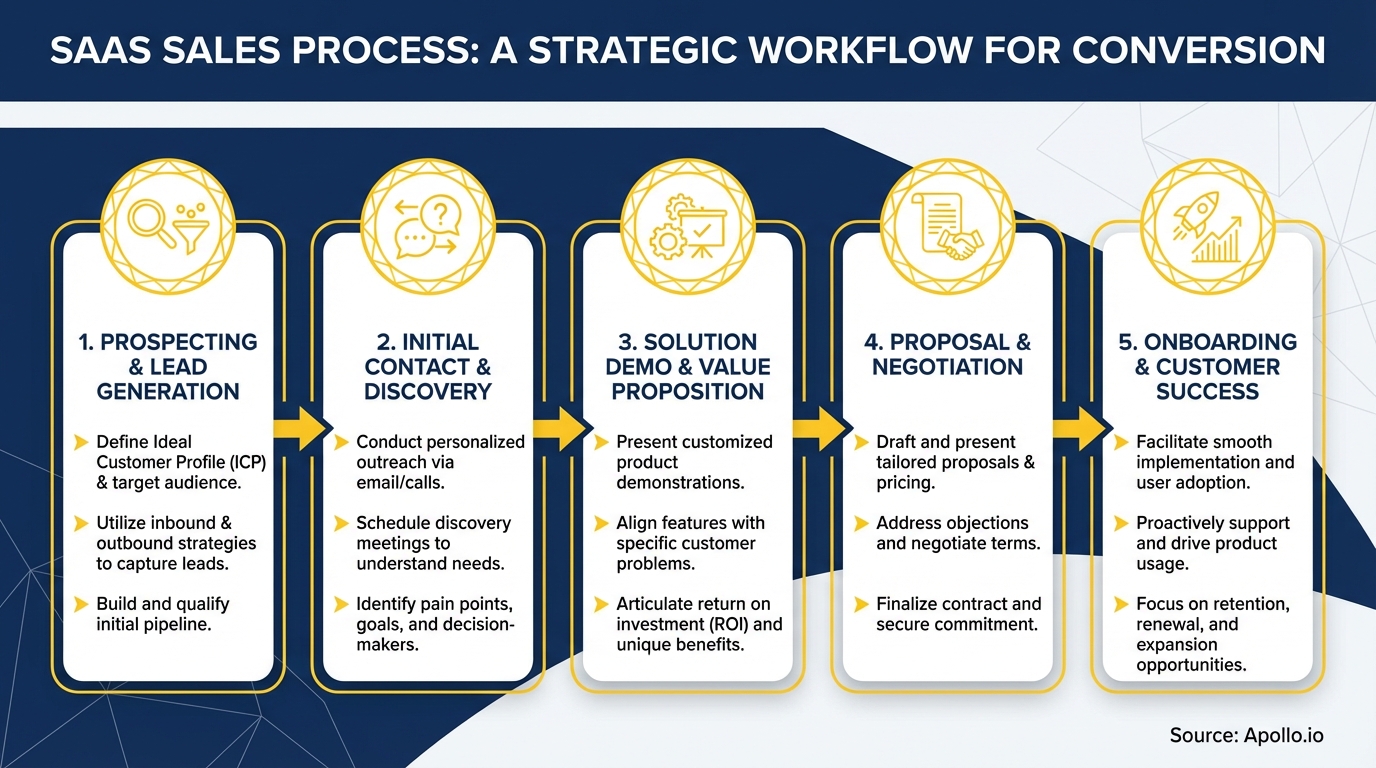
A SaaS sales process is a repeatable framework that guides prospects from initial awareness through purchase and renewal of cloud-based software subscriptions. Unlike traditional software sales with perpetual licenses, the SaaS model emphasizes recurring revenue, product-led growth, and ongoing customer success.
The process typically includes prospecting, qualification, demonstration, negotiation, onboarding, and expansion.
In 2026, effective SaaS sales processes are consensus-driven rather than seller-centric. They provide buying groups with self-serve resources, address procurement and security requirements early, and design explicit handoffs between automated workflows and human engagement. Research from Oliver Munro shows the median Customer Acquisition Cost (CAC) has hit $2.00 to acquire $1.00 of new annual recurring revenue (ARR), representing a 14% increase from 2023, making process efficiency critical.
Why Do SDRs Need a Structured SaaS Sales Process?
SDRs operating without a defined process waste hours on unqualified prospects and irrelevant outreach that buyers actively avoid. A structured SaaS sales process gives SDRs clear qualification criteria, messaging frameworks for different buyer personas, and progression rules that prevent deals from stalling.
It transforms prospecting from random activity into predictable pipeline generation.

The process must account for buying-group complexity.
Today's SaaS purchases involve five to 16 stakeholders across multiple departments (IT, security, procurement, end-users).
SDRs need stakeholder mapping templates, role-specific value propositions, and multi-threading strategies to navigate these groups.
Struggling to identify the right contacts? Search 224M+ verified business contacts with Apollo's 65+ filters to build targeted prospect lists in minutes.

How Does a Consensus-Driven SaaS Sales Process Work?
A consensus-driven process addresses the reality that 74% of B2B buyer teams demonstrate unhealthy conflict during decisions. Rather than pushing individual champions toward a close, this approach facilitates group alignment through shared problem definition, transparent evaluation criteria, and collaborative decision-making tools.
The framework includes five stages:
- Awareness & Problem Identification: Buyer-facing content (benchmarks, ROI models, peer comparisons) that builds consensus around the business problem
- Solution Exploration: Self-serve demos, interactive product tours, and security/compliance documentation that buying groups can review asynchronously
- Evaluation & Consensus Building: Mutual Action Plans (MAPs) with clear owners, decision criteria, and timeline commitments from all stakeholders
- Procurement & Legal Review: Pre-negotiated terms, reference architectures, and implementation plans that reduce friction with IT and procurement teams
- Onboarding & Expansion: Success metrics, usage dashboards, and account growth playbooks tied to business outcomes
This approach reduces the 86% deal stall rate by providing clear progression criteria at each stage. For Account Executives managing complex enterprise deals, explicit exit criteria (signed MAP, security review complete, budget confirmed) prevent premature advancement and forecast inaccuracy. Learn more about optimizing your B2B SaaS sales funnel with stage-specific metrics.
Turn Forecast Guesswork Into Revenue Clarity
Pipeline forecasting a guessing game? Apollo delivers real-time deal visibility and intent signals so you can predict revenue with confidence. Built-In boosted win rates 10% with Apollo's scoring.
Start Free with Apollo →What Are the Essential Components of a Modern SaaS Sales Tech Stack?
The average SaaS sales team uses 10-15 different tools across prospecting, engagement, data enrichment, meeting scheduling, and pipeline management. This fragmentation creates data silos, reduces rep productivity, and makes accurate forecasting nearly impossible.
RevOps leaders in 2026 are consolidating around integrated platforms that combine these capabilities.
| Capability | Traditional Approach | Consolidated Platform Approach |
|---|---|---|
| Contact Data | Separate data provider + manual enrichment | Built-in database with automatic enrichment |
| Engagement | Email tool + separate dialer + social platform | Multi-channel sequences in one workspace |
| Intelligence | Third-party intent data + manual research | Integrated signals and AI-powered insights |
| Pipeline Management | CRM + separate analytics tool | Native deal management with forecasting |
Teams consolidating their sales tech stack report significant benefits. "We reduced the complexity of three tools into one," shares Collin Stewart from Predictable Revenue. "We cut our costs in half," adds the Census team. Spending too much on disconnected sales tools? Consolidate your GTM stack with Apollo's all-in-one platform and eliminate 3-5 separate subscriptions.
How Do Sales Leaders Balance AI Automation with Human Engagement?
AI agents now handle follow-up sequences, meeting summarization, and next-step recommendations that once required SDR hours. However, Gartner predicts 75% of buyers will prefer human interaction over AI by 2030, creating a hybrid model where automation handles volume and humans focus on high-stakes moments.
Effective AI-human handoff points include:
- Security & Compliance Questions: Automated responses for standard queries, human experts for custom requirements
- Pricing & Negotiation: AI provides instant ranges, AEs handle final terms and multi-year commitments
- Executive Alignment: Automated stakeholder outreach, human-led executive business reviews
- Technical Architecture: Self-serve documentation, solutions engineers for custom integrations
Sales Leaders implementing this hybrid approach should start with data governance. Recent research shows 87% of enterprises missed 2025 revenue targets despite AI investment because 48% said their revenue data wasn't AI-ready. Clean pipeline definitions, standardized stage criteria, and unified CRM data are prerequisites for effective automation. Explore how AI sales enablement transforms rep productivity when built on quality data.
What Anti-Stall Tactics Keep SaaS Deals Moving Forward?
With 86% of B2B purchases stalling during the buying process, anti-stall playbooks are now standard operating procedure for high-performing SaaS teams. These playbooks diagnose the root cause of inertia (indecision, competing priorities, internal politics) and prescribe specific interventions.
Stage-specific anti-stall tactics:
- Discovery Stalls: Send comparative ROI analysis showing cost of inaction with peer benchmarks
- Evaluation Stalls: Facilitate champion coaching sessions to help them build internal business cases
- Procurement Stalls: Provide pre-approved terms sheet and reference customer security reviews
- Legal Stalls: Offer vendor-neutral risk assessment and competitor contract comparison
Buyers that reach consensus are 2.5x more likely to report high deal quality. Use deal management software to track stakeholder engagement, identify at-risk opportunities, and trigger intervention playbooks automatically. For Founders building repeatable sales motions, these systems create the revenue operations framework that scales with your team.
Ready to Build a Buyer-First SaaS Sales Process?
The SaaS sales landscape has fundamentally shifted toward consensus-driven, self-serve experiences supported by strategic human engagement. Teams that adapt their processes to address buying-group dynamics, provide transparent evaluation resources, and consolidate fragmented tech stacks will win in 2026's competitive market.
Start by auditing your current process against these criteria: Do you have self-serve ROI calculators? Are your security docs readily available?
Can buying groups access implementation plans without a sales call? Have you mapped typical stakeholder groups and their decision criteria?
Is your CRM data clean enough to support AI automation?
The companies closing deals faster aren't using more tools. They're using integrated platforms that give reps a single workspace for prospecting, engagement, and pipeline management. "Having everything in one system was a game changer," reports the Cyera team. Start free with Apollo and join 90K+ paying customers who consolidated their sales tech stack while improving win rates.
Prove Apollo's ROI In Your First 30 Days
Budget approval stuck on unclear metrics? Apollo tracks every touchpoint from prospect to closed deal—quantifying time saved, pipeline generated, and win rate improvements. Built-In boosted win rates 10% and ACV 10% with Apollo's scoring.
Start Free with Apollo →Don't miss these
Sales
Inbound vs Outbound Marketing: Which Strategy Wins?
Sales
What Is a Sales Funnel? The Non-Linear Revenue Framework for 2026
Sales
What Is a Go-to-Market Strategy? The 2026 GTM Playbook
See Apollo in action
We'd love to show how Apollo can help you sell better.
By submitting this form, you will receive information, tips, and promotions from Apollo. To learn more, see our Privacy Statement.
4.7/5 based on 9,690 reviews
