
50 Sales Interview Questions to Identify Top Performers in 2026
Hiring the right sales talent in 2026 requires more than traditional interview questions. With AI transforming quota attainment and data-driven selling becoming the standard, your sales interview questions must assess technical readiness, collaboration skills, and adaptability. This guide provides evidence-based questions, scoring rubrics, and role-specific frameworks to identify top performers.

Stop Manual Research—Apollo Finds Contacts Fast
Tired of spending 4+ hours daily hunting for contact info? Apollo delivers 224M verified contacts with 96% email accuracy instantly. Join 550K+ companies who eliminated manual research.
Start Free with Apollo →Key Takeaways
- AI-readiness assessment is critical: sellers who partner with AI tools are 3.7 times more likely to meet quota
- Evaluate conflict resolution skills since 74% of buyer teams experience unhealthy decision-making dynamics
- Use structured rubrics and neurodiversity-friendly practices to reduce hiring bias and improve team diversity
- Tailor questions by role (SDR, AE, enterprise) to assess job-specific competencies accurately
- Focus on data-driven selling capabilities as 60% of B2B organizations have transitioned to analytics-based approaches
What Are the Best Interview Questions for Sales Positions in 2026?
The best interview questions for sales positions evaluate AI readiness, data fluency, and collaboration under pressure. According to Gartner research, sellers who effectively partner with AI tools are 3.7 times more likely to meet their sales quotas. Your questions should uncover how candidates leverage technology, interpret metrics, and navigate complex buyer dynamics.
Modern sales roles require technical sophistication. AI writing tools and automation have transformed prospecting workflows, making it essential to assess candidates' comfort with sales technology platforms.
Why Do AI-Readiness Questions Matter?
AI-readiness questions identify candidates who can scale their output without sacrificing personalization. Ask: "Describe how you've used AI or automation tools to improve your prospecting efficiency.
What results did you achieve?" Strong candidates cite specific platforms, measurable time savings, and quality improvements.
Look for answers that demonstrate strategic tool selection rather than blind adoption. The best sellers use AI to handle research and administrative tasks while focusing human effort on relationship building and complex problem-solving.
How Do You Assess Data-Driven Selling Skills?
Data-driven selling skills are assessed through questions about metrics interpretation, pipeline forecasting, and decision-making based on analytics. Research by Gartner shows that 60% of B2B sales organizations have transitioned to a data-driven selling approach. Candidates must demonstrate fluency with CRM data, conversion metrics, and performance dashboards.
Ask: "Walk me through how you analyzed your pipeline last quarter. What metrics did you track, and what actions did you take based on the data?" Top performers reference specific KPIs like email response rates, meeting conversion percentages, and average deal velocity.
They explain how data insights informed their prospecting strategy or outreach cadence.

| Competency | Strong Answer Indicators | Red Flags |
|---|---|---|
| Metrics Fluency | Names 5+ relevant KPIs, explains trends | Vague references to "doing well" |
| Tool Usage | Describes specific platforms, workflows | "I just use what they give me" |
| Action Orientation | Shares data-driven strategy pivots | Passive reporting without adjustments |
| Forecasting | Accurate quota predictions with rationale | Guesswork or overly optimistic estimates |
Struggling to evaluate candidates' tech stack knowledge? Build your understanding of modern sales tools to ask informed follow-up questions.
See Every Deal Stage In Real Time With Apollo
Forecasting feels like guesswork without live pipeline data. Apollo gives you instant visibility across every deal stage so you can predict revenue with confidence. Built-In increased win rates 10% using Apollo's real-time insights.
Start Free with Apollo →What Questions Reveal Conflict Resolution Abilities?
Conflict resolution questions assess how candidates navigate buyer-team disagreements and internal obstacles. With 74% of B2B buyer teams experiencing unhealthy conflict during decision-making, according to Gartner research, sellers must facilitate consensus rather than forcing deals forward.
Ask: "Tell me about a time when key stakeholders disagreed on your solution. How did you help them reach alignment?" Strong candidates describe active listening, identifying underlying concerns, and creating frameworks for collaborative decision-making.
They avoid taking sides and instead position themselves as trusted advisors.
How Do Sales Leaders Evaluate Team Collaboration?
For Sales Leaders hiring managers or senior AEs, assess cross-functional collaboration abilities. Ask: "Describe how you've worked with marketing or customer success to close a complex deal." Look for examples of proactive communication, shared goals, and willingness to support team members beyond individual quota.
Need better visibility into your sales team's collaboration patterns? Track deals and team activity with Apollo's unified platform to identify coaching opportunities.
How Do SDRs Answer Questions About Prospecting Strategy?
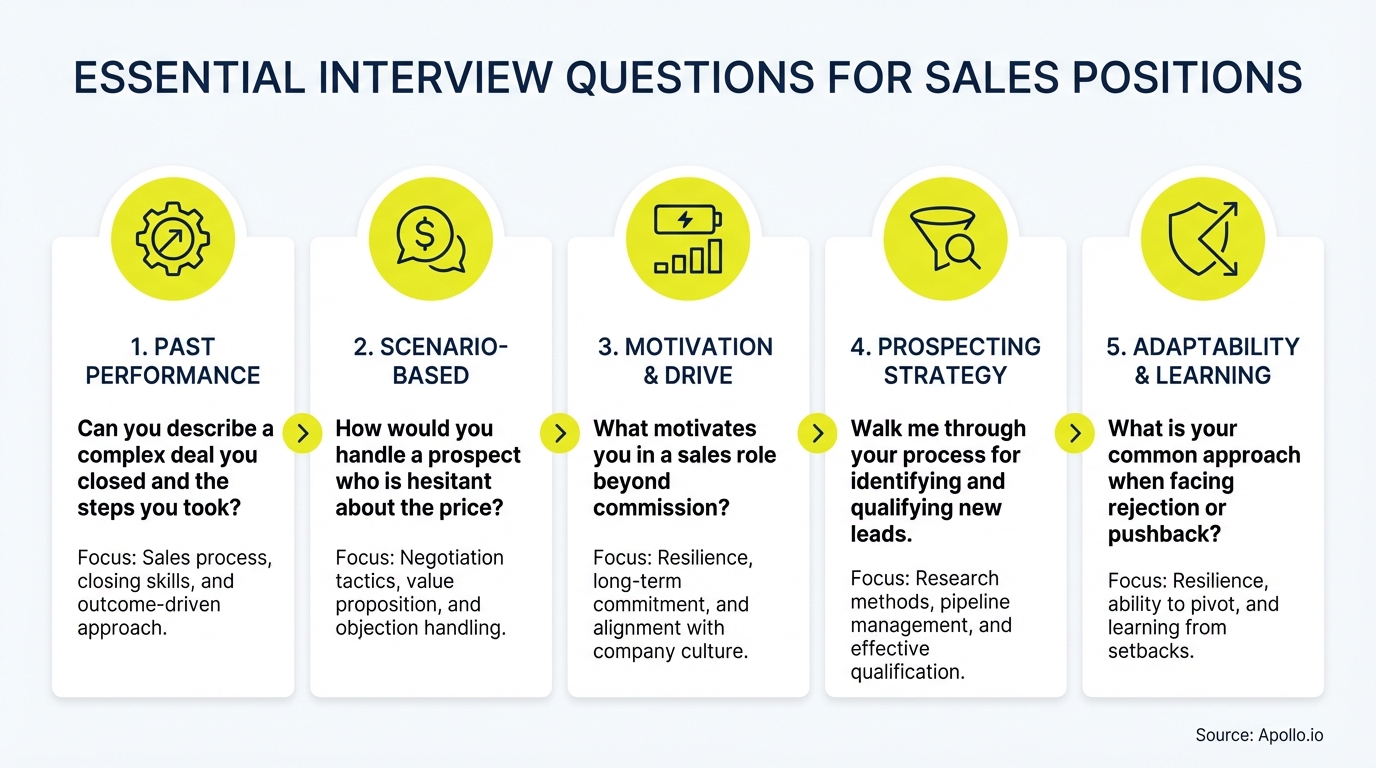
SDRs should articulate clear prospecting methodologies that balance volume with personalization. Ask: "How do you prioritize which accounts to target, and what's your research process before reaching out?" Strong SDR candidates describe ideal customer profile criteria, data sources they consult, and how they tailor messaging based on prospect signals.
Top SDRs mention using multiple channels (email, phone, social outreach) in coordinated sequences. They reference A/B testing subject lines, tracking response rates, and iterating based on performance data.
Look for candidates who view prospecting as a strategic discipline rather than a numbers game.
What Tools Do SDRs Use for Lead Generation?
Candidates should name specific sales development tools they've used for contact discovery, enrichment, and engagement. Ask: "What's your tech stack for prospecting, and how do you use each tool?" Strong answers demonstrate familiarity with B2B databases, sales engagement platforms, and conversation intelligence software.
Tired of candidates who can't find qualified leads efficiently? Search Apollo's 224M+ contacts with 65+ filters to show prospects what best-in-class prospecting looks like.
What Are Neurodiversity-Friendly Interview Practices?
Neurodiversity-friendly interview practices create equitable evaluation conditions for all candidates. With 20% of Fortune 500 sales organizations expected to actively recruit neurodivergent talent by 2027, inclusive hiring processes are both ethical and strategic.

Provide interview questions in advance so candidates can prepare thoughtful responses. Offer alternative formats like written responses or take-home exercises alongside traditional interviews.
Avoid rapid-fire questioning that favors quick verbal processing over deep analytical thinking.
| Practice | Implementation | Benefit |
|---|---|---|
| Advance Questions | Send 3-5 key questions 24 hours before interview | Reduces anxiety, allows preparation |
| Structured Format | Use consistent rubrics for all candidates | Minimizes unconscious bias |
| Clear Expectations | Explain interview structure and timeline upfront | Reduces cognitive load |
| Flexible Timing | Allow breaks or split into multiple sessions | Accommodates processing differences |
How Do You Tailor Questions by Sales Role?
Role-specific questions ensure you're evaluating competencies that directly predict success. SDRs need high activity tolerance and research skills. AEs require deal strategy and negotiation abilities. Enterprise sales roles demand executive presence and long-cycle patience.
For SDRs, ask: "How many touches does it typically take you to book a meeting, and how do you stay motivated through rejection?" For AEs, ask: "Walk me through how you managed a deal with a 6-month sales cycle and multiple stakeholders." For enterprise roles, ask: "Describe your approach to building relationships with C-level executives."
What Performance Metrics Matter Most by Role?
SDRs should discuss activity metrics (calls, emails, meetings booked) and conversion rates. AEs focus on pipeline generation, win rates, and average deal size.
Sales Leaders emphasize team quota attainment, forecast accuracy, and talent development. Tailor your scoring rubrics to weight these role-specific metrics appropriately.
Start Hiring Top Sales Talent in 2026
Effective sales interviews in 2026 require assessing AI readiness, data fluency, collaboration skills, and role-specific competencies. Use structured rubrics, neurodiversity-friendly practices, and scenario-based questions to identify candidates who will thrive in modern sales performance environments.
Build your interview framework around the competencies that drive quota attainment: technology adoption, analytical thinking, and buyer-centric problem-solving. Document your evaluation criteria to ensure consistency across interviewers and reduce unconscious bias.
Ready to equip your new hires with the tools they need to succeed? Start Your Free Trial and give your team access to 224M+ verified contacts, AI-powered engagement, and unified pipeline management in one platform.
Prove Apollo's Value In Your First Week
Budget approval stuck on unclear metrics? Apollo tracks pipeline impact from day one—quantifiable meetings booked, opportunities created, and revenue influenced. Built-In increased win rates 10% and ACV 10% using Apollo's measurable insights.
Start Free with Apollo →Don't miss these
Sales
Inbound vs Outbound Marketing: Which Strategy Wins?
Sales
What Is a Sales Funnel? The Non-Linear Revenue Framework for 2026
Sales
What Is a Go-to-Market Strategy? The 2026 GTM Playbook
See Apollo in action
We'd love to show how Apollo can help you sell better.
By submitting this form, you will receive information, tips, and promotions from Apollo. To learn more, see our Privacy Statement.
4.7/5 based on 9,690 reviews
