
How to Use Engagement Data to Refine Which Content to Send Next
Most B2B nurture programs still run on static drip sequences: send email one, wait three days, send email two. But buyers have moved on. A March 2026 Gartner survey found 67% of B2B buyers prefer a rep-free experience, and 45% used AI during a recent purchase. Static sequences can't serve buyers who self-research, compare vendors, and validate findings before a rep ever gets involved.
The fix is building a next-best-content system: a set of decision rules that reads engagement signals, identifies buyer intent, and routes the right asset to the right stakeholder at the right moment. Understanding which customer engagement metrics actually matter is the foundation of this approach.

Research Less. Pipeline More With Apollo.
Tired of burning hours verifying contacts before a single email goes out? Apollo surfaces accurate, ready-to-engage prospects so your team sells instead of searches. Over 600K companies already pipeline faster.
Start Free with Apollo →Key Takeaways
- Engagement signals (clicks, content shares, page visits, CTA completions) are more actionable when mapped to buying-group stage, not just individual lead score.
- B2B companies that personalize content based on engagement data see measurably higher conversion rates and revenue growth than those using generic sequences.
- The decision of when to stay rep-free vs. trigger a sales handoff should be driven by intent signals, not time-based rules.
- Marketing and sales must share engagement insights to close the loop; organizations that do are significantly more likely to exceed revenue targets.
- Personalization can backfire if overdone: the goal is reducing buyer uncertainty, not maximizing outreach volume.
What Is a Next-Best-Content System?
A next-best-content system is a set of signal-triggered rules that determines which content to send next based on what a buyer or buying group has already engaged with. It replaces calendar-based drip logic with behavior-based routing.
The core inputs are engagement events: email opens and clicks, content downloads, webinar attendance, pricing page visits, CTA completions, and social shares. Each event signals a buyer's current job (learning, comparing, validating) and informs the appropriate next asset. According to Madison Logic, 71% of B2B buyers expect personalized interactions and become frustrated when those expectations go unmet. A next-best-content system is how you meet that expectation at scale.
What Engagement Signals Should You Track?
Engagement signals fall into three tiers based on intent strength. Mapping each signal to a buyer job tells you what content to send next.
| Signal | Intent Tier | Buyer Job | Next-Best Asset |
|---|---|---|---|
| Blog post visit (1-2 pages) | Low | Problem awareness | Educational guide or checklist |
| Content download (gated) | Medium | Solution research | Case study or comparison asset |
| Webinar attendance + Q&A | Medium-High | Vendor evaluation | ROI calculator or proof deck |
| Pricing page visit (2+ times) | High | Decision validation | Customer story or sales rep outreach |
| CTA click (demo, trial, contact) | Very High | Purchase readiness | Immediate sales handoff |
| Content shared with colleague | High | Buying-group expansion | Stakeholder-specific version of same asset |
The share signal deserves special attention. When a contact forwards content to a colleague, the buying group is expanding. That's the moment to send a stakeholder-specific version of the same asset, not a generic follow-up. Intent data layers on top of these first-party signals to show which topics the account is actively researching off your site.

How Do You Build Buying-Group Personalization Rules?
Buying-group personalization means routing content decisions based on account-level engagement patterns, not just individual lead scores. A Gartner analysis found that buying-group-relevant content can improve committee consensus by 20%, while content tailored only to individual relevance can have a 59% negative impact on buying-group consensus.
Use these four rules to build your buying-group logic:
- Rule 1 - Champion signal: One contact downloads a guide. Send the champion a deeper technical asset and flag the account for sales awareness.
- Rule 2 - Multi-stakeholder signal: Two or more contacts from the same account engage with content in the same week. Trigger a buying-group-specific asset (e.g., an executive summary for the economic buyer).
- Rule 3 - Validation signal: Pricing page visited after a webinar. Send ROI evidence and a proof-of-value case study. A May 2026 Gartner report found 69% of buyers turn to sales reps to validate AI-generated research, so this is exactly when a rep-assisted touchpoint becomes appropriate.
- Rule 4 - Stall signal: No engagement for 14+ days after a high-intent action. Send a short, self-directed asset (video, checklist) to re-engage without pressure.
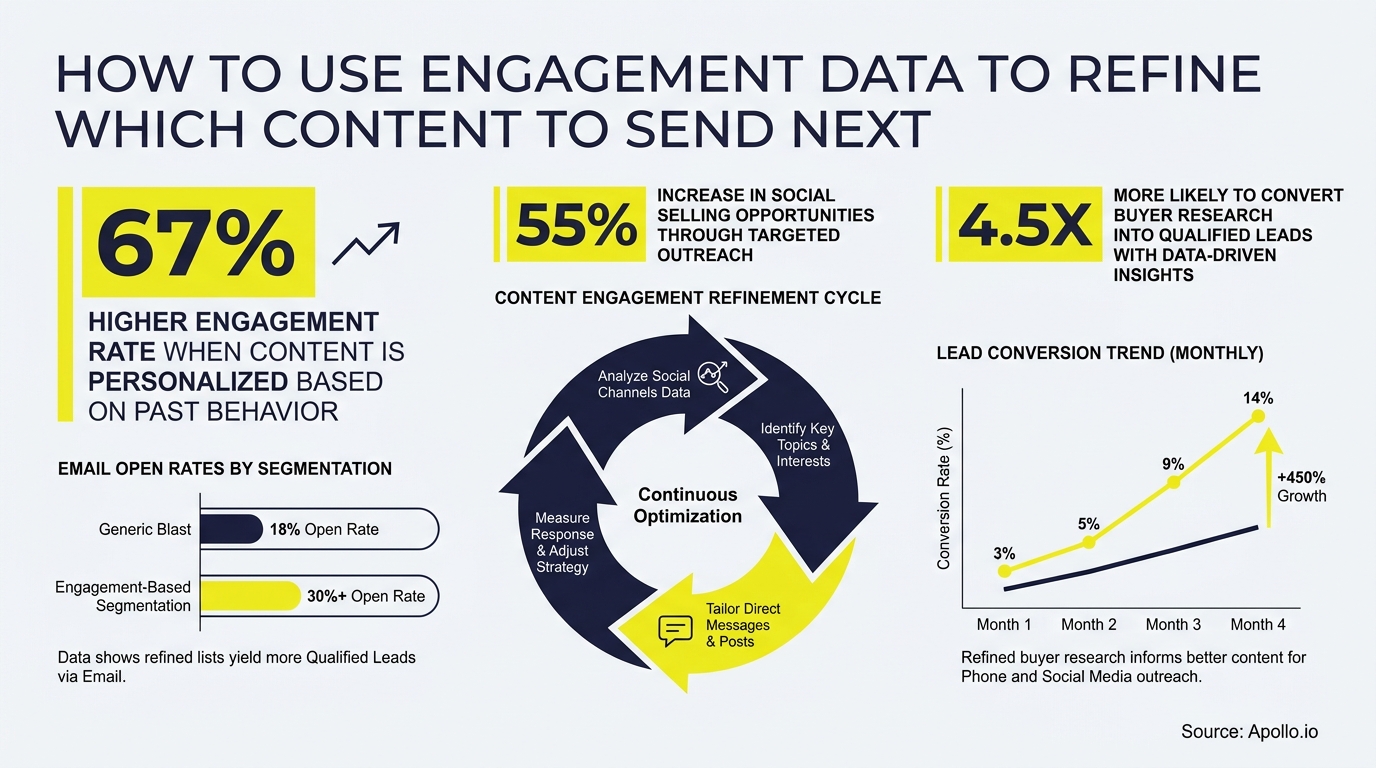
Research from Instapage shows B2B companies that personalize their marketing content experience a 58% increase in engagement. The signal-to-rule framework above is how you operationalize that lift.
Turn Funnel Guesswork Into Pipeline Wins
Quota stress keeping you up at night? Apollo surfaces quality leads and maps buying signals so your team stops chasing dead ends. Nearly 100K paying customers run sharper pipelines with Apollo.
Start Free with Apollo →When Should You Stay Rep-Free vs. Trigger a Sales Handoff?
The rep-free vs. rep-led decision should be driven by intent signals, not a fixed number of touches or days elapsed. Sending a rep too early wastes quota capacity and frustrates self-directed buyers.
Sending content when a buyer is ready to talk loses deals.
Stay rep-free when:
- Engagement is limited to awareness-stage content (blog, intro video)
- Only one stakeholder from the account has engaged
- No pricing, trial, or comparison page has been visited
- The contact has not responded to a previous email or CTA
Trigger a sales handoff when:
- Pricing page visited twice or more
- Demo CTA clicked or trial started
- Multiple stakeholders from the same account are active in the same week
- Content shared externally (buying group is expanding)
- Engagement score crosses your account-level threshold
Spending hours deciding which accounts are ready for a rep? Apollo's multi-channel sales engagement platform lets you build sequences that auto-trigger based on engagement signals, so reps only get notified when accounts are genuinely ready.
How Do RevOps and Marketing Leaders Implement This System?
RevOps leaders are best positioned to own the implementation because this system sits at the intersection of CRM data, marketing automation, and sales workflow. The instrumentation checklist below covers the minimum viable setup.
Instrumentation checklist:
- Tag all content assets by buying stage (awareness, evaluation, decision) and persona (champion, economic buyer, technical reviewer)
- Set up UTM tracking on every asset link to capture source, medium, and content type in your CRM
- Create engagement score fields at the account level (not just contact level) in your CRM
- Define score thresholds for each handoff trigger (e.g., account score of 50+ = sales alert)
- Build a shared dashboard where marketing and sales can see the same account-level engagement timeline
A Gartner 2024 survey found organizations with shared buyer-journey insights are 2.3x more likely to see higher sales conversion rates, yet 60% of companies lack those shared insights entirely. The dashboard step above is what closes that gap. For AEs managing active opportunities, contact data enrichment keeps the stakeholder records behind those engagement signals clean and current.
Data from Omnibound shows companies excelling at personalization generate 40% more revenue than average players. The implementation steps above are the operational difference between average and excellent.
How Can SDRs and AEs Use Engagement Data Day-to-Day?
SDRs benefit most from engagement data when it tells them who to call, why, and what to reference. Rather than cold-opening a call with generic discovery questions, an SDR can say: "I noticed your team downloaded our security checklist and visited the pricing page twice this week.
I wanted to see if you had questions we could address."
For AEs managing later-stage opportunities, engagement data reveals which stakeholders are active and which are silent. A silent economic buyer who suddenly visits the ROI calculator is a signal to request a business case conversation, not send another product one-pager. Building winning sequences around these signals is how top-performing reps consistently outperform calendar-based follow-up.
Struggling to keep sequences aligned with what prospects are actually engaging with? Apollo's AI-powered sales automation surfaces the right next step for each prospect automatically, so SDRs and AEs spend time selling, not guessing.
What Are the Pitfalls of Engagement-Based Personalization?
Engagement-based personalization can backfire when volume replaces relevance. A Gartner June 2025 study found personalized marketing created negative experiences for 53% of customers, who were 3.2x more likely to regret a purchase and 44% less likely to buy again.
The cause: over-personalization that feels surveillance-like or creates decision pressure rather than clarity.
Avoid these common mistakes:
- Over-triggering: Sending a new asset after every single click overwhelms buyers and signals you're watching too closely.
- Ignoring the buying group: Optimizing for the champion's clicks while the economic buyer remains unengaged leaves deals stalled.
- Conflating activity with intent: A contact who opens three emails but never clicks is not high-intent. Score completions and downstream actions, not passive opens.
- One-size personas: Sending the same "personalized" content to every VP of Sales ignores company size, industry, and deal stage context.
The corrective is active personalization: interactive assessments, guided tools, and buyer-controlled paths that let prospects signal their own priorities rather than having your system infer them from passive behavior alone.

Start Sending Smarter Content Today
Using engagement data to refine which content to send next is no longer a competitive advantage. It's table stakes.
The B2B teams winning in 2026 are those that have moved from static nurture tracks to signal-triggered, buying-group-aware content systems backed by clean contact data and shared marketing-sales dashboards.
Apollo brings contact intelligence, sales sequences, and engagement signals into one unified platform, so your team stops guessing and starts routing the right content to the right buyer at the right moment. As Cyera put it: "Having everything in one system was a game changer."
Schedule a Demo and see how Apollo's all-in-one GTM platform turns engagement data into your next best sales action.
Prove Pipeline ROI Faster With Apollo
ROI pressure killing your tool budget? Apollo delivers measurable pipeline impact from day one — so justifying the investment is easy. Leadium 3x'd their revenue. See your returns faster.
Start Free with Apollo →Don't miss these
Sales
Inbound vs Outbound Marketing: Which Strategy Wins?
Sales
What Is a Sales Funnel? The Non-Linear Revenue Framework for 2026
Sales
What Is a Go-to-Market Strategy? The 2026 GTM Playbook
See Apollo in action
We'd love to show how Apollo can help you sell better.
By submitting this form, you will receive information, tips, and promotions from Apollo. To learn more, see our Privacy Statement.
4.7/5 based on 9,690 reviews
