
How to Remove Duplicate Records Across Your Sales Database with an Integrated Platform
Duplicate records are silently draining your pipeline. According to Trykondo's B2B Sales Report, only 35% of sales professionals fully trust their CRM data's accuracy. When reps chase the same contact twice, sequences misfire, and AI-powered workflows route leads to the wrong owner, revenue leaks at every stage.
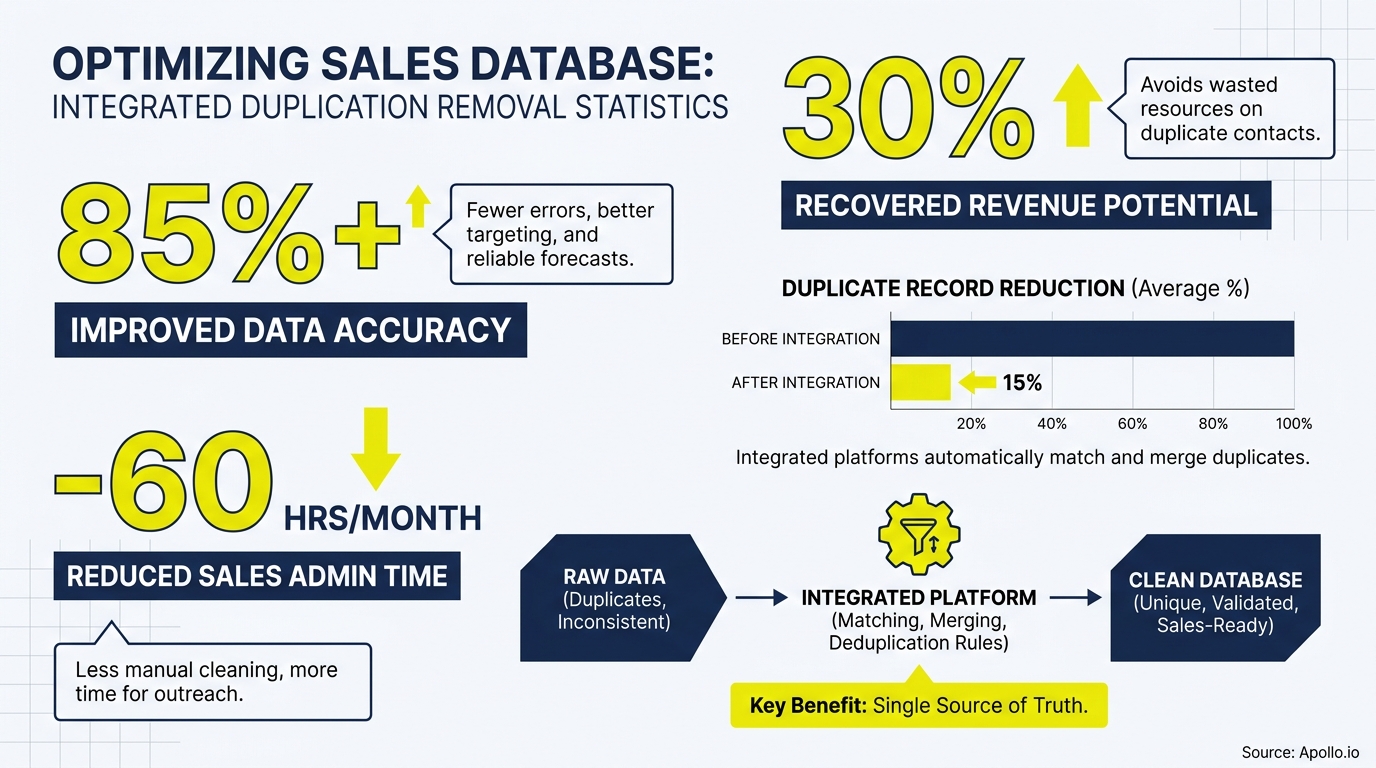
The fix is not a one-time cleanup. Using an integrated platform to remove duplicates across the sales database means building a continuous, prevention-first system that catches bad records before they corrupt your pipeline. This guide shows you exactly how to do it. For broader context on building a clean, scalable foundation, see How to Build a Sales Tech Stack That Scales Revenue.

Accurate Data, More Deals Closed
Tired of hours lost verifying contacts that bounce anyway? Apollo delivers 97% email accuracy so your team spends time selling, not searching. Join 600K+ companies building pipeline on data they can trust.
Start Free with Apollo →Key Takeaways
- Duplicate records are a top-tier CRM problem that compounds with every new data source, import, or integration you add.
- Poor data quality carries a steep financial cost that touches pipeline accuracy, rep productivity, and AI readiness.
- Prevention at the point of entry is more effective than periodic batch cleanup after duplicates have already spread.
- An integrated platform with identity resolution and continuous enrichment removes duplicates across every connected system, not just one tool.
- RevOps leaders who embed governance controls into their data workflows dramatically reduce manual stewardship overhead.
Why Do Duplicates Destroy Sales Database Accuracy?
Duplicate records corrupt your sales database by creating conflicting ownership, misattributed activity, and inflated pipeline metrics that mislead leadership. Research from Landbase confirms that poor data quality costs organizations an average of $12.9 million annually. That cost compounds when duplicates block AI tools from working correctly: bad routing, broken attribution, and wrong account ownership become systemic as agentic automation scales.
The core problems duplicates create in a sales database:
- Rep collision: Two SDRs contact the same prospect simultaneously, damaging the buyer relationship.
- Broken sequences: Automated outreach fires multiple times to the same contact under different record IDs.
- Inflated metrics: Pipeline reports double-count contacts, making forecasts unreliable.
- AI failure: Machine learning models trained on duplicate-heavy data produce inaccurate scoring and recommendations.
Data also decays fast. Industry research cited by Serghei Pogor on Medium places the annual B2B data decay rate at roughly 30-40%. Without continuous deduplication, even a clean database degrades quickly as contacts change roles, companies, and email addresses.
What Is an Integrated Platform Approach to Deduplication?
An integrated platform approach to deduplication uses a single system that connects your CRM, marketing automation, and data enrichment layers to detect, merge, and prevent duplicate records continuously, rather than relying on periodic manual cleanups.
This differs from point-tool dedupe in three critical ways:
| Approach | Scope | Timing | Governance |
|---|---|---|---|
| Point tool (manual) | Single system | Batch / periodic | Manual review |
| Integrated platform | Cross-system (CRM, MAP, enrichment) | Continuous / real-time | Automated rules + human review queue |
The integrated model uses identity resolution to assign a stable, unified profile (a "golden record") to each contact across all connected systems. When a new record enters through a web form, CSV import, or partner feed, the platform checks it against existing golden records before writing it to the database. Duplicates are blocked at intake rather than cleaned up after the fact.
Tired of dirty data slowing your team down? Start free with Apollo's 230M+ verified business contacts and keep your database clean from day one.
How Do RevOps Teams Build a Prevention-First Deduplication Program?
RevOps teams build prevention-first deduplication by embedding validation rules at every data intake point before records enter the CRM, rather than scheduling monthly cleanup projects. This is the most cost-effective approach because bad records never reach the database in the first place.
What Are the Core Steps to Implement Integrated Deduplication?
- Audit all data entry points. List every source feeding your CRM: web-to-lead forms, CSV imports, enrichment syncs, partner feeds, and manual entry. Each is a duplicate risk.
- Define your matching rules. Choose deterministic matching (exact email match) for high-confidence merges and probabilistic matching (name + company + domain similarity) for fuzzy deduplication. Apply stricter rules at intake, looser rules for retrospective scans.
- Establish golden record logic.Decide which field value wins when two records conflict. Common priority order: verified enrichment data, most recently updated CRM field, then manual entry.
- Connect enrichment to your CRM. Continuous contact enrichment keeps records current and surfaces merge candidates as contact data changes over time.
- Set up a review queue. Route ambiguous merge candidates (probabilistic matches below your confidence threshold) to a human reviewer rather than auto-merging. This protects against false positives.
- Schedule ongoing monitoring. Run automated duplicate scans weekly, not annually. Flag new duplicates as they enter rather than letting them accumulate.
For teams building out their broader automation infrastructure, What Is Sales Automation? Benefits, Tools, and How Apollo Helps covers the workflow automation layer that supports this kind of ongoing data hygiene.

How Does Deduplication Connect to AI Readiness?
Deduplication directly enables AI readiness because AI tools depend on consistent, non-duplicated records to produce accurate scoring, routing, and personalization. Duplicate records cause AI models to misattribute engagement signals, assign incorrect account ownership, and generate conflicting outreach recommendations.
As agentic automation expands in 2026, the cost of duplicates compounds. An AI agent routing a lead to the wrong owner, or triggering a sequence to a contact already mid-conversation, creates a worse buyer experience than no automation at all.
Clean golden records are the prerequisite for any AI-driven GTM motion.
Key AI-readiness checkpoints tied to deduplication:
- Unique contact IDs: Every person has one record, one engagement history, one owner.
- Complete firmographics: Enriched company data enables accurate ICP scoring without gaps.
- Consistent field formats: Standardized job titles, phone formats, and domain fields prevent matching failures.
- Lineage tracking: Know which source created and last updated each record for audit and rollback.
This connects directly to how sales analytics drives revenue growth: clean data is the foundation that makes reporting and forecasting trustworthy.
Turn Weak Leads Into Qualified Pipeline
Pipeline forecasting a guessing game because marketing leads never convert? Apollo surfaces high-intent buyers before your competitors do. Over 600K companies now build predictable pipeline — not hopeful guesses.
Start Free with Apollo →What Governance Model Should SDRs and RevOps Leaders Use?
SDRs and RevOps leaders should use a three-role governance model that assigns clear ownership for data quality without creating bottlenecks in the sales workflow.
| Role | Responsibility | Cadence |
|---|---|---|
| RevOps / Data Owner | Define matching rules, golden record logic, and merge policies | Quarterly rule review |
| SDR / Sales Rep | Flag suspected duplicates during prospecting; avoid creating new records for existing contacts | Ongoing / real-time |
| Sales Manager / AE | Review ambiguous merge queue; confirm account ownership on merged records | Weekly review queue |
Embedded governance means the platform enforces rules automatically. SDRs do not need to manually deduplicate; the system blocks duplicate creation at intake and surfaces conflicts in a queue for managers to resolve.
This mirrors the trend noted in a 2025 survey of enterprise data leaders, where approximately one-third named embedding governance into data workflows as their top modernization priority.
For SDRs specifically, clean data means more time prospecting and less time correcting bad records. See how sales productivity frameworks quantify the rep-hours recovered when data hygiene is automated rather than manual.
How Does Apollo Help Remove Duplicates Across the Sales Database?
Apollo serves as an integrated GTM platform that consolidates prospecting, enrichment, engagement, and pipeline management in one workspace, which structurally reduces duplicate creation by eliminating the multi-tool fragmentation that causes records to split across systems.
When sales data lives in one platform, the same contact record is used for prospecting, sequencing, and CRM sync. There is no import-export cycle between a data vendor, a sequencing tool, and a CRM where duplicates multiply at every transfer. As Predictable Revenue put it: "We reduced the complexity of three tools into one." (Read the full story.)
Apollo's data layer includes 97% email accuracy across 230M+ contacts and 65+ enrichment attributes, giving RevOps teams a verified data foundation to build golden records against. The waterfall enrichment capability pulls from multiple verified sources to fill gaps, reducing the incomplete records that often trigger false duplicate creation.
For teams evaluating the broader platform landscape, What Are Sales Intelligence Tools? provides a framework for comparing integrated platforms against point solutions.

Take the Next Step Toward a Clean, AI-Ready Sales Database
Removing duplicates from your sales database is not a one-time project. It is an ongoing program built on prevention-first intake controls, identity resolution, automated governance, and continuous enrichment.
The teams that solve this in 2026 are the ones that can trust their AI tools, their pipeline reports, and their rep workflows.
Apollo consolidates the data, enrichment, and engagement layers that make this possible in a single platform, so your GTM team spends time selling, not cleaning records. Schedule a Demo to see how Apollo's integrated platform keeps your sales database clean, enriched, and AI-ready.
Prove Pipeline ROI With Apollo
ROI pressure killing your tool budget approvals? Apollo delivers measurable pipeline impact from day one — so you walk into every renewal with hard numbers. Join 600K+ companies turning GTM spend into revenue they can prove.
Start Free with Apollo →Don't miss these
Sales
Inbound vs Outbound Marketing: Which Strategy Wins?
Sales
What Is a Sales Funnel? The Non-Linear Revenue Framework for 2026
Sales
What Is a Go-to-Market Strategy? The 2026 GTM Playbook
See Apollo in action
We'd love to show how Apollo can help you sell better.
By submitting this form, you will receive information, tips, and promotions from Apollo. To learn more, see our Privacy Statement.
4.7/5 based on 9,690 reviews
