
How to Structure a Multi-Step Sales Process Using Automation Tools
In March 2026, Gartner reported that 67% of B2B buyers prefer a rep-free experience and 45% used AI during a recent purchase. If your sales process still starts with an SDR cold call, you are designing for a buyer who no longer exists. Structuring a multi-step sales process using automation tools today means orchestrating self-serve education, signal-triggered workflows, AI-assisted qualification, and human handoffs at precisely the right moments. This article gives you a stage-by-stage blueprint to do exactly that. For deeper context on the fundamentals, see what sales automation is and how to use it the right way.

Research Less, Close More With Apollo
Tired of burning hours verifying contact info instead of selling? Apollo delivers accurate business contacts so your team spends time closing, not chasing. Join 600K+ companies building pipeline faster.
Start Free with Apollo →Key Takeaways
- A modern multi-step sales process is a hybrid: automation handles repetitive actions while humans own high-value conversations and complex decisions.
- Signal-triggered workflows outperform static email sequences because they respond to real buyer behavior rather than arbitrary timelines.
- Each stage needs a defined automation trigger, a human checkpoint, a buyer-facing asset, and a measurable KPI.
- AI governance matters as much as AI capability: ungoverned automation scales errors, not just efficiency.
- SDRs and RevOps teams that consolidate prospecting, engagement, and pipeline data into one platform remove the friction that breaks multi-step processes.
What Is a Multi-Step Sales Process Using Automation Tools?
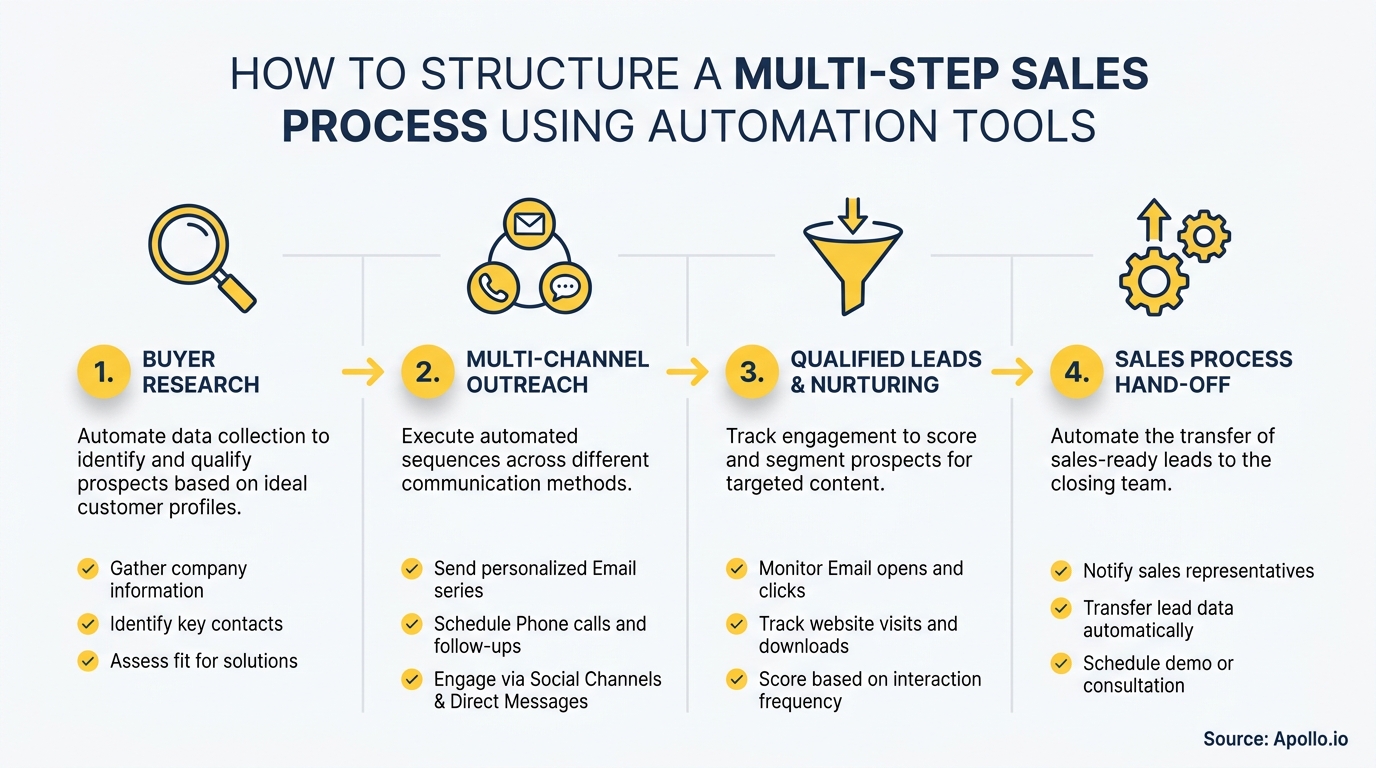
A multi-step sales process using automation tools is a structured sequence of buyer-facing stages where specific triggers activate automated actions, route signals to the right owner, and escalate to a human when deal complexity or buyer readiness warrants it. It replaces the rigid "Step 1 email, Step 2 call, Step 3 follow-up" cadence with a signal-based orchestration model.
According to Overton Collective, 76% of companies now use some form of sales automation in their go-to-market process. Yet most implementations stop at email sequences. A true multi-step system maps automation to every stage: anonymous awareness, intent capture, qualification, proposal, negotiation, and post-close expansion.
The key distinction: automation handles volume and consistency; humans handle judgment and trust. Understanding the types of sales automation helps you assign each tool to the right stage rather than automating everything indiscriminately.
How Do You Map Each Stage to an Automation Trigger and Human Checkpoint?
Each stage of the sales process should have four defined elements: an automation trigger, an automated action, a human checkpoint condition, and a stage KPI. The table below provides the full blueprint.
| Stage | Automation Trigger | Automated Action | Human Checkpoint | KPI |
|---|---|---|---|---|
| Awareness | ICP firmographic match or intent signal | Enrich record, add to audience segment | RevOps reviews ICP fit score weekly | Qualified account reach |
| Engagement | Email open, page visit, content download | Trigger personalized sequence, assign SDR task | SDR reviews reply sentiment before next touch | Reply rate, meeting booked rate |
| Qualification | Meeting booked or demo requested | Send pre-meeting research brief to AE | AE confirms BANT/MEDDIC fit on discovery call | SQL conversion rate |
| Proposal | Opportunity stage updated to "Proposal" | Generate draft proposal, notify champion | AE personalizes and sends with narrative | Proposal-to-close rate |
| Negotiation | Proposal opened multiple times or stalled 7+ days | Alert AE, surface competitive objection content | Sales leader reviews deal and coaches AE | Days in stage, discount rate |
| Close/Expand | Contract signed or renewal date approaching | Trigger onboarding sequence, CSM handoff task | AE introduces CSM on kickoff call | Time-to-value, NRR |
Struggling to find and enrich the accounts that feed the top of this process? Search Apollo's 230M+ contacts with 65+ filters to build stage-ready prospect lists.
How Do SDRs and AEs Implement Automation Without Losing the Human Touch?
SDRs and AEs implement automation effectively by reserving it for research, routing, and follow-up while keeping discovery, objection handling, and relationship-building fully human. The practical split: automate what is repeatable, personalize what is visible to the buyer.
For SDRs: Automate list building, data enrichment, sequence enrollment, and task creation. Use intent data to prioritize which accounts get human attention first. SDRs should only write or call when a signal justifies it, not on a fixed day-7 cadence.
For AEs: Automate pre-meeting research briefs, proposal notifications, and stall alerts. AEs invest their time in discovery, multi-threading stakeholders, and building consensus. AI sales tools that surface deal risk and next-best actions let AEs focus on the conversations that move revenue.
Research from B2B Rocket shows businesses using sales automation see an average productivity increase of 10-15%. That gain comes from eliminating low-value tasks, not from removing human judgment from high-stakes moments.

What Are the Rules for AI Governance in a Sales Automation Workflow?
AI governance in sales automation means defining who approves AI-generated outputs, which actions require human review before execution, and how to prevent automation from scaling errors or compliance risks. Without governance, AI amplifies bad data and poor messaging at scale.
Apply this "automate vs. human" rubric at each stage:
- Automate if: The action is repeatable, the data is verified, the output is low-risk, and volume justifies it.
- Human review if: The deal value is high, the buyer is a C-suite contact, the message is outbound cold, or the AI confidence score is below your threshold.
- Escalate immediately if: A buyer expresses negative sentiment, a legal or security question surfaces, or the opportunity exceeds your defined deal-size threshold.
RevOps leaders should audit automation outputs monthly: check for message drift, data decay, and sequence performance by stage. Connect your workflow automation platform to your CRM so every automated action is logged, attributable, and reversible.
Turn Funnel Gaps Into Pipeline Gold
Pipeline forecasting a guessing game? Apollo surfaces in-market buyers the moment they're ready, so your team stops chasing cold leads and starts closing real opportunities. Trusted by 600K+ companies building predictable revenue.
Start Free with Apollo →How Do You Measure a Multi-Step Automated Sales Process?
Measurement for an automated sales process requires stage-level KPIs, attribution logic tied to automation touchpoints, and a feedback loop that updates sequences based on performance data. Tracking only final revenue misses where the process breaks.
Build a four-layer measurement architecture:
- Activity layer: Emails sent, calls made, sequences enrolled, tasks completed per stage.
- Conversion layer: Stage-to-stage conversion rates (e.g., engaged to SQL, SQL to proposal).
- Revenue layer: Pipeline generated by automation source, average deal size, win rate by sequence type.
- Attribution layer: First-touch, last-touch, and multi-touch attribution mapped to automated assets (content, outreach, ads).
Review stage conversion weekly. If the engagement-to-meeting rate drops, audit your trigger logic and message relevance before adding more volume. Sales analytics that tie sequence performance to pipeline outcomes make this review fast and actionable.
Spending hours stitching together reports from disconnected tools? Apollo's AI sales automation platform keeps prospecting, engagement, and pipeline data in one workspace, so your measurement reflects the full journey.
What Tech Stack Does a Multi-Step Automated Sales Process Require?
A multi-step automated sales process requires five capability layers: data and enrichment, prospecting and segmentation, engagement and sequencing, pipeline and deal management, and analytics. The fewer platforms covering these layers, the less data fragmentation and integration failure you face.
According to Cirrus Insight, the global sales automation market more than doubled from $7.8 billion in 2019 to $16 billion in 2025, with projections to exceed $31 billion by 2035. That growth reflects real adoption, but many teams end up with overlapping tools that create data silos instead of a connected process.
Teams that consolidate see the clearest results. "Having everything in one system was a game changer" (Cyera). "We reduced the complexity of three tools into one" (Predictable Revenue). For a detailed breakdown of what each layer needs, see how to build a sales tech stack that scales revenue.

How Do You Build and Run This Process in 2026?
Building a multi-step automated sales process in 2026 starts with ICP clarity and clean data, then adds automation layer by layer, with governance checkpoints before each expansion. Skipping the foundation and going straight to AI agents scales a broken funnel, not a productive one.
Follow this implementation sequence:
- Define your ICP with firmographic and behavioral criteria. Enrich your existing contacts to close data gaps.
- Map your current buyer journey. Identify where buyers stall, self-serve, or disengage before rep contact.
- Build your stage table (trigger, action, asset, owner, KPI) using the blueprint above.
- Set your governance rules: approval thresholds, escalation paths, and output review cadence.
- Launch one automated stage at a time. Measure conversion before adding the next.
- Feed performance data back into messaging, targeting, and sequence design quarterly.
For step-by-step guidance on building the outreach layer, see how to build winning sequences that drive engagement and how to build an automated lead generation system.
A structured, automated sales process built on clean data and clear handoff rules is the competitive foundation for 2026 and beyond. Apollo brings prospecting, sequencing, AI automation, and pipeline management into a single platform, so your process runs without the integration debt. Start prospecting free with Apollo today.
Ramp Reps Faster, Prove ROI Sooner
ROI pressure killing your tool adoption? Apollo gets new reps producing pipeline from day one with scalable, repeatable workflows. 600K+ companies see measurable returns fast.
Start Free with Apollo →Don't miss these
Sales
Inbound vs Outbound Marketing: Which Strategy Wins?
Sales
What Is a Sales Funnel? The Non-Linear Revenue Framework for 2026
Sales
What Is a Go-to-Market Strategy? The 2026 GTM Playbook
See Apollo in action
We'd love to show how Apollo can help you sell better.
By submitting this form, you will receive information, tips, and promotions from Apollo. To learn more, see our Privacy Statement.
4.7/5 based on 9,690 reviews
