
How to Set Up Two-Way Data Sync Between Your Sales Platform and CRM in 2026
Most CRM sync projects fail not because of bad tooling, but because teams skip governance. According to a Bain & Company survey from April 2025, 70% of companies struggle to integrate their sales plays into CRM and other revenue technologies, with only about 20% realizing the full value from their sales and marketing activities. The fix is not a faster connector. It is a governed, selective bidirectional sync built on field ownership, conflict rules, and a pre-sync data audit. This guide covers exactly how to build that, step by step. For context on why CRM integration matters for your entire GTM motion, see how data sync improves B2B sales and marketing ROI.

Research Less, Pipeline More With Apollo
Tired of burning hours verifying contact info that goes nowhere? Apollo delivers 230M+ accurate business contacts so your reps spend time selling, not searching. Start building real pipeline today.
Start Free with Apollo →Key Takeaways
- Selective bidirectional sync, not blanket two-way sync, prevents data overwrites and protects CRM integrity.
- A pre-sync data audit with defined thresholds for duplicates, missing values, and expired records is a mandatory first step.
- A field ownership matrix (CRM-owned vs. shared vs. sales-platform-owned) is the single most important governance document you will create.
- RevOps leaders report that data inconsistencies are their top tech-stack frustration, making conflict resolution rules critical before go-live.
- Two-way sync is now an AI-readiness requirement: tech silos delay or limit AI initiatives for a majority of sales leaders integrating AI tools.
Why Is Two-Way Data Sync a Revenue Risk, Not Just an IT Task?
Two-way data sync between a sales platform and CRM is a revenue-risk issue because disconnected systems produce conflicting data that breaks forecasting, pipeline visibility, and AI-powered workflows. Research from RevOps Co-op's 2025 State of RevOps Survey found that 99% of RevOps professionals encounter technical data issues, and 71% acknowledge that poor data quality negatively impacts their go-to-market execution. When your sales engagement platform and CRM operate as separate silos, reps enter data twice, managers see stale pipeline, and AI agents make recommendations on incomplete records. Fixing sync is not an IT cleanup project. It is a GTM strategy decision.
According to Salesforce, 51% of sales leaders integrating AI report that technology silos delay or limit their AI initiatives. As AI-powered forecasting, lead scoring, and next-best-action tools become standard, the quality of your bidirectional sync directly determines whether those tools deliver value or compound your data problems.
One-Way vs. Selective Bidirectional Sync: Which Do You Need?
Selective bidirectional sync is the right choice for most B2B GTM teams, but one-way sync is safer for specific field categories. Use this decision framework before you configure anything.
| Sync Type | Best For | Risk Level | Example Fields |
|---|---|---|---|
| One-way (CRM → Sales Platform) | Account ownership, territory, deal stage | Low | Account Owner, Contract Value, Close Date |
| One-way (Sales Platform → CRM) | Engagement activity logging | Low | Email Opens, Call Outcomes, Sequence Status |
| Selective Bidirectional | Contact data that both teams update | Medium (requires conflict rules) | Job Title, Phone, Company Name |
| Blanket Two-Way (avoid) | No recommended use case | High (overwrites, duplicates) | All fields |
For RevOps leaders managing Apollo CRM integrations with Salesforce and HubSpot, the practical rule is: if two teams legitimately edit the same field, that field needs selective bidirectional sync with an explicit conflict rule. If only one team owns a field, use one-way sync and lock the other direction.
How Do You Run a Pre-Sync Data Audit?
A pre-sync data audit scores your CRM's current data quality across four dimensions before you enable any bidirectional flows. Enabling two-way sync on dirty data amplifies errors in both systems simultaneously.
Use this scorecard to assess readiness. Set a minimum threshold in each category before proceeding:
| Audit Dimension | What to Measure | Go-Live Threshold |
|---|---|---|
| Missing Data | % of contact records missing email, phone, or company | Under 15% missing |
| Duplicates | Duplicate contact and account records by email/domain | Under 5% duplicate rate |
| Expired Records | Contacts with no activity or update in 18+ months | Flag and exclude from sync scope |
| Field Inconsistency | Mismatched picklist values, formatting errors, free-text in structured fields | Standardize before sync-on |
Data enrichment and cleansing should run before you open bidirectional flows. Apollo's CRM enrichment tool lets you fill missing fields, standardize formats, and verify contact accuracy across 230M+ business records before sync goes live. Tired of dirty data propagating across both systems? Start free with Apollo's verified B2B contact data.

What Is a CRM Field Ownership Matrix and How Do You Build One?
A CRM field ownership matrix assigns every synced field to a system of record, preventing overwrites and defining which platform wins in a conflict. This is the single most important document in any two-way sync implementation.
Build your matrix with three ownership categories:
- CRM-Owned:CRM is the system of record. Sales platform can read but never write. Examples: Account Owner, Contract Value, Opportunity Stage, Close Date.
- Sales-Platform-Owned:Sales platform writes; CRM receives. Examples: Sequence Enrollment Status, Last Email Sent Date, Call Disposition, Meeting Booked Flag.
- Shared (Requires Conflict Rule):Both systems can update. Conflict rule determines winner. Examples: Job Title, Direct Phone URL, Email Address.
For shared fields, define a conflict rule for each one. The three standard options are:most-recently-updated wins, CRM always wins, or sales platform always wins. Document the rule per field, not per sync direction. RevOps leaders managing multiple integrations should treat this matrix as a living document, reviewed quarterly as field usage evolves.
Turn Funnel Guesswork Into Pipeline Clarity
Pipeline forecasting a guessing game because marketing leads never convert? Apollo surfaces high-intent prospects already moving toward a decision. Top revenue teams use Apollo to build pipeline that actually closes.
Schedule a Demo →How Do RevOps Teams Configure Field Mapping, Deduplication, and Conflict Resolution?
RevOps teams configure selective bidirectional sync by completing four sequential steps: field mapping, dedupe key setup, conflict rule assignment, and permissions testing. Skipping any step creates silent data corruption that is difficult to reverse.
Step 1: Field Mapping. Map only fields that appear in your ownership matrix. Do not enable sync for unmapped fields. Use exact API field names from both systems to avoid mismatch errors.
Step 2: Dedupe Matching Keys. Set a primary matching key (email address for contacts, domain for accounts) and a secondary fallback (phone number or company name).
Without matching keys, sync creates duplicate records instead of updating existing ones.
Step 3: Conflict Rule Assignment. Apply your field ownership matrix decisions inside your sync configuration.
Most iPaaS and native connectors support field-level conflict rules. If your connector only supports object-level rules, restructure your field ownership matrix to reduce shared fields.
Step 4: Eligibility and Permissions Testing. Before enabling live sync, run a sandbox test on 50-100 records. Verify that: (a) CRM-owned fields do not get overwritten, (b) dedupe keys match correctly, (c) conflict rules resolve as documented, and (d) OAuth token permissions are scoped to only the fields and objects required. Learn more about connecting Apollo with HubSpot and Salesforce for a practical example of this setup in action.
How Does Two-Way Sync Help SDRs and AEs Spend More Time Selling?
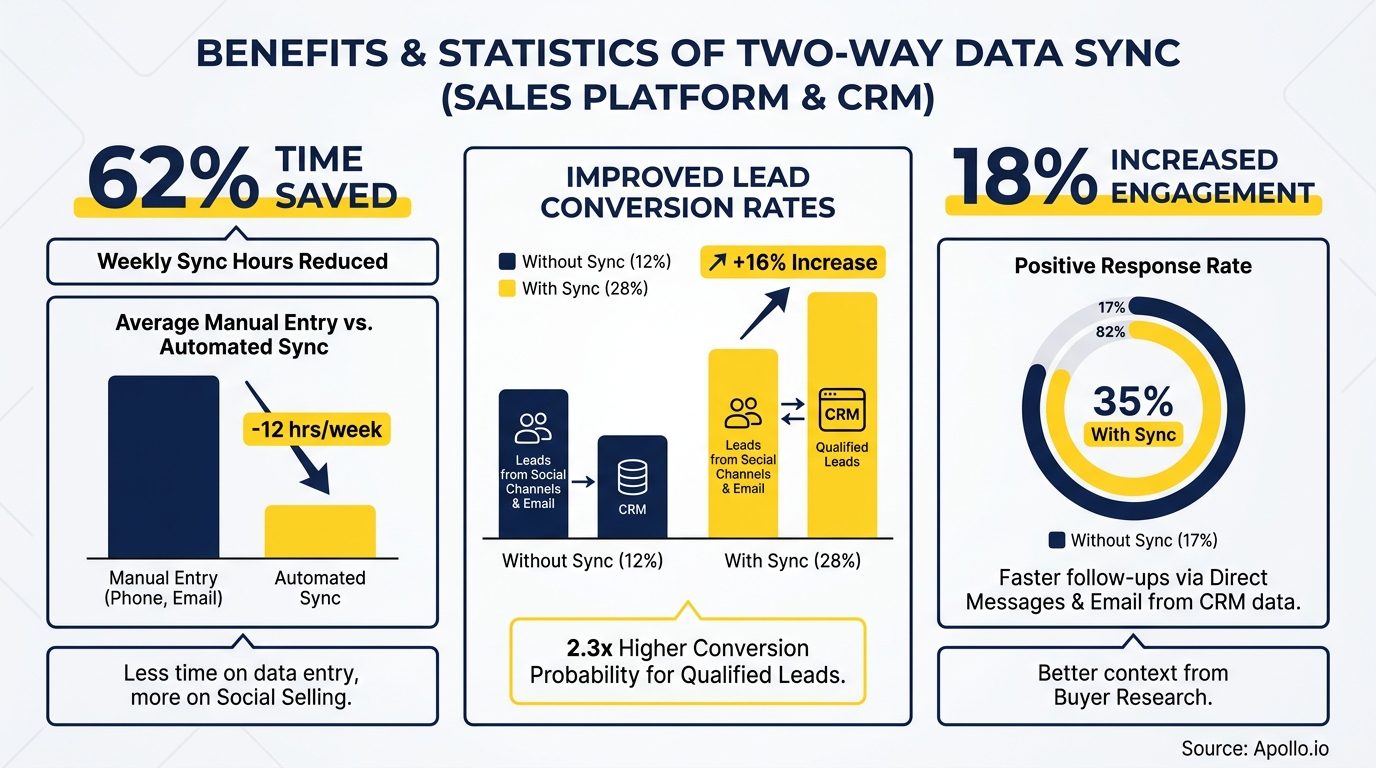
SDRs and AEs benefit directly from two-way sync because it eliminates manual CRM updates, giving them accurate context in whichever tool they work in. When sequence activity flows automatically from the sales platform into CRM, and when CRM account data flows back into the sales platform, reps stop switching tabs to reconcile records manually.
For SDRs, this means sequence status, call outcomes, and reply data appear in CRM without any manual logging. For Account Executives managing active deals, CRM stage changes and close-date updates flow back into the sales platform, keeping outreach sequences in sync with deal progression. Reliable sales automation depends on this bidirectional data foundation. When the data layer is clean and governed, AI-powered features like scoring and next-best-action recommendations actually work as intended, rather than surfacing stale or conflicting signals.
How Do You Maintain and Monitor a Live Two-Way Sync?
Maintaining a live bidirectional sync requires ongoing monitoring, not just a one-time setup. Sync errors compound quickly: one bad conflict resolution rule can corrupt hundreds of records before anyone notices.
Build these monitoring practices into your RevOps workflow:
- Sync error logs: Review daily for the first 30 days post-launch, then weekly.
- Duplicate rate tracking: Run a monthly dedupe report against your go-live threshold.
- Field drift audit: Quarterly review of your ownership matrix to catch fields that changed usage patterns.
- Token and permission audit: Review OAuth scopes and connected-app permissions quarterly to minimize security exposure.
- Sync volume anomaly alerts: Set alerts for unexpected spikes in sync volume, which often signal a loop or runaway trigger.
For teams using Apollo as their sales platform, Apollo's native CRM integration includes built-in sync controls that reduce the need for third-party middleware, consolidating your tech stack and reducing fragile point-to-point connections. As Cyera noted after consolidating their tools, "Having everything in one system was a game changer."

Start Syncing Smarter in 2026
Two-way data sync is no longer just a connector project. It is a governance decision that determines whether your AI tools, forecasting models, and GTM plays operate on trustworthy data. The teams winning in 2026 are those who audit first, assign field ownership explicitly, and apply conflict rules before enabling bidirectional flows, not after. For a deeper look at building a sustainable data foundation, explore how to build a data enrichment strategy that keeps your CRM accurate over time.
Apollo brings prospecting, engagement, enrichment, and CRM sync into one unified workspace, so your data stays clean without stitching together multiple tools. Start a free trial and see how Apollo's CRM integration reduces the complexity your RevOps team manages every day.
Ramp Reps Faster, Prove ROI Sooner
Struggling to justify your sales stack when ramp takes forever and pipeline impact is impossible to measure? Apollo gives new reps a running start with 230M+ verified contacts and built-in workflows. Leadium 3x'd revenue — see your ROI fast.
Start Free with Apollo →Don't miss these
Sales
Inbound vs Outbound Marketing: Which Strategy Wins?
Sales
What Is a Sales Funnel? The Non-Linear Revenue Framework for 2026
Sales
What Is a Go-to-Market Strategy? The 2026 GTM Playbook
See Apollo in action
We'd love to show how Apollo can help you sell better.
By submitting this form, you will receive information, tips, and promotions from Apollo. To learn more, see our Privacy Statement.
4.7/5 based on 9,690 reviews
