
How to Scale Prospecting for a Growing Sales Team in 2026
Most growing sales teams hit a prospecting ceiling not because they lack leads, but because their reps run out of time. According to MindTickle, sales representatives spend only 28-34% of their week actively selling, with administrative tasks consuming the rest. Scaling headcount alone won't fix that. You need a system. This guide breaks down how to build one, from capacity planning and signal-based sequencing to AI governance and tool consolidation. For a broader view, start with this playbook for building a sales tech stack that scales revenue.

Let Apollo Find Your Next Buyer
Tired of burning hours on manual research just to hit dead ends? Apollo surfaces verified contacts instantly so your reps spend time selling, not searching. Join 600K+ companies building pipeline faster.
Start Free with Apollo →Key Takeaways
- Prospecting scale is a time problem, not a lead volume problem. Automate research and admin before hiring more reps.
- Signal-based outreach (intent, hiring, tech changes) converts better than static lists because timing drives conversion.
- SDRs using AI tools are significantly more likely to hit quota than those who don't.
- Tool consolidation reduces complexity and cost. Teams that unify prospecting, engagement, and data on one platform move faster.
- Buyers increasingly self-educate. Your outreach must validate and facilitate, not just introduce.
Why Is Prospecting Hard to Scale?
Prospecting is hard to scale because rep time, not lead supply, is the binding constraint. Research from Orum's 2024 State of Sales Development found that 67% of SDRs spend at least 11 hours weekly on research and follow-up alone. That leaves little time for actual outreach. Add in CRM updates, internal meetings, and sequence management, and you have a team perpetually behind on pipeline.
The structural problem is that most teams try to solve this by hiring. But new reps take time to ramp, and they inherit the same broken workflows.
Scaling prospecting requires fixing the system first, then growing headcount into it.
How Do You Build a Capacity Model for SDR Prospecting?
A capacity model for SDR prospecting translates available selling time into pipeline output and tells you exactly when to hire versus when to automate. Use this framework:
| Input | Manual Workflow | AI-Assisted Workflow |
|---|---|---|
| Hours/week on research | 11+ hours | Reduced with automation |
| % of week actively selling | 28-34% | Meaningfully higher |
| Touches to book a meeting | 7-15 (2023 baseline) | 3-9 with better targeting |
| Ramp time for new SDR | 60-90 days typical | Shorter with playbook tools |
The practical rule: before adding a headcount, calculate how much capacity you can reclaim through automation. Data from Insight Market Research shows AI tools can save sales reps 11 to 12 hours per week by automating repetitive tasks. That's nearly a full additional selling day per rep per week.
SDRs and RevOps leaders should model this before the next headcount request. Define your touches-to-meeting ratio, your average meetings-to-opportunity rate, and your required pipeline coverage multiple.
Then work backwards to rep capacity needs.
What Is Signal-Based Prospecting and Why Does It Replace Static Lists?
Signal-based prospecting uses real-time triggers, such as hiring activity, funding rounds, technology changes, and buying intent data, to identify accounts most likely to convert right now. Static lists decay quickly and ignore timing.
Signals solve both problems.
Key signals to prioritize by tier:
- Tier 1 (highest intent): Active buying intent, open job postings for roles your product supports, recent funding announcements
- Tier 2 (moderate intent): Leadership changes, technology stack changes, company expansion signals
- Tier 3 (awareness): Industry news mentions, conference attendance, content engagement
Pair signal capture with sequencing rules: when a Tier 1 signal fires, trigger an immediate personalized outreach sequence. When Tier 2 fires, add to a nurture cadence. This is the foundation of intent-data-driven sales. For building the list infrastructure underneath this, see how to build a sales prospecting list that converts.
Struggling to find the right accounts at the right moment? Search Apollo's 230M+ contacts with 65+ filters and built-in intent signals.

How Do SDRs Use AI to Prospect at Scale in 2026?
SDRs use AI most effectively for three high-frequency tasks: email personalization, account research, and sequence optimization. According to Everstage, sellers who effectively partner with AI tools are 3.7 times more likely to meet their quota than those who do not. That's not a marginal gain.
The practical AI governance framework for SDR teams:
- Segment before you automate. Define ICP tiers and assign different messaging templates, sequences, and send limits per tier.
- Set quality gates. AI-drafted emails should pass a human review checkpoint for top-tier accounts. Mid-tier can send with light editing. Low-tier can send with template QA only.
- Measure per-sequence, not per-rep. Track reply rates, meeting rates, and opt-out rates by sequence and persona. Kill underperformers fast.
- Protect deliverability. In 2026, inbox authentication (SPF, DKIM, DMARC) and sender reputation management are non-negotiable at any outbound volume. Domain strategy is now an SDR ops concern.
Agentic AI is the next frontier: tools that autonomously research accounts, identify stakeholders, draft sequences, and trigger follow-ups based on engagement signals, not just calendar intervals. Teams operationalizing this now gain a meaningful timing advantage. Explore how sales automation done right accelerates pipeline without sacrificing quality.
Turn Funnel Gaps Into Closed Revenue
Pipeline forecasting a guessing game? Apollo surfaces verified, in-market prospects so your funnel fills with leads that actually convert. Nearly 100K paying customers stopped guessing and started closing.
Start Free with Apollo →How Can Revenue Leaders Consolidate Their Prospecting Tech Stack?
Revenue leaders can consolidate their prospecting tech stack by replacing separate tools for data, sequencing, dialing, and analytics with a unified GTM platform. Tool sprawl is the hidden tax on prospecting scale: each integration is a potential data sync failure, a training burden, and an added line item under scrutiny.
The consolidation case is clear from teams that have done it:
- "We reduced the complexity of three tools into one." — Collin Stewart, Predictable Revenue
- "We cut our costs in half." — Census
- "Having everything in one system was a game changer." — Cyera
When evaluating platforms, map every tool your team currently uses for prospecting: contact data, email sequences, dialers, CRM sync, intent signals, and analytics. Then identify which of those a single platform covers. The fewer handoffs between systems, the faster your reps move and the cleaner your pipeline data stays. For a structured evaluation, review this comparison of top sales engagement platforms.
Spending too much managing disconnected tools? Run your entire outbound motion from Apollo's unified sales engagement platform.
What Does a Scalable Prospecting Playbook Look Like?
A scalable prospecting playbook defines repeatable rules for targeting, sequencing, channel mix, and handoffs so that adding reps multiplies output without multiplying chaos. It answers: who do we contact, when, how, and what happens next.
Core playbook components:
| Component | What to Define |
|---|---|
| ICP scoring criteria | Firmographic filters, tech stack, signal triggers, exclusion rules |
| Sequence structure | Touch count, channel order (email, phone, social), timing intervals |
| Personalization rules | What gets customized per tier (subject line, opener, CTA) |
| Handoff criteria | When an SDR passes to AE, what data must be logged |
| Performance benchmarks | Reply rate, meeting rate, pipeline per rep by segment |
Account Executives benefit directly from this structure. When SDRs follow a documented playbook, AEs receive cleaner handoffs with full context, which shortens discovery and compresses sales cycles. For the analytics layer that keeps the playbook honest, see how sales analytics drives revenue growth. For performance management at the team level, explore sales performance management strategy.

Scale Prospecting as a System, Not a Headcount Problem
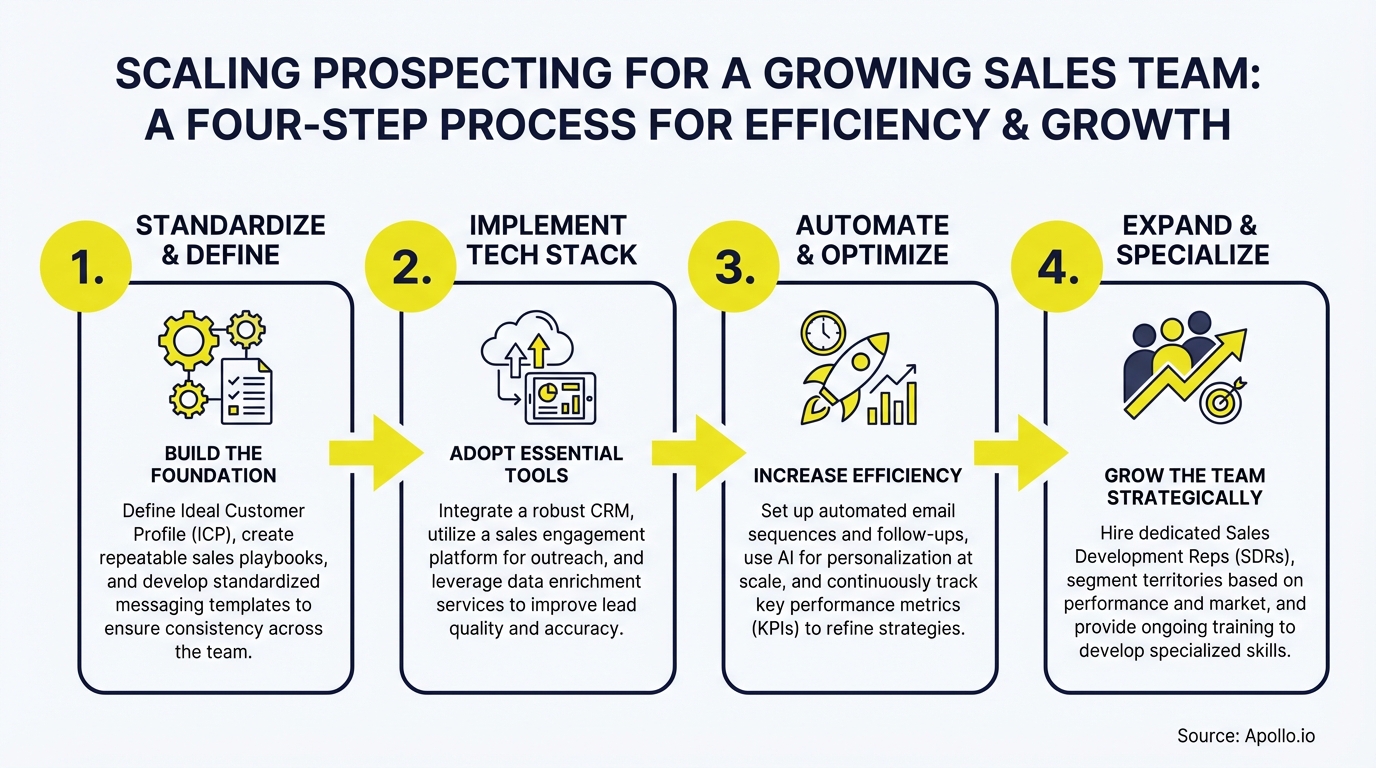
Scaling prospecting for a growing sales team means building a repeatable operating system: capacity planning grounded in real time data, signal-based targeting that replaces static lists, AI governance that protects quality at volume, and a consolidated tech stack that lets reps focus on selling instead of switching tabs.
Teams that get this right don't just book more meetings. They build a compounding pipeline engine where every new rep hits productivity faster and every process improvement benefits the whole team.
The playbook exists. The tools exist.
The advantage goes to teams that operationalize first.
Ready to build a prospecting system that scales? Start a free trial with Apollo and run your entire prospecting motion from one unified platform.
Prove Pipeline ROI With Apollo
Budget approval stuck on unclear metrics? Apollo delivers measurable pipeline impact from day one — no guesswork, no waiting. Leadium 3x'd annual revenue after switching. Start your free trial today.
Start Free with Apollo →Don't miss these
Sales
Inbound vs Outbound Marketing: Which Strategy Wins?
Sales
What Is a Sales Funnel? The Non-Linear Revenue Framework for 2026
Sales
What Is a Go-to-Market Strategy? The 2026 GTM Playbook
See Apollo in action
We'd love to show how Apollo can help you sell better.
By submitting this form, you will receive information, tips, and promotions from Apollo. To learn more, see our Privacy Statement.
4.7/5 based on 9,690 reviews
