
How to Scale Automation Rules as Your Sales Team Grows
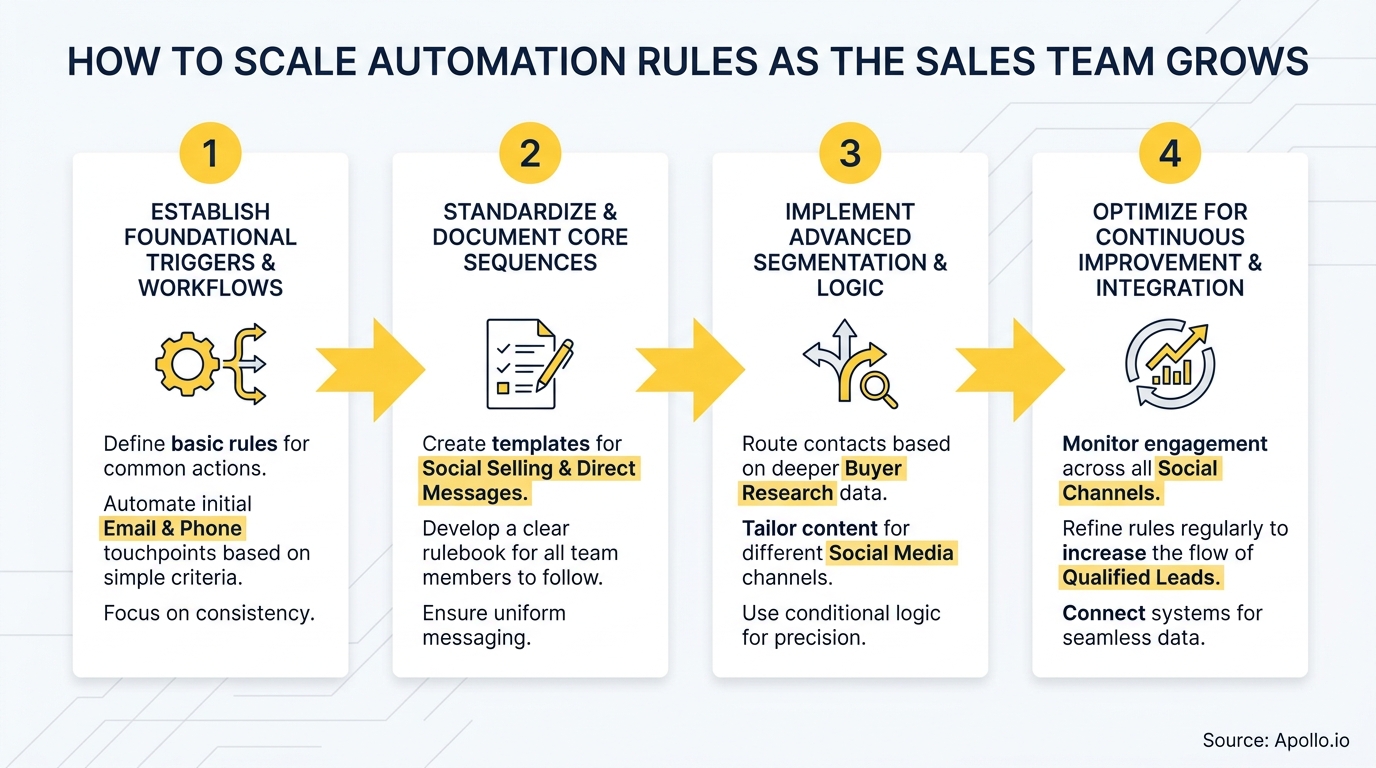
Your sales team doubled last quarter. Your automation rules didn't. Now leads are routing to the wrong reps, duplicate records are piling up, and RevOps is spending more time firefighting than building. Sales automation only compounds your results when it scales with your team structure — not against it.
According to Overton Collective, 76% of companies now use some form of sales automation in their go-to-market process. The problem isn't adoption — it's governance. Automation rules built for 10 reps break at 50. Here's how to scale them systematically.

Research Smarter, Not Harder With Apollo
Tired of your reps burning hours verifying contact info instead of selling? Apollo delivers 230M+ business contacts with 97% email accuracy so your team hits pipeline goals faster. Start prospecting in minutes.
Start Free with Apollo →Key Takeaways
- Rule sprawl is a governance problem, not a tooling problem — teams need ownership, audits, and change control, not more workflows.
- Data quality is the prerequisite for scaling automation: dirty CRM data amplifies routing errors and forecasting drift.
- A rule lifecycle (create, test, merge, retire, audit) prevents conflict between competing automations as headcount grows.
- Automation readiness gates — deduplication, required fields, exception queues — must be in place before expanding rules.
- Scaling by maturity stage (startup, growth, enterprise) keeps automation architecture matched to actual team complexity.
Why Does Rule Sprawl Happen as Teams Grow?
Rule sprawl happens when automation rules are created reactively — one per problem, one per new rep — without a shared ownership model or documentation standard. Each rule added in isolation increases the risk of conflicts, duplicate triggers, and silent failures that no one catches until a deal falls through.
Common symptoms include:
- Routing errors: Leads assigned to reps who left, or to the wrong territory after a reorg
- Duplicate records: Multiple rules creating contacts from the same source with different field mappings
- Manual overrides: Reps bypassing automation because it fires incorrectly, breaking reporting
- Forecasting drift: Stage-change rules firing late or out of sequence, corrupting pipeline data
A sales professional wrote on Reddit that the most effective approach is to rank every activity by time spent and estimated impact, then stop or automate only the high-time, low-impact ones — with the caveat that "automating involves set up, QA etc - like launching a product, so impact won't be felt right away." That discipline is exactly what prevents sprawl.
How Do You Build a Rule Lifecycle Governance Model?
A rule lifecycle model treats every automation like a product: it gets created, tested, documented, reviewed, merged or retired, and audited on a schedule. Without this, rules accumulate indefinitely.
| Stage | What Happens | Owner |
|---|---|---|
| Create | Define trigger, action, scope, and expected outcome | RevOps |
| Test | Run in sandbox with real record types before deploying | RevOps + Sales Ops |
| Document | Log rule name, purpose, trigger conditions, last-modified date | RevOps |
| Merge | Combine overlapping rules that fire on the same trigger | RevOps |
| Retire | Deactivate rules tied to defunct segments, reps, or campaigns | RevOps + Sales Leader |
| Audit | Quarterly review of rule performance, error logs, and coverage gaps | RevOps |
Pair this lifecycle with a simple RACI: RevOps owns rule architecture, Sales Leaders approve changes that affect routing or SLAs, and individual reps are informed of changes affecting their queue. Change control doesn't have to be bureaucratic — a shared doc or ticket system is enough at most team sizes.
Struggling to manage outreach automation at scale? Apollo's AI sales automation platform gives RevOps a unified workspace to build, monitor, and adjust workflows without juggling multiple disconnected tools.
What Are Automation Readiness Gates for CRM Data Quality?
Automation readiness gates are data quality thresholds that records must pass before automation rules act on them. Skipping these gates is where most scaling failures originate.
Salesforce's 2026 State of Sales report found that 46% of sales professionals using AI agents say data-quality issues hurt sales. Automation amplifies whatever data state it finds — clean data produces clean outcomes; dirty data produces bad routing, missed follow-ups, and corrupted forecasts at scale.
Build these gates before expanding rules:
- Deduplication threshold: Block automation from firing on records with a duplicate score above your defined limit
- Required fields check: Rules should not trigger unless company name, lifecycle stage, and owner are populated
- Quarantine queue: Records that fail the gate go into a review queue for manual triage, not into the main routing flow
- Enrichment gate: For high-value leads, require a minimum number of verified data points before routing to an AE
- Lifecycle stage validation: Confirm a record's stage is accurate before triggering stage-based nurture or scoring rules
Concerned about contact data accuracy feeding your automation rules? Apollo's data enrichment continuously verifies and fills gaps in your contact records so rules fire on accurate information, not stale fields.

How Should RevOps Leaders Scale Rules by Team Maturity Stage?
RevOps leaders should match automation complexity to team size and process maturity — not to what's technically possible. Overbuilding rules for a 15-person team creates the same sprawl risk as underbuilding for a 150-person team.
Data from JohnnyGrow shows RevOps adoption is at 84% among enterprise companies and 52% among midmarket companies, confirming that governance expectations vary sharply by stage. Here's a practical maturity model:
| Stage | Team Size | Priority Automations | Governance Minimum |
|---|---|---|---|
| Standardize | 1–15 reps | Lead assignment, follow-up reminders, CRM field updates | Rule log in a shared doc; one owner per rule |
| Systematize | 15–50 reps | Lead scoring, territory routing, SLA alerts, stage-change triggers | Quarterly audit; sandbox testing before deploy |
| Orchestrate | 50+ reps | Multi-signal routing, forecasting automation, exception queues, observability dashboards | RACI, change control tickets, rollback procedures |
For teams in the Orchestrate stage, sales analytics become critical — you need visibility into which rules fired, which produced pipeline, and which created noise. The Apollo Workflows engine is built for this stage, consolidating prospecting, sequencing, and routing into one governed workspace rather than spreading logic across multiple disconnected tools.
Turn Funnel Guesswork Into Pipeline Clarity
Tired of watching marketing leads stall before they ever reach your pipeline? Apollo surfaces high-intent prospects and arms your team with the signals to act fast. Nearly 100K paying customers stopped guessing and started closing.
Schedule a Demo →How Do SDRs and AEs Stay Productive When Automation Rules Change?
SDRs and AEs stay productive during rule changes when they are informed in advance, given a clear reason for the change, and shielded from mid-sequence disruptions. The biggest rep-side complaint about automation governance is surprises — a sequence that stops mid-flight or a lead that disappears from the queue without explanation.
A Reddit commenter added in a Reddit discussion that "automation works best for speed and consistency on the first touch and the follow-up cadence. The actual selling still needs a human once the lead is warm." This is the line RevOps should enforce in rule design: automate the logistics, not the conversation.
Practical steps for rep-side continuity:
- Notify reps of rule changes 48 hours before deployment, with a plain-language summary of what changes
- Never retire an active sequence rule mid-run — schedule retirements at the end of the current cycle
- Build exception notifications so reps see when a lead was quarantined rather than silently removed
- For AEs: keep deal-stage automation separate from prospecting automation so pipeline rules don't conflict with top-of-funnel triggers
Teams that get this right report the benefit sales productivity gains compound over time. As the sales tech stack consolidates around fewer, better-governed tools, reps spend more time selling and less time working around broken workflows. As Cyera noted after consolidating their stack, "Having everything in one system was a game changer."
Research from Utmost Agency shows sales teams using automation report 27% higher close rates and up to 20% increases in pipeline conversion — but those gains depend on rules that are clean, current, and conflict-free.
What KPIs Should You Track to Know If Automation Rules Are Scaling Well?
The right KPIs for automation governance measure rule health, not just pipeline output. Output metrics tell you what happened; governance metrics tell you why and whether the system is sustainable.
- Rule error rate: Percentage of automation triggers that result in an error or exception per week
- Routing accuracy: Percentage of leads assigned to the correct rep/territory without manual override
- Queue quarantine rate: Percentage of records held in exception queues — rising rates signal data quality degradation
- Manual override rate: High override rates indicate rules are misfiring or out of date
- Rule retirement cadence: Number of inactive rules retired per quarter — a healthy system retires as it creates
- SLA compliance rate: Percentage of leads touched within defined SLA windows, as governed by automation
Review these metrics in your quarterly audit alongside CRM workflow automation logs. A scorecard reviewed by RevOps and Sales Leadership every 90 days keeps automation architecture aligned with team structure as headcount and territory models evolve.

Scale Automation Rules That Grow With Your Team
Scaling automation rules is an operational discipline, not a one-time configuration project. The teams that get it right treat rules like code: versioned, tested, documented, and retired when obsolete.
They gate on data quality before expanding coverage. They match rule complexity to team maturity.
And they give SDRs, AEs, and RevOps leaders clear visibility into what's running and why.
Apollo brings prospecting, sequencing, enrichment, and workflow automation into a single governed platform — so your automation rules live where your reps work, not across eight disconnected tools. Teams like Predictable Revenue found that "we reduced the complexity of three tools into one," and Census reported they "cut our costs in half" after consolidating their stack.
Ready to build automation rules that scale with your team? Request a demo of Apollo and see how the unified workflow engine keeps your GTM motion governed, clean, and fast — from your first 10 reps to your first 500.
Prove Pipeline ROI With Apollo
ROI pressure making budget approvals feel impossible? Apollo delivers measurable pipeline impact your leadership can't ignore. Leadium 3x'd their annual revenue — see your ROI from day one.
Start Free with Apollo →Don't miss these
Sales
Inbound vs Outbound Marketing: Which Strategy Wins?
Sales
What Is a Sales Funnel? The Non-Linear Revenue Framework for 2026
Sales
What Is a Go-to-Market Strategy? The 2026 GTM Playbook
See Apollo in action
We'd love to show how Apollo can help you sell better.
By submitting this form, you will receive information, tips, and promotions from Apollo. To learn more, see our Privacy Statement.
4.7/5 based on 9,690 reviews
