
How to Provide Personalized CTAs Based on Customer Segments in 2026
Generic "Book a Demo" CTAs are losing effectiveness fast. Defining your ideal customer profile is the foundation, but the real pipeline lever is matching your CTA to where each segment sits in the buying journey. According to Sixth City Marketing, personalized CTAs convert 42% more visitors into leads than untargeted ones. The gap between teams that personalize and those that don't is now measurable in pipeline.

Build Pipeline Without the Manual Grind
Tired of your reps burning hours on research instead of selling? Apollo delivers verified contacts and AI-powered prospecting so your team scales outreach without scaling headcount. Join 600K+ companies building predictable pipeline.
Start Free with Apollo →Key Takeaways
- Segment CTAs by intent stage and buying task, not just job title. Role-only personalization can reduce purchase completion quality.
- Buying groups now include many stakeholders. Different roles need different next steps, from "Try a sandbox" to "Build a business case."
- Personalization can backfire. Gartner found it can make buyers feel overwhelmed. The goal is confidence-building, not pressure.
- Content format signals intent. Playbooks and guides indicate near-term buying decisions more reliably than eBooks.
- First-party engagement data (webinar attendance, page depth, email clicks) is the most reliable signal for CTA selection.
What Does Segment-Based CTA Personalization Actually Mean?
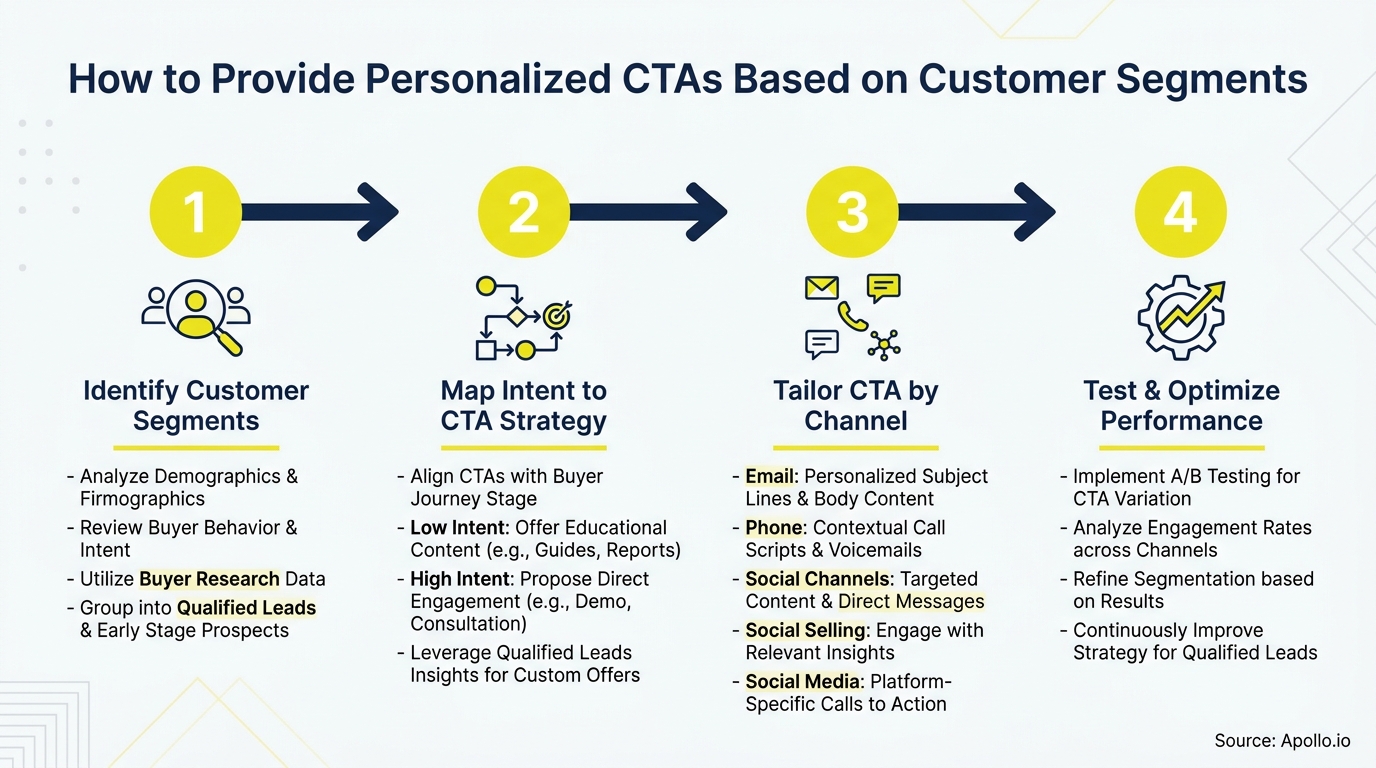
Segment-based CTA personalization means serving different calls to action to different visitor or prospect groups based on their account context, intent stage, and buying task, not just their demographic profile. A CTA is not just button copy.
It includes the offer, the destination, the asset format, and the timing.
Research from ON24 found that personalization in B2B businesses resulted in doubled conversion rates for meetings booked and a 68% increase in engagement with calls-to-action, compared to 8% across webinars as a whole. The performance gap is not marginal.
Most teams stop at persona-level personalization (e.g., "for marketing leaders" vs. "for IT"). The next level is intent-stage personalization: serving a confidence-building CTA to an early researcher and a friction-reducing CTA to a late-stage evaluator.
What Are the Core Customer Segments for CTA Mapping?
B2B CTA segments should map to four dimensions: firmographic fit, intent stage, buying-group role, and engagement behavior. Using intent data to layer these signals turns static segments into dynamic ones.
| Segment Type | Signal | CTA Direction |
|---|---|---|
| Anonymous / early awareness | First page visit, no form fill | Educational asset (guide, benchmark report) |
| Active researcher | Multiple page visits, content downloads | ROI calculator, comparison tool, peer case study |
| In-market evaluator | Pricing page visit, webinar attendance, high intent score | Free trial, sandbox access, technical deep dive |
| Late-stage buying group | Multiple stakeholders engaging, security/legal page visits | Security review doc, business case template, implementation guide |
| Existing customer | CRM stage, product usage data | Upsell feature demo, success story from similar account |
Strong customer data enrichment is what makes this mapping executable. Without accurate firmographic and behavioral data, segments collapse into guesswork.
How Does the CTA Decision Matrix Work by Intent Stage?
The CTA decision matrix maps segment signals to a specific next-best action, asset format, and landing destination. Intent stage is the primary axis; buying-group role is the secondary axis.
Forrester's 2026 research found that a typical B2B purchase now involves 13 internal stakeholders and nine external influencers, and more than 60% of buyers use trials to evaluate solutions. A single "Book a Demo" CTA cannot serve a CFO validating ROI, a security lead reviewing compliance, and a champion building an internal business case simultaneously.
- Early stage: Offer guides or benchmark reports. NetLine's 2025 data found guides were 46% more likely to drive 0-3 month buying decisions.
- Mid-stage evaluation: Offer on-demand webinars or interactive tools. On-demand webinars were 97% more likely to signal 3-6 month intent in the same NetLine study.
- Late-stage: Offer playbooks or implementation templates. Playbook registrations were 115% more likely to be associated with a buying decision within 12 months.
- Champion/economic buyer split: Serve the champion a sandbox CTA; serve the economic buyer an ROI model or executive brief.
Struggling to identify which accounts are in-market right now? Search Apollo's 230M+ contacts with 65+ filters to find and segment in-market buyers.

How Should SDRs and Marketing Teams Implement Segment-Based CTAs?
SDRs and marketing teams implement segment-based CTAs by connecting their ICP definition to behavioral triggers in their CRM and marketing automation platform. The execution stack matters less than the signal logic behind it.
Practical implementation steps:
- Define segment rules. Document exactly which data points qualify a contact for each segment (e.g., "pricing page visit + 3+ content downloads = in-market evaluator").
- Map CTAs to segments. Use the decision matrix above. Assign one primary CTA and one fallback CTA per segment.
- Enrich contact and account records. CTA personalization requires accurate job title, seniority, company size, and engagement history. Stale data produces mismatched offers.
- Build variant landing pages. Each CTA should land on a page that matches the segment's context, not a generic homepage or product page.
- Set fallback rules. If segment data is incomplete, default to the next-safest CTA (typically an educational asset rather than a demo request).
For RevOps leaders, the governance layer is critical. Validate segment definitions quarterly. A/B test CTA variants within each segment, not across segments, to generate clean signal. Track conversion rate, downstream pipeline, and time-to-opportunity by segment, not just aggregate click-through rate. Connect your customer engagement metrics to pipeline attribution so you know which CTA variants are actually generating revenue.
Sending personalized outreach sequences at scale? Automate segment-specific sequences with Apollo's multi-channel sales engagement platform.
Turn Funnel Gaps Into Closed Deals
Tired of watching quality leads stall before they ever reach sales? Apollo surfaces in-market buyers the moment they're ready, so your pipeline reflects reality — not guesswork. Nearly 100K paying customers trust Apollo to forecast with confidence.
Schedule a Demo →When Should You Not Personalize a CTA?
Avoid personalizing a CTA when your segment data is insufficient, when the personalization would feel intrusive, or when the offer mismatches the buyer's current confidence level. Gartner's 2025 research found that poorly designed personalization made customers 2x more likely to feel overwhelmed and 2.8x more likely to feel time pressure.
Those buyers were also significantly less likely to repurchase.
Risk guardrails to follow:
- Don't over-index on recency. A single pricing page visit is weak signal. Require two or more corroborating signals before escalating to a high-commitment CTA.
- Avoid role-only personalization. Gartner found buying groups are 40% less likely to complete a high-quality purchase when communication is tailored only to the buyer's role. Layer in buying task and account context.
- Respect sensitivity signals. If a contact visited your security or legal pages, serve a compliance resource, not a pushy demo request.
- Use "active" personalization. Gartner's recommended approach shifts from passive "next best action" nudges to CTAs that actively help buyers make confident decisions. "See how teams like yours implemented this" outperforms "Book now."
What Are Worked Examples of Personalized CTAs by Segment?
Here are four practical scenarios showing how segment signals translate to specific CTA choices.
| Scenario | Segment Signals | CTA Offer | Asset Format |
|---|---|---|---|
| Anonymous SaaS visitor | First visit, blog page, no CRM match | "See how [industry] teams solve [problem]" | Industry benchmark guide |
| Known SDR at 200-person company | 2 email opens, pricing page visit | "Start a free trial — no call required" | Self-serve trial landing page |
| CFO at in-market account | ROI/pricing page visits, low engagement score | "Build your business case in 10 minutes" | Interactive ROI calculator |
| Security lead at late-stage account | Security/compliance page visits, legal doc download | "Review our security documentation" | Security overview + trust center link |
Notice that none of these scenarios default to "Book a Demo." Each CTA matches the buyer's task and confidence level. For building a B2B marketing funnel that converts, this task-matched approach is what separates high-performing GTM teams from the rest in 2026.
How Do You Measure CTA Personalization Performance?
Measure CTA personalization performance at the segment level, not the campaign level. Aggregate click-through rates hide segment-specific failures. Track these metrics per segment:
- CTA conversion rate by segment: What percentage of that segment clicked and completed the desired action?
- Downstream pipeline contribution: Did this segment's CTA conversions generate qualified pipeline within 30/60/90 days?
- Time-to-opportunity: Did personalized CTAs accelerate deal velocity compared to generic ones?
- Segment validation rate: Are contacts entering the right segments, or is your signal logic creating false positives?
Run A/B tests within a single segment, not across segments. Testing a "Try Free" CTA against a "Book Demo" CTA across your entire audience conflates segment behavior and produces misleading results.
Test variant copy and offers within the in-market evaluator segment, then apply learnings to adjacent segments.

Start Personalizing CTAs with Better Segment Data
Personalized CTAs built on accurate segment data are one of the most direct levers for B2B pipeline growth in 2026. The mechanics are straightforward: define your segments with intent stage and buying-group role, map each to a confidence-building CTA, enrich your contact data to keep segments accurate, and govern with quarterly validation and within-segment A/B testing.
The teams that execute this well share a common foundation: clean, enriched account and contact data that feeds segment logic in real time. Apollo gives GTM teams the data enrichment, sales intelligence, and engagement automation to run segment-based CTA strategies from a single platform, without stitching together multiple tools.
As Predictable Revenue put it: "We reduced the complexity of three tools into one."
Start a free trial with Apollo and build the segment foundation your personalized CTA strategy requires.
Prove Pipeline ROI Before Next Quarter
ROI pressure killing your tool adoption? Apollo delivers measurable pipeline impact fast — 46% more meetings with AI, +10% win rates, +50% YoY growth. See results your CFO can't argue with.
Schedule a Demo →Don't miss these
Sales
Inbound vs Outbound Marketing: Which Strategy Wins?
Sales
What Is a Sales Funnel? The Non-Linear Revenue Framework for 2026
Sales
What Is a Go-to-Market Strategy? The 2026 GTM Playbook
See Apollo in action
We'd love to show how Apollo can help you sell better.
By submitting this form, you will receive information, tips, and promotions from Apollo. To learn more, see our Privacy Statement.
4.7/5 based on 9,690 reviews
