
How to Personalize Sender Details to Increase Open Rates in 2026
Most B2B teams obsess over subject lines while ignoring the field that recipients check first: who sent it. According to SalesOso, 42% of individuals prioritize the sender's name when deciding whether to open an email. That makes your From name, From address, and Reply-To a first-order open-rate lever, not an afterthought. If you want to improve results beyond subject line tweaks, learning what makes cold email subject lines work is valuable, but sender identity is where the open decision often starts.

Apollo Turns Hours of Research Into Minutes
Tired of burning your best selling hours on manual lead research and dead-end contact data? Apollo delivers verified emails and phone numbers instantly. Join 600K+ companies building pipeline faster.
Start Free with Apollo →Key Takeaways
- Sender name is the first thing 42% of recipients check before opening, making it a higher-priority optimization than subject lines alone.
- Hybrid formats like "Alex at Acme" consistently outperform generic brand aliases or no-reply addresses in B2B outreach.
- Personalized sender details are useless without SPF, DKIM, and DMARC alignment. Gmail, Outlook, and Yahoo now reject non-compliant bulk senders.
- Authority cues in sender names can lift opens, but the effect fades over time. Rotate sender identities and validate downstream metrics, not just opens.
- SDRs, AEs, and CSMs should each use a different sender identity matched to buying stage for maximum relevance and deliverability.
What Is the Sender Identity Matrix and Why Does It Matter?
The sender identity matrix is the combination of From name, From address, Reply-To, and role or authority signal that a recipient sees before opening your email. These four fields work as a single inbox-trust system alongside your subject line and preview text.
Treating them separately means optimizing only part of the picture.
| Sender Format | Example | Best Use Case |
|---|---|---|
| First Name + Brand | Alex at Acme | Cold outreach, SDR sequences |
| Role + Brand | Head of Growth, Acme | Authority-heavy ABM, executive touch |
| Brand Team | Acme Customer Team | Post-sale nurture, newsletters |
| Account Owner Name | Jordan Lee | Late-stage AE follow-up, named accounts |
| No-Reply / Generic | noreply@acme.com | Avoid for any engagement-focused send |
Research from Insight Mark Research shows sender-name personalization using a real person's name versus a generic brand name can increase email open rates by approximately 27%. A separate study cited by Karizma Marketing found that using a real sender name instead of just a brand name boosts opens by 19%. The range varies by list, industry, and cadence, but the direction is consistent: human beats anonymous.
How Should SDRs and AEs Choose Their Sender Identity?
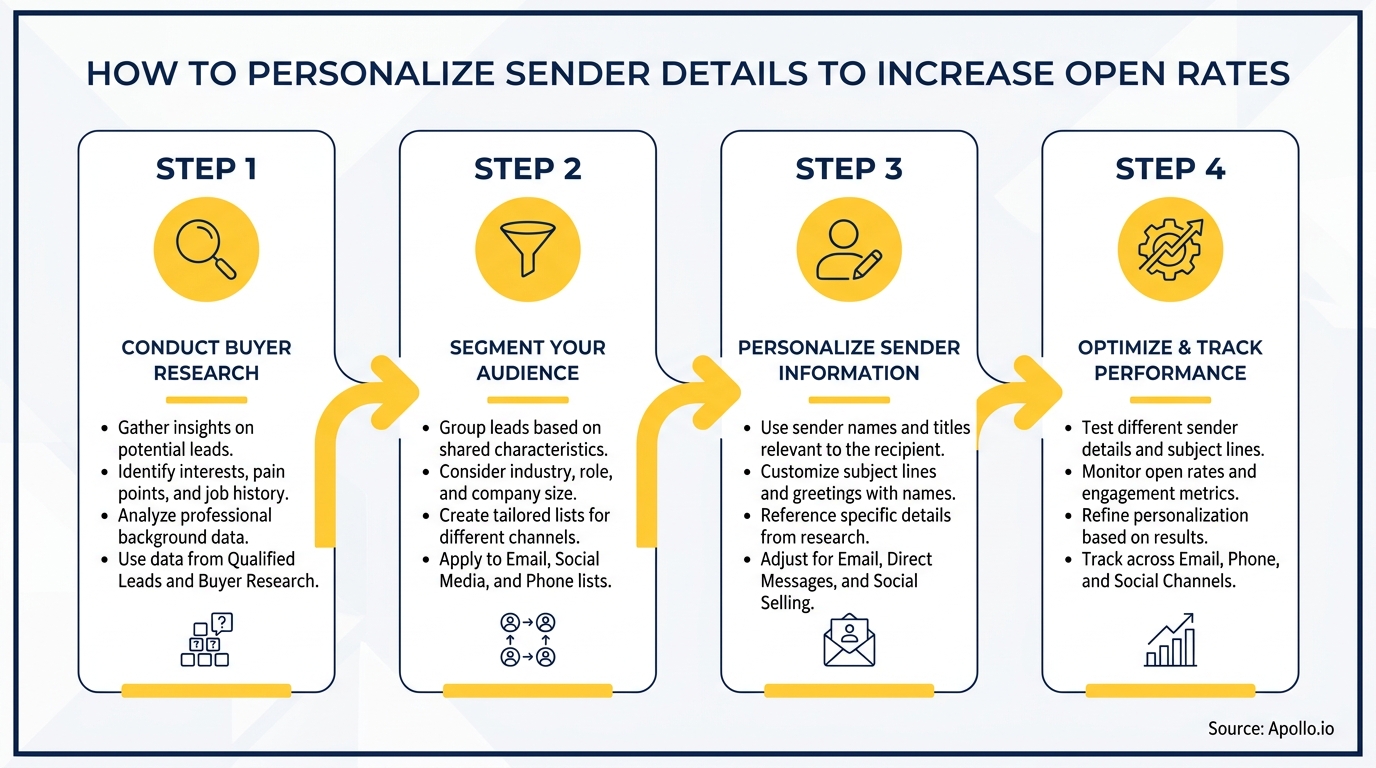
SDRs and AEs should match their sender identity to the prospect's stage in the buying journey. A single sender format applied to every touchpoint is a missed opportunity. For email personalization in sales sequences to work, the sender signal must align with the context the recipient expects.
- SDRs (cold outreach): Use "First Name at Brand" format. Feels personal, identifies the company, and invites replies.
- AEs (mid-to-late stage): Use the account owner's name directly. By this stage, the prospect knows the rep. Familiarity drives opens.
- Executives (ABM, strategic accounts): Use "Role at Brand" to signal authority. A 2025 field experiment found authority-based cues in sender names can lift open rates, though the effect fades over time, so rotate this format and track qualified replies, not just opens.
- CSMs (post-sale): Use the customer success rep's name. Continuity from the sales relationship matters here.
- Marketing sequences: Use "Brand Team" or a named individual to avoid the generic newsletter feel while maintaining brand recognition.
Spending hours building sequences manually across multiple tools? Automate your multi-channel sequences with Apollo's sales engagement platform and manage sender identity, timing, and personalization from one workspace.
What Is the Sender Trust Audit Every B2B Team Needs?
A sender trust audit verifies that your personalized From details are technically aligned with authentication requirements, or your emails may never reach the inbox. Gmail (as of November 2025), Microsoft Outlook (effective May 2025), and Yahoo all require SPF, DKIM, and DMARC alignment for bulk senders. Non-compliant traffic faces temporary or permanent rejection, making authentication a prerequisite for any open-rate strategy. Your sender reputation depends on getting these technical foundations right first.
- SPF: Your sending domain must list authorized IP addresses.
- DKIM: Every outgoing message must carry a valid domain signature.
- DMARC: Policy record must align From header with SPF/DKIM domain.
- Reply-To alignment: Reply-To should match or clearly relate to the From domain. Mismatches trigger spam filters.
- No no-reply addresses: Replies are positive engagement signals. Blocking them hurts deliverability and kills response rate.
- One-click unsubscribe: Required by Gmail and Yahoo for bulk sends. Missing this is a fast path to spam folders.
- Spam rate threshold: Keep complaint rates below 0.1%. Rates at 0.3% or higher trigger mailbox-provider penalties.
- Verified email addresses: Sending to invalid addresses damages domain reputation. Use a tool to verify email addresses before sending.
Turn Funnel Guesswork Into Real Pipeline
Quota pressure mounting while MQL-to-opportunity rates stay flat? Apollo surfaces in-market buyers the moment they're ready, so your pipeline reflects reality — not wishful forecasting. Nearly 100K paying customers stopped guessing.
Start Free with Apollo →How Do You Personalize the From Address and Reply-To Without Hurting Deliverability?
Personalizing the From address means using a domain-aligned address that reflects the sender's identity without breaking authentication. The goal is to appear human and credible while maintaining technical compliance.
Practical rules for From address personalization:
- Use
firstname@yourdomain.comorfirstname.lastname@yourdomain.comfor rep-based sending. - Avoid subdomains with no independent DKIM or DMARC policy. Each subdomain used for sending needs its own authentication setup.
- Set Reply-To to the same rep's address or a monitored inbox. Never route replies to a dead alias.
- If using role-based addresses like
growth@yourdomain.com, ensure someone monitors replies and the address is listed in your DMARC policy. - Separate marketing sends and transactional sends by DKIM domain or IP to protect each reputation independently.
BIMI (Brand Indicators for Message Identification) is an emerging visual layer worth tracking. As email-authentication infrastructure matures, verified brand logos will appear alongside the sender name in supported inboxes, adding a visible trust signal that reinforces your From name personalization.

How Should SDRs Test Sender Details Beyond Open Rates?
Open rates are no longer a reliable sole metric because Apple Mail Privacy Protection can inflate them artificially. B2B teams should treat opens as an inbox-placement signal and measure sender-detail experiments by downstream outcomes instead.
Use this testing framework when running A/B tests on sender identity:
| Metric | Why It Matters |
|---|---|
| Unique opens | Inbox placement indicator (use with MPP caveat) |
| Positive reply rate | Measures real engagement, not pixel fires |
| Meetings booked | Direct pipeline impact of sender trust |
| Click-through rate | Signals content relevance beyond the open |
| Complaint rate | Measures personalization backlash |
| Unsubscribe rate | Audience fit and sender trust signal |
Authority-based sender names can boost open rates initially, but research shows the effect fades. This means rotating sender identities, refreshing your sequences, and using intent data to match the right sender to the right moment, rather than treating any single format as a permanent optimization.
Struggling to track which sender variants drive meetings, not just opens? Use Apollo's AI-powered sales automation to run smarter sequences and measure real pipeline outcomes, all from one platform.
When Should You Stop Personalizing Sender Details?
Personalization can backfire. A Gartner survey of 1,464 B2B buyers found personalized marketing produced negative experiences for 53% of customers, with those customers being 3.2x more likely to regret a purchase.
The distinction that matters is between passive personalization (using data without consent cues) and active personalization (using context the prospect has shared or signaled). The former can feel intrusive.
The latter builds trust.
Signals that your sender personalization is hurting rather than helping:
- Complaint rate rising above 0.1%
- Unsubscribe rate spiking after a sender-name change
- Positive reply rate declining despite stable open rates
- Replies expressing confusion about who sent the email
When these signals appear, revert to a simpler, more transparent sender format. Credibility and consistency outperform cleverness over time. Pair your sender strategy with strong sales automation practices that keep your sequences relevant and your lists clean.

How Do You Put Sender Personalization Into Practice in 2026?
Effective sender personalization in 2026 is a system: authenticated domain, human From name, aligned Reply-To, stage-matched sender identity, and downstream metrics that go beyond opens. Start with the technical audit, then layer in the identity strategy.
Quick-start checklist:
- Confirm SPF, DKIM, and DMARC are active and aligned on every sending domain.
- Remove all no-reply addresses from engagement sequences.
- Map sender identity to buyer stage: SDR for cold, AE for late-stage, CSM for post-sale.
- Use hybrid formats (First Name at Brand) as your default for cold outreach.
- A/B test sender name variants over at least two weeks, measuring positive replies and meetings, not just opens.
- Monitor complaint rates weekly. Adjust or rotate sender identity if rates climb.
- Review your email subject line strategy alongside sender identity. Both fields work as a system in the inbox preview.
Apollo gives B2B GTM teams, from SDRs and AEs to RevOps and revenue leaders, a unified workspace to manage sequences, sender settings, verified contact data, and performance analytics without stitching together multiple tools. Trusted by nearly 100K paying customers including Anthropic, Smartling, and Cyera, Apollo consolidates prospecting, outreach, and pipeline tracking in one platform.
As Cyera put it: "Having everything in one system was a game changer."
Ready to build sender-personalized sequences that actually convert? Start Your Free Trial and run your first optimized sequence today.
Prove Pipeline ROI From Day One
ROI pressure killing your tool budget before it even starts? Apollo delivers measurable pipeline impact fast — with 46% more meetings booked using AI. Nearly 100K paying customers justified the spend. Yours will too.
Start Free with Apollo →Don't miss these
Sales
Inbound vs Outbound Marketing: Which Strategy Wins?
Sales
What Is a Sales Funnel? The Non-Linear Revenue Framework for 2026
Sales
What Is a Go-to-Market Strategy? The 2026 GTM Playbook
See Apollo in action
We'd love to show how Apollo can help you sell better.
By submitting this form, you will receive information, tips, and promotions from Apollo. To learn more, see our Privacy Statement.
4.7/5 based on 9,690 reviews
